When a community has suffered for years, repairing a damaged building is only part of the work. People also need courage, trustworthy leadership, shared priorities, and a renewed sense of who they are. That is the setting behind the question, “What is Nehemiah about?”
The book of Nehemiah is about rebuilding Jerusalem’s walls after the city had been damaged and left vulnerable, but its purpose reaches beyond construction. It also describes prayer, practical leadership, opposition, economic injustice, public worship, covenant renewal, and the challenge of living faithfully after a crisis.
Nehemiah is about rebuilding Jerusalem and restoring a people
Nehemiah begins in the Persian period, after the Babylonian conquest and exile had devastated Jerusalem. Some Jewish people had returned to Judah, and the temple had already been rebuilt, but Jerusalem’s walls and gates remained in poor condition. That meant the city was exposed to attack and carried the visible shame of defeat.
Nehemiah was serving as cupbearer to the Persian king, a position that involved close access to the royal court and required considerable trust. When he heard that Jerusalem was still broken down, he was deeply distressed. He prayed, mourned, fasted, and then asked the king for permission to travel to Judah and lead the rebuilding effort.
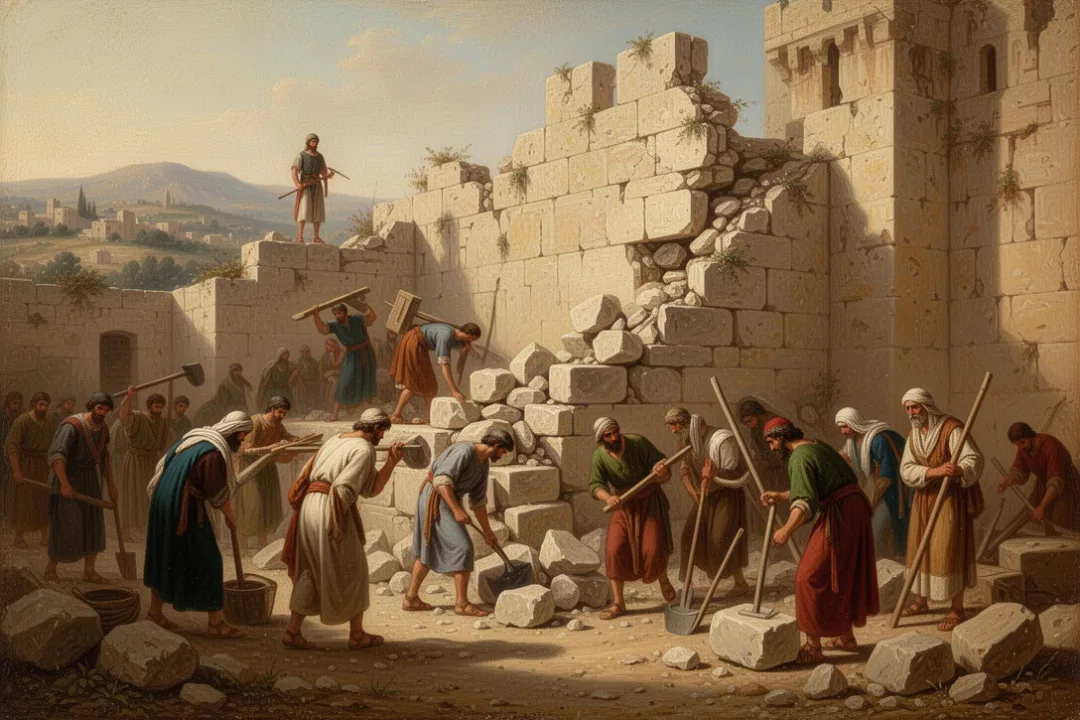
The wall project gives the book its central storyline. Nehemiah organizes families, priests, craftsmen, officials, and local residents into work groups. Each group repairs a particular section, gate, or nearby portion of the wall. The detailed list of workers shows that restoration was not presented as the achievement of one impressive individual; it was a shared responsibility.
Yet the physical wall is also a sign of something larger. Jerusalem’s restoration represents the recovery of a vulnerable community that needs protection, order, worship, and a renewed relationship with God. The book therefore moves from damaged walls to renewed communal life.
Main idea: Nehemiah is not merely a story about construction. It is about how a community responds to ruin by praying, working together, resisting opposition, correcting injustice, and renewing its covenant with God.
Why Jerusalem’s broken walls mattered in the ancient world
Modern readers may see a wall mainly as an old architectural feature, but in the ancient Near East a city wall had practical, political, and symbolic importance. Walls helped protect residents, control entrances, organize defense, and communicate that a city had stability. Broken gates and damaged fortifications left Jerusalem exposed and signaled that the city had not fully recovered.
The condition of Jerusalem also carried emotional and religious meaning. The city was associated with Judah’s history, worship, and identity, so its ruins reminded the people of conquest, displacement, and failure. Nehemiah’s grief reflects concern for God’s reputation as well as concern for the city’s residents.
This helps explain why Nehemiah does not treat the project as a private building contract. He sees the work as connected with the future of the Jewish people and with the promises God had made to their ancestors. His opening prayer recalls Israel’s disobedience but also appeals to God’s mercy and faithfulness, as reflected in Nehemiah 1.
The wall itself is completed remarkably quickly within the narrative, but completion does not solve every problem. A secure city can still contain poverty, exploitation, religious compromise, and internal division. Nehemiah’s larger task is to help establish a community that is physically safer and spiritually more faithful.
How Nehemiah responds to the crisis through prayer and planning
Nehemiah’s response offers one of the book’s clearest patterns: prayer and action work together. He does not rush into a public campaign immediately. First, he grieves, fasts, confesses sin, remembers God’s promises, and asks for favor before the king. His prayer is emotionally honest but also focused on a concrete request.
When the king asks what Nehemiah wants, he is prepared to answer. He requests permission to go to Judah, letters authorizing safe travel, and materials for rebuilding. The account shows a leader who depends on God while also thinking through logistics, authority, supplies, and timing.
After arriving in Jerusalem, Nehemiah does not announce every plan at once. He spends time inspecting the walls at night, viewing the damage personally and assessing what must be done. This private inspection helps him understand the situation before asking residents to commit themselves to the work.
His approach includes several practical leadership habits:
He listens before organizing. The original report of Jerusalem’s condition moves him to investigate rather than assume he already knows the facts.
He defines a specific problem. The damaged walls and gates give the community a clear task rather than an undefined call to “do better.”
He seeks proper authorization. His requests to the king provide official support and practical resources.
He assigns responsibility. Different groups take responsibility for identifiable sections of the wall.
He connects the work to a shared purpose. The residents are encouraged to rebuild together rather than simply complete isolated personal projects.
Nehemiah’s example does not mean every modern problem should be approached through political permission or large-scale organization. Its broader lesson is that faithful service often combines spiritual dependence, careful observation, clear communication, and disciplined action.
What the wall-building story teaches about teamwork
Nehemiah 3 contains a long record of people who repaired different parts of Jerusalem. At first glance, the list can seem repetitive, but it reveals the book’s view of community. Priests, rulers, merchants, craftsmen, families, and residents from surrounding areas all contribute. Some work near their homes, while others repair sections connected with their trades or responsibilities.
The list also makes the work visible. A large project becomes manageable when it is divided into specific assignments. Instead of asking one person to restore an entire city, Nehemiah creates a network of responsibilities that can be inspected, supported, and completed.
The record is not meant to suggest that every person contributed in exactly the same way. Some groups worked hard; one group is specifically criticized for refusing to help. That detail adds realism and shows that community projects can include uneven participation. Effective leadership does not require pretending that every member is equally cooperative.
Several principles emerge from this section:
Large tasks become less intimidating when divided into clear portions.
People are often more committed when they can see how their work serves the whole community.
Different skills and social positions can contribute to one shared purpose.
Public recognition can honor service and preserve a record of what was accomplished.
Shared work still requires accountability because not everyone will participate willingly.
The rebuilding is therefore both practical and symbolic. As each damaged section is repaired, the people demonstrate that Jerusalem’s future will depend on cooperation rather than isolation.
How Nehemiah deals with opposition and intimidation
The rebuilding effort quickly attracts opposition from local officials and influential figures. Sanballat, Tobiah, and Geshem are presented as opponents who question Nehemiah’s intentions, mock the builders, threaten violence, and attempt to weaken the project. Their exact political roles are not always easy to reconstruct, but the narrative clearly portrays them as serious obstacles.
The opposition changes form as the work continues. At first it appears as ridicule: the enemies suggest that the builders are weak and that even a small animal could damage their wall. Later, the threat becomes more direct, with plans to attack the workers. The opponents also use rumors and invitations designed to draw Nehemiah away from Jerusalem.
Nehemiah responds with both prayer and security measures. The people continue working while guards protect vulnerable areas. Builders may carry weapons, and workers are organized so that the community can respond quickly if an attack occurs. The book does not present faith as passivity.
Nehemiah also refuses to let every accusation dictate his behavior. When opponents claim that he intends to rebel against the king, he denies the charge and continues the work. When they invite him to meet outside the city, he recognizes the danger of being distracted or harmed and declines.
Nehemiah’s response, as recorded in Nehemiah 6, can be paraphrased this way: he is engaged in important work and will not abandon it to answer a manufactured distraction.
This section is about more than handling criticism. It shows how fear, confusion, false accusations, and repeated interruptions can threaten a good project. The people need courage, but they also need discernment. Not every demand for attention deserves an answer, and not every public claim deserves a long defense.
Why Nehemiah confronts poverty and exploitation inside Jerusalem
External opposition is not the only threat. In Nehemiah 5, Jewish residents complain that wealthy community members are charging interest, taking fields as security, and forcing some families to sell children into servitude to survive. The people are working on the wall while also facing severe economic pressure.
Nehemiah reacts strongly because internal exploitation undermines the community they are trying to restore. A rebuilt wall cannot make Jerusalem healthy if its residents are taking advantage of one another. The crisis reveals that social justice belongs to restoration; physical security and religious identity are not enough.
Nehemiah confronts the wealthy officials and nobles publicly. He calls for the return of fields, vineyards, houses, and improper interest. The leaders agree to his demand, and the community confirms the commitment through a formal oath.
The passage also describes Nehemiah’s own conduct as governor. He does not claim the usual food allowance from the population, partly because the people are already burdened. He and his servants help with the work rather than exploiting their position. The narrative presents his restraint as a contrast to leaders who use office for personal advantage.
This chapter raises difficult questions for any community:
Who benefits from a major rebuilding effort?
Who bears its costs?
Are vulnerable people being asked to sacrifice while the powerful grow stronger?
Do leaders follow the standards they impose on others?
Can public religious activity coexist with private exploitation?
Nehemiah’s answer is clear: faithfulness includes economic responsibility. Restoring buildings while ignoring predatory behavior would leave the deepest damage untouched.
How the completed wall leads to public worship and covenant renewal
Once the wall is completed, the story does not end with a victory celebration. The people gather to hear the Law read publicly by Ezra and other leaders. This event shifts the focus from construction to understanding God’s instruction.
According to Nehemiah 8, the people listen as the Law is read and explained so that they can understand its meaning. Their response includes grief because they recognize how far their lives have fallen short. The leaders then tell them that the occasion is sacred and should include joy, generosity, and shared celebration.
The movement from sorrow to joy matters. Repentance is not presented as endless self-condemnation. The community hears the Law, understands it, responds honestly, and learns to celebrate God’s provision with others, including those who have little prepared food.
The people also observe the Festival of Booths, a festival connected with Israel’s wilderness experience. Their celebration connects the restored community with its larger biblical story. They are not inventing a new identity after the crisis; they are recovering practices that locate them within the history of God’s people.
Nehemiah 9 records a long communal confession. The prayer recounts creation, Abraham, the exodus, the wilderness, the gift of the land, repeated rebellion, and God’s continued patience. This historical retelling teaches the people to interpret their present situation in light of God’s long faithfulness, not only their recent suffering.
The community then makes a written covenant. Leaders and families commit themselves to specific obligations involving marriage, Sabbath observance, temple support, offerings, and other aspects of communal life. The covenant is not merely an emotional promise to feel closer to God; it identifies concrete practices that will shape daily behavior.
Important distinction: Nehemiah treats rebuilding, worship, justice, and obedience as connected but not interchangeable. A strong wall does not prove spiritual faithfulness, and a public religious gathering does not excuse injustice.
What Nehemiah says about identity, separation, and belonging
Questions about identity appear repeatedly in the book. The returned community wants to preserve its covenant relationship and avoid patterns that previously contributed to unfaithfulness. This concern shapes rules about worship, Sabbath practices, temple support, and marriages with surrounding peoples.
Modern readers may find the passages about separation difficult, especially because the book sometimes speaks in broad group terms. The text reflects the religious and political pressures of its historical setting, including concern that foreign alliances and religious practices could pull the community away from its covenant obligations. It should not be reduced to a general command for hostility toward everyone outside the community.
Nehemiah’s concern is primarily about covenant loyalty. The people have returned from exile, but returning geographically does not automatically transform their habits. The book asks how a community can preserve its worship and values when surrounded by competing customs and pressures.
At the same time, the book should be read alongside the wider biblical witness, which includes commands to care for foreigners, accounts of outsiders who trust Israel’s God, and later challenges to narrow ethnic assumptions. Nehemiah highlights one urgent aspect of community restoration; it should not be used carelessly to justify prejudice or mistreatment.
What changes after Nehemiah leaves Jerusalem
Near the end of the book, Nehemiah returns to the Persian king for a period of time. When he later comes back to Jerusalem, he discovers that several reforms have weakened. A room in the temple has been given to Tobiah, one of the earlier opponents. The Levites have not received proper support, Sabbath rules are being violated, and some residents have entered marriages that Nehemiah views as a threat to the community’s covenant identity.
Nehemiah takes forceful action to restore the reforms. His return reveals a sobering truth: reform is difficult to maintain after an energetic leader steps away. Systems, habits, and personal commitments matter because enthusiasm alone fades.
These final chapters make the book more complex. Nehemiah is a courageous and generous leader, but his methods can also be severe. He prays repeatedly for God to remember his actions, which may sound self-focused to modern readers. Within the book, however, these prayers express a desire for God to recognize faithful service in a setting where the results remain fragile.
The ending does not present Jerusalem as perfectly restored. The wall stands, worship has been renewed, and reforms have been attempted, but the people remain capable of returning to old patterns. The book’s final emphasis is therefore not on effortless success. It is on the continuing need for vigilance, accountability, and dependence on God.
Common mistakes when interpreting Nehemiah
Nehemiah is often used to teach leadership, and its leadership lessons can be valuable. Still, several common approaches flatten the book or miss its central concerns.
Reducing Nehemiah to a leadership manual. The book includes leadership, but it also focuses on worship, covenant, poverty, public Scripture reading, and communal repentance.
Treating the wall as the only goal. The wall is completed relatively early, while much of the remaining narrative addresses how the people live afterward.
Ignoring internal injustice. Chapter 5 shows that exploitation by fellow Jews is a major crisis, not a minor side issue.
Assuming every opposition story applies directly to every modern disagreement. Nehemiah faced threats within a specific political and historical setting. Wisdom requires distinguishing genuine danger from ordinary criticism.
Using the book to excuse harshness. Nehemiah’s strong actions occur in a particular covenant and post-exilic context. They should not be copied without considering the whole biblical message and modern responsibilities.
Reading prayer and planning as alternatives. Nehemiah repeatedly combines dependence on God with preparation, delegation, security, and follow-through.
Expecting immediate perfection after a public commitment. The later chapters show that people can make sincere promises and still need continued correction.
Practical ways to read Nehemiah carefully
A thoughtful reading can keep the book’s different themes together instead of selecting only the parts that fit a preferred message. These steps can help:
Read the whole narrative before isolating individual verses. The meaning of the wall project becomes clearer when you see how it leads to worship, confession, and reform.
Mark the transitions. Notice when the story moves from prayer to planning, construction to opposition, building to economic conflict, and completion to covenant renewal.
Identify who is affected. Pay attention to workers, women, children, the poor, officials, priests, Levites, and outsiders rather than focusing only on Nehemiah.
Separate description from instruction. Some actions are reported because they happened, not necessarily because every reader is expected to imitate them literally.
Ask what problem each reform addresses. Sabbath observance, temple support, economic practices, and marriage policies each respond to particular concerns in the restored community.
Compare themes across Scripture. Use related passages about justice, leadership, exile, worship, and covenant to avoid making one book carry the entire biblical message.
Apply principles thoughtfully. Shared responsibility, honest prayer, resistance to manipulation, and care for the vulnerable transfer more directly than every ancient political or social practice.
These reading habits are useful because Nehemiah contains both inspiring achievements and troubling moments. The book invites admiration for perseverance while also requiring careful reflection on power, identity, justice, and the limits of human reform.
What Nehemiah means for faith and community life today
For many readers, Nehemiah speaks first to seasons of damage and discouragement. A family, congregation, neighborhood, or institution may have visible problems that developed over years. The book suggests that restoration begins with honest grief rather than denial, followed by prayer, assessment, and specific work.
It also challenges the idea that one gifted person can repair everything alone. Nehemiah leads, but the wall is built by many people. Sustainable restoration requires shared ownership, clear roles, honest communication, and willingness to address both external threats and internal wrongdoing.
The book’s treatment of opposition encourages steadiness without paranoia. Some criticism is meant to distract or intimidate, while other criticism may reveal a real problem. Nehemiah shows the value of testing accusations, refusing manipulative invitations, and protecting the work without allowing fear to control every decision.
Its strongest ethical challenge may be the treatment of the poor. A community cannot call itself restored while its members profit from the desperation of others. The question is not only whether the walls are standing, but whether people inside those walls are being treated with dignity and fairness.
Finally, Nehemiah directs attention toward the relationship between public renewal and daily obedience. Worship, Scripture, generosity, justice, and community practices all belong together. The book does not promise that one successful project will eliminate future failure. Instead, it portrays restoration as work that must be guarded, renewed, and brought back into alignment with God’s purposes.
In brief, Nehemiah is about rebuilding Jerusalem’s walls and rebuilding the life of a broken people. Its central message is that lasting restoration requires prayer, courageous leadership, cooperation, justice, attention to Scripture, and continued faithfulness after the visible work is complete.
Frequently asked questions
Who wrote the book of Nehemiah?
The book does not explicitly identify a single author in the modern sense. Much of it is written in the first person and presents Nehemiah’s experiences, prayers, decisions, and reforms. It was preserved as part of the biblical history of the post-exilic community, alongside Ezra, and its final form reflects the work of an editor or compiler.
Is Nehemiah the same person as Ezra?
No. Nehemiah and Ezra are different leaders who served the returned Jewish community. Nehemiah was a governor associated especially with rebuilding Jerusalem’s walls and addressing civic and economic problems. Ezra was a priest and skilled teacher of the Law who helped lead public instruction, confession, and religious reform.
How long did rebuilding Jerusalem’s wall take in Nehemiah?
The narrative says the wall was completed in fifty-two days after construction began. That rapid completion reflects strong organization, widespread participation, and the urgency of the project. It does not mean every aspect of Jerusalem’s restoration was finished at the same time; social, religious, and administrative reforms continued afterward.
What is the main spiritual lesson of Nehemiah?
A central lesson is that restoration requires more than repairing visible damage. Nehemiah connects prayer with practical action, teamwork with accountability, and worship with justice. The book also warns that reforms can weaken when people stop paying attention, so faithful communities need continuing repentance, wise leadership, and care for vulnerable members.









Leave a Reply