Have you ever postponed an important responsibility because work, money, family concerns, or discouragement seemed more urgent? The book of Haggai speaks to people in exactly that condition. Its message is short and direct: God’s people had returned from exile, but they had neglected rebuilding the temple while concentrating on their own houses and daily security.
Haggai is about putting God’s work back at the center of communal life. The prophet urged Judah’s leaders and people to rebuild the temple in Jerusalem, examined why their efforts had brought so little satisfaction, and encouraged them when the new building seemed unimpressive compared with Solomon’s temple. The book also points beyond the immediate construction project to God’s future rule, presence, and blessing.
Haggai’s messages come from Jerusalem in the second year of Darius, king of Persia, generally dated to around 520 BC. The people of Judah had been conquered by Babylon, and Jerusalem and its temple had been destroyed decades earlier. After Persia defeated Babylon, some exiles were allowed to return to Judah and begin restoring their community.
The book identifies the political and religious leaders who needed to act. Zerubbabel was the governor of Judah, and Joshua was the high priest. Haggai addressed both of them, along with “the remnant of the people,” meaning the community that had survived exile and returned to the land.
The setting matters because the people were not starting with a stable, prosperous society. They had limited resources, opposition, unfinished homes, and memories of catastrophe. They had made an initial attempt to rebuild the temple, but the work had stopped. Haggai’s prophecy calls them to resume it despite the difficult circumstances.
Central idea: Haggai does not simply tell people to work harder. He asks them to examine what their choices reveal about their priorities and then to rebuild in response to God’s presence and promise.
Why rebuilding the temple was the book’s central concern
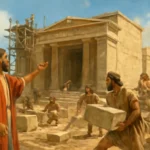
In ancient Israel, the temple was not merely a meeting place or a public monument. It represented God’s dwelling among his covenant people. The temple was where worship was organized, sacrifices were offered, and the community expressed its relationship with God. Rebuilding it was therefore a spiritual and national responsibility, not just an architectural project.
Haggai’s first message says the people claimed that the time had not yet come to rebuild the Lord’s house. At the same time, they were living in finished or paneled houses. The contrast exposes the problem: they had found enough time and energy to improve their own homes, but they treated worship and the community’s relationship with God as something that could wait.
The prophet does not criticize the existence of private homes. His concern is the imbalance between personal comfort and shared faithfulness. The people had allowed their own needs to become the standard by which every decision was measured. Haggai challenged them to reconsider what deserved their first attention.
Rebuilding the temple also represented the restoration of Judah after exile. A functioning temple would give the returned community a center for worship, identity, and public life. The project was a visible sign that the people were no longer defined only by what Babylon had destroyed.
What “consider your ways” means in Haggai
Haggai repeatedly tells the people to give careful thought to their ways. The phrase is an invitation to honest self-examination. Instead of assuming that hardship is random or that religious neglect has no consequences, the people are asked to look at the direction of their lives and the results of their choices.
The prophet describes a pattern of frustration: the people sow much but harvest little, eat without satisfaction, drink without feeling filled, earn wages that seem to disappear, and bring home earnings as if placing them in a bag with holes. These images portray effort without lasting benefit. Their economic struggle is connected in the prophecy with the unfinished temple and the community’s misplaced priorities.
Haggai also describes drought affecting the land. In the book’s theological framework, the poor harvest is not simply a weather problem. It is a covenant warning that calls the people back to obedience. This does not mean every individual hardship can be explained as punishment, nor does Haggai offer a formula that guarantees wealth after religious activity. His message addresses a particular community, at a particular time, under a particular covenant relationship.
The practical force of “consider your ways” remains clear. People can become so occupied with maintaining their own lives that they stop asking whether their priorities reflect their stated beliefs. Haggai urges the community to compare what it says matters with what it actually funds, builds, protects, and postpones.
How the people responded to Haggai’s message
The response to Haggai is one of the most encouraging features of the book. Zerubbabel, Joshua, and the people listened, and the text says they obeyed the voice of the Lord. They began work on the temple in the second year of Darius, shortly after Haggai’s opening message.
Their response shows that prophecy in Haggai is not intended merely to provide information. It calls for concrete obedience. The people had to organize labor, gather materials, face opposition, and commit themselves to a project that would take time. Their change of direction was visible in what they did, not only in what they said.
The book also says that the people came to fear the Lord. In this context, fear means reverent recognition of God’s authority rather than simple panic. Their renewed obedience begins with a changed understanding of whom they serve and what their community exists to be.
Haggai records a brief but powerful assurance from God: “I am with you.” That promise explains why the people could act despite weakness. God’s presence, not the community’s strength, is the foundation of the work. The temple mattered because it signified that presence, but the promise also reminded them that God was not absent while the building remained unfinished.
How Haggai addresses discouragement about an unimpressive temple
When construction began, some older people who had seen Solomon’s temple were apparently discouraged by the new building. The earlier temple had been associated with royal splendor and national strength. The new temple arose from a small, vulnerable community with fewer resources, so it could easily seem inferior.
Haggai acknowledges that comparison directly. He asks who among the people remembers the former glory and whether the present temple appears like nothing by comparison. The prophet does not deny that the new building looks less impressive. Instead, he tells Zerubbabel, Joshua, and the people to be strong and continue the work.
The encouragement rests on three promises: God is with them, his covenant with Israel still stands, and his Spirit remains among them. Their circumstances may look diminished, but God’s commitment has not diminished. The community is not required to reproduce the past before its obedience can have meaning.
Haggai then speaks of a future shaking of the nations and says that the desired treasures of the nations will come. The exact interpretation of this passage has been debated, and translations differ in how they render it. Its broad point is that God can bring a future glory greater than what the people can see at present. The new temple will not be judged only by its current appearance.
“The silver is mine, and the gold is mine,” declares the Lord in Haggai 2.
That statement shifts attention away from scarcity. The returned community may lack wealth, political power, and former prestige, but all resources ultimately belong to God. Haggai uses that truth to strengthen people who are tempted to conclude that a small beginning cannot serve a large purpose.
What Haggai teaches about holiness and moral influence
Haggai’s third dated message uses a question addressed to the priests. It asks whether holiness can be transferred from one thing to another through contact. The priests answer that it cannot. The passage then asks whether something unclean can make another thing unclean through contact, and the answer is yes.
This exchange illustrates a principle about ritual holiness and impurity. Holiness is not treated as something people automatically acquire by association with a sacred object. Impurity, however, can contaminate what it touches. Haggai applies the lesson to the people and their work: rebuilding the temple does not automatically erase the effects of their previous disobedience.
The message prevents a shallow understanding of religious activity. The people could not assume that working on a holy building made every aspect of their lives holy. External religious work must be joined to genuine obedience. Construction could not function as a substitute for repentance or faithful living.
At the same time, Haggai announces a change from that day forward. The prophet points to the moment when the foundation of the Lord’s temple was laid and promises that God will bless the people. This is not a mechanical bargain in which building materials purchase prosperity. It is a declaration that, after a period of correction, the community’s renewed relationship with God opens a new chapter of blessing.
What the final message to Zerubbabel means
The book’s last message is addressed specifically to Zerubbabel. Haggai again speaks of God shaking the heavens and the earth, overturning royal thrones, and disrupting the power of nations. These images describe God’s sovereignty over political powers. Empires may appear permanent, but they remain subject to his judgment.
God then says that he will take Zerubbabel as his servant and make him like a signet ring. In the ancient world, a signet ring represented authority, identity, and the power to validate a document. The image reverses an earlier judgment against Zerubbabel’s ancestor Jehoiachin, also called Coniah, in Jeremiah’s prophecy.
Haggai’s promise does not install Zerubbabel as an independent king at that moment. Judah was still under Persian rule. Instead, the signet-ring image signals God’s renewed favor toward the Davidic line and his control over the future of his promises. Readers of the Bible have connected this hope with later expectations about the Messiah, although Haggai itself focuses on God’s promise to Zerubbabel and the restoration community.
The final message widens the book’s horizon. The temple project is not an isolated building campaign. It belongs to a larger story in which God judges arrogant powers, preserves his covenant purposes, and works through seemingly weak representatives. The people are asked to act faithfully even though they cannot see the full outcome.
Common mistakes when interpreting the book of Haggai
Haggai is concise, but its direct language can be misunderstood if modern readers flatten its historical setting. These cautions help keep the book’s message grounded:
Do not reduce Haggai to a promise of financial prosperity. The book connects blessing with covenant faithfulness in a specific post-exilic situation, not with a universal guarantee that religious effort produces personal wealth.
Do not treat the temple as merely a building project. Its significance came from worship, God’s covenant presence, and the restoration of the community.
Do not assume every hardship is divine punishment. Haggai interprets Judah’s drought and poor harvest within its prophetic covenant context; that does not authorize people to diagnose another person’s suffering.
Do not ignore the leaders and the whole community. Zerubbabel and Joshua had distinct roles, but the people also had to participate. The work was shared rather than left to officials alone.
Do not confuse present appearance with final significance. The new temple looked unimpressive to some observers, yet Haggai emphasized God’s future purpose and presence.
Do not separate action from inner change. Starting construction was necessary, but the priestly teaching shows that outward activity did not automatically make the people holy.
Practical ways to apply Haggai’s message today
Haggai was addressed to ancient Judah, so its application should begin with care rather than direct one-to-one claims. Christians and other readers can still learn from its questions about priorities, discouragement, shared responsibility, and faithful action. The key is to apply the principles without pretending that modern circumstances are identical to those of the returned exiles.
Examine what receives your best attention. Look at your calendar, spending, energy, and long-term plans. These often reveal priorities more honestly than intentions do.
Identify what has been postponed indefinitely. A neglected responsibility may remain important even when there is always a practical reason to delay it.
Separate necessary provision from self-centered accumulation. Haggai does not condemn homes or ordinary work; it challenges a life organized around private comfort while communal obligations are ignored.
Take one concrete step. The people did not solve every problem before beginning. They started the work they had been called to do.
Expect discouragement during a good project. A worthy effort may look small beside an earlier achievement. Measure faithfulness by the task and calling, not only by visible impressiveness.
Share responsibility with the right people. Haggai addressed civil leaders, religious leaders, and ordinary members of the community. Healthy work usually requires cooperation rather than one person carrying everything.
Keep external activity connected to character. Serving, giving, building, or leading cannot replace honesty, repentance, justice, and love.
Remember that results are not fully visible. Haggai encouraged people to work under a promise whose complete fulfillment lay beyond what they could immediately observe.
These applications can be used in a household, congregation, nonprofit, or neighborhood. A group may need to ask whether it spends most of its energy preserving familiar comforts or serving the purpose it claims to value. Individuals may need to notice when “not yet” has become a permanent excuse.
A useful question from Haggai: If someone studied your recent decisions rather than listening to your stated beliefs, what would they conclude you consider most important?
How Haggai fits with Ezra, Zechariah, and the rest of the Bible
Haggai belongs to the period of Judah’s restoration after exile. The books of Ezra and Nehemiah provide additional accounts of rebuilding the temple, the city, and the community. Ezra especially helps readers see the administrative and historical setting, while Haggai gives the prophetic interpretation: the work mattered because the people were being called back to faithful worship.
Haggai is also closely associated with the prophet Zechariah, who ministered during the same general period. Both encouraged Zerubbabel, Joshua, and the returned community. Haggai is more compact and direct, while Zechariah uses extended visions and symbolic imagery, but both address discouragement and the hope that God will complete his purposes.
Within the larger biblical story, Haggai’s themes echo several enduring concerns: God’s presence with his people, the danger of divided loyalty, the need for repentance, and hope beyond present political conditions. The book does not present restoration as a return to effortless prosperity. It shows a vulnerable community learning to rebuild its life around worship and trust.
Why the book of Haggai still speaks to modern readers
Haggai remains relevant because people and communities still confuse activity with priority. It is possible to be busy, responsible, and financially occupied while neglecting the commitments that give those activities meaning. The prophet’s question is not simply, “Are you working?” It is, “What is your work serving?”
The book also speaks to anyone comparing a present assignment with a more impressive past. A congregation may be smaller than it once was. A family may be rebuilding after loss. A person may be beginning again with fewer resources than before. Haggai does not promise that the past will be recreated exactly; it offers courage to act faithfully in the present.
Its message includes both challenge and comfort. The challenge is to stop using delay, scarcity, or self-interest as reasons to neglect what matters. The comfort is that God’s presence is not limited by the size, wealth, or prestige of the work. Faithful beginnings can matter even when they look modest.
At its heart, the book of Haggai asks a community to reorder its life around God, rebuild what has been neglected, and trust that present obedience belongs to a future larger than immediate appearances. Its two short chapters combine practical correction with durable hope: consider your ways, be strong, work, and remember that God is with you.
Frequently asked questions
How many chapters are in the book of Haggai?
Haggai has two chapters. Despite its short length, it contains four dated prophetic messages delivered during the rebuilding of Jerusalem’s temple. The messages address the returned exiles, their leaders, their economic hardship, their discouragement, and the future significance of the restored temple and Davidic leadership.
Who was Haggai speaking to?
Haggai spoke to the Jewish community that had returned from Babylonian exile, especially Zerubbabel the governor and Joshua the high priest. His messages also addressed the wider population. He called the entire community to resume rebuilding the temple rather than leaving the work to political or religious leaders alone.
What does Haggai mean by “the latter glory” of the temple?
Haggai contrasts the modest appearance of the restored temple with the glory remembered from Solomon’s temple. He then promises that God will bring greater future glory. The statement emphasizes God’s future action and presence, rather than claiming that the new building already matched the earlier temple in wealth or appearance.
Is Haggai mainly about building a church?
No. Haggai specifically concerns the post-exilic rebuilding of Jerusalem’s temple, which represented God’s covenant presence and the restoration of Judah’s worship. Modern readers can apply its themes of priorities and faithful service, but the temple project should not be treated as a direct blueprint for constructing a contemporary church building.







Leave a Reply