The best place to begin reading the Bible is usually the Gospel of Mark or John, because the Bible’s central message is understood through the life, teaching, death, and resurrection of Jesus.
Why the right Bible reading plan depends on your purpose
The Bible is a collection of 66 books in Protestant editions, written across many centuries by different authors and in several literary styles. Catholic and Orthodox editions include additional books, but every major Christian tradition centers its reading on God, creation, Israel, Jesus Christ, the church, and the hope of restoration.
That variety explains why simply opening to a random page can feel confusing. A short letter, a prophetic vision, a legal passage, a poem, and a Gospel story all require different reading habits. Your best starting point depends on whether you want to meet Jesus, understand Christian beliefs, find words for prayer, process suffering, or read the Bible from beginning to end.
You do not need to understand every difficult passage before continuing. Begin with a manageable book, read in context, and ask what the passage reveals about God, people, faith, and faithful action. Understanding grows through steady reading rather than through trying to solve everything at once.
A reliable starting point: Read Mark for a fast-moving account of Jesus, John for a more reflective account of his identity, and Luke followed by Acts for the story of Jesus and the early church.
Choose what to read based on your immediate need
Before selecting a book, identify the question you are bringing to the Bible. You may want a clear narrative, practical wisdom, comfort during grief, help with prayer, or a broad understanding of the Christian story. The following options provide a useful first direction.
To learn about Jesus: Start with Mark, Luke, John, or Matthew.
To understand the Christian message: Read Luke, Acts, and Romans with attention to their surrounding context.
To develop a prayer life: Read selected Psalms, Matthew 5–7, and Philippians.
To find wisdom for everyday choices: Read Proverbs, James, and selected passages from Ecclesiastes.
To read a complete story: Choose Ruth, Esther, Jonah, or Genesis.
To explore the Old Testament: Read Genesis, Exodus, 1 Samuel, or the shorter prophetic books with a guide.
To find comfort in suffering: Read Psalms 13, 23, 42, 46, and 130, along with Job and 2 Corinthians.
To understand love and relationships: Read 1 Corinthians 13 in context, Ruth, Song of Songs, and Ephesians.
These recommendations are not meant to reduce the Bible to a collection of isolated quotations. A passage usually makes more sense when you read the whole chapter and understand who is speaking, who is listening, and what problem the text addresses.
Start with Mark if you want a clear account of Jesus
The Gospel of Mark is a strong first book because it moves quickly and keeps Jesus at the center. It introduces his teaching, healing, conflicts, relationships, death, and resurrection without requiring extensive knowledge of Israel’s history before you begin.
As you read, watch how different people respond to Jesus. Some recognize his authority, some misunderstand him, and some oppose him. Mark presents discipleship as a process in which people learn gradually what it means to trust and follow Jesus.
Mark is also useful for readers who struggle to maintain a daily habit. Its chapters are relatively short, and the narrative naturally encourages you to keep reading. You could read one chapter a day, or read the whole book over several sittings to notice the larger movement of the story.
Read John when you want to consider Jesus’ identity
The Gospel of John has a slower, more reflective style than Mark. It emphasizes who Jesus is and what his signs, conversations, death, and resurrection mean. Repeated themes include life, light, belief, love, truth, witness, and the relationship between Jesus and the Father.
John is especially helpful if you are asking questions such as, “What did Jesus claim about himself?” or “Why do Christians worship Jesus?” Important conversations include Jesus’ meetings with Nicodemus in chapter 3, the Samaritan woman in chapter 4, and Martha in chapter 11.
Do not worry if some sections seem mysterious on a first reading. Read for the main movement: Jesus reveals God’s character, calls people to trust him, forms a community, and gives himself for others. You can return later to study individual passages more carefully.
Read Luke and Acts to follow the Christian story
Luke and Acts belong together because they were written as two parts of one extended account. Luke presents Jesus’ ministry, death, and resurrection. Acts continues with the growth of the early Christian movement, beginning in Jerusalem and expanding through the work of the apostles.
Luke pays close attention to people often pushed to the edges of society, including the poor, women, foreigners, sinners, and those viewed as religious outsiders. His Gospel also highlights prayer, the work of the Holy Spirit, forgiveness, and God’s concern for the vulnerable.
Acts shows that the early church faced disagreement, persecution, cultural differences, and practical problems. It can help you see Christianity not merely as a set of private beliefs, but as a community learning how to live out its convictions in public and personal life.
If you read Luke and Acts together, keep a simple list of recurring themes. Notice how the Holy Spirit guides people, how the message crosses cultural boundaries, and how the disciples respond when their expectations are challenged.
Use Matthew to connect Jesus with Israel’s Scriptures
The Gospel of Matthew is a helpful choice when you want to see how Jesus relates to the Old Testament. It presents Jesus as the promised Messiah and repeatedly places his life and teaching within Israel’s story.
Matthew contains substantial teaching sections, including the material in chapters 5–7 commonly called the Sermon on the Mount. Read these chapters as a connected presentation of life in God’s kingdom, not as a checklist of unrelated rules.
Matthew also emphasizes forgiveness, humility, mercy, prayer, and the responsibilities of a community of disciples. Its final chapter commissions Jesus’ followers to make disciples among all nations, giving the Gospel a broad and outward-looking conclusion.
Read Genesis and Exodus for the beginning of the biblical story
Genesis introduces the Bible’s major themes: creation, human rebellion, judgment, promise, family, blessing, covenant, and God’s relationship with particular people. Its stories include Adam and Eve, Noah, Abraham and Sarah, Isaac and Rebekah, Jacob and Rachel, and Joseph.
Genesis is not written like a modern science textbook or a contemporary biography. It combines narrative, genealogy, poetry, and theological reflection. Read its stories carefully, paying attention to what the text says rather than assuming that every character is presented as a moral example.
Exodus continues with Israel’s rescue from slavery, the covenant at Mount Sinai, the Ten Commandments, and the construction of the tabernacle. It explores freedom, worship, leadership, law, community responsibility, and the question of how a holy God lives among an imperfect people.
If you read Genesis and Exodus together, you will encounter foundations for ideas that appear throughout the rest of the Bible. These include creation, covenant, sacrifice, priesthood, Passover, deliverance, and the promise of God’s presence.
Read Psalms when you need language for prayer
Psalms gives you words for a wide range of experiences, including joy, fear, anger, guilt, gratitude, loneliness, trust, celebration, and grief. It does not require you to pretend that faith removes difficult emotions. Instead, many psalms bring honest feelings into the presence of God.
Some psalms praise God as creator and king. Others ask for protection or justice. Some confess wrongdoing, while others describe waiting for help. Psalm 23 is widely read for its picture of God’s guidance and care; Psalm 42 gives voice to spiritual thirst and discouragement; Psalm lament is not a rejection of faith but a form of faith that continues speaking to God.
Try reading one psalm slowly and separating its movement into three parts:
The situation: What is happening to the writer or community?
The request or response: What does the writer ask, remember, confess, or praise?
The change in perspective: Does the psalm end with confidence, continued waiting, worship, or unresolved pain?
Not every psalm ends with a simple resolution. That can be helpful when you are experiencing sorrow or uncertainty. The collection makes room for both confident praise and unanswered questions.
Read Proverbs for practical wisdom and character formation
Proverbs is a book of wise sayings about speech, work, money, friendship, anger, sexuality, discipline, generosity, and decision-making. It repeatedly contrasts wisdom with foolishness, not merely as intelligence versus ignorance, but as a way of living that respects or rejects God’s instruction.
Because Proverbs contains short sayings, read each one as a general principle rather than an absolute promise that applies mechanically in every circumstance. For example, advice about diligence does not mean every diligent person will become wealthy, and advice about honest speech does not mean truthful choices always produce immediate rewards.
A practical way to read Proverbs is to choose one chapter matching the day of the month and select two or three sayings to consider. Ask how each one might affect a conversation, a financial decision, a friendship, or a work habit. James offers a helpful New Testament companion because it also focuses on speech, perseverance, favoritism, wealth, and active faith.
Read Ruth and Esther for compact, complete stories
Ruth is a short narrative about loyalty, loss, migration, work, family responsibility, and redemption. Ruth is a Moabite woman who becomes part of Israel’s story through her relationship with Naomi and her marriage to Boaz. The book shows how ordinary acts of faithfulness can matter within a much larger account of God’s purposes.
Esther takes place in the Persian Empire and follows a Jewish woman who becomes queen and faces a threat against her people. The book explores courage, identity, political power, risk, and communal responsibility. God is not named directly in the Hebrew text, which invites readers to consider how providence may be perceived through events, choices, and timing.
These books work well when you want to read an entire biblical book in one or two sittings. Afterward, consider how the characters change, what dangers they face, and how the story’s ending reshapes the events that came before it.
Read Romans and Ephesians for major Christian themes
Romans is a sustained letter about sin, grace, faith, Israel, Jesus, the Holy Spirit, and life in a community shaped by the gospel. It is intellectually demanding, but its overall argument becomes clearer when read in sections rather than as a collection of favorite lines.
Romans 1–4 addresses humanity’s need for God’s mercy. Chapters 5–8 explore the significance of Christ, new life, suffering, and the Spirit. Chapters 9–11 consider Israel’s place in God’s purposes. Chapters 12–16 turn toward practical relationships, worship, humility, conscience, and community.
Ephesians focuses on unity in Christ, reconciliation between groups, spiritual maturity, relationships, and life shaped by love. It is shorter than Romans and may be easier to read as a whole. Read its theological claims alongside its practical instructions so you can see how belief and behavior are connected.
When reading either letter, remember that they were written to real communities dealing with real questions. A letter’s statements about conduct should be interpreted within its larger message about grace, identity, worship, and responsibility toward others.
Read the shorter letters for focused guidance
The New Testament includes several brief letters that address particular aspects of Christian life. They can be useful once you have read at least one Gospel, because their advice assumes a basic understanding of Jesus and the early Christian community.
Philippians: Read for joy, humility, perseverance, contentment, and partnership in faith.
James: Read for practical instruction about speech, favoritism, trials, wisdom, wealth, and putting faith into action.
1 Peter: Read for hope and faithful conduct during hardship or social pressure.
1 John: Read for assurance, love, obedience, truth, and discernment.
Galatians: Read for freedom in Christ, grace, faith, and the work of the Spirit.
Colossians: Read for the supremacy of Christ and the transformation of everyday conduct.
Short letters can be read repeatedly over several weeks. On a first reading, identify the author’s main concern. On a second reading, mark repeated words and contrasts. On a third, choose one practical response that fits the letter’s overall message rather than relying on a single sentence.
Approach difficult Old Testament books with context
Some of the Bible’s most meaningful books are also the easiest to misunderstand when read in isolation. Leviticus contains laws about worship, purity, sacrifice, and community life. Job explores undeserved suffering and challenges simplistic explanations. Ecclesiastes reflects on mortality, pleasure, work, injustice, and the limits of human understanding.
The prophetic books, such as Isaiah, Jeremiah, Ezekiel, and the twelve shorter prophets, address specific historical crises. They combine warnings, accusations, symbolic actions, poetry, promises, and visions. Read them with a study Bible or reliable background resource that explains the political and religious situation.
Do not assume that every prophecy is predicting a distant event in the same way. Some passages address the prophet’s own community, some use poetic imagery, and some are read by Christians in relation to Jesus. Good interpretation begins by asking what the passage meant within its original setting before considering later applications.
When a passage is confusing: Read the entire chapter, check who is speaking, identify the audience, compare nearby passages, and consult more than one trustworthy translation or study resource.
Build a Bible reading routine that you can sustain
A useful plan is one you can continue. Reading several chapters on the first day and abandoning the plan by the end of the week is less helpful than reading one chapter attentively most days. Choose a time and place that fit your actual schedule rather than an ideal routine you cannot maintain.
Choose one book: Begin with Mark, John, Luke, Ruth, Philippians, or Psalms.
Set a modest pace: Read one chapter or a clearly defined section at a time.
Read the passage twice: First for the main idea, then for repeated words, contrasts, questions, and changes.
Write one observation: Record what the text says before writing what you think it means.
Ask one application question: Consider what belief, attitude, prayer, or action the passage invites.
Return to the context: Read the previous and following sections when a verse seems unclear.
Discuss difficult passages: Ask a mature pastor, teacher, or study group for help rather than forcing a quick answer.
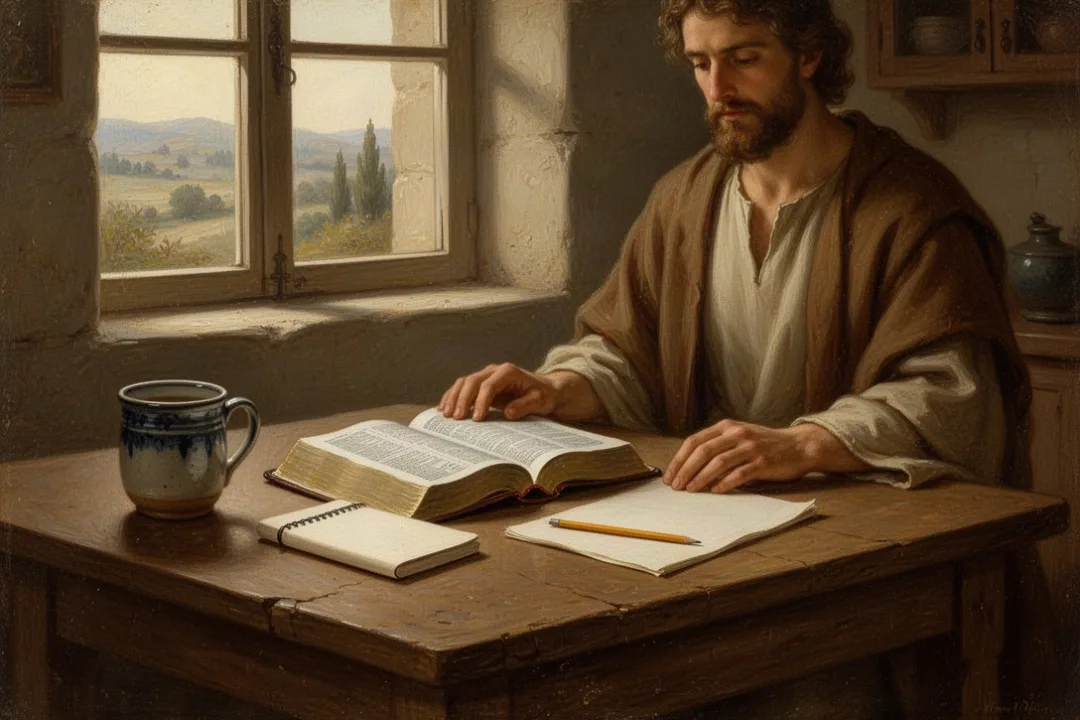
A simple note-taking pattern can keep your reading focused. Write “What does it say?”, then “What does it mean?”, and finally “How should I respond?” The questions are straightforward, but they discourage you from jumping to application before understanding the passage.
Read the Bible in a way that respects its different genres
Narrative tells what happened within a story, but not every event is presented as something to imitate. The actions of flawed biblical characters may reveal failure, conflict, or the consequences of sin. Look for the narrator’s emphasis, the development of the plot, and the way later passages interpret the event.
Poetry uses images, parallel lines, and emotional language. A statement about mountains singing or trees clapping communicates meaning through imagery rather than ordinary scientific description. Read poetic passages for their emotional and theological force.
Letters develop arguments and give instructions. Follow the logic from paragraph to paragraph. A line about Christian behavior may depend on an earlier explanation of grace, identity, or the resurrection.
Wisdom literature offers reflection and guidance, while apocalyptic literature uses visions and symbols to portray judgment, hope, and God’s final victory. Revelation should not be read as though every symbol were a straightforward prediction chart. Its worship, warnings, and hope matter even when particular images are debated.
Use cross-references without losing the main passage
Cross-references can show how biblical themes develop. A passage in Hebrews may draw on Psalms, an event in Matthew may echo Exodus, and a statement in Romans may depend on Genesis. These connections are valuable, but they should supplement your reading rather than replace it.
Start with the passage in front of you. Identify its main point, then look at references that clarify a quotation, person, place, or theme. Write down whether the connection is a direct quotation, a shared image, a similar idea, or a later interpretation.
Reading the Bible with cross-references also helps prevent isolated interpretation. A difficult verse should not be made to carry a meaning that conflicts with the broader teaching of its chapter, book, or biblical context.
Select a reading order for longer-term study
After your first book, choose an order that matches your goals. A Jesus-centered route might move from Mark to John, Acts, Romans, and selected Psalms. A whole-story route could begin with Genesis, Exodus, Joshua, Judges, Ruth, 1 Samuel, 2 Samuel, Luke, Acts, and then continue through the New Testament.
Another option is to combine an Old Testament book with a New Testament book. For example, read Genesis alongside John, Exodus alongside Hebrews, or selected Psalms alongside Luke. This approach lets you experience different genres without staying in a difficult section for too long.
A chronological plan can be helpful, but biblical chronology is not always simple. Some books overlap historically, and the exact order of certain events is debated. A standard canonical order is perfectly suitable if it helps you move through the books consistently.
Know how to respond when a passage troubles you
You may encounter violence, harsh judgment, apparent contradictions, cultural practices that seem strange, or teachings that challenge your assumptions. Do not dismiss the concern, but do not form a final conclusion from one difficult paragraph either.
Mark the passage and ask several questions:
What genre am I reading?
What historical situation surrounds this passage?
Is the text describing an action, commanding an action, or recording someone’s words?
How does the larger book develop this subject?
How do other biblical writers address the same theme?
What do responsible interpreters from different Christian traditions say about it?
Some questions will remain difficult. Faithful reading does not require pretending that every tension has an immediate explanation. It does require patience, honesty, humility, and a willingness to distinguish what the text clearly says from what you are inferring.
Choose a translation and tools that support understanding
Most widely used English Bible translations are suitable for regular reading. Some aim for a more word-for-word approach, while others prioritize natural contemporary English. Reading a familiar translation helps you build continuity, and comparing another translation can clarify a sentence that seems difficult.
A study Bible can explain historical settings, names, measurements, geography, and major interpretive questions. A Bible dictionary is useful when a word or custom appears repeatedly. A trustworthy commentary can help with passages that require more background, though you should compare interpretations rather than treating one note as infallible.
Digital tools can make it easier to search themes, listen to a passage, compare translations, and maintain a reading plan. Still, convenience should not replace attention. Put notifications aside, read in a quiet setting when possible, and give the passage enough time to make its own impression.
What to read in the Bible during different seasons of life
There is no single book that solves every emotional or spiritual need. Different passages may serve you at different times, and rereading a familiar book can reveal something new as your circumstances change.
During grief: Read Psalms of lament, John 11, Romans 8, and 2 Corinthians 1.
During anxiety: Read selected Psalms, Matthew 6, Philippians 4, and 1 Peter 5.
When facing a major decision: Read Proverbs, James, Acts, and passages about humility and prayer.
When you feel spiritually distant: Read Luke 15, Psalm 51, John 15, and 1 John.
When you need courage: Read Joshua 1, Esther, Daniel 3, Acts 4, and Hebrews 11.
When relationships are strained: Read Ruth, Matthew 18, Romans 12, 1 Corinthians 13 in context, and Ephesians 4.
When beginning Christian faith: Read Mark, John, Acts, Romans, and Philippians.
These passages are starting points, not substitutes for pastoral care, counseling, medical treatment, or practical help when those are needed. The Bible can shape hope and wisdom, while trusted people and professional support may help address immediate circumstances.
The most fruitful answer to what to read in the Bible is usually a clear book, a steady pace, and an honest desire to understand. Begin with Jesus if you are new to Scripture, use Psalms and Proverbs for regular prayer and wisdom, and gradually add the Old Testament and the letters as your familiarity grows. Read patiently, keep the larger story in view, and let difficult passages become invitations to study rather than reasons to stop.
Frequently asked questions
What is the best book of the Bible to read first?
Mark is often the easiest starting point because it gives a direct, fast-moving account of Jesus. John is a good alternative if you prefer a more reflective presentation of Jesus’ identity and mission. If you want a short complete story, Ruth is approachable. Read one whole book before moving between many disconnected passages.
Should I read the Bible from Genesis to Revelation?
You can, but it is not the only effective approach. Reading from Genesis onward gives you the broad biblical story, yet some readers lose momentum in lengthy legal or prophetic sections. Beginning with a Gospel, then Acts and a shorter letter, can provide context before you work through the Old Testament.
What should I read in the Bible when I feel discouraged?
Psalms can give language to fear, sadness, anger, and hope without requiring you to hide difficult emotions. Psalm 23 is often read for God’s care, while Psalms 42 and 46 address distress in different ways. You might also read Romans 8 or Philippians for Christian hope and perseverance.
How much of the Bible should I read each day?
Choose an amount you can sustain, such as one chapter or a short section. Reading slowly enough to understand the context is usually more useful than completing many chapters without attention. A consistent routine of ten to fifteen minutes can build familiarity, and you can extend it when your schedule and concentration allow.






Leave a Reply