What the 40 days in the wilderness mean in the Bible
What the 40 days in the wilderness mean in the Bible
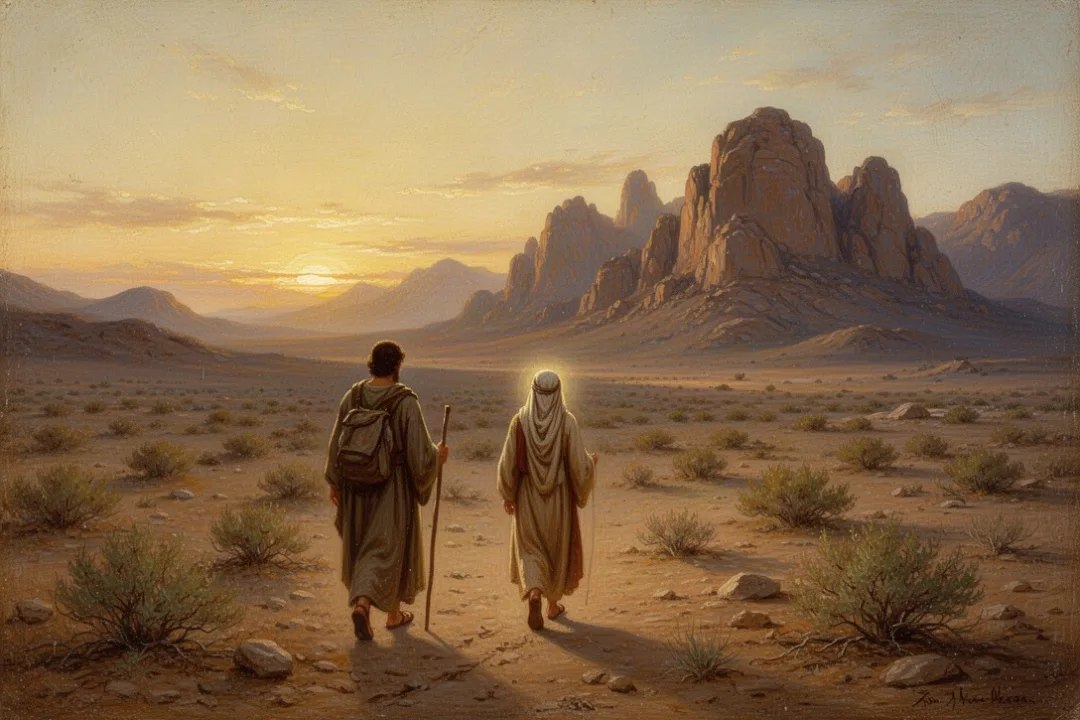
When you hear the phrase 40 days in the wilderness, you may be wondering which biblical story it describes. The phrase most often refers to Jesus’ wilderness temptation, but the Bible also tells of Moses and Elijah spending 40 days in wilderness settings. Israel’s related story lasts 40 years, not 40 days.
These accounts are connected by more than a number. They place a person in an isolated environment where ordinary supports disappear, motives are tested, and dependence on God becomes unmistakable. The experiences are difficult, but they are not identical: Jesus fasts and faces temptation, Moses receives God’s covenant law, and Elijah travels toward a renewed prophetic calling.
Which biblical stories involve 40 days in wilderness?
The clearest reference is Jesus’ 40 days in the wilderness after his baptism. Matthew 4:1-11 and Luke 4:1-13 describe the Spirit leading Jesus into the wilderness, where the devil tempts him. Mark 1:12-13 gives a shorter account, emphasizing the testing and Jesus’ presence among wild animals.
Two earlier figures also spend 40 days in an intense wilderness-related experience:
Moses remains on Mount Sinai for 40 days and 40 nights while receiving the covenant instructions from God, as described in Exodus 24:18. Exodus 34:28 describes another 40-day period connected with the renewal of the covenant.
Elijah travels for 40 days and 40 nights to Mount Horeb after fleeing Queen Jezebel, according to 1 Kings 19:8. There he encounters God and receives direction for what comes next.
Israel spends 40 years in the wilderness after the exodus from Egypt. This is a generation-long period of wandering and formation, not a 40-day fast.
Because these stories share the same time pattern, later readers often see them as related. Moses represents the giving of the law, Elijah represents the prophetic tradition, and Jesus appears in the New Testament as the one who fulfills and surpasses both earlier patterns. The connections are theological rather than a claim that every wilderness account follows exactly the same sequence.
Keep the time periods distinct: Jesus, Moses, and Elijah are associated with 40 days, while the Israelites’ wilderness experience lasts 40 years. Treating them as one event can blur the meaning of each story.
What happened during Jesus’ 40 days in the wilderness?
Jesus enters the wilderness immediately after his baptism. At the baptism, he is publicly identified as God’s beloved Son; in the wilderness, that identity is tested under pressure. The sequence matters because the temptations challenge not whether Jesus has a role, but how he will carry it out.
The Gospel accounts describe Jesus fasting for 40 days and becoming hungry. The temptations then focus on three related questions: whether he will use power for immediate self-interest, whether he will force God to prove his protection, and whether he will gain authority through compromise and worship of the devil.
Turning stones into bread: Jesus is challenged to use his identity and power to satisfy his physical hunger. His response, drawn from Deuteronomy 8:3, places dependence on God above immediate appetite.
Jumping from the temple: Jesus is urged to throw himself down so that angels will rescue him. The temptation would turn faith into a demand for a spectacular sign. Jesus answers from Deuteronomy 6:16, rejecting the idea of testing God.
Accepting worldly authority: Jesus is offered dominion over the kingdoms of the world in exchange for worship. He responds with the command to worship God alone, echoing Deuteronomy 6:13.
The story is not simply about resisting three unrelated bad choices. Each temptation offers a shortcut around the kind of obedience Jesus has come to embody. He could satisfy hunger without waiting, gain public recognition through spectacle, or receive power without suffering. He refuses all three paths.
Why does Jesus spend 40 days in the wilderness?
The New Testament presents the wilderness as a place of testing and preparation. Jesus does not go there because he has failed or because God has abandoned him. Matthew and Luke say the Spirit leads him there, showing that the hardship belongs to the beginning of his public ministry.
The number 40 also connects Jesus with Israel’s wilderness story. Israel passes through the sea and enters the wilderness after leaving Egypt. Jesus passes through baptism and then enters the wilderness. Israel repeatedly complains and turns toward other sources of security; Jesus remains faithful when offered easier alternatives.
This connection does not mean the Israelites are merely a negative example. Their story establishes the biblical pattern of a people learning trust after deliverance. Jesus relives that pattern personally and responds with faithfulness where Israel often falters.
Jesus also answers every temptation with language from Deuteronomy, a book shaped by Israel’s wilderness experience. He draws on passages about hunger, dependence, loyalty, and refusing to test God. The responses show that Scripture is not being used as a decorative quotation; it frames the kind of obedience Jesus chooses.
Luke places the temptations in a sequence that ends at the temple, while Matthew places the temple temptation second. The difference does not change the central message. Both accounts show Jesus rejecting self-serving power, manipulation of God, and idolatrous authority.
How should you understand the number 40 in the Bible?
In biblical narratives, 40 often marks a substantial period of testing, transition, judgment, or preparation. It is long enough to represent a meaningful season rather than a brief interruption. The number can also recall earlier events and invite readers to compare one person’s response with another’s.
That pattern appears in several settings:
The rain of the flood falls for 40 days and 40 nights in Genesis 7.
Moses spends 40 days on Mount Sinai in periods associated with receiving or renewing the covenant.
Israel’s spies explore Canaan for 40 days in Numbers 13, followed by the wilderness judgment measured in years.
Elijah travels 40 days to Horeb after a period of fear, exhaustion, and isolation.
Jesus fasts and is tempted for 40 days before beginning his public ministry.
These examples do not all have the same meaning. The flood involves judgment, Moses’ time on the mountain involves revelation, Elijah’s journey involves renewal and recommissioning, and Jesus’ fast involves testing before ministry. The shared number creates a literary and theological association, but the surrounding details determine the specific message.
It is also wise not to turn the number into a rigid formula. The Bible does not say that every spiritual test must last exactly 40 days or that the number automatically guarantees a particular outcome. Its meaning comes from the story, the person involved, and the action that follows the wilderness period.
What did Moses do for 40 days on Mount Sinai?
Moses’ 40-day periods differ from Jesus’ wilderness fast. Moses goes up Mount Sinai to meet with God and receive the covenant instructions for Israel. Exodus 24:18 describes him staying on the mountain for 40 days and 40 nights, without presenting the episode primarily as a satanic temptation.
His time on Sinai is connected with revelation, covenant, and leadership. God gives Moses instructions concerning Israel’s worship, community life, priesthood, tabernacle, and relationship with God. The mountain becomes a place where Israel’s identity as a covenant people is defined.
The story also contains a painful contrast. While Moses is on the mountain, the people make and worship a golden calf. Their impatience reveals how quickly fear and uncertainty can lead to a substitute for God. Moses’ extended encounter with God therefore stands beside Israel’s failure to wait.
Exodus 34 describes another 40-day period after the covenant is broken and then renewed. Moses returns to the mountain, and the covenant relationship is restored. The emphasis is not merely on a private spiritual experience. Moses receives what the community needs in order to live as God’s people.
For this reason, Moses’ 40 days point toward receiving God’s instruction before leading others. His authority is not self-created. It comes from an encounter with God and from responsibility to communicate that covenant faithfully.
How is Elijah’s 40-day journey different?
Elijah’s 40-day journey in 1 Kings 19 begins not with strength but with collapse. After confronting the prophets of Baal on Mount Carmel, Elijah learns that Jezebel wants him killed. He flees into the wilderness, sits under a broom tree, and asks to die.
God’s response begins with care for Elijah’s physical condition. An angel provides food and water, and Elijah rests. Only after he has eaten and slept does he travel toward Horeb, the mountain associated with Moses and the revelation of God.
This detail makes Elijah’s story especially significant for readers who associate wilderness with spiritual discipline alone. Elijah is not told simply to try harder. His exhaustion is addressed with rest, nourishment, and continued presence. The story recognizes that fear and physical depletion can shape how a person perceives a crisis.
At Horeb, Elijah encounters powerful natural phenomena, including wind, an earthquake, and fire. The narrative then describes a quiet sound or gentle voice, depending on the translation. God asks Elijah why he is there, hears his account, and gives him new instructions, including the appointment of future leaders.
Elijah’s 40 days therefore lead to renewed purpose rather than public triumph. He discovers that his work is not finished, that he is not as alone as he believes, and that God’s activity is not limited to dramatic displays. The wilderness becomes a place where despair is met with care and direction.
What do the 40 days reveal about temptation and obedience?
Jesus’ wilderness testing shows that temptation often takes a legitimate need or desire and detaches it from trust and obedience. Hunger is real, authority can be used for good, and Scripture is precious. The danger lies in pursuing these things through self-rule, spectacle, or compromise.
The first temptation addresses immediate physical need. Jesus is hungry, but he will not define his sonship by satisfying himself apart from the Father’s will. His answer does not deny the importance of food; it places physical nourishment within a larger dependence on God.
The second addresses public proof. A dramatic rescue from the temple would attract attention, but it would manipulate God and turn trust into a test. Genuine faith does not require creating a crisis so that God must respond visibly.
The third addresses power without obedience. Jesus is offered influence over the kingdoms of the world without the path of suffering and faithful service. He rejects authority gained through worshiping anything other than God.
A useful reading principle: The wilderness temptations are not mainly about avoiding ordinary objects such as bread, buildings, or political authority. They are about refusing to use good or powerful things in ways that replace trust in God.
What does “wilderness” mean in these stories?
The biblical wilderness is not necessarily a completely empty desert. It can refer to a rugged, sparsely settled region where food, water, shelter, and social protection are limited. Its meaning comes from the vulnerability it creates.
In the wilderness, people cannot rely on familiar routines in the same way. Moses is separated from the camp while receiving the covenant. Elijah is cut off from ordinary support while fleeing for his life. Jesus is isolated while preparing for public ministry and facing temptation.
Wilderness can therefore represent several experiences at once:
Disorientation: familiar landmarks and routines no longer provide security.
Dependence: basic needs expose the limits of self-sufficiency.
Testing: pressure reveals what a person trusts and how that trust shapes decisions.
Preparation: the period can equip someone for a responsibility that follows.
Encounter: isolation can become a setting for receiving God’s instruction or care.
These meanings should not be used to romanticize suffering. The Bible does not present every hardship as a lesson that a person must endure without help. Elijah receives food and rest, Israel receives manna and water, and Jesus’ wilderness experience takes place within the Spirit’s leading. Biblical wilderness stories make room for both endurance and divine provision.
What can Christians learn from the 40 days in the wilderness?
These stories offer practical lessons, but they should be applied carefully. Jesus’ 40-day fast is unique in its place within his ministry and should not be treated as a universal requirement. Moses’ mountain experience cannot be copied simply by withdrawing from everyone, and Elijah’s journey should not be used to shame someone who is exhausted.
Several principles do transfer meaningfully:
Identity should come before performance. Jesus faces temptation after being identified at his baptism, not in order to earn God’s love. Spiritual practices are healthier when they respond to grace rather than attempt to purchase acceptance.
Pressure reveals governing priorities. A difficult season can expose whether you are driven mainly by comfort, recognition, control, or faithfulness.
Scripture requires faithful interpretation. Jesus answers a distorted use of Scripture with a fuller biblical understanding. Quoting a verse does not automatically make an argument faithful.
Physical needs are real. Elijah’s rest and food show that spiritual care is not separate from the body. Sleep, nourishment, and safety may be necessary before clear discernment is possible.
Preparation may be hidden. Moses receives instructions away from the public, and Jesus begins his ministry after an unseen period of testing. A season without visible results may still shape future service.
Wilderness seasons have different endings. Jesus begins public ministry, Moses returns to lead a covenant people, and Elijah receives new assignments. The outcome depends on the story, not on a simple promise that hardship ends in immediate success.
For someone going through a difficult season, the most responsible application is not to assume that God caused every painful circumstance. Instead, you can ask what support, wisdom, truth, and faithful action are needed now. The stories invite dependence without discouraging practical help.
Is fasting required to understand the 40 days in the wilderness?
Fasting is central to Jesus’ account because the Gospel writers specifically describe him going without food for 40 days. Moses’ periods on Sinai also involve abstinence from food and water according to Exodus 34:28, though the circumstances are extraordinary. Elijah’s account emphasizes food provided for the journey rather than a chosen fast.
Fasting in the Bible can express mourning, repentance, dependence, preparation, or focused prayer. It is not presented as a way to control God or prove superior spirituality. Jesus’ temptation story particularly shows that fasting does not make a person immune to temptation; even after prolonged spiritual focus, Jesus experiences hunger and pressure.
People should approach fasting with wisdom. Those who are pregnant, managing diabetes, taking certain medications, recovering from an eating disorder, or dealing with other health concerns should seek professional medical guidance before changing their diet. A spiritual practice that causes harm or reinforces disordered behavior does not reflect the careful purpose of these narratives.
You can engage the themes without attempting a 40-day fast. Reading the relevant passages, setting aside regular time for prayer, reducing a distracting habit, serving someone in need, or asking trusted people to help you discern a decision may better express dependence in your circumstances.
How do Moses, Elijah, and Jesus compare?
Putting the three accounts side by side shows both continuity and difference. Moses is called up the mountain to receive covenant revelation. Elijah journeys to the mountain in distress and receives care and renewed direction. Jesus is led into the wilderness to face temptation before beginning his public ministry.
Their experiences can be compared through four questions:
What begins the experience? Moses receives God’s summons, Elijah flees after a threat, and Jesus is led by the Spirit after baptism.
What is the main pressure? Moses is separated from the people and receives demanding covenant responsibilities; Elijah faces fear and exhaustion; Jesus faces hunger and direct temptation.
What does God provide? Moses receives instruction, Elijah receives food and renewed commission, and Jesus remains faithful through Scripture and obedience.
What follows? Moses returns with covenant responsibilities, Elijah resumes prophetic work, and Jesus begins proclaiming God’s kingdom and calling disciples.
The New Testament later places Moses, Elijah, and Jesus together at the Transfiguration in Matthew 17, Mark 9, and Luke 9. The scene links Jesus with the law and the prophets while presenting him as uniquely central. That later connection helps explain why readers see the wilderness accounts as part of a larger biblical pattern.
How should you apply a wilderness season to your own life?
If you are using the phrase for a difficult personal season, begin by describing the situation honestly rather than assigning it a spiritual label too quickly. Are you grieving, burned out, isolated, uncertain about a decision, recovering from failure, or facing pressure to compromise your values? A clear description helps you seek the right kind of support.
Then consider a grounded process:
Attend to basic needs. Rest, food, medical care, safety, and trustworthy companionship are not distractions from spiritual life.
Name the temptation or pressure. Ask whether you are being pushed toward immediate relief, public approval, control, or a compromise that violates your convictions.
Test your interpretation. Read the surrounding biblical context instead of relying on an isolated phrase. Discuss difficult questions with mature and trustworthy people.
Choose the next faithful action. Wilderness stories rarely provide every future detail. They often show the next step: receive instruction, rest, return, speak truth, or serve.
Stay connected to community. Isolation can distort judgment. Elijah believed he was alone, but God showed him that others remained faithful.
Watch for a changed assignment. The period may not end with the result you expected. It may clarify what you should continue, release, or begin.
A personal wilderness season is not proof that you are spiritually superior, and it is not proof that you have been rejected by God. The biblical accounts include obedience, fear, exhaustion, provision, correction, and renewed purpose. They encourage honest dependence rather than dramatic claims about every hardship.
The phrase 40 days in wilderness ultimately points to a pattern of testing that can reveal what guides a person when comfort and control are stripped away. Jesus shows steadfast obedience, Moses receives instruction for a community, and Elijah discovers care and a continuing mission. Read together, these stories present the wilderness as a difficult place where God may sustain, teach, correct, and prepare—but where each person’s experience remains distinct.
Frequently asked questions
Did Jesus spend exactly 40 days in the wilderness?
Matthew 4:1-11 and Luke 4:1-13 describe Jesus spending 40 days in the wilderness, while Mark gives a shorter account of the same event. The Gospel writers emphasize his fasting, hunger, and temptation. The period is presented as a real part of his preparation for public ministry, but the accounts do not provide a modern-style timetable with daily details.
Were Moses and Jesus both fasting for 40 days?
Their experiences are similar in duration but different in purpose and setting. Moses’ time on Mount Sinai centers on receiving and renewing the covenant, while Jesus’ wilderness period centers on fasting and resisting temptation. Exodus also describes Moses abstaining from food and water during a 40-day period, but the two stories should not be treated as identical spiritual practices.
Why did Elijah travel for 40 days?
Elijah travels to Horeb after fleeing a threat from Jezebel and experiencing deep exhaustion and despair. God first provides him with food and rest, then meets him at the mountain and gives him further instructions. The journey represents care, encounter, and renewed prophetic responsibility rather than a test Elijah chooses for himself.
Does the Bible say every difficult season lasts 40 days?
No. The number 40 carries recurring biblical associations with testing, transition, and preparation, but it is not a promise that personal hardship will end after 40 days. Some biblical wilderness periods last much longer, including Israel’s 40 years. Personal circumstances require discernment, practical support, and patience rather than a fixed timetable.











Leave a Reply