The Bible contains a remarkable moment in which a donkey unexpectedly speaks. In common retellings, this episode is famous not merely as a quirky curiosity, but as a vivid example of how God can use an unlikely instrument to convey a message. The story, often summarized as the talking donkey narrative, centers on a man named Balaam and the animal that carries him on a perilous journey. When readers encounter the moment in Scripture, they glimpse a dramatic collision between human intention, divine sovereignty, and the power of speech—even when that speech comes from a creature we typically overlook. This article offers a careful, thorough survey of the phenomenon known as the bible donkey talking, tracing its origins, its meanings, and its enduring resonance across Jewish, Christian, and broader thoughtful reception.
The Plain Tale: Where the Talking Donkey Appears
Numbers 22–24: The Narrative in Focus
The canonical story of the donkey that spoke appears in the book of Numbers, chapters 22 through 24. It sits within a larger arc about Israel’s journey, prosperity, and conflict with neighboring peoples. Balaam, a non-Israelite prophet or diviner depending on the interpretive lens, is summoned by Balak, the king of Moab, who fears the rising strength of Israel. Balak seeks to hire Balaam to pronounce curses against Israel; he believes that a powerful curse will reverse the fortunes of his people in battle. What unfolds, however, is not a straightforward invocation of curse after curse, but a drama in which a seemingly ordinary animal becomes a vehicle for a divine message.
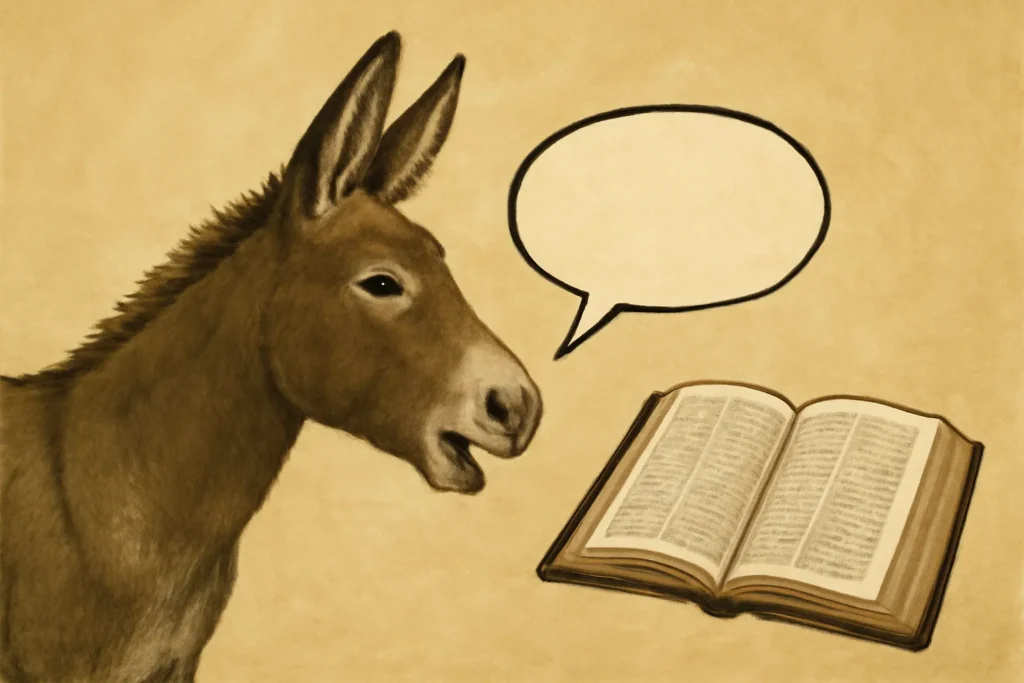
In the sequence, Balaam mounts his donkey, and the three travelers—the prophet, the animal, and the angel with a drawn sword—move toward their destination. The angel of the Lord stands in the path as an impediment, invisible to Balaam but visible to the donkey. The donkey sees the supernatural danger and refuses to proceed, weaving into the field, pressing against a wall, and squeezing Balaam against a wall’s narrow aperture. Frustrated, Balaam strikes the donkey. Then, in the moment when the donkey speaks, a profound interruption breaks the pattern of a typical journey: the animal asks the prophet why he has beaten him, and Balaam replies in the most human terms—impatient, defensive, and self-justifying.
What is startling is not the donkey’s capacity for speech alone, but the fact that the donkey names a moral and spiritual hazard that Balaam himself is blind to. The donkey’s question—“What have I done to you, that you have beaten me these three times?”—functions as a critique of Balaam’s discernment and a prompt to pause. Then the donkey’s mouth speaks, and the text records a direct greeting from God through the animal: “am I not your donkey, on which you have ridden, ever since I was yours, to this day? Have I ever done something to you, that you would turn aside from me?” The moment culminates with Balaam’s eyes opened to the angel’s presence, and the instruction to bless Israel instead of curse them—an outcome that subverts Balak’s expectations and demonstrates the sovereignty of God over human plans.
In the immediate aftermath, Balaam does as the Lord pleases, delivering a chain of oracles rather than imprecations. The donkey narrative thus functions not as a standalone miracle but as a dramatic catalyst that reframes the entire episode: a humble beast becomes a surprising interlocutor, guiding a human toward a higher obedience and toward a revelation that transcends human calculations about power and success.
The Text in Context: Historical and Literary Settings
Historical backdrop and literary purpose
To appreciate the full significance of the bible donkey talking, it helps to situate the narrative within its historical and literary milieu. The Numbers account sits at the juncture of the wilderness period, where the people of Israel move from bondage toward nationhood. The encounter with Balak and Balaam highlights tensions between divine blessing, prophetic authority, and political maneuvering among ancient Near Eastern powers. The story uses a blend of travelogue, dialogue, and prophetic oracles to accomplish several aims:
Reinforce divine sovereignty over human schemes, even when those schemes involve power, wealth, or national security concerns.
Expose spiritual blindness in one of the story’s central figures, Balaam, whose perception is challenged not by a human rival but by a nonhuman speaker enabled by God’s command.
Model humility and correction by showing that moral insight can arrive through unlikely channels—and that obedience to God’s will matters more than clever manipulation of outcomes.
Give readers a test case for how prophets and would-be prophets should respond to divine revelations that disrupt personal ambitions.
The donkey’s speaking is thus not a mere oddity; it is a device that reveals truth about human hearts, divine purposes, and the moral shape of prophetic ministry. Its placement in Numbers, a book often read as a travel diary of Israel’s formation, underscores the theme that journeys toward promise require attentiveness to God’s directions—even when the guide is an animal and the messenger is a divine dream, vision, or voice heard in a most disarmingly ordinary moment.
The choice of a donkey as a messenger is loaded with symbolic weight. In the ancient world, the donkey was a work animal—reliable, steady, and often underestimated. Its very nature invites humility: a creature that carries burdens and travels at a modest pace. Within the biblical imagination, this ordinariness becomes an occasion for extraordinary intervention. Several layers of meaning emerge:
Humility vs. Pride: Balaam’s confident posture—convinced he can command supernatural outcomes—meets a force far beyond his skill. The donkey, typically a symbol of toil, becomes the instrument of divine restraint, nudging the prophet toward a posture of humble dependence on God’s will.
Perception beyond sight: The donkey’s ability to “see” the danger that Balaam cannot perceive mirrors a larger theme in Scripture: spiritual discernment often exceeds human senses when God is at work.
Nonhuman agency in prophecy: The narrative challenges readers to recognize that God can authorize even animals to perform roles in the unfolding of His plan, highlighting the breadth of divine sovereignty.
Voice for ethical accountability: The donkey’s words function as a moral check—on Balaam’s intent and on any reader’s assumptions about who or what qualifies as a legitimate conduit of divine truth.
Beyond its symbolic resonance, the donkey’s speaking in Numbers 22–24 serves as a dramatic pedagogy: a moving scene that unsettles complacency and invites readers to reconsider who carries moral responsibility in moments of crisis. In this sense, the speaking beast becomes a spiritual teacher, challenging human pride and pointing toward a higher allegiance to the God who guides destinies from the margins of expectation.
The Dialogue: What the Donkey Says and Why It Matters
A brief look at the exchange and its rhetorical impact
The donkey’s articulation—though concise—has a weighty impact. The words function as a test of Balaam’s inward life more than as mere commentary on his outward actions. The exchange unfolds in a sequence that illuminates several doctrinal and ethical themes:
Question and moral correction: The donkey’s question to Balaam—implicitly asking about the harm Balaam inflicts upon it—offers a mirror for Balaam’s treatment of others and his overall ethical posture.
Divine clarity through an unexpected voice: The moment when God opens Balaam’s eyes to the angel reveals that truth may come through unlikely interlocutors, a recurring motif in biblical storytelling.
Redirected prophecy: Instead of cursing Israel as Balak desires, Balaam pronounces blessings. The donkey’s intervention thus precipitates a turn toward divine intention rather than human strategy.
Call to obedience over calculation: The narrative invites readers to weigh expediency against fidelity to God’s purposes, a critical topic for any era in which leadership seeks favorable outcomes through clever means.
From a literary angle, the donkey’s voice also contributes to the text’s dramatic pacing. The interruption by the beast creates a pivot point that shifts momentum—from a potential drama of conquest to a revelation of grace. The dialogue thereby enacts a theological truth: God’s plan may not align with human planning, and often the means through which revelation arrives are not what we expect—or deserve.
Translations, Textual Nuances, and Language Notes
Hebrew terms and linguistic considerations
To appreciate the bible donkey talking moment, it helps to note a few linguistic details. In Hebrew, the term for donkey is chamor. The phrase often translated as “donkey” can carry the nuance of a burden-bearing animal used for transport or labor. The action of “speaking” in the Numbers narrative is standard, but the context—God enabling speech through a nonhuman—requires careful translation to preserve the sense of awe and wonder without reducing the donkey to a mere rhetorical device.
Some scholarly discussions focus on the Hebrew verb for “to speak” in this scene—dabar or amar—and how its usage here emphasizes not merely the act of vocalization but the transmission of a divine message. In translations, the phrase “the donkey spoke” must be understood in the framework of a theophany—a visible or audible manifestation of God’s presence that makes such speech meaningful rather than fantastical.
Different Bible translations handle the moment with varying emphasis on moral, rhetorical, or miraculous dimensions. Some emphasize the ethical confrontation (the donkey’s rebuke) more than the miracle itself; others foreground the angel’s presence as the immediate cause of the warning. Readers should note how translation choices shape interpretation and how the “speaking beast” motif functions across the text’s many readers and communities.
Symbolism and Cultural Reception
How the story has been read across generations
The donkey that spoke in the Bible has inspired a wealth of interpretive traditions. In Jewish rabbinic literature, the episode is often discussed within the broader exploration of prophetic authority and the limits of human perception. Some commentators highlight Balaam’s ethical fault lines—his willingness to be hired as a seer for hire—while others emphasize the donkey’s role as a moral witness.
Christian exegetes have likewise engaged the narrative in varied ways. Some see Balaam as a foil for true prophetic faith, others as a case study in divine sovereignty triumphing over human plans. The donkey’s speech is frequently read as a reminder that God can use any creature to accomplish a message that humans need to hear. In devotional contexts, the episode is cited as a vivid emblem of humility: even a humble animal can discern danger, while a prophet’s blind spot invites correction by God’s creatures and by God Himself.
In broader culture, the idea of a talking donkey has become a familiar trope in literature, art, and film. The image of an ordinary beast suddenly delivering a weighty message resonates because it challenges entrenched assumptions about who can be a messenger of truth. The story’s enduring power lies in its paradox: the most unassuming creature becomes a conduit for divine instruction, while a renowned prophet becomes a learner in the face of a miraculous interruption.
Donkey in Art, Literature, and Popular Culture
Artistic depictions of the Balaam story often emphasize the moment of the donkey’s speech, highlighting facial expressions and the tension between human ambition and divine restraint.
In literature and children’s books, the talking donkey offers a gentle entry into discussions about humility, obedience, and listening for God’s voice in unexpected places.
In contemporary media, the motif surfaces whenever a seemingly ordinary figure or tool reveals hidden depth or truth—an allegory about looking beyond appearances to discern what matters in moral decision-making.
Interfaith and Theological Reflections
Perspectives from Judaism, Christianity, and Islam
Across traditions, the bible donkey talking narrative is primarily anchored in Jewish and Christian texts, where it is read as a record of God’s direct intervention in prophetic affairs. In Judaism, scholars often stress the integrity of the biblical text—its ability to reveal moral lessons through a dramatic, almost theatrical, encounter with the divine. The donkey’s voice is treated not as mere whimsy but as a legitimate instrument through which God communicates, corrects, and redirects a flawed human agent toward fidelity to the covenant.
In Christian thought, the narrative becomes a focal point for discussing discernment, obedience, and the sovereignty of God over political and national ambitions. Some commentators see Balaam’s missteps as a cautionary tale about the dangers of expediency in prophecy—how the allure of wealth, prestige, or political advantage can obscure the true purpose of divine revelation. The donkey’s intervention then functions as a moral check, reminding readers that prophetic authority is subordinate to God’s will and that even a beast can bear witness to a higher truth.
In Islamic traditions, there is no canonical Qur’anic account of Balaam’s talking donkey. Some later folkloric or exegetical traditions may recount similar motifs, but the core Balaam episode as presented in Numbers is not part of Islamic revelation. Nevertheless, readers exploring interfaith reflections may note a shared interest in the themes of prophetic authority, divine correction, and humility before the divine will. The central takeaway across traditions remains instructive: the path toward truth often requires humility, openness to correction, and a willingness to listen to voices that might surprise us.
Practical Takeaways for Today
Although the donkey that spoke in the Bible belongs to an ancient narrative, its lessons remain surprisingly relevant for contemporary readers. Here are practical takeaways drawn from the story’s richness:
Humility in leadership: Leaders and would-be prophets alike can fall into certainty about their own plans. The Balaam episode warns against arrogance and invites a posture of receptive obedience to God’s direction.
Discerning what we cannot see: The donkey perceives unseen danger that Balaam misses. The text invites readers to cultivate spiritual discernment, recognizing that not all threats or opportunities are visible to the naked eye or the popular perception.
Communication across barriers: A talking donkey illustrates that truth can come through unlikely channels. Be open to revelations that arrive from unexpected sources, whether through people, events, or creatures that accompany us on our journey.
Integrity over expediency: Balaam’s motive—economic gain—compromises the integrity of his prophetic gift. The story challenges readers to weigh motives, ensuring that one’s work serves righteousness rather than personal advantage.
Scriptural humility: Even sacred figures can misinterpret or misuse their gifts. The tale encourages humility before the text’s mysteries and a readiness to be corrected by the biblical witness itself.
Conclusion: The Enduring Significance of the Talking Donkey
The biblical episode of the donkey that spoke in Numbers 22–24 endures because it engages some of humanity’s deepest questions: What happens when we think we control the outcome? How do we hear God in unfamiliar voices? What does it mean to be faithful to a divine commission when the path is fraught with political and personal temptations?
As a narrative device, the speaking donkey invites readers into a space where the miraculous sits beside the ordinary, where a creature of burden becomes a bearer of divine truth, and where a prophet’s pride yields to divine correction. The broader message of the bible donkey talking story is not simply about a miracle; it is about the character of God who interrupts human schemes with mercy, redirects toward blessing, and calls us, regardless of our status or expertise, toward a higher obedience.
Whether one reads it as a historical account, a theological parable, or a literary drama, the tale remains a powerful reminder that in the theatre of faith, voices come from all directions—and the ultimate aim is not to win a argument or secure a favorable outcome, but to align with God’s purposes for blessing, justice, and truth.











Leave a Reply