Introduction: The Bible’s Talking Donkey and Its Enduring Message
Among the most memorable scenes in the Bible is the talking donkey episode from the book of Numbers. This is not simply a curious miracle about an ass that spoke; it is a carefully crafted narrative with theological stakes, dramatic irony, and moral warnings. The story—often called Balaam’s donkey or the speaking donkey narrative—tests a prophet’s openness to divine guidance, exposes the gap between physical sight and spiritual perception, and demonstrates how God can use even an ordinary creature to deliver a crucial message. In popular retellings and in scholarly study alike, this episode serves as a touchstone for discussions about obedience, prophecy, and the nature of divine communication.
This article explores the Bible talking donkey from its biblical context, its literary and theological significance, and the practical lessons it offers for readers today. We will use a variety of terms—talking donkey, speaking donkey, donkey that spoke, ass that spoke, and the talking ass—to reflect the range of expressions found in translations and in scholarly discourse. By tracing the narrative, its characters, and its later reception, readers can gain a richer understanding of why this modest animal remains a powerful symbol in religious imagination.
Origin and Context: Where and Why This Story Appears
The talking donkey narrative is set in the wilderness encampments of the Israelites during their journey to the Promised Land. It appears in Numbers 22–24, a section of the Pentateuch often called the Wilderness Narratives. The central human figure is Balaam, a foreign prophet whom the Moabite king Balak hires to curse Israel. What begins as a political maneuver quickly unfolds into a theological drama about obedience, discernment, and the sovereignty of God.
To understand the significance of Balaam’s donkey, it helps to set the stage with the key players and motives. Balak fears the march of Israel, and he hopes the prophet Balaam can reverse that fear by cursing the people. Balaam, a controversial figure who sometimes pursues profit or prestige, finds himself at a crossroads where his ambitions collide with a divine interruption. The ass that spoke becomes the unlikely conduit through which God interrupts Balaam’s plans and redirects his steps.
The cultural backdrop matters as well. Donkeys were common beasts of burden in the ancient Near East, associated with endurance, stubbornness, and practical wisdom in some traditions. The shock of encountering a speaking donkey arises precisely because an animal—normally thought to be governed by appetite and habit—claims a voice beyond its own species. This juxtaposition—an animal addressing a human with moral seriousness—heightens the sense that the narrative is about more than a miracle; it is about seeing with spiritual eyes.
The Roadside Encounter: A Donkey’s Perceptiveness and the Prophet’s Blindsight
The pivotal moment in the story occurs as Balaam rides his donkey along a path with wheels that turn toward a field, a wall, and then a narrow pass. The donkey perceives danger in the form of an angel of the Lord standing with a drawn sword, blocking the way. The human rider, however, does not see the divine messenger in front of him, and he becomes furious at what he perceives as the animal’s stubbornness.
The Angel of the Lord and the Hidden Peril
In the narrative, the angel of the Lord is a symbol of imminent judgment and divine intervention. The donkey’s first instinct is to turn aside from the peril, choosing safety over route. Balaam’s reaction—striking the donkey—reveals a mind clouded by haste and a heart focused on material gains rather than obedience to God. The drama escalates as the traveler insists on moving forward, while the animal tries to protect him from danger.
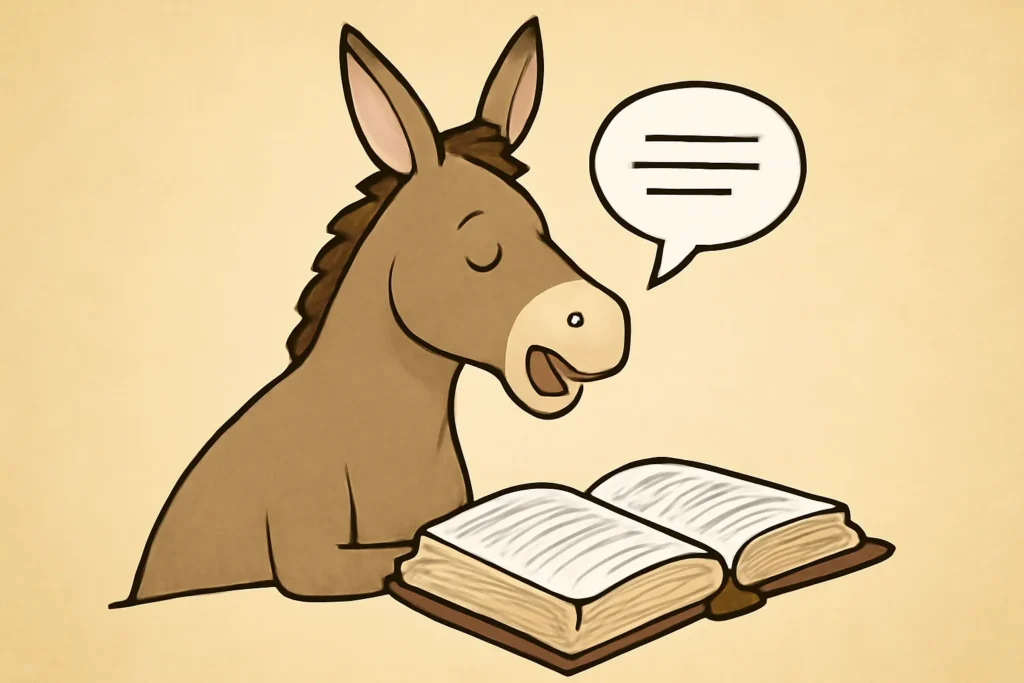
After Balaam strikes the donkey again and again, something extraordinary happens: the donkey speaks, opening a window into a moral and theological conversation. In Numbers 22:28, the Lord opens the mouth of the donkey, and the animal asks Balaam a pointed question: “What have I done to you, that you have ridden me these three times?” The speaking donkey then proceeds to rebuke Balaam for treating it with cruel contempt and for ignoring the very danger that the animal has seen.
The Message: The Donkey as a Messenger and the Prophet’s Awakening
The moment when the donkey that spoke addresses its master is one of the most striking in biblical literature. The animal’s interruptions and inquiries serve a dual purpose: they protect Balaam and they reveal the hidden reality that the prophet cannot perceive with his naked eye. The dialogue culminates with the God opening Balaam’s eyes to see the angel of the Lord standing in the way with a sword raised. The revelation forces Balaam to confront not only the danger on the road but also the danger of spiritual blindness.
This episode is commonly interpreted as a dramatic reversal: the ass that talked becomes the first to expose Balaam’s misalignment with God’s will. Instead of cursing Israel as Balak desires, Balaam ends up pronouncing blessings, a turn that many scholars read as evidence of a genuine prophetic encounter shaped by divine guidance. The narrative invites readers to consider how divine sovereignty can thwart human plans and how truth can come through unexpected messengers.
Literary and Theological Significance of the Speaking Donkey
The tale of the biblical talking donkey offers rich material for literary analysis and theological reflection. The donkey, in this telling, is not merely a passive vehicle but a sentient actor who interrupts a human agent to perform a divine task. The episode dramatizes the tension between human will and divine purpose, reminding readers that perception and reality may diverge and that God can bridge that gap through unlikely channels.
Anthropomorphism, Irony, and Theophany
A notable feature of this story is its use of anthropomorphism—the ascribing of human traits to an animal—in order to communicate a spiritual truth. The irony is sharp: the donkey demonstrates discernment that the prophet lacks until God intervenes. Theophanic language—God’s self-disclosure through a nonhuman mouth—highlights the belief that divine revelation is not limited to human sources.
Prophecy, Blessing, and the Reversal of Expectation
The episode also foregrounds the moral complexities of prophecy. Balaam’s career as a prophet is marked by a paradox: he seeks to gain advantage through divination, but he becomes a conduit for blessings at the very moment Balak wants curses. The speaking donkey becomes a catalyst that prevents a human plan from eclipsing God’s intention for Israel. The outcome reinforces the biblical claim that God’s purposes endure beyond human ambition.
Lessons for Today: What the Talking Donkey Teaches Modern Readers
Readers throughout history have drawn a variety of lessons from the story of Balaam’s donkey. Although the setting is ancient, the core issues—obedience, discernment, humility, and the care of others—remain relevant for contemporary life. Below are some of the most frequently drawn insights.
God speaks in surprising ways: The speaking donkey reminds us to remain open to messages that come through unlikely channels and to test what we hear against divine will.
Perception vs. reality: Physical sight can be insufficient for spiritual perception. Just as Balaam cannot see the angel, we may miss hidden spiritual realities unless God opens our eyes.
Humility before divine sovereignty: Balaam’s journey shows how easily ambition can distort judgment. The creature that speaks becomes a moral counterbalance to human pride.
Ethical responsibility of leaders: The prophet’s responsibility to bless rather than manipulate emphasizes integrity as a nonnegotiable trait for leadership.
Compassion for creatures and creation: The donkey’s restraint and care for Balaam’s safety illustrate a broader ethic of responsibility toward animals and the vulnerable in our care.
Ethical and Moral Reflections: Interpreting Miracles Without Reducing Them
The story challenges readers to think about miracles without turning them into mere wonders. The speaking donkey is not an endorsement of sensationalism; it is a dramatic vehicle for moral instruction. Interpreting this text invites careful attention to context, language, and purpose. Some questions that arise in ethical reflections include:
How should we respond when divine messages come through unlikely sources, including nonhuman agents or unexpected circumstances?
What does it mean to discern God’s will in situations where human plans clash with spiritual truth?
What responsibilities do leaders have when they realize they have distorted their course? Can a single corrective sign redirect a life committed to the wrong ends?
How ought communities read biblical miracles in ways that honor God’s sovereignty while preserving human accountability?
Donkey as a Messenger: The Reversal of Roles and Its Implications
The idea of a humble donkey as a messenger carries a striking reversal: a lowly creature becomes the instrument through which a greater truth is spoken. This reversal resonates with biblical themes about God’s preference for the humble and the outsider to reveal wisdom to the proud and powerful. The episode suggests that the strength of a message does not always depend on the stature of its bearer; rather, it depends on the fidelity of the one who carries it to God’s purposes.
For contemporary readers, the ass that spoke is a reminder that truth can come from the margins. It invites a posture of listening—toward the natural world, toward those who are marginalized, and toward voices that challenge our most entrenched assumptions. In this sense, the speaking donkey is less a curiosity and more a spiritual invitation to humility and attentiveness.
Historical-Cultural Context: Animals, Prophets, and the World of the Wilderness
Understanding the wider historical-cultural world helps illuminate why the donkey speaking moment lands with such force. In the ancient Near East, donkeys were indispensable for transport and commerce, prized for their endurance and practical utility. They symbolized steadiness and reliability in daily life. Yet the biblical narrative elevates the donkey beyond its ordinary function by granting it speech, thereby challenging expectations about creaturely wisdom and the limits of human perception.
The encounter also interacts with the broader theme of divine appearances in nature. The angel of the Lord who blocks Balaam’s path uses a sword to convey the seriousness of obedience. The drama thus links the mundane (a journey on a dusty road) with the transcendent (God’s will acting in history). This seamless weave of the ordinary and the extraordinary is part of why the story remains memorable for readers who study the relationship between human intention and divine purpose.
New Testament Reflections and Later Interpretations
The episode does not exist in a vacuum; it has echoes in later biblical literature and in classical biblical interpretation. The apostle Peter cites Balaam as an example of greed and the dangers of being “twisted” by profit, while also noting the donkey’s restraint as part of the moral caution. In 2 Peter 2:15–16 and Jude 1:11, the narrative is recalled to warn against false prophets and to illustrate a point about the consequences of pursuing selfish ends. These later allusions show how the biblical talking donkey became a reference point for discussions about integrity, revelation, and divine judgment.
Within medieval and modern interpreters, the story has also served as a canvas for exploring the relationship between human obedience and divine sovereignty. Some writers emphasize the donkey’s voice as a call to humility in the face of God’s overwhelming purposes, while others use the episode to discuss the problem of evil and the ways God can appropriates flawed figures to accomplish good ends. Across centuries of reading, the speaking ass remains a powerful symbol for readers seeking to understand how heaven can intersect earth in surprising and life-shaping ways.
The tale of Balaam’s donkey is more than a quirky miracle. It is a multidimensional narrative that invites readers to examine the limits of human perception, the scope of divine authority, and the ethical obligations that accompany prophetic power. The talking donkey stands at the crossroads of humility and judgment, offering a vivid reminder that God’s purposes often outrun human plans. In the end, the animal’s courage to speak becomes a catalyst for Balaam’s awakening and for a blessing that speaks louder than any curse Balak could have imagined.
For students of scripture, clergy preparing sermons, or curious readers exploring biblical miracles, the tale of the speaking donkey provides fertile ground for reflection. It challenges readers to listen more closely, to question certainty, and to recognize that the most profound messages can come from the most unlikely sources. Whether one reads it as history, poetry, or theological instruction, the Bible talking donkey remains a compelling invitation to examine how God communicates, who is authorized to speak, and how truth can break through the noise of human ambition.








Leave a Reply