Bible Woman with Blood Issue: Faith, Healing, and the Woman with the Issue of Blood
Bible Woman with Blood Issue: Faith, Healing, and the Woman with the Issue of Blood
The story commonly titled the Woman with the Issue of Blood appears across three of the Gospels, where a woman unnamed in the text presses through a crowd to touch Jesus’ garment in hopes of relief from a long, painful illness. This narrative is more than a medical miracle; it is a compact study in faith, social stigma, ritual purity, and the compassion of Jesus. In exploring the figure often called the bleeding woman or the hemorrhaging woman, readers encounter a pivotal moment that has shaped Christian teaching on healing, dignity, and the transformative power of belief. This article surveys the biblical accounts, situates them in their historical and cultural setting, and draws lessons for contemporary faith communities and personal faith journeys.
Introduction: Who is the Bible woman with blood issue?
The phrase bible woman with blood issue can be used in several ways to describe the same person across the Gospel narratives. In some translations she is explicitly called the woman with the discharge of blood, in others the woman who had a flow of blood, and in still others simply the hemorrhaging woman. Regardless of the wording, the core portrait remains: a woman who has suffered for years, who has exhausted her resources, and who dares to seek healing through contact with Jesus. The emphasis is not merely on a medical cure, but on a transformation that reaches the heart, redefines identity, and restores relationship with God and community.
The Story in the Gospels: where the accounts live
The healing narrative of the bleeding woman appears in three writers of the New Testament with varying details, yet sharing a common core:
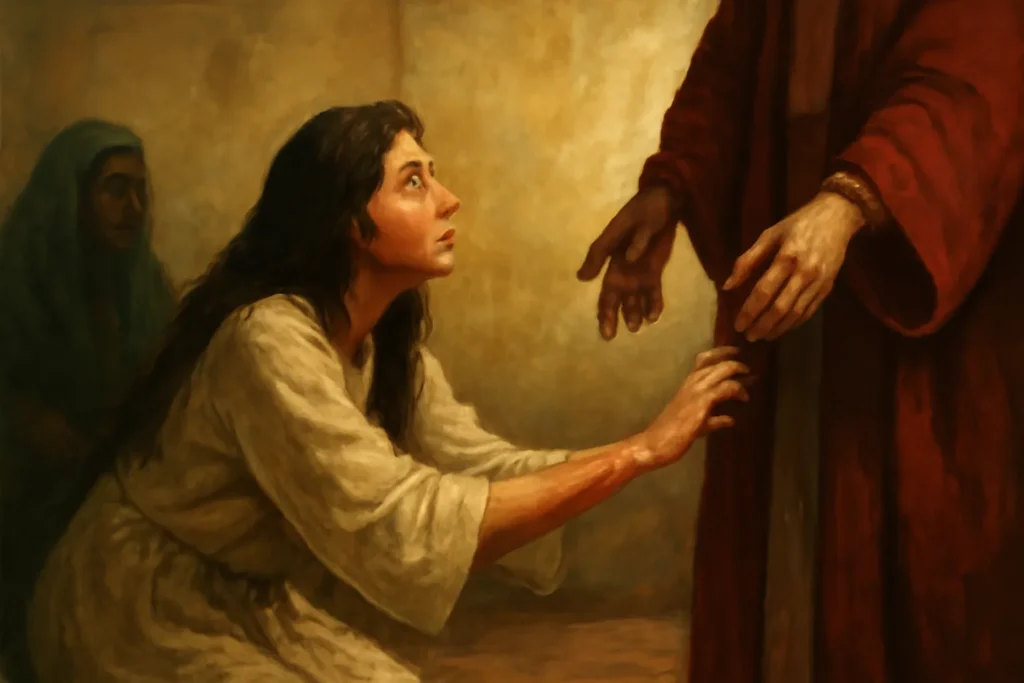
Mark 5:25-34: The bleeding woman had endured twelve years of suffering, had spent all she had on physicians, and had only grown worse. She touches Jesus’ cloak in the crowd, and Jesus notices that power went out from him. When questioned, she reveals herself, and Jesus declares, “Daughter, your faith has made you well. Go in peace and be healed of your disease.”
Matthew 9:20-22: The account highlights the woman’s faith and the crowd’s press around Jesus. The message to her is similar: “Take heart, daughter; your faith has healed you.”
Luke 8:43-48: Luke adds the note that no one could heal her, and emphasizes the tenderness of Jesus’ response: “Daughter, your faith has saved you; go in peace.” The scene underscores the intimate address “Daughter”—a term of kinship and inclusion rather than mere diagnosis.
Historical and cultural context: purity, law, and social distance
To understand the full weight of the narrative, it is essential to situate the bleeding woman within the ritual purity codes of the ancient Israelite law in Leviticus. A person with a bodily discharge was considered ritually impure, a status that carried practical consequences: such a person would be isolated from social and religious life, and contact with others could transfer impurity. The woman’s condition—fifteen or twelve years, depending on tradition—placed her in a social and religious margin. She had likely faced stigma, limitations on synagogue or temple participation, and the economic pressure of long-term illness.
Yet the Gospel writers illuminate a paradox at the heart of Jesus’ ministry: compassion disrupts ritual boundaries. By allowing a woman who would usually be kept at arm’s length (and a woman who is not named) to touch him, Jesus models a countercultural priority: human dignity and healing precede ritual concerns. The crowd’s response is telling—some may have been scandalized, but Jesus’ response is explicitly gracious: “Daughter, your faith has made you well.” The scene thereby reframes healing not as an achievement of religious ritual but as an act of divine mercy that recognizes and affirms the person’s humanity.
The narrative arc: faith, persistence, and healing
The arc of the story follows a recognizable pattern in many healing narratives within the Gospels: hope arises, obstacles appear, faith is tested, and healing occurs. For the bible woman with blood issue, the obstacles include years of illness, exhaustion from costly medical treatments, and the social barrier of public exposure. Her decision to seek Jesus, even from behind in the crowd, shows a form of bold faith that is both personal and practical. The act of touching Jesus’ garment is not mere superstition; it is a concrete gesture of trust—the conviction that even a small, tactile connection with the divine can unleash transformative power.
This narrative emphasizes that faith is action as much as belief. She does not wait for a formal invitation or for Jesus to call her forward; she takes a courageous step that demonstrates her hope. When Jesus asks, “Who touched my clothes?” the reply is not denial but confession, followed by a public affirmation: the healing is complete, and the person is restored. The phrase “your faith has made you well” is pivotal: healing is inseparable from the woman's trust in Jesus’ authority and benevolence.
The personal voice of the woman: vulnerability, faith, and boldness
The unnamed woman in the text offers a compelling example of resilience. The narratives present her not as a mere patient but as a person with a story and a voice. In many readers’ eyes, she embodies the experience of countless individuals who endure illness and social exclusion in silence, then discover the courage to seek help from a figure believed to carry hope. The moment of confession—“it was I who touched him”—is a turning point in the scene, transforming private pain into a public testimony of mercy. The Gospel writers deliberately preserve her anonymity to highlight a universal message: even those who are socially marginalized can become the recipients of divine attention and welcome.
Jesus’ response: compassion, affirmation, and healing power
The response of Jesus in this story is central to its theological impact. First, he acknowledges the reality of the healing event: power had gone out from him. Then he invites the woman into the light of encounter: “Who touched my clothes?” Finally, he offers a healing word that transcends the physical ailment: “Daughter, your faith has made you well. Go in peace.” The gentleness implicit in “Daughter” redefines the person’s identity from a stigmatized status to familial belonging. The closing blessing—“go in peace” or “go in God’s peace”—signals reconciliation with God and community, not merely the absence of symptoms.
This portrayal challenges readers to see healing as a holistic experience: body, mind, relationships, and worship life are all affected. The healing narrative invites a broader understanding of what it means to be made whole: restoration to health, to social inclusion, and to the sense that one is cherished by God.
Theological significance: faith as relation to God
The story foregrounds a simple, yet profound observation: faith in Jesus is the primary agent of healing, though not in a way that denies medical or practical concerns. The woman’s persistent hope—despite years of disappointment—intensifies the drama of the miracle. The Greek term for “your faith has healed you” is often understood as sozo, which can be rendered as “save” or “save and heal,” indicating a comprehensive restoration. In this sense, the healing is not only physical but relational: it reconstitutes the individual’s place within the covenant community and within God’s purposes.
Key terms and concepts
: trust in Jesus’ power and willingness to help, manifested in action.
: a holistic restoration that includes physical well-being, peace, and social reintegration.
: the reaffirmation of the woman's personhood beyond her illness and her status within the purity system.
: the compassionate response of Jesus that crosses cultural and legal boundaries.
Ritual purity vs. compassionate healing: a theological tension
One of the most striking features of the story is its challenge to purely ritual considerations when confronted with human need. The bleeding woman’s condition would have made her unclean, creating a barrier to public life and worship. Jesus’ willingness to engage with her—while she is still within the crowd—illustrates a theology in which compassion takes precedence over ritual purity. This does not dismiss the significance of purity laws; rather, it reveals that the divine intent behind those laws is to promote human flourishing, not to perpetuate exclusion or stigmatization.
Although the core event is consistent, each Gospel writer adds unique color and emphasis. The bleeding woman is a composite portrait drawn from different Gospel traditions, not a single biographical sketch. These variations allow readers to hear how early Christian communities understood healing, faith, and Jesus’ authority in slightly different ways. The Markan version stresses the dramatic moment when Jesus identifies the healer and pronounces healing in the presence of witnesses. The Matthew version foregrounds the faith of the woman as the decisive factor and emphasizes the compassionate response of Jesus through a direct address. The Luke account situates the event in a broader pattern of Jesus’ care for those marginalized by illness, gender, and status.
The woman’s identity and the power of a compassionate designation: “Daughter”
Across translations, one term stands out: “Daughter”. This address is more than a term of familial relation; it is a theological claim about belonging. In a world that often defined persons by ritual status or medical condition, Jesus’ use of this intimate designation redefines the bleeding woman as part of the family of God. The effect is both personal and ecclesial: it models a church that welcomes marginalized voices, preserves their dignity, and invites them to live in peace and purpose.
Lessons for today: applying the story to faith communities
The biblical portrait of the hemorrhaging woman offers several practical lessons for contemporary faith communities:
Practical applications for sermons, Bible study, and pastoral care
In sermons, invite listeners to reflect on how faith engages with practical life—health, finances, and social belonging—without reducing faith to a formula.
In Bible study groups, compare the three Gospel accounts to appreciate diversity in witness while preserving the core message of healing and inclusion.
In pastoral care, affirm the dignity of people facing chronic illness, offering both spiritual nurture and practical support.
The healing narrative invites readers to hold two realities together: that pain and fragility exist in the human condition, and that God’s power is not distant from human suffering. The story does not insist that every ailment will be cured in every instance, but it does affirm that faith, when directed toward Christ, opens a channel of divine grace into human life. For many believers, the idea of peace—a sense of restored harmony with God and others—becomes a central feature of healing that outlives physical symptoms.
In modern ministry contexts, this translates into an approach that blends spiritual direction with thoughtful care for physical health. Churches can cultivate spaces where people can share their burdens, receive prayer, and access practical resources, while also preserving the dignity of each person, including women, men, and children who carry the weight of illness or social stigma.
Broader biblical and theological implications
The figure of the bleeding woman contributes to a broader biblical narrative about God’s plan for healing and inclusion. It foregrounds the idea that God’s mercy extends to the vulnerable, and that the coming of the Messiah inaugurates a new era in which ritual barriers are reinterpreted through the lens of compassion. The story resonates with other healing narratives in the Gospels—where faith, mercy, and Jesus’ authority reveal the in-breaking of God’s kingdom and invite adherents into a new way of living together in peace.
Conclusion: the enduring message of the Bible woman with blood issue
The tale of the Woman with the Issue of Blood remains a powerful witness to the interplay of faith, healing, and inclusion in the Christian tradition. By focusing on a woman who endured years of hardship, the Gospel writers invite readers to see healing as more than relief from symptoms: it is a restoration of personhood, a redefinition of belonging, and a revision of what counts as holy touch. In a world that continues to wrestle with illness, stigma, and separation, this narrative offers a compact, enduring invitation: approach with courage, trust in God’s mercy, and accept the transformative welcome that Christ extends to every “daughter” in need.
As scholars and faith communities reflect on this bible woman with blood issue, let the story encourage ongoing conversation about devotion, community care, and the ways faith can become a living bridge between suffering and healing. The unnamed woman’s courage is a reminder that the smallest acts of faith—reaching out in a crowd, pressing toward the one who offers mercy—can yield profound outcomes: not only a cure, but a renewed sense of place in God’s family and a renewed sense of purpose in one’s life.








Leave a Reply