Chaplain Salary by State: Average Pay Across U.S. States
Chaplain Salary by State: Average Pay Across U.S. States
This article provides a comprehensive look at chaplain salaries by state, offering an overview of the average pay you can expect across the United States. While the figures vary by setting—hospitals, prisons, military facilities, hospices, churches, and university or secular organizations—the data below highlights broad patterns in compensation for professional chaplains. Readers should consider factors such as education level, professional credentials, experience, and cost of living when interpreting these ranges. The goal is to equip job seekers, HR professionals, and students with a clear sense of how chaplain earnings differ from state to state and what tends to drive those differences.
What determines chaplain compensation across states
Salary levels for chaplains are shaped by several intertwined factors. Understanding these elements helps explain why average pay varies across state lines and why even within a state you might see different compensation in different settings.
Geographic cost of living: States and metropolitan areas with higher living costs often offer higher salaries to attract qualified chaplains, but the real purchasing power may be affected by housing costs, taxes, and local prices for goods and services.
Employment sector: Salaries in hospitals, academic institutions, corrections facilities, or military installations can diverge substantially. Hospital chaplains often earn more than those in small church settings or volunteer roles, due to patient-facing responsibilities and organizational budgets.
Education and credentials: Holding advanced ministry degrees (for example, a Master of Divinity) and credentials from professional bodies (such as ACPE, NACC, or ABHE certifications) commonly correlate with higher pay bands and leadership roles.
Experience and seniority: Longer tenure, leadership responsibilities (like clinical pastoral education supervision), and specialized units (oncology, ICU, palliative care) typically command higher compensation.
Work setting and shift patterns: Night shifts, weekend coverage, and after-hours on-call duties often come with additional stipends or higher hourly rates in some organizations.
Public vs private sector: Government and large nonprofit systems may offer more standardized pay scales, while smaller faith-based organizations might rely on grant funding and donations, influencing salary stability and growth.
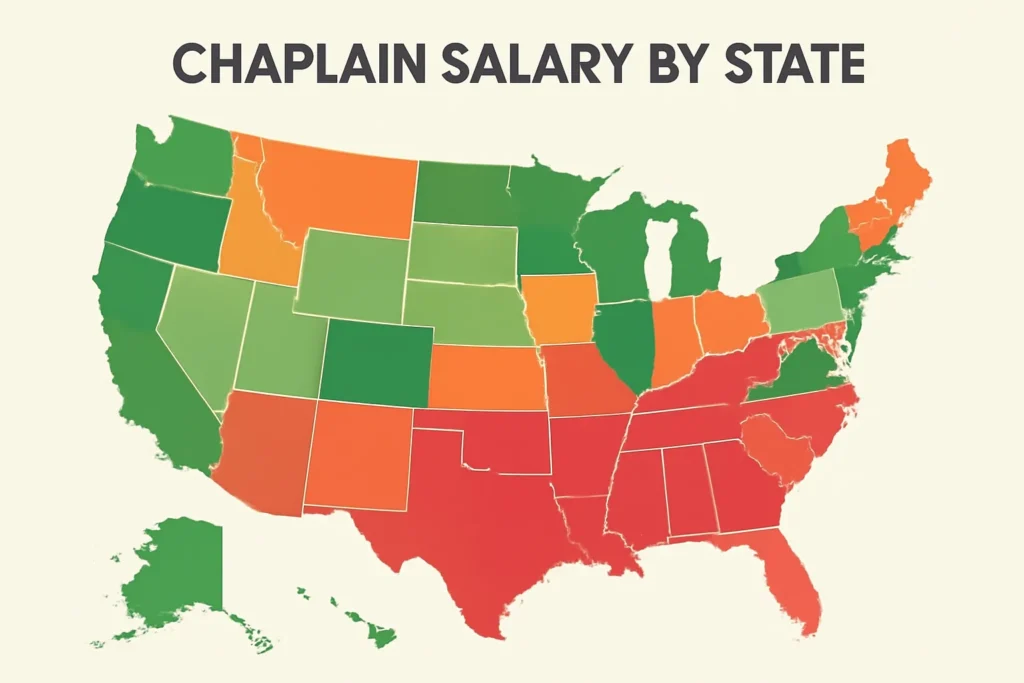
State-by-state snapshot: average pay across U.S. states
Below is a regional snapshot that aggregates typical annual salary ranges for professional chaplains. The ranges reflect common configurations—full-time, institutional chaplains working in hospitals, prisons, universities, hospice care, or large faith-based organizations. Use these as a guide, not a guarantee, and consider local market conditions and specific employer policies.
Northeast
New York: estimated annual salary range around $70,000–$95,000, with a median near $80,000. Higher end often found in major urban hospital networks and teaching hospitals; rural areas may fall toward the lower end.
New Jersey: typically $65,000–$90,000, with urban systems and academic medical centers tending toward the higher end; rural facilities may be at the lower end.
Massachusetts: common range $68,000–$92,000, with experience and specialty units (oncology, behavioral health) pushing pay upward.
Pennsylvania: ranges often around $57,000–$77,000, though large academic medical centers can exceed this in metropolitan markets.
Connecticut: typically $60,000–$90,000, with notable variation by city and hospital system.
Rhode Island: commonly $58,000–$82,000, higher in coastal health networks and regional medical centers.
Maine: generally $50,000–$68,000, with smaller institutions often paying toward the lower end.
New Hampshire: ranges around $56,000–$78,000, with urban hospitals on the higher side.
Delaware: commonly $58,000–$80,000, where hospital and university settings influence the upper limits.
Midwest
Illinois: often $62,000–$84,000, with Chicago-area facilities frequently paying toward the top of the range.
Michigan: typically $55,000–$76,000, with higher salaries in major medical centers and academic hospitals.
Ohio: ranges commonly $54,000–$74,000, with urban networks offering more competitive compensation.
Indiana: usually $52,000–$70,000, with variation by system size and location.
Wisconsin: around $54,000–$77,000, supported by robust healthcare facilities in Milwaukee, Madison, and larger networks.
Minnesota: commonly $60,000–$82,000, with Twin Cities hospitals often near the upper end.
Missouri: typically $52,000–$73,000, with higher ranges in St. Louis and Kansas City medical systems.
Iowa: usually $50,000–$68,000, with variations by facility size and urban proximity.
Nebraska: ranges about $52,000–$70,000, influenced by hospital network scale.
Kansas: commonly $54,000–$72,000, with metropolitan areas offering relatively higher pay.
North Dakota: typical range $50,000–$70,000, larger facilities paying toward the top end.
South Dakota: often $48,000–$66,000, with rural communities tending toward the lower end.
South
Texas: ranges frequently $50,000–$72,000, with major hospital systems near urban centers reaching higher figures.
Florida: commonly $54,000–$78,000, where large academic medical centers and hospice operations can push toward the upper end.
Georgia: typically $53,000–$74,000, with variation by region and facility type.
North Carolina: ranges around $54,000–$78,000, with Raleigh-Durham and Charlotte markets often at the higher end.
South Carolina: usually $50,000–$70,000, with higher pay in larger health systems and urban campuses.
Virginia: commonly $56,000–$79,000, with coastal and northern regions often paying toward the top of the range.
North Carolina (duplicate note above, kept for clarity): ranges around $54,000–$78,000.
Tennessee: typically $50,000–$70,000, with higher pay in major hospital networks and research institutions.
Alabama: commonly $48,000–$66,000, with urban health systems offering more opportunities for advancement.
Mississippi: often $46,000–$64,000, particularly in smaller communities and rural settings.
Kentucky: ranges around $50,000–$69,000, with larger teaching hospitals spanning the higher end.
Louisiana: typically $50,000–$68,000, shaped by urban hubs like New Orleans and Baton Rouge.
West
California: widely reported ranges $68,000–$100,000, with major medical centers and university systems driving the top end.
Washington: commonly $60,000–$86,000, with Seattle-area facilities often at the higher end.
Oregon: ranges around $60,000–$85,000, reflecting strong hospital networks and private hospitals in urban regions.
Arizona: typical range $54,000–$78,000, with growth in larger healthcare systems in Phoenix and Tucson.
Colorado: commonly $60,000–$85,000, boosted by high concentrations of medical centers in Denver and Boulder.
New Mexico: ranges about $50,000–$70,000, with opportunities in Albuquerque metro and rural health facilities.
Nevada: often $56,000–$78,000, particularly in Reno and Las Vegas hospital networks.
Utah: typically $54,000–$77,000, with pay tied to regional medical centers and university settings.
Hawaii: ranges around $60,000–$90,000, with cost of living considerations but strong demand in local health systems.
Alaska: commonly $60,000–$82,000, reflecting remote locations and state facilities with unique needs.
Northwest and Mountain states (general): often $50,000–$75,000, with urban centers at the higher end and rural posts at the lower end.
How sector and credentialing influence compensation
Beyond the broad regional patterns, the sector you work in and your professional credentials can meaningfully affect take-home pay. Here are key considerations for job seekers aiming to optimize compensation while advancing in the chaplain profession.
Hospital chaplains often command higher salaries than hospice or small church-based chaplaincy roles, thanks to larger budgets, more complex clinical teams, and patient-care responsibilities.
Clinical pastoral education (CPE) graduates and those with board certification or recognized credentials may qualify for leadership roles such as supervisor or program director, which typically brings higher pay bands.
Military chaplains and those in federal or state facilities frequently operate within structured pay scales that incorporate allowances for postings, housing stipends, and security clearances.
Educational credentials—a Master of Divinity (M.Div.) or equivalent, plus clinical or health-care specialization—tend to correlate with higher starting salaries and faster salary growth in many systems.
Experience and specialty areas (palliative care, mental health integration, spiritual care in ICU, pediatrics, or oncology) can push compensation upward due to demand for specialized skills.
Practical guide for maximizing chaplain earnings by state
If you are evaluating a career path or negotiating a chaplain salary in a specific state, consider these practical steps. They can help you align your qualifications with state and employer expectations and optimize your overall compensation package.
Research regional job markets: Look at hospital systems, university medical centers, correctional facilities, and hospice providers in your target state to gauge typical salary bands for your role.
Build credentials: Pursue formal clinical training (CPE), supervision, and credentialing through recognized organizations to access higher-paying roles.
Plan strategically for location: In high-cost areas (for example, parts of the Northeast and West Coast), salaries may be higher, but adjusting for cost of living is essential to assess real value.
Explore multiple settings: If you can work in a larger health system, a university setting, or a correctional system, you can diversify income potential and benefits.
Negotiate comprehensively: In addition to base pay, discuss shift differentials, on-call stipends, health benefits, retirement plans, and paid time off, which can significantly affect total compensation.
Cost of living and its impact on chaplain pay
One important caveat when comparing chaplain salaries by state is the impact of cost of living. Two states may report similar salary ranges, yet the real purchasing power can differ markedly due to housing, taxes, and everyday expenses. Regions with high living costs—such as coastal urban centers or major metro areas—may offer higher nominal salaries but offset those gains with higher rent and housing prices. Conversely, states with a lower cost of living can yield strong purchasing power even if the nominal salary is lower. When evaluating a job offer, job seekers should calculate a rough cost-of-living adjustment to understand how far their salary will stretch in practice.
Common questions about chaplain pay by state
Which state pays chaplains the most? Overall, coastal states with large medical centers and academic hospitals—such as parts of New York, California, and Massachusetts—tend to offer higher salary ranges, especially for experienced professionals in specialized units.
Do church-based chaplains earn less than hospital chaplains? In many cases, yes, because hospital positions are typically funded through hospital budgets and may offer larger benefits packages. However, some large church organizations or interfaith networks can offer competitive compensation, particularly for lead chaplains or those overseeing multiple campuses.
How does credentialing affect earnings? Credentials and advanced training often open doors to leadership roles and specialized units, which tend to come with higher pay bands and faster advancement potential.
What role does experience play across states? Experience is a strong predictor of salary in any state, with senior chaplains and those who supervise interns or CPE programs commanding higher wages than entry-level colleagues.
Regional patterns reflect urban density, hospital networks, and local cost of living, with higher nominal salaries in dense metropolitan areas.
Settings matter: Health care systems and universities typically offer more robust compensation than standalone faith-based ministries in smaller communities.
Credentials pay off: Investment in advanced education and clinical training often translates into higher earning potential and leadership opportunities.
Cost of living should be considered: A higher salary in one state may not equate to greater purchasing power once housing costs and taxes are taken into account.
For students and early-career chaplains, the ideal path to a competitive salary typically combines formal chaplaincy education, accredited clinical training (CPE), and strategic job choices in higher-paying regions or larger institutions. For experienced chaplains, expanding into supervisory roles, program development, or specialty units can yield meaningful salary growth across states. Whether you are researching the best state to pursue chaplaincy or negotiating a job offer, this guide aims to provide a solid framework for understanding the average pay across U.S. states and the variables that shape those figures.
Note: The salary ranges above are intended to offer a useful, high-level view of trends in chaplain compensation. They should be used in conjunction with local market data, employer-specific pay scales, and current job postings. Readers seeking precise figures should consult regional salary surveys, hospital HR departments, professional associations (such as ACPE, NACC, and ABHE), and current job postings to obtain the most up-to-date numbers for their target state and sector.











Leave a Reply