History of Evangelical Christianity: Origins, Growth, and Global Influence
History of Evangelical Christianity: Origins, Growth, and Global Influence
The history of evangelical Christianity is a long arc that begins with reformational currents, moves through revival movements that awakened vast numbers of believers, and expands into a global network of churches, mission societies, seminaries, and media enterprises. This article traces the origins, maps the growth, and surveys the global influence of evangelical Christianity as it is understood in contemporary discourse. Along the way we will encounter a variety of expressions and labels—evangelical Protestantism, evangelical revivalism, born-again faith, neo-evangelicalism—and we will note how historians have described different phases of a movement that has repeatedly redefined its priorities in response to social change, theological debate, and cross-cultural contact.
Origins and early formation of an evangelical identity
The word evangelical derives from the Greek euangelion, meaning “good news” or “gospel.” But the modern usage of the term crystallized only in the context of centuries of Christian history. In the Protestant Reformation, reformers emphasized the authority of Scripture, the centrality of the gospel, and the need for personal faith. In that broader milieu, groups and individuals began to articulate a shared concern with biblical authority, personal conversion (often framed as a “born again” experience), and a mission-centered life oriented toward proclaiming the gospel to others.
Protestant roots: Reformers such as Luther, Calvin, and their heirs foregrounded the sufficiency of Scripture and the necessity of personal faith, laying groundwork that later generations would connect with revival movements.
pietism and renewal: In German-speaking lands and beyond, Pietist leaders like Philipp Jakob Spener and August Francke emphasized heartfelt religion, *lay involvement*, and the practical outworking of faith, influencing later evangelical sensibilities.
Anglican gravity: In Britain and the Atlantic world, Anglican ministers and laypersons fostered a climate in which evangelical fervor could flourish, particularly as evangelical preaching and mission-minded preaching reached broader audiences.
A distinctive evangelical identity began to take shape in the 17th and 18th centuries through networks of preachers, societies, and lay reformers who prioritized three core emphases: the authority of Scripture, the necessity of personal conversion, and the task of evangelism. These emphases did not emerge in a single moment but rather coalesced over time as different reformers, revivalists, and missionaries articulated a shared sense that the gospel had transformative power for individuals and communities alike.
The Great Awakening and the making of evangelical identity
The term Great Awakening refers to a series of revival movements in the 18th and early 19th centuries that swept across British North America and the British Atlantic world. These awakenings are often cited as a watershed in the formation of evangelical culture because they popularized mechanisms of revival, emphasized personal experience, and nurtured a new generation of evangelical leaders.
First Great Awakening (c. 1730s–1740s)
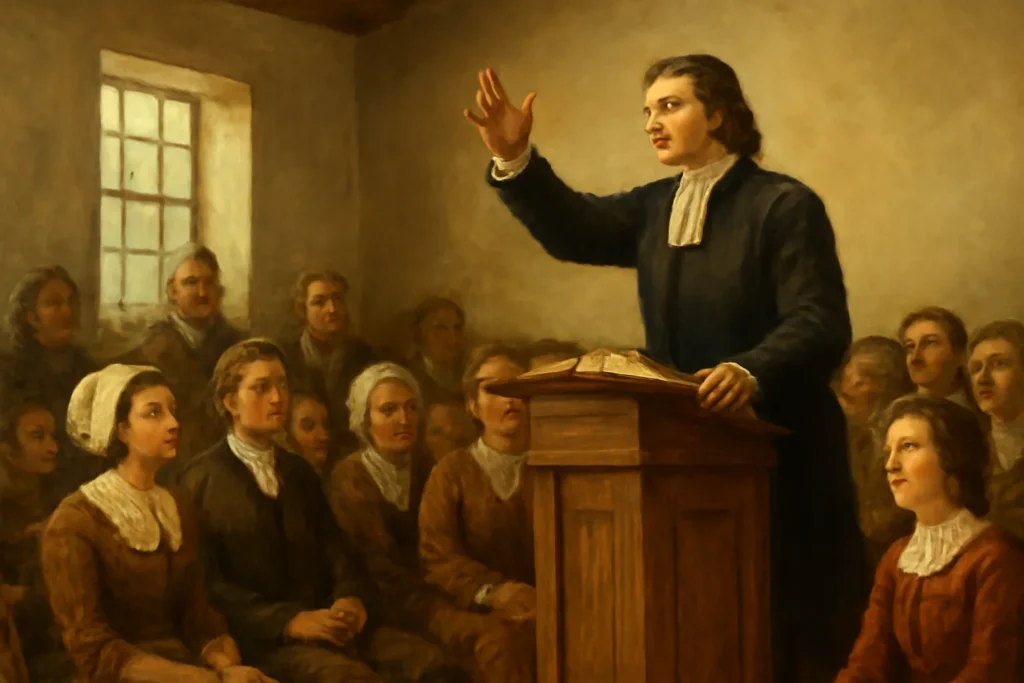
In colonial America, awakening preachers such as Jonathan Edwards and George Whitefield drew crowds with sermons about sin, grace, and the need for personal repentance. Edwards stressed the inward work of grace and the certainty of salvation for those who believed, while Whitefield’s itinerant preaching made evangelical discourse public and accessible to many who had not previously engaged with church life. The revival was characterized by emotional preaching, revival meetings, and a broader culture of religious conversation that crossed denominational lines.
Second Great Awakening (c. 1800s)
The Second Great Awakening intensified and broadened evangelical influence in the United States. It produced new denominations and reform movements—temperance, abolition, and mission societies—that linked personal conversion to social change. Preachers such as Charles Grandison Finney emphasized the possibility of personal transformation, while a wave of camp meetings and revival circuits created ongoing cycles of conversion and renewal.
The Great Awakenings also helped institutionalize evangelical activism—a recurring pattern in which preaching, education, and organized mission went hand in hand. They supported the idea that individuals could be moved to faith, and that communities could be shaped by a shared gospel-centered life. In addition, the awakenings contributed to the emergence of evangelical publishing and a proliferation of devotional literature that spread quickly through penny press and early print networks.
Key figures such as Edwards and Whitefield demonstrated how preaching, theology, and revival could coexist with a robust active public presence.
New forms of evangelical ministry, including itinerant preaching and revival circuits, helped distribute evangelical ideas across regions and social strata.
The awakenings laid groundwork for a transatlantic missionary ethos that would later fuel global outreach.
19th century: expansion, institution-building, and transnational missions
The nineteenth century witnessed rapid growth of evangelical networks, the founding of mission societies, and the translation and dissemination of religious literature on an unprecedented scale. This era saw evangelical Christianity mature into a global movement with institutional depth, including seminaries, missionary boards, publishing houses, and voluntary associations that mobilized many laypeople for service.
Institutional expansion and the missionary impulse
The combination of religious zeal and organizational savvy produced a robust missionary movement that sought to reach peoples and nations beyond Europe and North America. Missionary societies created training programs for missionaries, established schools and clinics, and funded translations of the Bible and literacy programs for new readers of the Gospel.
William Carey and the first long-term commitments to overseas missions in places like India became emblematic of a broader push to bring the gospel to diverse cultures.
Translation work and literacy programs often accompanied missionary activity, with a focus on producing access to Scripture in local languages.
Evangelical print culture expanded through periodicals, tracts, and books that circulated across oceans, reinforcing a shared sense of purpose.
In addition to mission work, evangelical leaders emphasized social reform as part of a robust gospel witness. Debates about education, temperance, abolition of slavery, and the role of religion in public life reinforced a conviction that the gospel should inform both private faith and public action.
20th century transformations: fundamentalism, neo-evangelicalism, and media
The twentieth century brought intense debate within evangelical circles, most notably the fundamentalist-modernist controversy of the 1920s and 1930s. This era exposed divergent approaches to biblical interpretation, science, and culture. In response, a broader strand of evangelicalism emerged—often called neo-evangelicalism—that sought to engage culture more openly, emphasize gospel proclamation, and cooperate across denominations.
The fundamentalist movement and its influence
The fundamentalist movement rallied around defending a set of core doctrines—scriptural inerrancy, the virgin birth, the atonement, and the future return of Christ—against perceived liberal reinterpretation. This period produced distinctive publishing, preaching styles, and institutional forms that continued to influence evangelical life for decades. While some fundamentalists separated from secularized culture, others sought cooperation with broader evangelical efforts.
Mass media, crusades, and the rise of the public evangelist
From the mid-20th century onward, mass media became a powerful tool for evangelism. The era of radio and television gave rise to household names whose messages reached millions. Prominent figures such as Billy Graham organized large-scale crusades, produced radio programs, and helped shape a public-facing, culturally engaged form of evangelicalism. This period helped shift evangelical identity toward a more centralized public presence and a strategy that combined preaching with media savvy.
Use of evangelical media networks enabled rapid dissemination of sermons, testimonies, and influence on public discourse.
Crusades and open-air campaigns created mass experiences of conversion that reinforced a shared language of faith across diverse communities.
Institutional growth included seminaries, publishing houses, and para-church organizations that strengthened evangelical infrastructure.
Global expansion and the demographic shift of influence
In the latter half of the 20th century and into the 21st, the center of gravity for evangelical Christianity shifted decisively toward the Global South. Growth in Africa, Latin America, Asia, and parts of Oceania led scholars to describe evangelicalism as a truly global phenomenon rather than a Western import. Local contexts, languages, and cultural norms shaped distinctive forms of evangelism while preserving shared convictions about biblical authority, conversion, and mission.
Across the world, evangelical networks engaged in education, health care, social services, and civic life, often partnering with local churches and international agencies. In many places, evangelical churches became central community hubs, offering leadership development, literacy programs, and disaster relief. The rapid growth of churches and denominations in the Global South has also influenced debates about theology, worship styles, and political engagement within the broader evangelical family.
In Africa and Latin America, megachurches and networks of congregations expanded rapidly, blending local musical traditions with evangelical preaching.
In Asia and the Pacific, revival movements, Bible study networks, and missionary training centers contributed to diverse expressions of the faith while maintaining shared doctrinal anchors.
The global mission movement often emphasized local leadership and contextualization of the gospel, encouraging collaboration among churches across borders.
Culture, politics, and the evangelical public square
Evangelical Christianity has interacted with politics, education, and culture in complex ways. In some contexts, evangelical networks have pursued social transformation through policy advocacy, humanitarian relief, and grassroots organizing. In others, they have prioritized purely spiritual growth and church life. The balance between evangelism as personal transformation and evangelism as social action has been a persistent feature of debates within the movement.
Entrenchment and reform within public life
As evangelical communities grew in public prominence, debates over the relationship between faith and public life intensified. Some leaders argued for a distinctively Christian public square, while others advocated for a more separationist approach that kept church affiliation separate from state policy. These tensions manifested in education policy, media ethics, and responses to social issues, with evangelicals often claiming to uphold moral witness without endorsing a single political platform.
Education, social services, and justice initiatives
Evangelical organizations historically invested in education, literacy, medicine, and relief work. In many regions, church-affiliated schools and hospitals became essential community resources. Some movements linked evangelism to social justice concerns, including care for the poor, advocacy for human rights, and relief during times of crisis. The result has been a diversified portfolio of activities in which spiritual formation sits alongside social impact.
Contemporary trends: diversity, digital evangelism, and ecumenical horizons
In the contemporary era, evangelical Christianity demonstrates remarkable diversity in theology, worship, practice, and organizational form. Digital technology, global travel, and cross-cultural partnerships have enabled unprecedented connectivity while also presenting challenges related to authenticity, accountability, and the integrity of mission.
Digital evangelism and transnational networks
The emergence of online ministries, streaming sermons, and social media outreach has transformed how the gospel is communicated and how communities are built. Digital platforms can expand reach to remote audiences, enable rapid response in times of crisis, and facilitate international collaboration among churches and mission groups. Yet they also raise questions about spiritual discernment, digital ministry ethics, and the quality of online discipleship.
Global evangelicalism now operates in a pluralistic world where different theological streams, worship styles, and cultural norms intersect. Some communities emphasize confessional precision and historical creeds, while others prioritize experiential faith and contextualized proclamation. The ongoing negotiation involves how to maintain unity around core gospel essentials while respecting local expressions of faith.
Multiethnic churches and leadership development
As demographics shift, multiethnic congregations and leadership pipelines have become more common. This trend invites careful attention to issues such as racial justice, intercultural communication, and the equitable distribution of opportunities within church structures. Across regions, leaders are developing training, mentorship, and governance models designed to reflect broader participation while preserving theological coherence.
Key figures, institutions, and cultural artifacts that shaped a movement
Across the centuries, certain figures, institutions, and cultural artifacts became iconic within evangelical history. While no single list can capture every contributor, the following elements illustrate the architecture of the movement:
Preachers and revivalists whose oratorical skills and spiritual claims mobilized wide audiences—figures such as Edwards, Whitefield, Wesley, and Graham represent different epochs but a shared commitment to gospel proclamation.
Missionary societies and bible societies that organized foreign and domestic evangelism, produced translations, and funded education and community development.
Religious publishing networks, tracts, devotional literature, and periodicals that created a shared lexicon of faith and made doctrine accessible to lay readers.
Academic and para-church institutions such as seminaries, colleges, and organizations focused on evangelism, youth ministry, and welfare initiatives that shaped praxis and leadership.
Challenges, criticisms, and ongoing conversations
The history of evangelical Christianity has not been without difficulties. Critics have questioned the legacy of mission work in relation to colonialism, the balance between evangelism and social responsibility, and the ways that church power has interacted with political authority. Inside evangelical circles, debates continue about biblical interpretation, gender roles, cultural engagement, and the pace of change in worship practices. Proponents argue that a robust gospel invites reform from within, while critics caution against overwhelming cultural assimilation that risks losing doctrinal core.
Despite these tensions, the trajectory of evangelical Christianity over the centuries shows a persistent pattern: a commitment to biblical authority, a dynamic vision for personal conversion, and a strong emphasis on evangelism and mission that seeks to reach diverse peoples with the message of the gospel. The global footprint—through churches, missions, educational institutions, and humanitarian networks—illustrates how a religious movement rooted in a particular set of beliefs can adapt to, influence, and be shaped by a wide array of cultural contexts.
In closing, the history of evangelical Christianity can be read as a story of renewal, adaptation, and resilience. It is defined not only by doctrinal summaries but also by the lived experiences of believers who, across generations, have understood the gospel as news that changes lives, families, communities, and nations. From the first stirrings of reform and revival to the present-day transnational networks, evangelical Christianity remains a moving, contested, and publicly visible facet of world Christianity.









Leave a Reply