John 20 and 21 record what happened after Jesus rose from the dead. John 20 centers on the empty tomb, Jesus’ appearances to Mary Magdalene and the disciples, Thomas’s response, and the Gospel’s purpose: that readers may believe Jesus is the Messiah and have life through him. John 21 then shows the risen Jesus meeting seven disciples by the Sea of Galilee, restoring Peter, and clarifying the difference between Peter’s calling and another disciple’s path.
Together, these chapters move from confusion to recognition, from fear to peace, and from failure to renewed service. They do not present resurrection faith as a vague feeling. They connect faith to the testimony of witnesses, Jesus’ bodily presence, the disciples’ mission, forgiveness, and the continuing work of following him.
John’s Gospel has been building toward the death and resurrection of Jesus. Earlier chapters identify Jesus as the Word who became flesh, the Lamb of God, the source of living water, the bread of life, and the good shepherd. His crucifixion appears to bring his public ministry to an end, but John 20 announces that death did not have the final word.
John 20 supplies the central resurrection witness, while John 21 functions as a personal and communal epilogue. The final chapter is not a detached story added for decoration. It shows how disciples who have seen the risen Jesus must live afterward: they work, listen, receive provision, serve others, and follow Christ even when they do not know what lies ahead.
Central idea: John 20 emphasizes that Jesus is risen and worthy of faith; John 21 shows what faithful discipleship looks like after the resurrection.
A step-by-step breakdown of John 20 and 21
Mary Magdalene finds the tomb open. She sees that the stone has been removed and reports the discovery to Simon Peter and the beloved disciple.
Peter and the beloved disciple inspect the tomb. They find the burial cloths, but they do not yet understand fully what Jesus’ resurrection means.
Jesus appears to Mary. He calls her by name, and she recognizes him. He commissions her to tell the disciples that he is ascending to the Father.
Jesus appears to the gathered disciples. He gives them peace, shows them his wounds, and sends them as the Father sent him.
Jesus speaks about the Holy Spirit and forgiveness. The disciples receive a mission involving the announcement of forgiveness and the serious recognition of sin.
Thomas encounters the risen Jesus. Jesus meets Thomas’s doubts with evidence and calls him toward faith.
John states the purpose of his Gospel. The signs were recorded so readers may believe Jesus is the Messiah, the Son of God, and receive life through that faith.
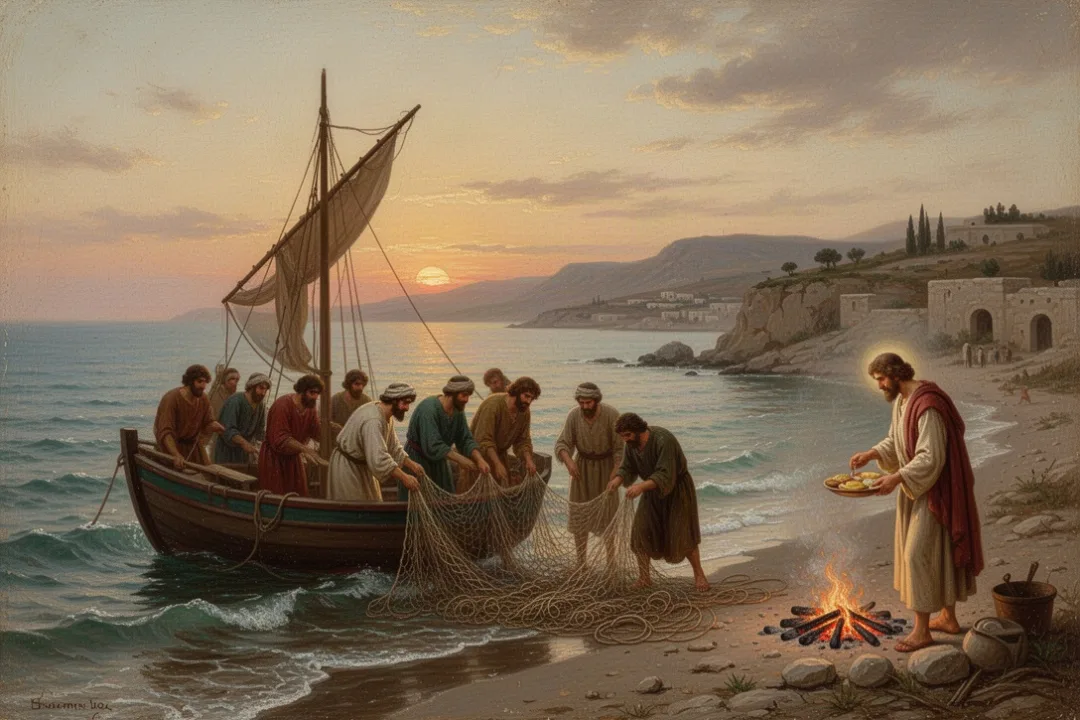
Jesus appears beside the Sea of Galilee. The disciples catch nothing during a night of fishing until Jesus directs them to cast the net again.
Jesus feeds the disciples. He prepares bread and fish, creating a setting of fellowship and provision.
Jesus restores Peter’s calling. Three questions about Peter’s love lead to three commands to care for Jesus’ sheep.
Jesus corrects Peter’s concern about another disciple. Peter is told to follow Jesus rather than compare his future with someone else’s.
The Gospel closes with a witness to its reliability. The beloved disciple is presented as the source of testimony, while the abundance of Jesus’ works is affirmed.
What happens at the empty tomb in John 20
John begins the chapter with Mary Magdalene coming to the tomb early, while it is still dark. She sees the stone removed and assumes that someone has taken Jesus’ body. Her first response shows that the empty tomb by itself does not immediately produce complete understanding; she needs further revelation before she recognizes the resurrection.
Mary runs to Simon Peter and the disciple whom Jesus loved. The two men go to the tomb, with the other disciple arriving first and Peter entering before him. They observe the linen burial cloths and the separate cloth associated with Jesus’ head. The scene is orderly rather than chaotic, and the beloved disciple sees and believes, although the disciples still have not grasped everything Scripture says about resurrection.
The account gives attention to physical details: the stone, the tomb, the burial cloths, and the location where Jesus had been laid. John is presenting a claim about an event, not merely describing an inspiring spiritual experience. At the same time, the disciples’ understanding develops gradually, which makes their responses more human and more historically textured.
Why Mary Magdalene recognizes Jesus when he calls her
After Peter and the beloved disciple return home, Mary remains near the tomb, grieving. She sees two angels inside, then turns and sees Jesus without initially knowing who he is. She mistakes him for the gardener until he says her name. Recognition comes through a personal address that connects the risen Jesus with the teacher she knew before the crucifixion.
Mary’s encounter carries several important meanings. First, Jesus is not a stranger or an impersonal force; he remains the same person who knows his followers. Second, grief can limit what a person is able to perceive, even when the evidence is directly before them. Third, Jesus gives Mary a message for the disciples, making her the first witness in John’s resurrection narrative.
Jesus tells Mary not to hold on to him in the way she may have wanted. He is not simply returning to ordinary life with his followers. His resurrection begins a new stage in which he will ascend to the Father, and his relationship with the disciples will be shaped by the promised Spirit and by faith.
What Jesus means when he gives the disciples peace
Jesus appears to the disciples while they are behind locked doors because they fear the authorities. His first word is a greeting of peace. This is more than politeness. In John’s Gospel, Jesus has already promised his followers peace in the midst of trouble, and his resurrection appearance demonstrates that fear does not control the future of the community.
Jesus then shows his hands and side. The risen Jesus is continuous with the crucified Jesus: the wounds are not erased from the story. His glorified life does not deny his suffering; it reveals that suffering and death have been overcome. The disciples rejoice because they recognize him and understand that the one who was killed is alive.
Jesus sends them as the Father sent him. The mission of the disciples therefore comes from Jesus’ own mission, not from personal ambition. They are to carry his witness into the world with the authority and purpose they have received from him.
How John 20 describes the Holy Spirit and forgiveness
Jesus breathes on the disciples and tells them to receive the Holy Spirit. The action recalls the biblical image of God giving life through breath. John presents the disciples’ mission as dependent on divine life and power rather than on their own courage or intelligence.
Jesus then speaks about forgiving and retaining sins. This statement has been interpreted in different ways among Christian traditions, but its basic setting is clear: the disciples are entrusted with announcing and applying the message of reconciliation under Jesus’ authority. Their task is not arbitrary personal judgment. It is connected to the truth about Jesus and to the response people make to that truth.
Reading note: The peace, mission, Spirit, and forgiveness in John 20 belong together. Jesus does not merely comfort frightened disciples; he prepares them to represent him faithfully.
What Thomas teaches about doubt and faith
Thomas is absent when Jesus first appears to the gathered disciples. When they tell him that they have seen the Lord, he responds by saying that he needs to see and touch the marks of crucifixion before he will believe. John does not soften Thomas’s words, but neither does he reduce Thomas to a permanent unbeliever.
Eight days later, Jesus appears again when Thomas is present. He invites Thomas to examine the evidence he requested. Jesus does not shame him for asking; instead, he meets him in the place of uncertainty and calls him to faith. Thomas responds with a direct confession, addressing Jesus as “my Lord and my God”—a statement John places near the end of his Gospel to reinforce Jesus’ divine identity.
The passage also addresses later readers who will not have the same physical encounter. Jesus pronounces blessing on those who believe without seeing him in the manner Thomas did. This does not mean faith is irrational or detached from testimony. John has just emphasized eyewitness evidence, written testimony, signs, and the trustworthy witness of the disciples.
Thomas therefore represents more than a warning about doubt. His story shows that honest uncertainty can be brought to Jesus, that evidence matters, and that faith ultimately involves entrusting yourself to the identity of the risen Christ. The passage does not promise that every question will disappear before belief becomes possible.
Why John states the purpose of his Gospel in John 20:30-31
John explains that Jesus performed many other signs in the presence of his disciples that are not recorded in the book. The signs included in the Gospel have been selected for a purpose. They are meant to lead readers to believe that Jesus is the Messiah and the Son of God, and that believing readers may have life in his name.
This statement helps you read both John 20 and the entire Gospel. The chapters are not simply a complete diary of every post-resurrection event. They are a carefully shaped testimony. Each scene contributes to John’s larger purpose of revealing who Jesus is and showing what comes through faith in him.
The word life is especially significant in John. It refers to more than continued biological existence. Throughout the Gospel, life is associated with knowing God through Jesus, receiving spiritual nourishment, living in the light, and sharing in the relationship Jesus has with the Father. Resurrection makes this life possible because Jesus himself has passed through death and lives again.
What happens during the breakfast by the Sea of Galilee
John 21 opens with several disciples at the Sea of Tiberias, also called the Sea of Galilee. Simon Peter, Thomas, Nathanael, the sons of Zebedee, and two other disciples are together. Peter says he is going fishing, and the others join him. They work through the night but catch nothing.
At daybreak, Jesus stands on the shore, although the disciples do not recognize him at first. He asks whether they have any fish and directs them to cast the net on the right side of the boat. The catch is so large that they struggle to draw in the net. The beloved disciple recognizes Jesus, and Peter responds by putting on his outer garment and going toward shore.
The scene echoes the disciples’ earlier experiences with Jesus, but its meaning has changed. They are not being called for the first time; they are learning how to depend on the risen Lord. The empty net illustrates the limits of unaided effort, while the abundant catch follows attentive obedience to Jesus’ direction.
Why John mentions the large catch and the unbroken net
John records a precise number for the fish and says that the net does not tear. The detail makes the scene concrete, but it may also suggest the scale and completeness of the disciples’ future mission. Fish had already been used in the Gospels as an image connected with gathering people, and the disciples’ work after the resurrection will involve bearing witness to many nations.
At the same time, the passage should not be forced into a code in which every number has a hidden meaning. The narrative’s clearest point is that Jesus provides what the disciples cannot produce by themselves. Their success comes through his word, and their work remains dependent on recognizing and obeying him.
The disciples discover that Jesus has already prepared a charcoal fire, bread, and fish. He invites them to add some of the fish they have caught, then gives them food. The combination is significant: Jesus provides the meal, yet he also welcomes their contribution. Mission is both a gift from him and a task in which his followers participate.
How Jesus restores Peter after his denial
After breakfast, Jesus asks Simon Peter three times whether he loves him. Peter had denied knowing Jesus three times during the night of Jesus’ arrest. John does not describe Jesus publicly humiliating Peter or demanding a dramatic performance. Instead, Jesus gives Peter three opportunities to affirm his relationship with him.
Each affirmation is followed by a command to care for Jesus’ followers: feed the lambs, shepherd the sheep, and feed the sheep. The exact wording varies, but the central responsibility is consistent. Love for Jesus must become dependable care for people. Peter’s restoration is not merely emotional reassurance; it is a renewed vocation.
Jesus uses language associated with a shepherd, an image he applied to himself earlier in John. Peter does not replace Jesus as the ultimate shepherd. He serves under Jesus’ authority and cares for people who belong to Jesus. The repeated possessive language matters: the sheep are Christ’s, not Peter’s personal possession.
Peter’s past failure does not disappear, but it no longer has to define his future. Jesus addresses the failure directly through the repeated questions and then gives Peter work to do. Restoration, in this passage, means being brought back into faithful service rather than being excused from responsibility.
What Jesus tells Peter about suffering and following him
Jesus tells Peter that when he was younger, he dressed himself and went where he wanted, but a future time would involve another person stretching out his hands and taking him where he did not want to go. John explains that this points to the kind of death by which Peter would glorify God.
The statement connects Peter’s future with the cost of discipleship. Earlier, Peter had confidently claimed that he would lay down his life for Jesus, but he later denied him. After the resurrection, Jesus does not flatter Peter’s self-confidence. He gives him a sober picture of costly faithfulness and then says, “Follow me” in substance.
Christian service is therefore not measured only by visible success, public influence, or comfort. Peter’s calling includes caring for others and remaining faithful through suffering. The resurrection does not remove every hardship from the disciple’s path; it gives that path a new destination and meaning.
Why Peter should not compare his calling with the beloved disciple
Peter turns and sees the disciple whom Jesus loved following them. He asks what will happen to that disciple. Jesus replies that Peter’s responsibility is to follow him, not to control or predict another person’s future. John clarifies that Jesus did not say the beloved disciple would never die; the saying had been misunderstood as a prediction.
This exchange exposes a common danger in discipleship: comparison can distract you from obedience. One believer may receive a long life, another a public role, another a hidden ministry, and another a path marked by suffering. Jesus does not give Peter all the details about someone else because Peter already has enough direction for his own next step.
The passage does not teach that other people’s needs are irrelevant. Peter has just been instructed to shepherd the sheep. It teaches that concern for others must not become speculation, envy, or an excuse to avoid your own calling. Faithfulness begins with responding to what Jesus has made clear to you.
How John 21 closes with witness and abundance
The Gospel ends by identifying the beloved disciple as the one who testifies to these events and whose testimony is presented as trustworthy. John then says that Jesus did many other things, so many that the world could not contain all the books that might be written about them.
This closing does two things. It confirms that the Gospel rests on testimony, and it acknowledges that no written account can exhaust the significance of Jesus. The claim is not that every possible detail has been recorded. The claim is that the witness preserved in the Gospel is sufficient for its purpose: to reveal Jesus and call readers to life-giving faith.
The final image is one of abundance. Jesus’ deeds, words, and significance exceed the limits of any single book. John has selected particular signs and conversations, yet the risen Christ cannot be reduced to a collection of isolated episodes.
Major themes shared by John 20 and 21
Resurrection and continuity: Jesus is truly alive, and the wounds of the crucifixion remain part of his identity.
Recognition: Mary recognizes Jesus when he calls her, the beloved disciple recognizes him through the miraculous catch, and Thomas confesses him after seeing the evidence.
Peace in fearful circumstances: Jesus meets disciples behind locked doors and gives them peace before sending them out.
Mission: The disciples are sent as Jesus was sent, with the Spirit’s enabling presence.
Restoration: Peter’s denial does not prevent Jesus from renewing his calling and entrusting him with pastoral care.
Faith and testimony: John writes so people who were not present at the original events can believe through reliable witness.
Following without comparison: Peter must obey Jesus without demanding full knowledge of another disciple’s future.
Practical ways to study John 20 and 21
Read the chapters in one sitting first, then return to each scene. Notice who is present, what each person understands, and how Jesus changes the direction of the conversation. Repeated words such as see, believe, love, follow, and sheep help reveal the connection between resurrection faith and daily discipleship.
Compare the reactions to the empty tomb: Mary grieves, Peter investigates, and the beloved disciple believes. Ask how each response develops.
Track the movement from fear to mission: The disciples begin behind locked doors and are sent into the world.
Examine Thomas’s encounter: Separate what the passage says about evidence from what it says about trust.
Study Peter’s restoration: Look at the relationship between loving Jesus and caring for his people.
Consider the fishing scene: Ask what the empty net, Jesus’ instruction, and the shared meal reveal about dependence.
Reflect on comparison: Identify ways concern about someone else’s path can draw attention away from following Jesus.
You can also read John 20 alongside the opening of Genesis, where creation begins with darkness and God’s life-giving action. John’s Gospel repeatedly uses creation imagery, and the resurrection scenes suggest that Jesus’ rising marks the beginning of a renewed creation. Read John 21 alongside the earlier shepherd teaching in John 10 to see why Peter’s care for the sheep remains subordinate to Jesus’ own shepherding.
What John 20 and 21 invite you to believe and practice
These chapters invite belief in Jesus as the crucified and risen Messiah, not merely admiration for a remarkable teacher. They present the resurrection as the foundation for peace, mission, forgiveness, worship, and hope. The disciples’ testimony is offered so readers can respond personally to Jesus rather than remain detached observers.
They also give a realistic picture of life after an encounter with the risen Christ. Disciples may still face fear, uncertainty, work that appears fruitless, memories of failure, and questions about other people. Jesus meets them in those conditions, gives direction, restores those who have failed, and calls them to continue following him.
The final command given to Peter captures the practical force of both chapters: follow Jesus faithfully. That means receiving his peace, trusting his word, caring for his people, accepting the cost of discipleship, and leaving another person’s future in his hands.
Frequently asked questions
Are John 20 and 21 separate resurrection accounts?
They are two connected chapters in the same Gospel, not unrelated accounts. John 20 presents several resurrection appearances and explains why the Gospel was written. John 21 continues the story by showing Jesus with disciples in Galilee, especially Peter. The second chapter gives practical shape to the faith and mission established in the first.
Does John 21 say Peter was forgiven for denying Jesus?
The chapter does not use a formal sentence such as “Peter is forgiven,” but Jesus’ actions clearly restore him to active service. By asking Peter three times about his love and entrusting him with the care of the sheep, Jesus addresses the earlier threefold denial and renews Peter’s responsibility among the disciples.
Who is the disciple whom Jesus loved?
John’s Gospel never gives this disciple a personal name. He is presented as a close eyewitness and as the source or representative of testimony preserved in the Gospel. Christian readers have traditionally associated him with John the apostle, but the text itself emphasizes his role as a trusted witness rather than explicitly identifying him.
What does the miraculous catch of fish symbolize?
The catch demonstrates that the disciples’ work succeeds through Jesus’ direction rather than through effort alone. It also fits the Gospel’s wider pattern of abundant provision. The passage may suggest the future fruitfulness of their witness, but its clearest meaning is practical: the disciples must recognize Jesus, listen to him, and depend on his provision.







Leave a Reply