Patriarchs and Promises: The Genesis Narrative and the Call of Abraham
The story often called the Patriarchs lays the foundation for a distinctive biblical timeline of Israel. In the opening chapters of Genesis, we encounter the calls of Abraham, Isaac, and Jacob, forming a lineage through which blessing and a land promise will travel. This period introduces two crucial ideas that echo throughout the biblical history of Israel: the covenant relationship between God and a chosen family, and the call to be a blessing to all nations. The narrative unfolds in a sequence that scholars describe as the Abrahamic Covenant, the blessing of descendants, and the eventual relocation toward a land designated as the Promised Land.
The Genesis narrative emphasizes not only a line of descent but also a theology of land, descendants, and faith. The story moves from the initial call to leave homeland, to encounters with God on journeys through the Fertile Crescent, to the growth of a family whose fortunes will shape the biblical timeline of Israel. In this arc, we encounter key motifs such as faith tested by hardship, hospitality extended to strangers, and the affirmation that God’s promises persist even when human circumstances seem unlikely. Throughout this early period, the language of promise, covenant, and land anchors the later chronology that stretches from patriarchal narratives to the exodus, wanderings, and settlement in a homeland that would become central in biblical memory.
Variations in naming abound when scholars discuss this stage of the biblical history of Israel timeline. Some speak of the Patriarchal Era, others of the Genesis era of beginnings, and still others call it the early Israelite tradition. The essential point remains: this is the moment when a people begins to coalesce around a divine vocation that will reverberate through later ages, shaping worship, law, and identity.
Key figures and themes in this era
Abraham and the covenant that promises land, descendants, and blessing
Isaac and Jacob as recipients of the covenantal blessing
The emergence of a distinct people who will become known as Israel in later biblical memory
The central role of faith, obedience, and the testing of trust in God’s plan
As the narrative turns toward the next phase, the people who will become Israel begin to conceive of a shared journey toward a homeland. This sets the stage for the dramatic events that follow—the descent into egyptian bondage, the deliverance through the Exodus, and the revelation of God’s law at Sinai—moments that anchor the chronology of the Hebrew Bible and shape the sub-sections of the biblical history of Israel timeline.
Exodus and Sinai: Liberation, Law, and the Covenant at Sinai
The move from the patriarchs to the great national narrative is marked by the Exodus, the dramatic departure from Egypt, and the experience of liberation that becomes the hinge point in the biblical chronology. The book of Exodus narrates the rescue of the people from oppression, the crossing of the Red Sea, and the encounter with God on the wilderness journey.
At Sinai, the Sinai Covenant is established, and the people receive the law—central components of the biblical history of Israel timeline that will continue to shape Jewish and Christian interpretation. The tabernacle, priesthood, and a system of offerings are introduced as the people prepare to enter a land promised to their ancestors. The events of Exodus and Sinai are not only about escape but about formation: identity is redefined, worship is ritualized, and a people is formed with a distinctive sense of holy vocation.
The narrative emphasizes fidelity and failure in alternating patterns. When the people trust God and keep the covenant, success follows; when they falter by idolatry or rebellion, consequences follow. This cycle becomes a defining feature of the biblical timeline of Israel, repeated in various forms across later periods, including the time of the judges and the return from exile. In the theology of the text, freedom is less about political sovereignty and more about a relationship with God expressed through obedience, worship, and communal life.
Wilderness, law, and worship
Giving of the Ten Commandments and the broader Mosaic Law
Construction of the tabernacle as the portable center of worship
Organization of priestly duties and sacrificial system
Preparation for life in a land promised to the ancestors
From Wilderness to Conquest: Joshua, Judges, and the Settlement of Canaan
After the wandering period, the people begin to settle in the land of Canaan. The biblical narrative transitions from the Sinai experience to a land-focused phase characterized by conquest, settlement, and a complex period of leadership under various judges. This era marks the transition from a nomadic or semi-nomadic identity to a more settled, localized sense of community with regional tribes. The books traditionally associated with this phase—primarily Joshua and Judges—form a continuous thread in the biblical history of Israel timeline by describing both success in acquiring land and repeated cycles of apostasy.
The conquest under Joshua is followed by a long era in which tribes live under local leadership rather than a centralized monarchy. The judges arise in cycles of deliverance and relapse, illustrating a nation that is still forming its collective sense of law, leadership, and loyalty to the covenant. In this period, the land becomes a tangible stage for the drama of faith, obedience, and renewal, as communities seek to worship the Lord while navigating the challenges of neighboring peoples and shifting political dynamics.
Conquest, settlement, and cycles of faith
Conquest of Canaan and the allocation of territory among tribes
Judges as regional leaders and charismatic deliverers
Periodic calls to repentance and renewal in the face of idolatry
A developing sense of national identity anchored in faith and land
United Monarchy: Saul, David, Solomon, and the Temple
The biblical timeline of Israel culminates for a major stretch in the period of the United Monarchy, when the tribes are united under a single sovereign. The reigns of Saul, David, and Solomon are pivotal for both political structure and spiritual aspiration. A central achievement of this era is the establishment of the Jerusalem capital and the construction of the Temple, seen as the national spiritual center and a focal point for worship, sacrifice, and covenant memory.
The Davidic Covenant—a promise of a lasting throne for David’s lineage—frames this period as a time of political consolidation and religious ambition. The temple’s dedication in Jerusalem becomes a landmark event in the biblical narrative, connecting worship to the political life of the nation and shaping the clock of the timeline that runs through the monarchy and into later centuries. While the era is celebrated for unity and architectural achievement, it also faces internal tensions, external threats, and the complexities of managing a growing, diverse kingdom.
Two or three pillars of the United Monarchy
Saul as the first king who unites the tribes under covenant memory
David establishing political capital and military expansion
Solomon constructing the Temple and developing wisdom literature
The era’s legacy: a canonical tradition that reverberates through prophetic and psalmic writings
Divided Kingdom and Exile: Northern Israel, Judah, and the Babylonian Challenge
After Solomon’s reign, the united kingdom fractures into the Northern Kingdom of Israel and the Southern Kingdom of Judah. This division marks a decisive turn in the biblical timeline of Israel, as political instability, moral compromise, and prophetic critique intensify. The prophets become voices of warning, consolation, and restoration, and the looming threat of exile becomes a central motif. In 586 BCE, the Babylonian Empire conquers Jerusalem, destroys the Temple, and carries many leading citizens into exile. This catastrophe reshapes religious life, memory, and expectation, setting the stage for a renewed Jewish identity after the exile and a redefined relationship with land and temple worship.
The Divided Kingdom phase also features powerful prophetic voices that insist on faithfulness to the covenant, social justice, and authentic worship. Figures such as Isaiah, Jeremiah, and Hosea articulate accountability for idolatry and injustice while offering a horizon of hope—restoration, repentance, and a future where God’s promises endure despite national failure.
Prophetic voices and the exile
Prophets offering critique, consolation, and vision for restoration
The fall of Jerusalem and the Babylonian Exile
Emergence of a memory of Temple and land that will shape later post-exilic hopes
Return from Exile and the Post-Exilic Community: Ezra, Nehemiah, and the Rebuilding
The decree of Cyrus the Great allows a return from exile, initiating a new chapter in the biblical timing of Israel. The post-exilic period centers on rebuilding the Temple, reestablishing the Jerusalem wall, and reconstituting communal worship. Leaders like Zerubbabel, Ezra, and Nehemiah guide the restoration of religious and civic life, while prophets such as Haggai and Zechariah encourage perseverance and reorientation of the community’s identity around covenantal fidelity rather than political grandeur alone.
This era reframes the biblical timeline of Israel by emphasizing return, renewal, and a continued expectation of a future redemption. The rebuilt temple becomes a place of worship, study, and communal memory, linking the ancient promises to a new post-exilic reality. The people who emerge from exile face the challenge of maintaining distinctiveness in a broader imperial context, while carrying forward the ethical and devotional core of their faith.
Ezra, Nehemiah, and the restoration of life in covenant memory
Ezra rebuilding the religious and social order through adherence to the Law
Nehemiah rebuilding the walls of Jerusalem and reforming governance
Reassertion of dietary, purity, and Sabbath observances as signs of fidelity
Intertestamental Years: The Hellenistic Period, Hasmonean Rule, and Jewish Reform
The biblical chronology of Israel continues into the intertestamental era, when the land experiences Hellenistic influence, dynastic shifts, and a revival of Jewish self-definition under the Hasmonean dynasty after the Maccabean Revolt. This period is often described as a time of cultural and religious ferment, in which the Jewish people navigate the pressures of a dominant empire while preserving traditions, language, and ritual life. The rededication of the Temple, celebrated in later memory as Hanukkah, marks a symbol of Jewish resolve and a reassertion of temple-centered worship.
While political autonomy waxes and wanes, the biblical history of Israel timeline in this phase emphasizes resilience, fidelity to the covenant, and a desire to maintain distinct religious identity in the face of external pressures. The language shifts from exile and return to a more complex negotiation with surrounding cultures, including the emergence of apocalyptic and partisan writings that reflect the hopes and anxieties of a people awaiting broad-scale deliverance.
Key developments in the Hasmonean and Hellenistic context
The Maccabean Revolt as a dramatic assertion of religious liberty
The Hasmonean dynasty and political independence for a time
Growing tensions between local Jewish communities and the expanding imperial authorities
Roman Era and the New Testament Context: From Judea under Rome to the Birth of the Christian Movement
In the late biblical period, the land is under Roman rule, and life in Judea and surrounding regions is shaped by imperial administration, urban centers, and a diverse religious landscape. The Herodian Temple stands as a prominent symbol of the era’s religious life, while the expectations of a messianic figure, long-standing covenantal hope, and administrative realities coalesce in the century leading up to the first century CE.
This portion of the timeline of Israel in the Bible bridges the Hebrew Bible and the New Testament, highlighting how the social, political, and religious currents of the time set the stage for the birth narratives and early Christian movement. The life of Jesus, his followers, and the surrounding historical context are often understood within this broader biblical chronology as the culmination of centuries of biblical history and the emergence of a new way of interpreting the covenantal tradition.
Roman rule and expectations
Herod the Great as a client king under Rome and architectural patron of Jerusalem
The growth of urban centers and a diverse religious climate
Messianic expectations and the social texture of first-century Judea
The Legacy of the Biblical Timeline: Synagogue to Scripture, from Past to Present
The biblical history of Israel timeline is not merely a list of kings and events; it is a narrative that intertwines divine covenants, human fidelity, and the interpretation of what it means to belong to a people defined by promise. Across patriarchal stories, exilic losses, post-exilic restoration, and the dynamic tensions of later periods, a thread remains constant: the memory of a covenant and a call to be a blessing to the world. This enduring thread—woven through the law, the prophets, and the gospels—shapes how communities read scripture, understand identity, and imagine hope.
The study of this timeline is, in many ways, an invitation to consider how historical memory is transmitted in sacred texts, how communities balance fidelity to tradition with the demands of new circumstances, and how the idea of a land, a people, and a divine vocation continues to influence both faith and scholarship today. The biblical history of Israel timeline thus functions as a map of continuity and change, showing how ancient events informed later theological reflection and how the covenantal imagination remains a living force in religious life.
How to Read the Biblical Timeline of Israel: Approaches and Tools
Scholars, educators, and readers approach the timeline in diverse ways. Some emphasize the literary and theological threads that connect events across books, while others foreground historical plausibility, archaeology, and extrabiblical sources. A timeline of Israel in the Bible can be approached through:
Chronological sequencing that follows canonical books (Genesis through Revelation) with attention to bridging narratives
Historical-context reading that situates events within Egyptian, Mesopotamian, Persian, Hellenistic, and Roman frameworks
Thematic strands such as covenant, exile, return, temple worship, prophetic critique, and messianic expectation
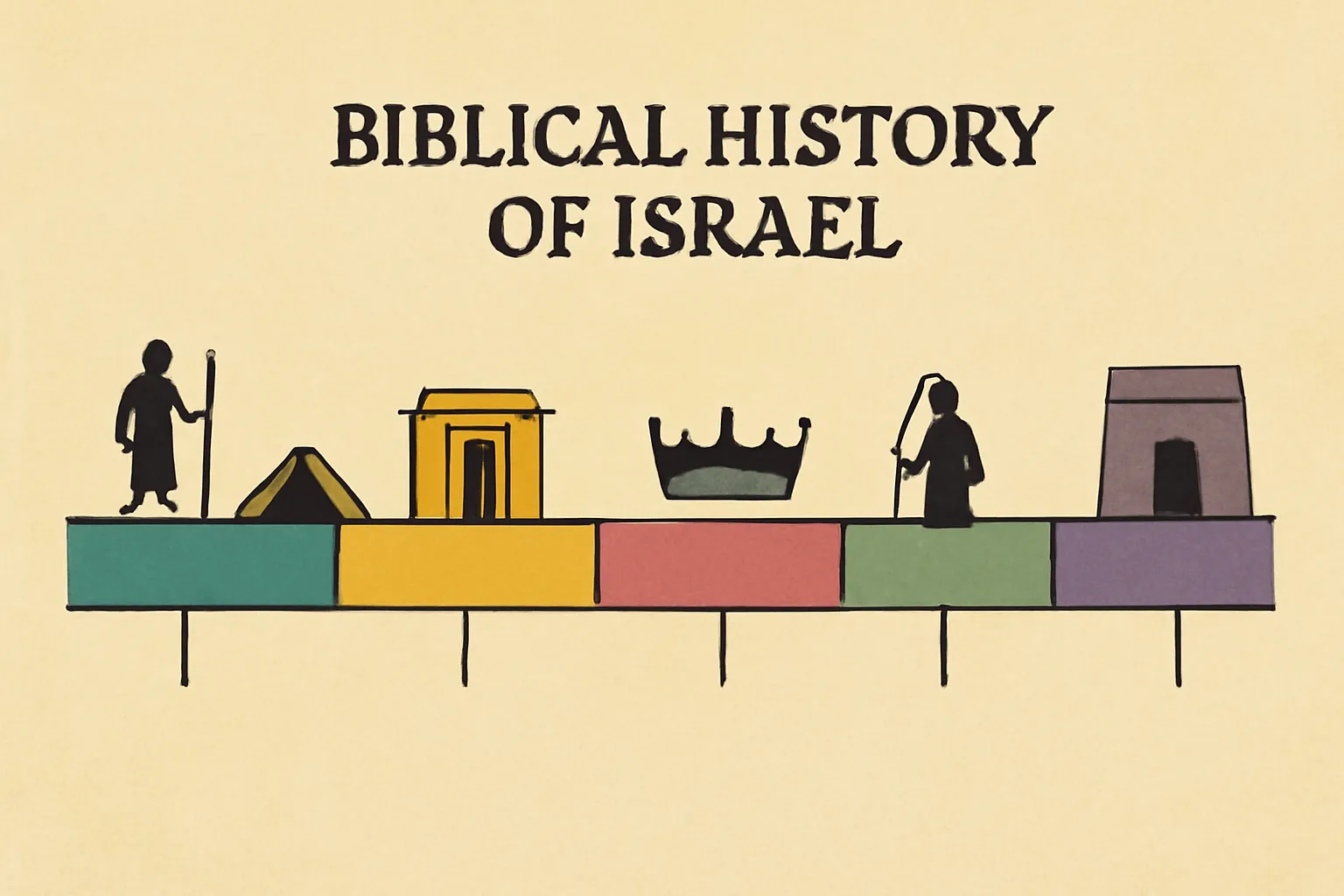
For learners and readers, a clear method is to build a layered timeline that marks major milestones, including the patriarchs, the exodus, the judges, the united and divided monarchies, the exile and return, and the later periods under foreign rule. A visual or textual timeline can help highlight how the biblical narrative moves from particular stories about individuals to a broader communal memory that persists across generations.
Glossary of Core Terms in the Biblical History of Israel Timeline
To help readers navigate this extensive biblical history of Israel timeline, here is a concise glossary of essential terms that recur across sections:
Covenant — a formal, binding promise between God and a people
Promised Land — the land declared for Israel’s possession as part of God’s blessing
Exodus — the departure of the Israelites from Egypt and their journey toward Sinai
Sinai Covenant — the giving of law and establishment of worship practices
Temple — the central sanctuary for worship and sacrifice in Jerusalem
Exile — the removal of elites and a significant portion of the population from the land
Return — the post-exilic reassembly of the community and rebuilding efforts
Hasmonean Dynasty — a period of Jewish self-rule after the Maccabean revolt
Messianic Expectation — hope for a divinely guided deliverer and king
Whether you study the biblical chronology of Israel as a sequence of events or as a tapestry of faith, the journey from the patriarchs to the post-exilic community offers a rich panorama of how memory, covenant, and land intertwine. This comprehensive guide to the timeline helps readers grasp the arcs that define biblical history and see how each era builds on the one before it, shaping Jewish and Christian understandings of salvation, identity, and hope.

 Por Laura Jara