Talmud vs Torah: Key Differences, History, and Significance
Talmud vs Torah: Key Differences, History, and Significance
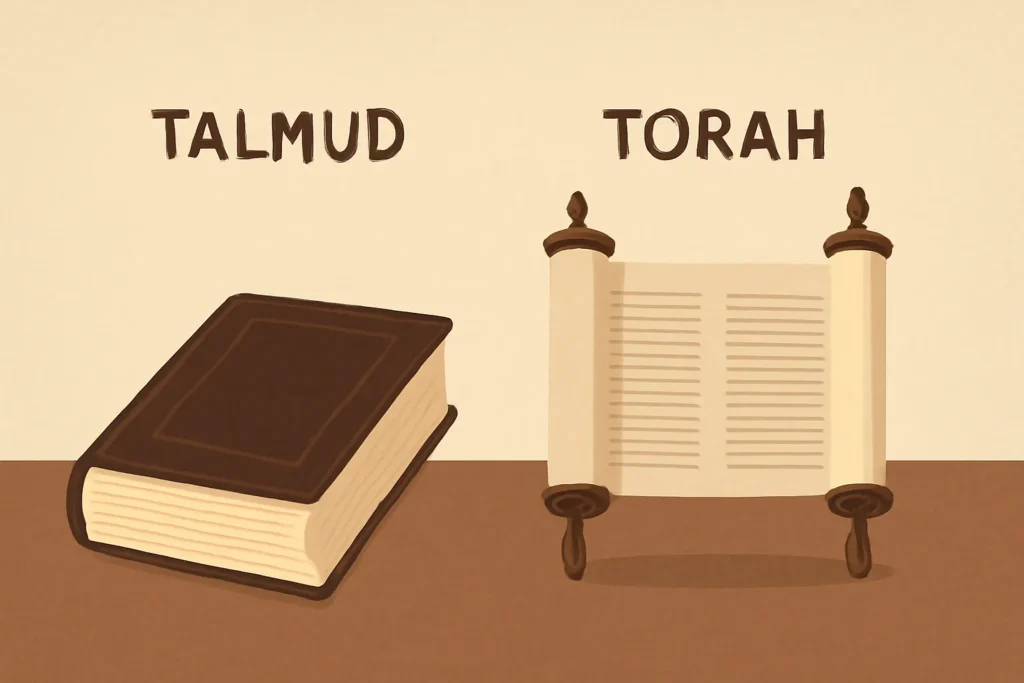
In Jewish tradition, the study of sacred literature unfolds along two parallel streams that together shape belief, practice, and identity. At the core are the Written Torah, the five books traditionally ascribed to Moses and regarded as the foundational revelation, and the Oral Torah, the body of interpretation, explanation, and extension that enables the Written Torah to be applied across generations. From these streams emerge two major literary bodies: the Torah as a canonical text, and the Talmud as an expansive Rabbinic commentary and legal corpus. Although they are deeply connected, these terms refer to distinct kinds of authority, different kinds of content, and different modes of study. This article explores Talmud vs Torah by examining key differences, tracing historical development, and explaining their enduring significance for Judaism and beyond.
Key Differences between the Talmud, Rabbinic Literature, and the Torah
Foundational definitions and scope
The Torah is best known as the Five Books of Moses—Genesis, Exodus, Leviticus, Numbers, and Deuteronomy. In classic Rabbinic usage, it is understood to consist of both a Written Torah (the textual Books) and an Oral Torah (the interpretations and expansions needed to live by those texts). In everyday language, however, people often distinguish the Written Torah as the explicit scriptural text and the Torah more broadly as the whole of Jewish scriptural law and narrative.
The Talmud denotes a sprawling Rabbinic corpus that grows out of late Second Temple era debates and flourishes in the post-Temple centuries. It is not a single book but a combined compendium consisting of two major components: Mishnah and Gemara, together with related textual layers like Tosefta and various midrashic materials in some editions. In common usage, Talmud often refers specifically to the Talmud Bavli (Babylonian Talmud), which is the most widely studied version, though there is also the Talmud Yerushalmi (Jerusalem Talmud).
Languages and modes of discourse
The Written Torah is primarily in Biblical Hebrew, with occasional Aramaic insertions in later prophetic and other books. The Oral Torah and Rabbinic literature rely heavily on Aramaic for legal dialects, casuistic reasoning, and analytic argumentation. The Talmud itself contains a dense mixture of Hebrew and Aramaic, reflecting a dynamic culture of debate, q&a, and practical casuistry.
In contrast, the Torah as a fixed scriptural text presents narrative, covenantal laws, genealogies, and prophetic perspectives in a way that invites interpretation rather than continual amendment within a single volume. The Talmud embodies an ongoing project of interpretation and application, turning broad commandments into concrete legal rules and practical guidance.
The Written Torah provides the foundational covenantal revelation and the core legal and ethical commands. It sets the framework for Jewish faith and practice, but it does not by itself spell out every possible situation a Jew might encounter. The Oral Torah—and especially the rabbinic interpretation codified in the Mishnah and Gemara—fills in those details, explains ambiguities, and develops methodologies for new cases. The Talmud is the living engine of that interpretive tradition: it presents debates, analyses, and diverse opinions, often concluding with practical rulings (halakhah) as well as imaginative storytelling (aggadah).
In practical terms, the Torah provides the divine text and the covenantal narrative that anchors Jewish identity, while the Talmud provides the interpretive inheritance that allows that text to be observed in changing circumstances across time and place.
Historical development: origins, redaction, and transmission
From revelation to written articulation
Traditional Jewish belief holds that the Five Books of Moses were revealed at Sinai and transmitted to the people of Israel with an accompanying moral and ritual law. Over the centuries, scribes and sages in various communities began to discuss, debate, and record the implications of those divine statutes. This process gave rise to what later scholars and rabbinic authorities would call the Oral Torah, a living interpretive tradition that complements the textual revelation. The term Oral Torah does not imply a new revelation but an ongoing, interpretive dialogue that makes the Written Torah intelligible and applicable.
The Mishnah: codifying oral tradition
By around the end of the second century CE, the Mishnah emerged as a concise, organized code of Rabbinic laws and teachings. Compiled by the sage Rabbi Judah the Prince (Rabbi Yehuda HaNasi), the Mishnah represents a turning point in Rabbinic Judaism: it “puts in writing” the core interpretive content of the Oral Torah and structures it into six orders covering topics from agricultural laws to festival observance and civil law.
The Gemara and the two Talmuds: Babylonian and Jerusalem
Following the Mishnah, extensive discussions and expansions were recorded in the Gemara, a set of analyses, disagreements, and clarifications that illuminate the Mishnah’s rulings. There developed two major centers of activity and teaching:
The Babylonian Talmud (Talmud Bavli), produced in the academies of Babylonia, which became the more widely studied and traditionally authoritative version in most Jewish communities.
The Jerusalem Talmud (Talmud Yerushalmi), produced in the Land of Israel, which reflects a somewhat different legal and philosophical emphasis.
The Babylonian Talmud generally crystallized in the period roughly from the 5th to the 6th centuries CE, though its analysis and expansion continued for several centuries. The Jerusalem Talmud reached its more complete form somewhat earlier, but it never achieved the same degree of global transmission as its Babylonian counterpart. Together, these two compendia form the heart of the Talmud as scholars and students know it.
Later medieval and modern developments
After the medieval period, the Talmud remained central to Jewish learning, but it was supplemented by commentaries, supercommentaries, and legal codes. Medieval authorities such as Rashi and Tosafot on the Talmud, and later codifiers like Maimonides (Rambam) and Rabbi Joseph Karo (Shulchan Aruch), helped shape how the Talmud influences daily practice. In modern times, many scholars and educators study the Talmud using print editions, lithographs, and digital tools, and they often participate in study cycles like daf yomi (the daily page study of the Talmud), further extending its reach.
Structure and content: what each body contains
The Torah: the five books and their core themes
The Five Books unfold a narrative of beginnings, covenant, and law. Broadly, they cover creation, early humanity, patriarchal history, the enslavement and exodus of the Israelites, the giving of the commandments at Sinai, and the wanderings and experiences of the Israelites in the wilderness, followed by a set of laws and narratives that guide daily life and communal existence. Major subsections include:
Genesis (Bereishit): origins, families, covenants, and foundational stories.
Exodus (Shemot): redemption, the giving of the Law, and the construction of the sanctuary.
Leviticus (Vayikra): priestly rules, purity statutes, and ritual life.
Numbers (Bamidbar): wanderings, census data, and legal narratives.
Deuteronomy (Devarim): reiteration of the commandments and the path forward for Israel.
Beyond these five books, Rabbinic tradition often engages with the Narrative and Ethical Layers of the text, interpreting motives, moral lessons, and social obligations. The textual form may present laws in direct commands, narratives that illuminate character and responsibility, and prophetic interjections that frame how a people should live in relationship with God and one another.
The Talmud: Mishnah, Gemara, and the legal imagination
The Mishnah provides the compact, coded framework of Jewish law. The Gemara then adds layered discussion: legal arguments, textual analysis, dialectical exchange, and stories. Together they form a dynamic conversation about how to interpret and apply the law in varied contexts. Key features include:
Legal reasoning: casuistic analysis, constructive arguments, and technique for deriving halakhic rulings.
Dialectical method: frequent presentation of competing opinions, often concluding with a practical ruling but sometimes leaving questions open for future discussion.
Aggadah: narrative and non-legal material that transmits ethics, theology, and wisdom through parables, legends, and homiletic reflections.
The Talmud is notable for its multi-voiced nature: it preserves debates among sages, schools of thought, and regional differences. Because of this, the Talmud is not merely a manual of rules; it is a cultivated environment for critical thinking, problem-solving, and moral discernment.
Roles in practice: study, law, and daily life
Study traditions and methods
In traditional Jewish study, havruta (study partnerships) and shiurim (guided lectures) are central to mastering great texts. Students often work through a single daf (page) of the Talmud with a partner, debating interpretations and testing conclusions. The Torah study, by contrast, often involves direct engagement with the text of the five books, sometimes with commentaries such as the Rashi and the Ramban on particular verses, and often in a classroom or study hall setting.
In many communities, the Talmud has become a symbol of rigorous intellectual discipline, while the Torah study symbolizes foundational faith and covenantal obligation. Yet these paths frequently converge: the study of the Written Torah is enriched by the interpretive methods of the Talmud, and the practical laws found in the Mishnah and Gemara illuminate and clarify the verses of the Five Books.
Halakhah and aggadah: two faces of Talmudic study
Within the Talmud, two broad strands emerge. The halakhah side seeks to derive and articulate practical laws—what to do, when to do it, and how to observe commandments in daily life. The aggadah side collects ethical teachings, legends, and theological reflections that shape beliefs, values, and the moral imagination. Both strands matter for Jewish life: legal rulings govern ritual practice and civil matters; narrative and ethical teachings inform character, communal memory, and spiritual aspiration.
Significance: why these works matter in Judaism and beyond
Religious authority and doctrinal development
For many Jewish communities, the Torah stands as the sacred charter of the Jewish people. It establishes the commandments (mitzvot), stories of creation and covenant, and the prophetic voice that calls for justice and righteousness. The Talmud functions as the living mechanism through which that charter is interpreted across generations, addressing new technologies, new social structures, and changing circumstances. In this sense, the Oral Torah and the Talmud are not secondary texts but partners that keep the covenant relevant.
Medieval and modern scholars often trace how Talmudic interpretation influenced legal philosophy, social ethics, and questions of civil rights, ritual purity, property, marriage, and criminal law. In blueprints like the Shulchan Aruch or the commentaries of Rashi, the Talmud’s legal logic remains a living force in how communities decide issues ranging from Sabbath observance to food laws and ritual purity.
Cultural and educational impact
The impact of the Torah and the Talmud extends beyond religious law. Studies of these texts have contributed to literary and linguistic traditions, as well as to intellectual habits such as careful reading, close interpretation, and disciplined argumentation. The Talmud’s format—rich in argument, counterargument, and layered interpretation—has often been compared to advanced legal and philosophical discourses in other traditions, and it has shaped the way debates are conducted in scholarly settings across the world.
Contemporary education and pluralism
In modern times, institutions across diverse Jewish communities emphasize both Torah study and Talmud study, though the emphasis may differ by denomination. Some communities prioritize the direct study of the Written Torah with commentaries; others center the Talmud as a primary vehicle for cultivating reasoning and ethical judgment. Global accessibility through translations, online study cohorts, and digital editions has broadened participation, allowing lay readers and scholars from many backgrounds to engage with the same core texts.
Common misconceptions about Talmud and Torah
The Talmud equals Judaism. In reality, the Talmud is a central Rabbinic text within Judaism, but Judaism encompasses the entire corpus of sacred literature, including the Written Torah, the Prophets, the Writings, and a wide range of later legal and ethical writings.
The Torah is only the five books. Some traditions use the term Torah to refer to the entire body of divine revelation in the Tanakh (the entire Hebrew Bible) and to the interpretive laws that accompany it, which is why the phrase Written Torah is sometimes used to distinguish the scriptural text from the rabbinic interpretive layer.
Talmud study is only about ritual rules. Although halakhic (legal) rulings are a major part of the Talmud, the corpus also preserves rich aggadah material—ethical teachings, parables, and theological reflections—that shape worldview and moral understanding.
All Talmudic discussions have clear, decisive outcomes. The Talmud often presents multiple opinions and unresolved questions, emphasizing the value of critical thinking, careful reasoning, and the humility to recognize ambiguity when appropriate.
Education today: approaches to studying Torah and Talmud
Practical pathways for learners
Learners today can engage with both texts through various routes:
Chumash study with classical commentaries: reading the Five Books with traditional explanations to illuminate verses and laws.
Talmud study in parallel: focusing on a tractate or a daf yomi cycle to explore the Mishnah and Gemara together, often with a partner or a study group.
How-to guides and translations: using accessible English translations and guided commentaries to gradually build fluency in the language and argumentation style of the Talmud.
Digital learning platforms: online courses, livestream shiurim, and searchable databases that make the texts more approachable for contemporary readers.
Regardless of the entry point, a comparative approach helps: recognizing that the Torah provides the divine framework, while the Talmud supplies the interpretive toolkit. This dual literacy—textual reverence combined with analytical rigor—helps learners appreciate why these works are studied together rather than in isolation.
Glossary of essential terms
Torah: the foundational revelation; often used to denote the Five Books of Moses or, more broadly, the written and interpreted law that governs Jewish life.
Written Torah: the textual portion of the Torah—the Five Books of Moses.
Oral Torah: the interpretive tradition that explains and expands the Written Torah.
Torah in some contexts refers to the broader body of scriptural and interpretive law, including Jewish scripture and rabbinic commentary.
Talmud: the composite Rabbinic work consisting of Mishnah and Gemara, including the Babylonian and Jerusalem editions.
Mishnah: the codified compilation of Rabbinic laws, foundational to the Talmud.
Gemara: the analytical commentary on the Mishnah that forms the second major component of the Talmud.
Halakhah: Jewish legal rulings derived from the Talmud and later legal codes.
Aggadah: the non-legal, narrative, ethical, and theological portions of Rabbinic literature.
Talmud Bavli: the Babylonian Talmud, the more widely studied version of the Talmud.
Talmud Yerushalmi: the Jerusalem Talmud, the version produced in the Land of Israel.
A final reflection on the relationship between Talmud and Torah
The relationship between the Torah and the Talmud is not a simple binary of text versus commentary. Rather, it is a dynamic partnership that sustains Jewish law, ethics, and identity across generations. The Written Torah provides the enduring covenantal text, while the Oral Torah—as articulated in the Mishnah and Gemara—expands, adapts, and interprets that revelation so it can be lived in varied times and places. The study of these works often involves balancing reverence for sacred wording with the disciplined, constructive disagreement that makes Jewish law living and robust. For students, teachers, and communities, engaging with both streams offers a comprehensive path to understanding the moral universe of Judaism: a universe that is at once ancient and always renewing itself through interpretation, debate, and discovery.










Leave a Reply