The origins of the project to rebuild the Temple: why the Second Temple emerged
The destruction of the original sanctuary often called the First Temple, by the Babylonians in 586 BCE, left a people in exile and a sacred identity that needed renewal. When the Persian Empire under Cyrus the Great rose to power, a policy shift opened the door for return and rebuilding. The decree attributed to Cyrus granted the Jews permission to return to their homeland, to lay the foundation of a new house of worship, and to reestablish the worship that had been central to biblical faith. This set in motion the project that would become the Second Temple—not merely a replica of Solomon’s temple, but a new center of religious life that would endure for several centuries.
Key elements of the Second Temple project were shaped by the political framework of the Persian period, the religious leadership among the returning exiles, and the prophetic and administrative encouragement that sustained the work. The endeavor was not just architectural; it was a national and religious renewal. The aim was to reconstitute the sacrificial system, to reestablish the cult, and to re-create a coherent space where worship, prayer, and ritual sacrifices could be offered in continuity with pre-exilic traditions.
In tracing the origins of the project, it is important to recognize that multiple actors contributed to the outcome. The people who returned from exile, the priestly leadership, the political authorities in Jerusalem, and the wider community in the Persian Empire all played roles. Historians and religious scholars often describe this era as the emergence of the Second Temple period, a chronological and cultural phase that would be defined not only by the physical structure but also by the evolving religious practice, governance, and identity of the Jewish people under foreign rule.
As a result, the question often framed in historical questions—Who built the Second Temple?—has a layered answer. It was not a single architect or a single moment, but a sequence of leaders, communities, and eras that together produced the rebuilt sanctuary. The following sections address the principal builders, the social and religious context, and the historical forces that shaped the Second Temple from its inception to its later renovations.
Who built the Second Temple? The principal builders and their roles
The rebuilding project was headed by two central figures who gave the enterprise its political and religious direction. Zerubbabel, as governor of Judah and a scion of the Davidic line, provided state leadership and organizational authority. Jeshua (also transliterated as Joshua), the high priest, gave spiritual legitimacy and ritual oversight. Together, they anchored the project in both secular leadership and sacred office. In many sources, this pairing is described as the decisive pairing for the construction and dedication of the temple precincts.
Zerubbabel — governor of Judah, heir to the Davidic line, organizer of the return, and a principal civil leader who oversaw labor, resources, and logistics for the rebuilding effort.
Jeshua (the high priest) — the religious leader responsible for maintaining ritual purity, priestly functions, and the ceremonial elements of the temple’s early reestablishment.
Their collaboration reflected a model in which political authority and temple leadership were interwoven to restore worship and communal life.
The community of returnees and the workers
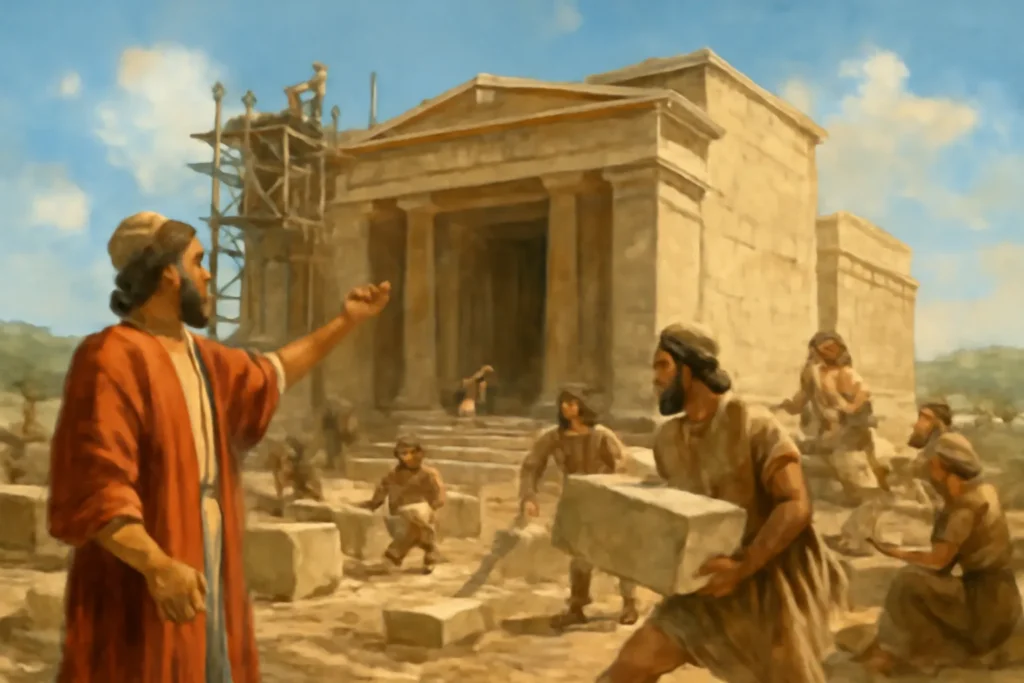
The builders were drawn from the returning exiles and the local Levites and priests who supported the project. The labor force included skilled artisans, stone workers, carpenters, and men and women who contributed to the reorganization of a sacred space. The work relied on the mobilization of several returning families, the distribution of tasks, and the mobilization of resources granted by the Persian administration. It is important to see the Second Temple as a community-built structure rather than a project undertaken by a single segment of society.
Prophetic voices and administrative support
Haggai and Zechariah provided prophetic encouragement that energized the work, urging the people not to abandon the task, to prioritize the temple, and to trust in divine involvement in the restoration.
Ezra and Nehemiah contributed to the broader cultural and religious renewal during and after the initial rebuilding, reinforcing the covenantal framework and guiding reforms that affected the temple and the wider city.
The combined leadership—political, priestly, and prophetic—ensured that the rebuilding did not occur in isolation but as part of a larger program of restoration. The talent pool, from governors to priests and lay workers, illustrates that the project relied on a diverse coalition rather than a single group or a solitary architect.
The builders’ broader significance: continuity and renewal
In this light, the Second Temple should be understood as a product of living tradition reinterpreted in a new political setting. The community embraced continuity with the First Temple while redefining worship for a post-exilic reality. The project bridged two eras: the pre-exilic sacred tradition and a reconstituted temple-centered life under Persian auspices.
Historical context and significance: the temple’s place in the wider world
To understand who built the Second Temple, it helps to situate the project within the broader historical panorama of the ancient Near East. The Jews who returned to Judah faced a landscape reshaped by conquest, empire, and shifting religious ideas. The Persian Empire’s approach to governance allowed for local autonomy in matters of worship while maintaining imperial oversight. In practical terms, this meant that the people of Judah could reconstruct a temple precinct and restore their sacrificial rites, but within the boundaries of a subject province and a imperial framework that sought stability and loyalty from its diverse populations.
The financing, logistics, and political authorization were intertwined with the imperial system. The decree of Cyrus, often cited as a decisive moment, created for the returning community a legal basis and a moral mandate to rebuild. Subsequent kings—such as Darius I and Artaxerxes I—continued to interact with the community, providing continuing leverage and occasionally obstacles. The temple’s story is thus not merely the work of local artisans; it is also the story of a people negotiating their identity under royal policy, and a religious institution that sought to renew worship and ritual in a changed world.
Opposition from neighboring communities, particularly the region’s other groups, occasionally impeded progress. The opponents of the reconstruction, including some local powers and share of the population who questioned the return to a central shrine, engaged in political or rhetorical maneuvers to slow or block the work. Yet the persistence of the returning community, aided by prophetic encouragement and sustained by religious conviction, carried the project forward. This struggle illustrates a central tension in the Second Temple story: the drive to restore a sacred center in the face of external pressures and internal disagreements.
Historical narratives often link the Second Temple to later chapters of Jewish history, including a complicated relationship with Hellenistic culture after the conquests of Alexander the Great, and eventually the Hasmonean period that followed, which saw further transformations in the temple precincts. The Herodian renovation, described in later centuries, would become the most famous phase for many readers due to its impressive scale and lasting influence on the temple’s appearance, even though this article focuses on the origins and early development of the sanctuary itself.
Construction phases: from foundation to completion, and beyond
The rebuilding of the Second Temple unfolded in distinct phases, each marked by leadership, prayer, and public works. The phases were shaped by religious devotion and practical considerations, including the availability of labor, the allocation of materials, and the supervision of the royal administration in Babylonian or Persian records.
First phase: laying the foundation and reestablishing the altar
The earliest stage involved clearing the site on the Temple Mount, laying the foundation, and reestablishing the daily sacrificial rites at the altar. This foundational step signaled not only a physical rebuilding but also a renewal of religious life. The altar played a central role in this phase, serving as the locus where offerings could be brought in accordance with the covenantal laws. The foundations symbolized continuity with the past while inaugurating a renewed religious space for the present generation.
Second phase: completing the sanctuary and restoring the ritual system
After the foundation and altar, the construction of the temple sanctuary itself began. The work included restoring the nave, the inner sanctuary (the Holy Place), and the Holy of Holies in a manner that reflected pre-exilic tradition but adapted to the new material reality and the needs of the returning community. The priests and Levites reconstituted the ritual system, resuming the cycles of sacrifice, feast days, and liturgical duties that had defined worship before the exile. This phase culminated in a dedication ceremony, marking the sanctification of the space for communal worship.
Administrative and religious significance
Administration under the governance of Zerubbabel and the Jeshua line.
Support from prophetic voices that energized the work.
Integration of Persian political oversight with Jewish religious life, enabling a functioning temple economy and ritual calendar.
It is helpful to recognize that the term Second Temple encapsulates a moment in time when the people sought to reconstitute a sacred space within new political realities. The rebuilt sanctuary served not only as a place of prayer but also as a center for governance, education, and community identity. The temple precincts became the locus where laws were taught, offerings were made, and the covenantal relationship with God was reaffirmed in a context of exile and return.
Herod’s grand renovation: the “Second Temple” as a grand complex
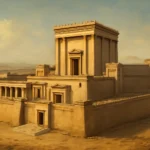
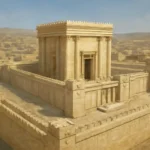
In the last stage of its long history, the Second Temple underwent a sweeping expansion and remodeling under the client-king Herod the Great, beginning around the late 20s BCE. While the essential sanctuary remained the spiritual heart, the Herodian renovation transformed the site into a monumental complex with a remarkable platform and expansive courtyards. This renovation was not simply about creating a more impressive building; it was a political and religious statement intended to express loyalty to Rome while also improving the infrastructure for large crowds during pilgrimage and festival days.
The Herodian Temple was famous for its imposing platform, its vast outer courts, and the highly refined work of artisans. The outer complex included the Court of the Gentiles, then the Court of Women, the Court of Israel, and the Court of the Priests, moving toward the inner sanctuary. The outer courts accommodated worshippers from across the Jewish nation and, by later times, echoed with thousands of pilgrims during major feasts. The temple’s architecture was designed to accommodate ceremonial processions, sacrifices, and a schedule of rituals that drew participants from across the land.
Although the core sanctuary remained in place, the Herodian remodeling greatly enhanced the exterior beauty and the scale of the precinct. The project included rebuilding walls, adding porticoes, and adorning stonework with a level of refinement that made the site famous across the ancient world. The result was a temple complex that stood as a symbol of religious devotion and political sovereignty, though its grandeur would be cut short by conflict and the eventual Roman destruction in 70 CE.
Variations on the question: different ways to phrase who built the Second Temple
Scholars and educators often pose the central question in varying terms to reflect different aspects of the historical process. Here are several widely used phrasings, each highlighting a facet of the broader story:
Who were the builders of the Second Temple? — emphasizing the people and groups involved in the physical construction and operational renewal.
Who oversaw the rebuilding of the Second Temple? — stressing leadership and administration, including governors and priests.
Who is credited with constructing the Second Temple? — reflecting traditional attributions, including Zerubbabel and Jeshua as foundational leaders.
Which leaders guided the restoration of the Temple precincts? — focusing on leadership roles and religious authority.
Who built the Second Temple and under whose decree? — connecting the project to imperial policy, especially the Cyrus decree and subsequent Persian oversight.
The broader inquiry is thus multi-layered: it encompasses political, religious, and social dimensions. The term “Second Temple” refers to a living institution that developed through the interactions of exiles returning to their homeland, the priests who reestablished worship, local authorities, and imperial rulers who granted permission, resources, and sometimes constraints. The answer, therefore, is not a single name but a constellation of actors who, together, created a rebuilt sanctuary that became central to Jewish religious life for centuries.
The enduring legacy: what the rebuilt sanctuary gave to the community
The story of the Second Temple offers a window into how a sacred space can anchor a people’s identity through years of change. The rebuilding project—led by Zerubbabel and Jeshua with encouragement from Haggai and Zechariah—was a decisive step in reconstituting worship after exile. The temple’s presence allowed the Jewish people to maintain a centralized ritual system, a coherent liturgical calendar, and a sense of unity across a diverse and geographically dispersed population.
Over the centuries, the temple continued to evolve. The Herodian renovation added architectural grandeur and practical capacity, enabling large crowds to participate in pilgrimage festivals. The temple thus functioned not only as a religious site but also as a stage on which the community enacted its covenantal relationship with God, observed scriptural law, and shaped its political and cultural life under foreign rule. The memory of the Second Temple would survive through many generations in religious literature and in the way Jewish communities understood sacred space and ritual practice.
The destruction of the temple in 70 CE by the Romans marked the end of a physical era, but the idea of a shared sanctuary persisted in Jewish religion and memory. In that sense, the builders of the Second Temple created more than a building; they helped foster a spiritual framework that could carry forward across centuries of history, adaptation, and renewal.






Leave a Reply