When Did the Israelites Become Jews? A Comprehensive Timeline of Jewish Origins and Identity
When Did the Israelites Become Jews? A Comprehensive Timeline of Jewish Origins and Identity
When Did the Israelites Become Jews? A Comprehensive Timeline of Jewish Origins and Identity
Questions about the moment or process by which the ancient Israelites transitioned into what we call Jews today touch on language, religion, ethnicity, and collective memory. This article explores a long arc of identity that did not crystallize in a single year or event. Instead, the shift from an ancient Israelite or Hebrew people to a people identified as Jews happened through centuries of political change, religious development, exiles, returns, and diaspora communities. By looking at historical milestones, linguistic shifts, and evolving self-understanding, we can trace a comprehensive timeline that illuminates how the people who were once called Ivri, Yisrael, or Ioudaios became known as Yehudim, Judeans, and later simply Jews.
Origins and early identities: from Ivri to Israelite
To answer the question, when did the Israelites become Jews, we must begin with the earliest records of identity in the ancient Near East. In biblical and extra-biblical texts, the people who would become central to Jewish tradition are often referred to by several labels:
Ivri or Hebrew (a term appearing in ancient Mesopotamian and Canaanite sources and in the Hebrew Bible), which in some contexts denotes a cultural or linguistic group rather than a political state.
Yisrael or Israel as the name of the people tied to the patriarch Jacob, who is also called Israel; the name marks the evolving unity of a people bound to a set of ancestral promises.
Israelites or Benei Yisrael, the phrase used later in the Bible to describe the descendants of the twelve tribes and the early community that followed the covenantal path described in Torah and Prophetic writings.
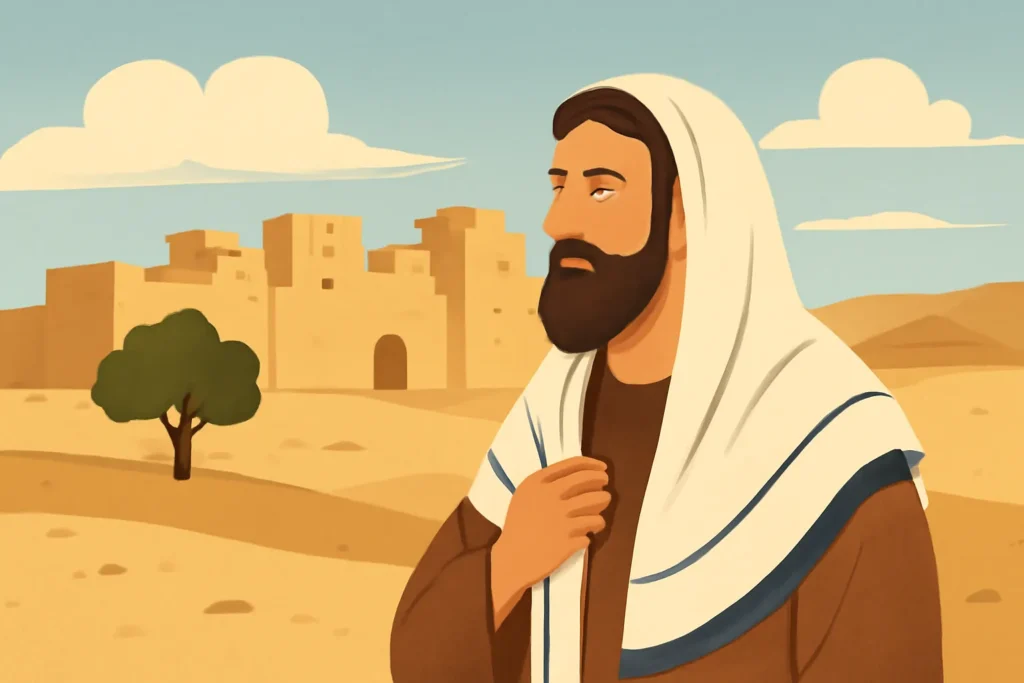
In the earliest chapters of the Bible, the identity is deeply connected to covenant, land, and law rather than to a formal religious system as in later centuries. The idea of a single political entity under a king—first exemplified by the United Monarchy under Saul, then David, and Solomon—emerges in the late second millennium BCE. During this period, the people visible in sources are not yet a “religion” in the modern sense but a congregational community bound to a common ancestral heritage, sacred space, and shared law. The question “when did the Israelites become Jews” therefore invites us to consider a longue durée—from peoplehood centered on land and covenant to a more explicit religious-ethical identity that would develop in later eras.
The united monarchy, the split, and the rise of Judea
By the early first millennium BCE, the political landscape of the ancient Near East included a united kingdom under David and Solomon, followed by a division into the northern kingdom of Israel and the southern kingdom of Judah. Throughout this period, the term Judeans—or in Greek Ioudaioi—begins to appear as a label for the people living in the southern territory around Jerusalem. The survival and continuity of Jewish law and identity through the Book of the Twelve and related sources provided a framework that later generations would read as the seedbed of a more defined Jewish identity than the broader term Israelite could fully capture.
Historically, it is in this era that the idea of a people tied to a specific tribe or region begins to take on a more distinctive religious flavor. The religious life surrounding the Temple in Jerusalem and the covenantal obligations described in the Torah become markers of “being a people” in a way that will be read by later communities as a proto-Jewish self-understanding. Critics and scholars who study the etymology and early usage often point to how the early labels reflect both sovereignty and piety, foreshadowing the later move toward a distinct religious-ethnic identity eventually known as Judaism.
The most decisive inflection in the story of when the Israelites became Jews occurs in the wake of the Babylonian Exile. In 586 BCE, the First Temple in Jerusalem was destroyed, the aristocracy and priestly class were displaced, and a significant portion of the population was carried to Babylon. This traumatic event disrupted political sovereignty but did not erase a sense of covenantal identity. In exile, communities maintained their religious practices, dietary laws, calendar observances, and scriptural studies, which became a powerful core of what later generations would recognize as Jewish identity.
When Cyrus the Great of Persia conquered Babylon and issued a decree permitting exiles to return home, a new phase opened. The later emergence of a Second Temple (begun around 516 BCE) provided a renewed center for religious life and legal interpretation. It is during and after this period that the term Ioudaios (Greek) and its Latin counterparts begin to be used more widely in the surrounding cultures to designate people associated with Judah and, by extension, with a distinctive religious tradition tied to the Temple and its covenantal laws. The key question for understanding the transition to a distinctly Jewish identity is not merely political restoration but the way communities interpreted law, ritual purity, and authority in the absence of the original Temple’s priestly apparatus after 70 CE. In the meantime, the phrase “when did the Israelites become Jews” can be read as marking the shift from a temple-centered, land-bound identity to a people who maintain a covenantal way of life even in foreign lands.
Language shifts and self-definition in the Second Temple era
During this era, linguistic shifts reinforce a deepening sense of a distinct community. The Hebrew Bible itself is translated into Greek (the Septuagint) in the later Hellenistic period, in which the term for a Jew appears as Ioudaios. In Greek and Latin texts of the period, the community is more often identified by political location (Judea) and religious adherence than by a simple ethnonym. The distinction between a national-ethnic identity and a religious community becomes more pronounced as Judaean life interacts with Hellenistic culture and later Roman rule. The evolution from Israelite to Jew in broader usage becomes increasingly plausible as commentators observe how Jewish law and ritual—especially circulating around the Temple and its later diasporic communities—shape a durable identity beyond political sovereignty.
From Yehudi to Ioudaios: Hellenistic and Roman eras
In the centuries surrounding the Common Era, the labels continue to evolve. The Greek term Ioudaios is widely used in classical literature to refer to Judeans or people who identify with the Jewish religion. The Roman period, including the Hasmonean Dynasty (140–37 BCE) and later Roman provincial rule, further cements the distinction between a people who share a religious law and a political state. The Hasmoneans, who asserted a form of independence for parts of Judea and expanded a priestly-kingly leadership, help shift the public self-understanding toward a combined religious and national identity. At the same time, the diaspora communities spread across the Mediterranean and beyond, preserving practices and texts in Hebrew, Aramaic, Greek, and Latin. In this milieu, the question of when the Israelites became Jews is often framed as a gradual linguistic and ritualization of an evolving self-concept rather than a single point of change.
The language of the sources—Temple inscriptions, Dead Sea Scrolls, Philo, Josephus, and later rabbinic writings—demonstrates a continuum: people who are Jews in one context describe themselves as a people of the covenant, a nation with a long memory of ancestors and scriptures, and a religious community bound to a set of laws and norms. The shift toward a more precise religious-ethnic self-definition can be traced across late Second Temple literature into the early rabbinic era.
Rabbinic Judaism and the emergence of a distinct Jewish identity
The destruction of the Second Temple in 70 CE and the marginalization of temple-centered worship in favor of synagogues and study halls mark a fundamental transformation. With the rise of Rabbinic Judaism, the center of religious life moves from priestly ritual performed at a ritual space to a system of law and interpretation that can operate under diverse political regimes and in diasporic settings. This era saw the crystallization of what later generations would call rabbinic Judaism, a form of Jewish religious practice grounded in the written Torah and the oral interpretations developed by the Sages.
In rabbinic literature, the label Yehudi (the Hebrew term for a Jew) becomes a common self-designation. The Sages distinguish between the broader sense of being a descendant of Israel and the more specific commitment to Torah study and observance. The term Ivri sometimes recurs in earlier sources, but in rabbinic and medieval Hebrew, Yehudi becomes the standard designation for a member of the Jewish people. The transformation from a national or regional identity to a faith-based, interpretive tradition is central to the answer to When did the Israelites become Jews? Because the rabbinic era defines Jewish life through law, learning, and community norms rather than temple ritual alone, the identity begins to take on a distinctly religious character that persists into later centuries, even as geographic and political realities change.
Key features of rabbinic Jewish identity
Canon formation: The closing of the Hebrew Bible as a fixed corpus and the development of the Mishnah and Talmud later codifications.
Religious authority: The emergence of rabbinic authorities whose rulings guide daily life, festival observance, and ritual purity.
Community over temple: A shift toward local houses of study and community prayer when the Temple cannot be rebuilt.
Diaspora viability: The ability to sustain Jewish life under diverse empires and cultures through shared law and study.
Medieval to early modern transformations: continuity and adaptation
In the medieval period, Jewish communities spread across Europe, the Middle East, and North Africa. The carriers of Torah study, exegesis, and liturgical creativity helped sustain a robust sense of Jewish peoplehood, even as it converged with local languages and cultures. The term Jews becomes common in many European languages, reflecting the ongoing, evolving identity that blends religious practice with a sense of shared history and exile. During this era, a crucial conversation develops about how a people who once lived in a land with a Jewish temple can retain a coherent identity in multiple lands without an independent state. The status of the Jewish community in the diaspora helps illustrate that the transition from an ancient Israelite past to a modern Jewish present occurs within a framework that is intensely religious, culturally durable, and often legally defined by local authorities or religious courts.
Two broad strands shape the medieval and early modern evolution of Jewish identity:
Religious and legalism: The rabbinic project continues to define the practical boundaries of being a Jew—laws of kashrut, Sabbath, purity, family status, and ritual practices.
Ethno-cultural memory: The memory of exile, the longing for Zion, and the insistence on a shared historical memory reinforce a sense that the people, even when dispersed, remain connected by a covenantal tradition.
From emancipation to modern times: the redefinition of Jewish identity
The modern era introduces new pressures and opportunities that further shape the transformation from an ancient Israelite past to a contemporary Jewish identity. The late 18th and 19th centuries bring the Haskalah (Jewish Enlightenment) in Europe, which argues for education, integration, and modernization within a Jewish framework. This movement helps establish a modern concept of Judaism as a religion that can adapt to national citizenship and secular cultures while preserving distinct religious and cultural traditions. The emergence of political Zionism in the late 19th and early 20th centuries intensifies the relationship between the Jewish religious identity and a national one, culminating in the establishment of the modern State of Israel in 1948. Concurrently, the diaspora redefines Jewish identity in new terms—cultural, religious, ethnic, and civic—across continents and centuries.
In this period, the language of self-identification shifts again. The term Jew is widely used for people who identify with Jewish religion, culture, and heritage, while the term Hebrew or Ivri remains for the ancient language and sometimes for a cultural revival through modern Hebrew. The modern usage often foregrounds questions of lineage, conversion, and belonging. The debates about who is considered a Jew—under Orthodox, Conservative, Reform, and other streams—become especially pronounced as state and society grapple with questions of citizenship, rights, and religious authority. This is a decisive phase in how the older question, when did the Israelites become Jews, is reframed: no longer a simple historical moment, but a continuous negotiation of identity across communities, centuries, and legal frameworks.
The Jewish people, Israel, and global identity today
In contemporary discourse, several interlocking identities coexist. Some people speak of Jews as an ethnoreligious group, distinguishing between religious practice and ethnic heritage. Others emphasize the national dimension, particularly as it relates to the state of Israel and the right of Jews to live there or hold citizenship. For many, the phrase when did the Israelites become Jews remains a historical question, but the practical question today is broader: what does it mean to be Jewish in a world of multiple identities, languages, and political borders?
Key modern considerations include:
The distinction between ethnicity, religion, and nationality in defining Jewish identity.
The role of conversion and the various halachic (Jewish law) standards for determining who is considered Jewish within different communities.
The impact of the State of Israel, diaspora communities, and intercultural exchange on how Jews think about their past and their future.
How scholars use terms like Israelite, Hebrew, Judean, and Jew to describe different periods and social meanings without implying an unbroken, single-genealogical line.
Timeline of milestones: a concise but comprehensive view
Below is a structured timeline that highlights the most influential moments in the shift from an ancient Israelite self-understanding to a modern Jewish identity. These milestones are interwoven with the broader cultural, religious, and political currents of their times.
c. 1200–1000 BCE: Emergence of the early Israelite confederation and the consolidation of a distinct people around shared ancestry, law, and worship practices. The term Ivri appears in various sources as a designation for the early Hebrew-speaking communities.
c. 1000–930 BCE: The United Monarchy under Saul, David, and Solomon; the people's sense of identity expands beyond kinship to include a national covenantal framework anchored in the land and Temple worship.
c. 930 BCE: The kingdom divides into Israel (north) and Judah (south), with the latter centering around Jerusalem and the Temple. The term Judah and Judeans gains prominence as a regional label.
722 BCE: Fall of the northern kingdom to Assyria; the surviving communities in the south maintain a distinct identity tied to the temple and the covenant.
586 BCE: Babylon destroys the First Temple and exiles the elite to Babylon; a diaspora begins that will shape Jewish memory and practice for centuries.
538–515 BCE: Persian-backed return under Cyrus and the eventual rebuilding of the Second Temple; the foundations for a renewed religious life are laid.
4th–3rd centuries BCE: The Sepharadic and Ashkenazic worlds begin to diverge culturally; the Hebrew Bible is rendered and studied in multiple languages, including Greek (Septuagint).
2nd century BCE (Hasmonean period): A revolt leads to a degree of political independence under the Maccabees; the term Judea gains political significance, and priestly leadership asserts strong religious authority.
1st century CE: Destruction of the Second Temple (70 CE) shifts Jewish life toward the synagogue, study, and law—rabbinic leadership begins to define a durable, adaptable form of Jewish practice.
2nd–6th centuries CE: Emergence and codification of Rabbinic Judaism; the term Yehudi is common in rabbinic literature to denote a Jew; the concept of Jewish peoplehood persists through diaspora communities across the Roman Empire and beyond.
7th–13th centuries CE: Jewish life flourishes under Islamic rule in the Middle East and North Africa, as well as in parts of Europe; a robust tradition of scholarship, philosophy, and poetry grows alongside legalistic debates that define the practice of Judaism.
14th–18th centuries CE: Persecution and expulsions alongside cultural florescence; in Europe, communities adapt to local conditions while preserving a shared religious and historical memory.
18th–19th centuries CE: The Haskalah (Jewish Enlightenment) fosters modernization, education, and integration into broader societies, while reform movements reframe Judaism as a livable modern faith with diverse expressions.
Late 19th–20th centuries CE: Zionist thought advocates for national revival in the land of Israel; the modern state of Israel is established in 1948, intensifying the interplay between religious identity and national belonging for Jews worldwide.
Mid–late 20th century to today: Jewish identity continues to be shaped by globalization, diaspora connections, debates about conversion and marriage laws, and ongoing dialogue about what constitutes belonging in a pluralistic world.
How to understand the variation in terminology: key terms explained
Throughout this long arc, several terms recur with nuanced meanings. Understanding how these terms relate helps answer the central question without oversimplifying the past.
Israelite — An ancient term for the people of Israel in biblical and early historical sources, often used to denote the broader ethnoreligious group before it acquired a more defined religious identity.
Hebrew or Ivri — A linguistic and cultural label that frequently appears in ancient sources; it designates language, culture, and the people who spoke it.
Judah/Judean — Term tied to the southern kingdom centered around Jerusalem; increasingly used in historical sources to identify people dwelling in or associated with the land of Judah and the Temple.
Ioudaios — The Greek designation that translates to “Judean” or “Jew,” used extensively in Hellenistic and Roman era texts to refer to those who followed Jewish law and tradition.
Yehudi — The Hebrew term for a Jew, especially prominent in rabbinic and modern Hebrew as the standard self-designation for a member of the Jewish people.
Jew — A later, widely used English term adopted from the historical development above, representing a religious, cultural, and ethnic identity that persists into the modern era.
Addressing the core question: does “when” equal a single moment?
Most scholars avoid implying a precise instant when all Israelites suddenly became Jews. Instead, the most accurate answer emphasizes a gradual evolution in which language, religious practice, law, and communal self-understanding gradually converged toward what later generations would label Judaism.
Key reasons for this view include:
The reliability of ancient literary sources showing a continuity of law and covenant life even as political authority changed hands.
The transformation from temple-centered ritual to temple-agnostic or temple-adjacent rabbinic practice after 70 CE, which redefines Jewish life around study and community rather than exclusively temple rites.
Dialectical shifts in language and self-identity, moving from ethnolinguistic categories to religiously framed self-definition in rabbinic and medieval sources, and finally to modern ethnoreligious identities.
Historical events such as exile, return, and diaspora that force Jewish communities to adapt without a sovereign homeland, reinforcing a durable, trans-regional sense of peoplehood.
Practical implications: identity, law, and belonging
Understanding the evolution from Israelite to Jew has real implications for how we read religious law, communal life, and modern debates about belonging. Several themes recur across centuries and geographies:
Identification and allegiance: The shift from a people defined primarily by a land and a temple to a people defined by covenantal allegiance and law helps explain why Jewish communities could maintain continuity without a centralized political state.
Conversion and continuity: The question of who is a Jew—whether by birth, lineage, or conversion—has been central in halakhic debates, reflecting the long-standing tension between inherited identity and freely chosen faith.
Diaspora as a proving ground: The long diasporic experience shows how multiple communities can sustain a shared identity while adopting local languages and customs, a hallmark of a civilization with strong internal cohesion.
Nationhood and religion: The 20th century introduces the modern state into this history, complicating the relationship between Jewish religion and Jewish nationality and prompting renewed conversation about what it means to be a Jew in a modern state.
Putting it together: answering the question with a synthesized view
When we ask when did the Israelites become Jews, the best answer is a layered one. It spans from the ancient labels of Ivri and Israelite to a more explicit Jewish identity anchored in rabbinic law, communal practice, and a transnational memory. The process is best understood as a long arc—one that begins in the biblical era with the emergence of a distinct people under covenant, continues through the critical disruptions of exile and return, and culminates in the modern era where Jewish identity encompasses religion, culture, ethnicity, and national affiliation.
In short, the Israelites did not become Jews at a single moment in time, but through a continuous set of shifts—linguistic, religious, political, and social—that accumulated over centuries. The question, deceptively simple, invites us to recognize a long, interconnected history: a people who maintained their sense of covenant and tradition as they navigated exile, empire, diaspora, and modern nationhood. The answer, therefore, is that the transformation was gradual and multi-faceted, a testament to the resilience and adaptability of a people whose story continues to shape both Jewish life and world history.
Further reading and resources
For readers who want to explore this topic in greater depth, consider consulting a mix of scholarly and historical resources that cover biblical history, Second Temple Judaism, Rabbinic law, and modern Jewish identity. Some reliable starting points include:
Introductory surveys of Biblical Israelite history and the evolution of Jewish identity across ancient, medieval, and modern periods.
Primary texts such as the Hebrew Bible, Septuagint, Philo, Josephus, and key rabbinic works (Mishnah, Talmud, and later commentaries).
Overviews of the Hasmonean period, Second Temple Judaism, and the development of rabbinic law in late antiquity.
Contemporary scholarship on the ethno-religious dimensions of Judaism, including discussions of matrilineal vs patrilineal descent, conversion practices, and the definitions of Jewish belonging in different communities.
Whether you phrase it as when did the Israelites become Jews, when did the Israelites turn into Yehudim, or how did the Judeans evolve into a modern Jewish people, the core insight remains the same: Jewish identity emerged through a dynamic, lifelong process that linked ancestry, law, ritual, language, memory, and community across millennia. Understanding this evolution helps illuminate not only the past but the ongoing story of what it means to be Jewish in today’s world.








Leave a Reply