When you read about Esther, you may wonder how an apparently ordinary young woman became central to one of the Bible’s most dramatic stories. Esther was a Jewish exile who became queen in the Persian Empire and used her position to save her people from destruction. Her story is recorded in the Old Testament book that bears her name.
She is also known by her Hebrew name, Hadassah. Esther lived under the care of her older cousin Mordecai, concealed her Jewish identity when she entered the royal palace, and eventually confronted King Ahasuerus about a plot against the Jews. Her courage, careful timing, and willingness to accept personal danger are the central features of her biblical character.
Esther appears in the Book of Esther, one of the historical books of the Old Testament. The book tells how God preserved the Jewish people living in Persia during a period when they faced an empire-wide threat.
The text gives Esther two names. Her Hebrew name is Hadassah, while Esther is the name by which she is known in the royal setting. Hadassah is related to the myrtle plant, whereas the origin and meaning of Esther are less certain. The use of two names reflects her life between Jewish family life and the wider Persian court.
Esther was an orphan. After her parents died, her cousin Mordecai took responsibility for her and raised her as his own daughter, according to Esther 2:7. The relationship is sometimes described as that of cousins, but Mordecai’s role was clearly that of her guardian.
She belonged to the Jewish community living in exile in Persia. Her ancestors or earlier generations had been taken from Jerusalem during the Babylonian conquest, and not all Jewish families returned to Judah when later Persian rulers allowed some exiles to go back. Esther’s story therefore takes place among Jews who remained scattered throughout the empire.
Core answer: Esther was a Jewish orphan raised by Mordecai who became queen of Persia and risked her life to prevent the destruction of the Jewish people.
The Persian king in the book is called Ahasuerus. Many readers and scholars identify him with Xerxes I, who ruled the Persian Empire in the fifth century BC, although the exact historical identification has been discussed. The book itself focuses less on royal biography than on the danger facing the Jews and Esther’s response to it.
How Esther became queen of Persia
The story begins with King Ahasuerus holding an extended royal feast in Susa, one of the important cities of the Persian Empire. The event displays the wealth and reach of his kingdom. During the celebration, the king orders Queen Vashti to appear before the guests, but she refuses.
Vashti’s refusal leads to her removal from the position of queen. The king’s advisers then recommend a search for young women throughout the empire so that the king can choose a new queen. Esther is brought into the royal household along with many other candidates.
Esther’s Jewish identity is not revealed because Mordecai had instructed her not to disclose it. The biblical account emphasizes that she gained favor with the palace official responsible for the women and that she followed Mordecai’s guidance even after entering the palace.
When Esther is presented to Ahasuerus, he chooses her as queen. Her rise is striking because she does not appear to seek political power or make a public campaign for the position. She enters the royal court as a young Jewish woman whose identity is hidden, yet her place in the palace later becomes essential to her people’s survival.
The early chapters also show Mordecai’s vigilance. While sitting near the king’s gate, he discovers a plot by two royal officials to assassinate Ahasuerus. Mordecai reports the plan through Esther, and the event is recorded in the royal records. This detail becomes significant later, when the king unexpectedly reviews those records.
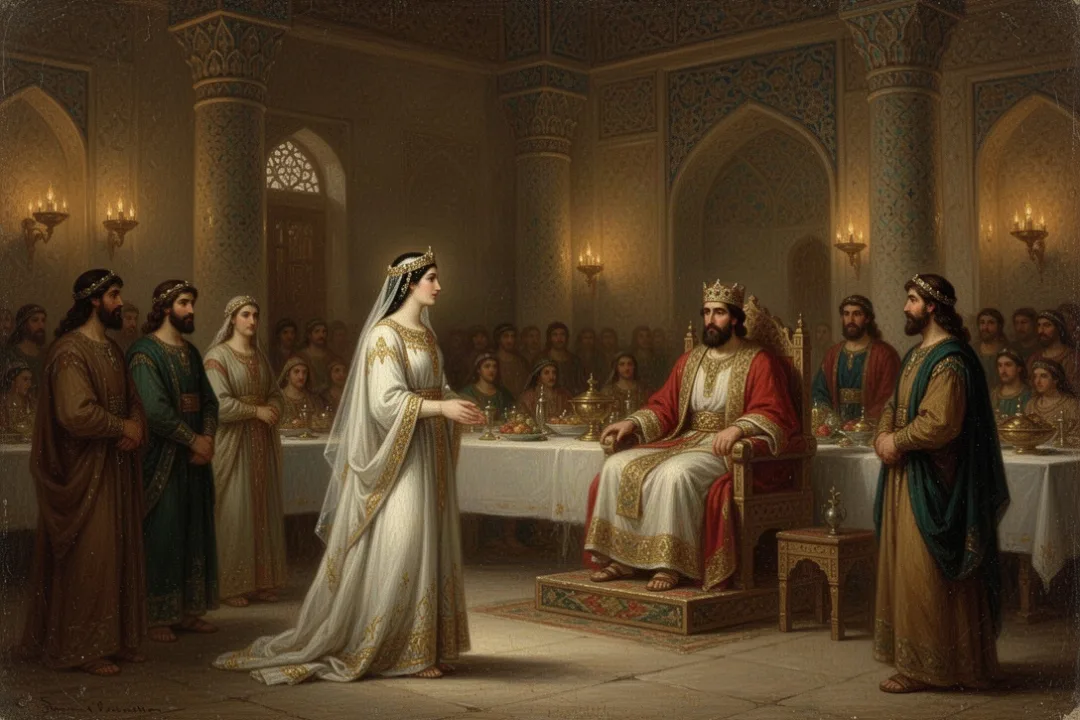
Esther’s position as queen did not mean she could freely enter the king’s presence. Persian court protocol made an unsummoned approach potentially fatal, even for the queen. Esther’s access to power was therefore real but limited, and she had to act with patience, wisdom, and careful judgment.
She was an outsider in the royal court because she belonged to a conquered and displaced people.
She was protected by secrecy for a time, since her Jewish identity remained hidden.
She had influence but not unrestricted authority over the king or the empire.
She had to make decisions through timing and relationship, rather than through official command.
How Esther saved the Jewish people
The threat begins when Mordecai refuses to bow before Haman, a high-ranking official whom the king has elevated above other officials. The book does not describe every reason for Mordecai’s refusal, but it makes clear that the conflict becomes personal and political.
Haman learns that Mordecai is Jewish and decides that punishing one man is not enough. He persuades the king to issue a decree against all the Jews in the Persian Empire. The decree sets a date for their destruction and permits violence against them throughout the kingdom.
When Mordecai hears the news, he mourns publicly and sends word to Esther. At first, she is hesitant to intervene. Mordecai reminds her that remaining silent may not protect her and suggests that she may have reached the royal position for a purpose connected with this crisis. Esther 4 records this exchange without presenting it as a simple or easy decision.
Esther then asks Mordecai and the Jewish people in Susa to fast for three days. She and the women with her will fast as well. Afterward, she plans to approach the king, even though doing so without an invitation could result in death. Her statement that she will go despite the danger expresses both resolve and realism.
Esther’s decision is essentially this: she will approach the king, even though the outcome is uncertain and the risk is personal.
Esther does not immediately accuse Haman or demand that the king reverse the decree. Instead, she invites the king and Haman to a banquet. At that banquet, she invites them to another banquet. The delay may seem surprising, but it creates a setting in which the king becomes attentive and the tension increases.
That night, the king cannot sleep and orders the royal records to be read. He discovers that Mordecai had once exposed an assassination plot but had received no public honor. Haman, who has come to request permission to execute Mordecai, is instead forced to honor him publicly.
At the second banquet, Esther reveals her identity and explains that she and her people have been marked for destruction. She identifies Haman as the person behind the plan. The king reacts against Haman, and the official is executed on the very structure he had prepared for Mordecai.
The first decree cannot simply be erased under Persian law. Esther and Mordecai therefore work to issue a new decree allowing the Jews to defend themselves. The Jewish community survives the attack, and Mordecai receives a position of great authority in the empire.
This sequence shows that Esther’s courage was not limited to one dramatic speech. She took several connected actions:
She listened to the warning instead of treating the crisis as someone else’s problem.
She called for fasting, involving the Jewish community and preparing herself spiritually and emotionally.
She approached the king despite the possibility of execution.
She used two carefully planned banquets to create the right moment for her appeal.
She identified the threat clearly and helped secure legal protection for her people.
What Esther’s courage means
Esther is often remembered as a courageous woman, but her courage is not the absence of fear. The story gives her a genuine reason to hesitate. She knows that she may lose her life, and she also understands that her royal position does not guarantee the king’s favor.
Her courage consists in acting while the outcome remains uncertain. She does not receive a promise that the king will welcome her or that her plan will succeed. She accepts a serious risk because the danger to her people is greater than the safety she might gain through silence.
Esther also demonstrates strategic wisdom. She does not confuse courage with impulsiveness. She gathers support, chooses the moment, prepares the king through conversation and meals, and speaks directly when the circumstances are ready.
Her story gives a fuller picture of bravery than a single bold act. Courage may include prayer or fasting, asking trusted people for support, gathering facts, and choosing words carefully. Esther’s approach is deliberate without being passive.
Another important feature is the movement from hidden identity to public identification. Esther begins the story by concealing that she is Jewish. By the decisive banquet, she openly identifies herself with the people targeted by Haman’s decree.
That disclosure is dangerous because it connects Esther personally to the threatened community. She is no longer able to remain separate from the consequences. Her statement to the king effectively communicates, “The people threatened by this decree include me.”
Practical lesson: Esther’s example joins courage with preparation. She does not rush into danger without thought, but she also does not let fear or privilege keep her silent when others are at risk.
Esther’s story also highlights the influence of people who work behind the scenes. Mordecai identifies the danger and challenges Esther to respond. The Jewish community fasts with her. Palace officials, servants, and royal records all affect the direction of events. Esther is the central figure, but the rescue involves a network of people and circumstances.
The book does not portray Esther as powerful from the beginning. She is an orphan, a minority woman in a foreign court, and someone whose freedom is restricted by royal authority. Her position changes, but her vulnerability never disappears completely. Her strength becomes visible precisely because she acts within difficult limits.
Where God appears in the Book of Esther
One distinctive feature of Esther is that the Hebrew version of the book does not explicitly mention God by name. It also does not directly describe prayer in the same way as books such as Psalms or Daniel. This absence has led readers to pay close attention to providential timing throughout the story.
Events repeatedly turn in unexpected ways. Esther becomes queen before the crisis appears. Mordecai learns of the assassination plot. The king cannot sleep on the night when the royal records matter. Haman arrives just as the king is deciding how to honor Mordecai. The threat designed for the Jews ultimately brings about Haman’s downfall.
The book does not pause to explain each event by saying that God caused it. Instead, readers are invited to consider how apparently ordinary details work together to preserve the Jewish people. The hiddenness of God in Esther is therefore part of the book’s distinctive character, not an accidental omission.
Some editions of the Greek Old Testament include additions to Esther that contain explicit prayers and references to God. These additions are accepted as part of the biblical canon in some Christian traditions but not in others. The Hebrew form of the book, which is central to Jewish Scripture and Protestant Bibles, presents the story without direct mention of God.
That difference should be kept in mind when someone asks whether Esther is a religious story. The book’s faith perspective is communicated through the survival of the Jewish people, the preservation of their identity, and the reversal of a plan to destroy them, even though explicit theological statements are limited.
The story also helps explain the Jewish festival of Purim. Esther 9 connects the festival with the days when the Jews gained relief from their enemies and with the casting of lots associated with Haman’s plan. Purim became a time to remember the deliverance described in the book, including through feasting, gifts, and care for people in need.
What Esther teaches readers today
Esther’s story is especially meaningful for readers who feel overlooked or constrained by their circumstances. She does not begin as a public leader with recognized authority. Her influence develops gradually, and she must use the limited access available to her.
Her example does not mean every person must seek public power. It suggests that your position can carry responsibility, especially when you are able to speak to people who cannot be heard in the same room. Esther’s opportunity is inseparable from the risk faced by those outside the palace.
The book also warns against the danger of dehumanizing an entire community. Haman’s plan treats the Jews as a problem to eliminate rather than as neighbors with individual lives and dignity. Esther’s intervention exposes the human cost hidden behind an official decree.
Mordecai’s challenge to Esther raises a difficult question about privilege. Can personal safety be separated from the suffering of one’s community? Esther is not blamed for initially fearing the consequences, but she is urged to recognize that silence may not preserve her security forever.
Readers can draw several grounded lessons from her decisions:
Pay attention to threats against vulnerable people, even when you are not the immediate target.
Seek wise counsel before taking a high-risk action.
Prepare carefully instead of assuming that urgency requires recklessness.
Use access responsibly when you have a voice in a powerful setting.
Remember communal support; Esther did not face the crisis entirely alone.
Esther is not presented as flawless or all-powerful. The narrative does not give her every answer, and it does not remove the danger surrounding her. What it does show is a woman who moves from hiddenness to identification, from hesitation to action, and from private safety to solidarity with her people.
That is why Esther remains one of the Bible’s most memorable figures. She was an orphan, a queen, a Jewish exile, and a courageous advocate. Her story centers on the preservation of a threatened people and on the possibility that a person placed in an unlikely position can act with wisdom when the moment demands it.
Frequently asked questions
Was Esther a real person?
The Book of Esther presents her as a historical queen in the Persian Empire. Many readers accept the account as a record of real events, while scholars continue to discuss the book’s historical details, literary style, and the identity of King Ahasuerus. The Bible itself identifies her as Hadassah, a Jewish woman who became queen and protected her people.
Was Esther related to Mordecai?
Yes. Esther 2:7 describes Mordecai as her older cousin who raised her after her parents died. Because he acted as her guardian, some translations or explanations describe their relationship in family terms that emphasize his parental care. He remained an important adviser and ally when Esther faced the threat against the Jews.
Why did Esther hide that she was Jewish?
Mordecai instructed Esther not to reveal her Jewish identity when she entered the royal palace. The text does not give one detailed explanation for this instruction, but the hostile environment and Esther’s vulnerable position provide understandable reasons for caution. She eventually disclosed her identity when doing so was necessary to expose Haman’s plot.
What is Esther remembered for in Judaism?
Esther is remembered for helping save the Jews of Persia from Haman’s planned massacre. Her story is read during Purim, a Jewish festival that celebrates the reversal of the threat and the community’s deliverance. Purim traditions include hearing the Book of Esther, sharing food, giving gifts, and helping people in need.




Leave a Reply