Esther and Mordecai are the central human figures in the Book of Esther, one of the Bible’s historical and wisdom-shaped narratives. They were Jewish people living in the Persian Empire, far from Jerusalem and the land of Judah. Their story unfolds in the royal city of Susa, where political power, court rivalry, and ethnic tension placed an entire community at risk.
Esther was a young Jewish woman whose Hebrew name was Hadassah. After becoming an orphan, she was raised by Mordecai, an older relative from her father’s family. The book presents Mordecai as her guardian, adviser, and protector. Their relationship is central to the story because Esther’s position inside the royal palace eventually gives her an opportunity to act on behalf of the Jewish people.
Mordecai was a Jewish exile associated with the tribe of Benjamin. The opening genealogy connects him with the earlier deportation of Judeans to Babylon, although interpreters discuss whether the passage describes Mordecai himself or an ancestor. He served at the Persian king’s gate, a phrase that suggests a position connected with the royal court, administration, or public access to the palace.
The king is called Ahasuerus in the Hebrew text. Many scholars identify him with Xerxes I, who ruled the Persian Empire in the fifth century B.C.E., although the book’s historical details and literary purpose have been discussed for centuries. The story’s setting is unmistakably Persian: it includes royal banquets, written decrees, court officials, imperial provinces, and the king’s dependence on advisers.
How Esther became queen of Persia
The story begins with a lavish royal celebration. Ahasuerus holds a long series of banquets to display his wealth and power. During the festivities, he commands Queen Vashti to appear before the guests, but she refuses. The king responds by removing her from her position and seeking a new queen throughout the empire.
Young women from across the kingdom are brought into the royal system. Esther is taken to the palace, but Mordecai instructs her not to reveal that she is Jewish. The text does not describe Esther as freely choosing a royal contest in the modern sense. Instead, it portrays a system in which the king’s officials gather women for possible selection as queen.
Esther wins the king’s favor and becomes queen. Her success gives her access to the center of power, but it does not immediately give her freedom to speak. She remains under pressure to hide her identity, and the king’s court is governed by strict rules. Even a queen cannot simply approach the king without being summoned.
Mordecai continues to watch over Esther from outside the palace. He does not publicly identify her as his relative, but he stays connected to her through the palace court. This relationship shows that Esther’s new status has not erased her family ties or her responsibility to the vulnerable Jewish community.
Important context: Esther’s position gave her influence, but it also placed her under real danger. Her decision to speak to the king was not a simple exercise of privilege; it involved risking her life.
Why Mordecai refused to bow to Haman
Mordecai’s conflict with Haman begins when the king promotes Haman above other officials. The royal servants are ordered to honor Haman, but Mordecai refuses to bow or show him the expected respect. The text links Mordecai’s refusal to his Jewish identity, though readers have proposed different explanations for the precise issue at stake.
Haman reacts with extreme anger. Instead of punishing only Mordecai, he decides to destroy all the Jews in the empire. His response reveals the danger of unchecked power: a personal grievance becomes an imperial policy. Haman presents the Jewish people to the king as a distinct group whose customs differ from those of other subjects. He persuades Ahasuerus to authorize a decree against them.
The king gives Haman authority to issue the decree in the king’s name. Official letters are sent throughout the empire, setting a date for the Jews to be attacked and their property taken. Because Persian royal decrees are treated as difficult or impossible to revoke, the danger is not merely a threat from one official. It has become law backed by the full authority of the empire.
Mordecai learns about the decree and responds with public mourning. He tears his clothes, wears sackcloth and ashes, and cries out near the palace gate. Other Jewish people throughout the empire also fast and mourn. These actions show that the crisis affects the entire community, not only Mordecai and Esther.
How Esther and Mordecai responded to the crisis
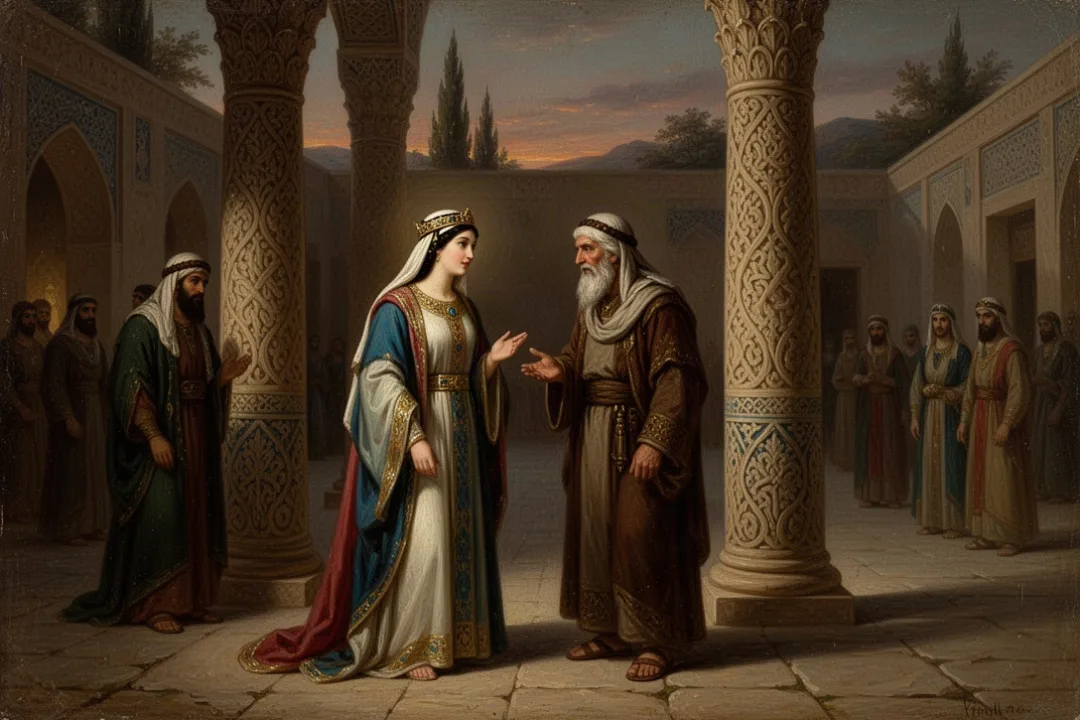
At first, Esther does not know why Mordecai is grieving. She sends clothing to him, but he refuses it. Their exchange develops through messengers because Esther is inside the palace and Mordecai is outside. He sends her a copy of Haman’s decree and asks her to appeal directly to the king.
Esther hesitates because approaching the king without an invitation could result in death. She has not been summoned for thirty days, and the law does not make an exception for the queen. Her concern is practical and justified: the palace’s rules protect the king’s authority more than they protect the people who live under it.
Mordecai then challenges Esther to consider whether her position has given her a unique responsibility. He warns that silence will not ultimately protect her and suggests that deliverance for the Jews may arise from another source. His message does not promise that Esther will be safe. Instead, it forces her to decide what kind of queen and member of the Jewish community she will be.
Esther accepts the responsibility. She asks Mordecai to gather the Jews in Susa and have them fast for her. She and her attendants will fast as well. Then she will go to the king, despite the danger. Her response demonstrates that courage in Esther’s story is deliberate action under threat, not the absence of fear.
Her words communicate a willingness to accept the consequences of her decision. Rather than relying only on her royal title or personal charm, she prepares spiritually and communally. The fast places her action within the support of the Jewish people and acknowledges that the crisis cannot be solved by private ambition alone.
Why Esther used banquets instead of making one immediate accusation
Esther approaches the king, and he extends his favor to her. Rather than immediately naming Haman as the enemy, she invites the king and Haman to a banquet. At that gathering, she invites them to another banquet on the following day. Her method may seem indirect, but the story presents it as careful strategy within a dangerous court.
Several factors make her approach effective. Esther must secure the king’s attention, control the setting as much as possible, and expose Haman’s plot in a way the king cannot easily dismiss. She also needs to show that the decree threatens her personally. Simply stating that an unnamed population is in danger might not move a ruler who has already authorized the policy.
Haman leaves the first banquet pleased by his access to the king and queen, but his satisfaction collapses when he sees Mordecai still refusing to honor him. At home, Haman boasts about his wealth, family, and royal advancement. Yet he admits that Mordecai’s presence ruins his enjoyment. His wife and advisers suggest building a tall structure on which Mordecai can be executed.
That night, the king cannot sleep. He orders the royal records to be read and discovers that Mordecai once uncovered a plot against the king. Mordecai had reported the danger, but he had received no reward. The timing creates one of the book’s most striking reversals: Haman arrives intending to request Mordecai’s execution, but the king asks him how to honor a man whom the king wishes to reward.
Haman assumes the king means him. He proposes royal clothing, a royal horse, and public proclamation of the king’s favor. The king then orders Haman to carry out those honors for Mordecai. The official who planned to humiliate Mordecai must instead lead him through the city and announce his importance.
How Esther exposed Haman’s plot
At the second banquet, the king again asks Esther what she wants. She identifies herself with the endangered people and asks that her life and the lives of her people be spared. Her appeal transforms the issue from an abstract administrative decree into a direct attack on the queen and her community.
Esther identifies Haman as the person responsible. The king is furious when he realizes that Haman has placed the queen in danger. Haman begs Esther for mercy, and the king interprets his posture near the queen as another offense. The narrative then turns against Haman completely: the structure prepared for Mordecai becomes the place of Haman’s execution.
The reversal is not merely a change in personal fortunes. Haman had used the king’s authority to make violence appear lawful. Esther brings the hidden political scheme into the open, while Mordecai’s earlier loyalty to the king becomes part of the case against Haman’s influence. Their separate acts of faithfulness converge at the moment when the plot is exposed.
Haman’s death does not automatically cancel the first decree. This detail matters. The Persian legal system in the story treats the king’s written orders as binding, so the king issues a second decree allowing the Jews to assemble and defend themselves. Mordecai receives Haman’s former position and authority to help organize the response.
How the Jewish people were delivered
The second decree gives the Jewish communities permission to protect themselves against those who attack them. Royal messengers carry the order throughout the empire. The people who had faced mourning and fear now experience relief, confidence, and public honor.
When the appointed day arrives, the Jews defeat those who seek their destruction. The narrative emphasizes that they do not seize the property of their enemies, even though the decree allows it. That repeated detail presents their action as defense rather than a campaign for wealth.
The story records conflict in several locations and describes additional fighting in Susa. Esther later requests that the conflict in the capital continue for another day, a detail that has led readers to wrestle with the book’s violence and its presentation of communal survival. The account is shaped by the reality of threatened annihilation in an ancient imperial world, not by modern categories of political or military conflict.
Mordecai and Esther establish annual observances to remember the Jews’ relief from danger. The festival is called Purim, connected with the lots Haman cast to determine the date of the planned attack. The name preserves the memory of a threat that appeared to be controlled by chance but was overturned through courage, strategy, and unexpected reversals.
Purim remembers reversal: mourning changes into celebration, and the threatened community gains security.
Purim emphasizes communal memory: the deliverance is recorded and shared across generations.
Purim includes generosity: the book connects the festival with gifts of food and support for people in need.
Purim honors Esther and Mordecai: their decisions become part of the community’s continuing identity.
What Esther and Mordecai reveal about courage and responsibility
Esther’s courage develops gradually. She begins the book as someone whose identity is hidden and whose movements are controlled by the royal system. By the crisis point, she chooses to reveal her identity and risk her life. Her growth does not mean she becomes reckless. She combines preparation, fasting, timing, diplomacy, and direct speech.
Mordecai’s courage looks different. He refuses to participate in an act of honor toward Haman, accepts the consequences of that refusal, and mourns publicly when the decree is issued. He also pushes Esther to act without pretending that the outcome is guaranteed. His role illustrates the importance of moral pressure from outside the center of power.
Together, Esther and Mordecai show that responsibility can take different forms. Esther uses access and personal risk; Mordecai uses protest, information, persistence, and organizational leadership. Neither succeeds alone. Mordecai needs Esther’s access to the king, while Esther needs Mordecai’s warning, support, and connection to the Jewish community.
Their relationship also demonstrates that family can include more than affection. Mordecai raised Esther, advised her, and challenged her. Esther listened to him, but she ultimately made her own decision. Their bond includes protection, honesty, disagreement, and shared responsibility.
Why God is not explicitly named in Esther
One of the most discussed features of the Book of Esther is that God is not directly named in the Hebrew version. The book also does not explicitly mention prayer, Torah observance, the Temple, or a return to Jerusalem. Fasting appears at the center of Esther’s preparation, but the narrative does not explain it with a direct theological statement.
This silence has encouraged different interpretations. Some readers see God’s providence in the timing of events: the king’s sleepless night, the discovery of Mordecai’s unrewarded loyalty, Esther’s access to the throne, and Haman’s unexpected downfall. The book never announces that these events are divine interventions, yet their pattern invites readers to perceive hidden care and purpose.
Other readers focus on the political and human dimensions of the story. Esther and Mordecai must make decisions within an unjust system, and the community’s survival depends on preparation and action. The absence of an explicit divine name can direct attention to responsibility: people cannot wait passively for rescue when they have the opportunity to protect others.
For Jewish readers, the book’s place in the festival of Purim has helped preserve a communal memory of survival in exile. For Christian readers, Esther is often read alongside other biblical accounts of providence, courage, oppression, and deliverance. Interpretations differ, but the text consistently invites careful attention to what happens when ordinary people use influence on behalf of those facing danger.
Historical and literary questions about Esther and Mordecai
Readers sometimes ask whether every detail in Esther can be confirmed through outside historical records. The book’s Persian setting is plausible, and some customs, administrative practices, and court details fit what is known about ancient Persia. Still, scholars continue to debate the relationship between the narrative and independently documented history.
The identification of Ahasuerus with Xerxes I is common because the names are linguistically related, but the book is not written like a modern historical report. It uses carefully arranged scenes, repeated reversals, dramatic timing, and irony. Haman’s plot, the king’s sleeplessness, and the unexpected punishment structure the story as a literary account of deliverance.
The book also raises questions about chronology and genealogy. Mordecai’s connection to the Babylonian exile may refer to his family line rather than his own lifetime. Esther’s relationship to Mordecai is described through family language that can be translated or interpreted in more than one way, but the narrative clearly presents him as her older guardian and close relative.
These questions do not remove the story’s value. They help readers distinguish between what the text clearly states, what later traditions infer, and what scholars debate. A responsible reading should avoid presenting uncertain details as settled fact while still taking the narrative’s themes seriously.
Common mistakes when reading Esther and Mordecai
The story is familiar enough that readers may unconsciously simplify it. Several common assumptions obscure important parts of the narrative and its ethical tension.
Calling Esther a modern beauty-pageant winner: the palace system involved royal power and the compulsory gathering of women, not a contemporary voluntary competition.
Reducing Esther to a passive figure: she begins under constraints but eventually plans a risky intervention and speaks decisively to the king.
Describing Mordecai as Esther’s biological father: the book presents him as her relative and guardian who raised her after she became an orphan.
Assuming Esther and Mordecai immediately revealed their Jewish identity: Esther kept her identity hidden for a time because Mordecai instructed her to do so.
Ignoring the legal problem after Haman’s death: the first decree remains in force, so a second decree is needed to permit Jewish self-defense.
Treating Purim as only a celebration of revenge: the festival also remembers deliverance, community solidarity, gifts, and support for people in need.
Claiming that God is explicitly mentioned throughout the book: the Hebrew narrative is notable precisely because God’s name does not appear directly.
Using “the Jews” as though the story concerns a single local group: the narrative describes Jewish communities spread across the Persian Empire.
Reading tip: Pay attention to reversals and timing. The narrative often reveals its meaning through events that first appear ordinary, such as a sleepless night or an overlooked record of service.
Practical lessons from Esther and Mordecai’s decisions
The story offers practical guidance without turning every detail into a simple formula. Esther does not act impulsively, and Mordecai does not treat courage as a substitute for planning. Their example suggests that responsible action often requires both moral clarity and careful preparation.
Gather reliable information. Mordecai learns the content of the decree and sends Esther a copy. Before responding to a crisis, establish what has actually happened and who is affected.
Recognize the influence you already have. Esther does not control the empire, but she has access to the king. Mordecai has information, persistence, and a connection to the community. Effective action often begins with using the influence already available.
Seek support rather than acting in isolation. Esther asks the Jewish community to fast with her. Serious decisions benefit from trusted people who can offer wisdom, solidarity, and practical help.
Choose timing carefully. Esther’s banquets create a setting in which the king will hear her appeal. Timing is not avoidance when it helps truth be heard and danger to be reduced.
Name the harm clearly. Esther explains that her own life and the lives of her people are threatened. Specific language can expose the human cost hidden behind official policy.
Remember the vulnerable after the immediate danger passes. The institution of Purim turns a single rescue into a lasting communal memory. Communities need practices that preserve lessons and care for those still in need.
These lessons should not be used to blame people who cannot safely confront an abuser, government, employer, or powerful institution. Esther had a unique position, and Mordecai’s situation was also specific. Courage may involve direct speech, documentation, seeking protection, organizing support, or helping another person reach safety.
How Esther and Mordecai are remembered today
Esther and Mordecai remain especially important during Purim, when Jewish communities read the Megillah, the Hebrew scroll of Esther. The celebration commonly includes public reading, gifts of food, gifts to people in need, and festive meals. Customs vary among communities, but the central purpose is to remember deliverance and strengthen communal joy.
Their story also continues to shape discussions about diaspora identity, hidden identity, political power, and resistance to persecution. Esther lives within a foreign empire without abandoning her connection to her people. Mordecai serves near the royal court while maintaining a distinct identity. Neither character fits the idea that survival requires complete assimilation or constant withdrawal.
The narrative is also valuable because it does not present courage as one-size-fits-all. Esther’s action is public and politically risky. Mordecai’s begins with refusal and public mourning. The Jewish community fasts, communicates, organizes, and eventually defends itself. Their combined response shows that large threats may require several forms of courage working together.
At the heart of the story is a question about responsibility: what should a person do when remaining silent appears safer, but silence leaves others exposed? Esther’s answer is shaped by her position, her relationships, her community, and her willingness to accept risk. Mordecai’s answer is shaped by conscience and persistence. Their story endures because it treats survival not as luck alone, but as a responsibility shared by people who choose to act.
Frequently asked questions
Were Esther and Mordecai married?
No. The Book of Esther presents Mordecai as Esther’s older relative and guardian, not her husband. He raised her after she became an orphan and continued advising her after she became queen. Esther’s marriage was to King Ahasuerus, the Persian ruler who selected her as queen after Vashti was removed.
What was Mordecai’s relationship to Esther?
Mordecai was Esther’s close relative and legal guardian. The text says he took her into his household and raised her as his own daughter after her parents died. He remained concerned for her safety and communicated with her through palace messengers during Haman’s plot.
Why did Esther hide that she was Jewish?
Mordecai instructed Esther not to disclose her Jewish identity when she entered the palace. The narrative does not give one detailed explanation, but the instruction reflects the risks of being a minority within the Persian court. Esther revealed her identity only when doing so was necessary to appeal for her people’s survival.
What festival honors Esther and Mordecai?
The Jewish festival of Purim honors the deliverance described in the Book of Esther. Its name recalls the lots, or purim, that Haman used when selecting the planned date for attacking the Jews. Common observances include hearing the Megillah read, sharing food, giving gifts to people in need, and holding a festive meal.







Leave a Reply