Baal Worship Today: History, Modern Practices, and Contemporary Perspectives
Baal Worship Today: History, Modern Practices, and Contemporary Perspectives
Understanding Baal worship today requires stepping back to its ancient roots and then surveying how the term is used in modern religious discourse, scholarship, and popular culture. This article explores Baal worship today through three lenses: history, modern practices, and contemporary perspectives. It uses variations of the phrase to capture semantic breadth—such as “Baal-worship today,”“present-day Baal devotion,”“modern Baal rites,” and “current Baal veneration,”—while keeping the discussion grounded in historical and cultural context.
The figure commonly known as Baal is not a single, solitary deity with a single, fixed set of attributes. In the ancient Near East, the word baal is a title meaning “lord” or “master,” and it appears in multiple linguistic and regional contexts. Over time, however, Baal Hadad became one of the most prominent manifestations of this title in the Levant and adjacent regions. In this section, we trace how Baal worship historically emerged, how scholars characterize it, and how it interacted with neighboring belief systems.
Origins and names
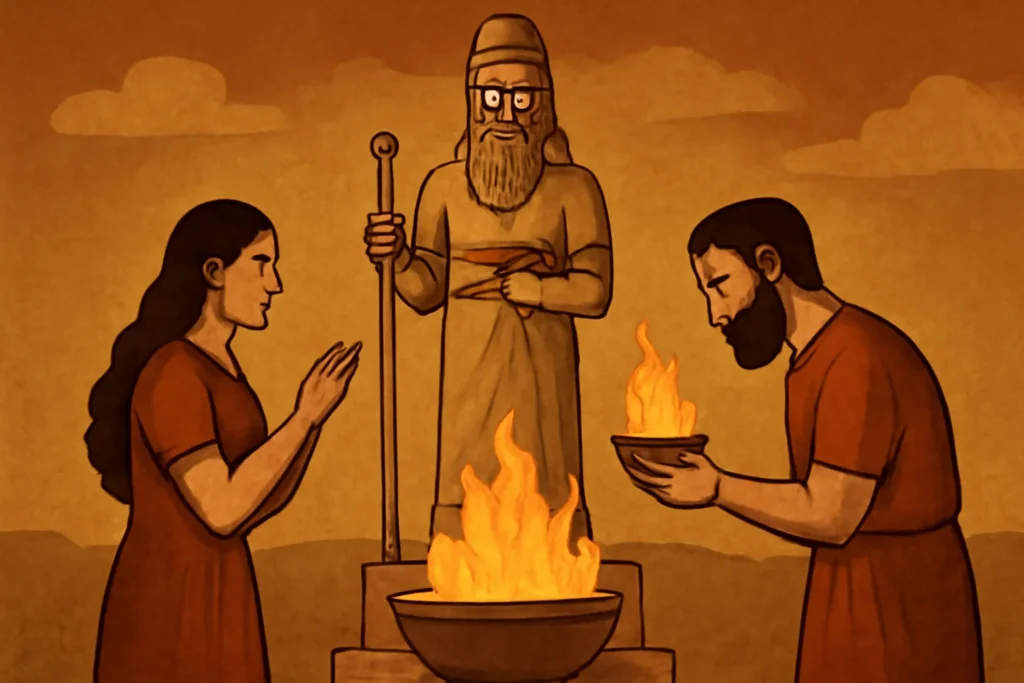
In the Bronze Age and early Iron Age economies of the Levant, Baal often referred to a god associated with storms, rain, fertility, and agriculture. The name Ba’al Hadad—“Lord Hadad” or “Lord of Hadad” (Hadad being another name for a sky god)—is one of the best-documented manifestations of this deity. The religious landscape at places like Ugarit, and across Canaan, featured a pantheon in which several deities could be identified as baalim (lords) of cities, places, or natural forces. In this framework, Baal is both a specific divine figure and a generic epithet that could apply to other local lords when invoked in ritual practice.
Ancient inscriptions and literary texts, including the famous Ugaritic tablets, present the ritual and mythic life surrounding Baal. They describe offerings, festivals, and mythic narratives in which the storm god’s powers are invoked to ensure harvests, rain, and the fertility of the land. In this sense, the worship of Baal was deeply tied to the agrarian cycle and the social order of urban and rural communities alike. The use of the title baal in many different languages and city-states underscores that this was a broad cultural category rather than a single, monolithic cult.
Baal in Ugarit, Phoenicia, and the wider region
In Ugarit and neighboring regions, the storm god is often identified with Baal Hadad, and rituals emphasize control over weather, rainfall, and agricultural success. The parallel religious currents in Phoenician cities—where traders, sailors, and farmers intersected—helped shape the diffusion of Baal-centered cults along the Mediterranean littoral. The cults associated with Baal interacted with other deities such as Asherah and Astarte, leading to a complex religious ecosystem in which devotion to Baal might be complemented or contested by female consorts and other divine figures. This network of associations is important when considering the later biblical portrayals of Baal as both a powerful adversary and a legitimate divine figure in certain contexts.
Mythological cycles—including stories about the struggle between Baal and the storm god Mot—are part of the broader Canaanite religious imagination. These narratives illuminate how ancient communities understood vitality, seasons, and cosmic balance. Over successive centuries, as monotheistic currents grew in the region—especially within Israel and Judah—dedicated worship of Baal often came to be framed as rival to the worship of Yahweh. Biblical and post-biblical writers frequently portray Baal worship as a danger to covenant community life, yet they also reflect a deeper, more complicated reality in which Baal was a recognizable cultural figure with a real historical footprint. In short, the ancient practice known as Baal devotion did not disappear overnight; it gradually receded from public life as monotheistic frameworks hardened, but its traces linger in archaeology, onomastics, and literary memory.
Archaeology and ancient textual studies reveal that elements of Baal-centered worship persisted in certain urban and rural settings far beyond the height of Canaanite city-states. In some Mediterranean contexts—such as Carthage and other Phoenician colonies—deities associated with the Baal tradition continued to have cultural resonance into later periods. Even so, the religious landscape shifted decisively as empires, trade networks, and religious reform movements reinterpreted or superseded older cults. The historical arc of Baal worship thus spans a long timeline: from vibrant ritual life in Bronze Age cities to a complex, mediated memory in later centuries. Understanding this arc helps readers distinguish between historical Baal worship and how the term is used in modern discussions.
Modern practices and contemporary expressions
Today, when people talk about Baal worship today, they are usually referring to one of several broader possibilities: scholarly interest in ancient religion; modernized or reconstructed religious movements that seek to revive aspects of Baal-centered cults; occult or esoteric traditions that incorporate Baal as a symbol or entity within ceremonial magic; or cultural and educational discussions that address how ancient worship is remembered, misrepresented, or repurposed in contemporary media. In practice, direct, organized worship of Baal as a discrete, widely practiced religion is not common in the modern world. Instead, the landscape is diverse and nuanced, with notable clusters in scholarship, occultism, and cultural memory. The following subsections outline these patterns with clarity and nuance.
Academic and reconstructionist approaches
In the realm of scholarship and reconstructionist religious thought, modern Baal devotion appears mainly as a scholarly reconstruction or a ritual-informed interpretation of ancient sources. Some contemporary pagans and polytheists engage in what they call neopagan reconstruction or polytheistic reconstruction, seeking to align ritual practice with historical sources such as the Ugaritic tablets, inscriptions, and comparative mythology. In this frame, practitioners may invoke or honor figures associated with Baal in ways that echo ancient rites, though frequently they do so within ethical and legal constraints consistent with contemporary religious pluralism. For many academics, the aim is not to re-create a religion of the past in full but to understand how Baal worship functioned in its historical setting, what it signified for communities, and how it shaped social and political life. In this sense, the phrase “modern Baal devotion” tends to describe intellectual and spiritual curiosity rather than mass religious movements.
In Western esotericism and ceremonial magic, Baal appears as a symbolic figure with a range of associations—often as a powerful spirit or demonized king in grimoires and magical writings. Contemporary occult practitioners may mention Baal or its variants (such as Ba’al or Beelzebub) when discussing ritual invocations, correspondences, or the hierarchy of spirits within a magical system. It is important to recognize that such uses are distinct from historical worship in the ancient Semitic world. They reflect a modern syncretism in which ancient names are repurposed to convey particular symbolic meanings—such as sovereignty, mastery, or elemental force—within a modern magical framework. For readers curious about the interface between traditional myth and modern occult practice, this area merits careful study and clear critical discernment, since sources can be interpretive, symbolic, or mythic rather than historical accounts of living devotion.
Beyond academic and occult contexts, Baal-worship today often appears in popular culture as a trope or symbol. In films, novels, and video media, Baal or Baal-adjacent figures may function as archetypal antagonists or as mythic embodiments of power and danger. This popular representation can influence public understanding—sometimes simplifying or sensationalizing ancient beliefs. Educational contexts—museums, university courses, and public lectures—tend to present Baal within the broader arc of ancient Near Eastern religion, emphasizing historical methods, linguistic evidence, and cultural memory. Here, the objective is often to prevent anachronistic conclusions and to illuminate the actual practices and beliefs of ancient communities rather than to promote sensational interpretations of “witchcraft” or “demon worship.”
Regional resonance and lasting monuments
Even when direct worship is not actively performed, regional legacies of Baal remain visible. The ruins of temples dedicated to Baal in places like Baalbek (in modern Lebanon) stand as archaeological witnesses to an ancient religious landscape. While visitors today typically encounter history, tourism, and scholarship rather than living rites, these sites remind us of the long continuity and transformation of Baal-associated traditions. In this sense, present-day Baal reverence may exist more as a scholarly or cultural memory than as a regular, everyday religious practice.
Contemporary perspectives on Baal in the present day
Scholars, theologians, and cultural commentators approach the subject of Baal worship today from multiple angles. Some emphasize continuity with the ancient past, arguing that certain features of Baal-centered cults—such as the association with rain, fertility, and agricultural cycles—echo in later religious innovations and agricultural rituals. Others stress discontinuity, highlighting how monotheistic communities reframed or rejected Baal worship as spiritual a threat. Still others examine how modern groups reinterpret the Baal categories to explore questions of power, sovereignty, or ecology in a contemporary moral universe. The following sections summarize these perspectives and some of the central debates that shape current thinking about Ba'al devotion, Baal veneration, and related terms.
Scholarly debates and interpretive frameworks
One ongoing scholarly debate concerns whether Baal represents a single, unified deity or a broader class of “lords” whose identities vary by locale. Some scholars propose that Baal Hadad was the principal form in several regions, while others argue for a more fluid concept in which “Baal” serves as a rotating title that could attach to different local gods depending on context. The question of syncretism—the blending of religious traditions—also figures prominently. In many periods, the worship of Baal existed alongside veneration of other deities, and the boundaries between these identities could be porous. Contemporary researchers often emphasize the social and political functions of Baal ritual: irrigation, land ownership, conflict resolution, and the legitimization of rulers, all embedded within sacred practices. When we speak of Ba'al devotion in historical terms, we are often describing a complex social technology as much as a system of belief.
Interfaith and polemical perspectives
From a theological vantage point, monotheistic traditions frequently portray Baal as a rival or idol. In modern interfaith dialogues, the historical Baal is understood not merely as an artifact of “myth” but as a case study in how religious communities define authority, covenant, and the boundaries of permissible worship. Some contemporary religious critics use the language of present-day Baal worship to caution against idolatry in general, while scholars routinely caution against equating ancient religious practice with modern sensationalism. The key takeaway is the importance of distinguishing between ancient ritual categories, modern ceremonial practices, and metaphorical usage—each with its own context and ethical implications.
Ethical considerations and responsible scholarship
Given the enduring fascination with Baal, it is essential to approach the topic with respect for historical complexity and sensitivity toward living religious communities. Responsible discussions about Baal worship today avoid sensational claims, recognize the diversity of modern interpretations, and acknowledge the limits of our evidence. When educators, journalists, or scholars discuss Baal in the present day, they typically foreground distinctions between myth, history, and contemporary spirituality. This disciplined approach helps readers avoid conflating ancient ritual life with modern occultism or misrepresenting the beliefs of living faith communities.
Common misconceptions about Baal in the modern era
As with many ancient deities, contemporary discourse around Ba'al worship often includes misconceptions. Some of the most frequent misunderstandings include:
That Baal was a single, universally worshiped god across all of the ancient Near East. In reality, Baal was a title used across diverse cultures for different local deities, with varying rites and associations.
That modern people openly worship Baal as a public religion. In most places, there is no widespread, organized Baal-worship movement akin to ancient cults; instead, there are scholarly, educational, or esoteric uses of the name and symbol.
That all references to Baal in the Bible reflect an identical figure. The biblical corpus reflects polemical, historical, and literary uses that sometimes diverge from how Baal appeared in living cults in ancient Canaan and Phoenicia.
That Baal-worship today is inherently antagonistic to monotheistic faiths. Contemporary discussions often recognize historical tensions while differentiating them from modern religious pluralism and interfaith dialogue.
What “Baal worship today” does not imply
It is important to clarify what modern discussions do not imply. They do not automatically endorse or celebrate ancient practices as a model for current life. They do not equate academic inquiry with religious endorsement. And they do not indict contemporary communities by appealing to sensationalized stereotypes about “pagan worship.” Instead, the accurate frame is to understand Baal within its historical contexts and to examine how those histories influence present-day scholarship, culture, and spiritual exploration.
Glossary of terms and concepts related to Baal
Baal
A title meaning “lord” used for multiple deities in ancient Semitic languages; commonly associated with the storm god Hadad in some regions.
Baal Hadad
The storm/fertility deity often identified with Baal in Canaanite and Phoenician contexts.
Asherah
A mother goddess figure who appears in the same religious milieu as Baal and is part of the broader mythic network surrounding Baal worship in some sources.
Mot
A death deity in some Baal-related myths, notably in conflict with Baal in Ugaritic narratives.
Beelzebub
A later Judaic-Christian demonized form associated with Baal in some traditions and literature, illustrating how names evolve in religious memory.
Hellenistic and Roman syncretism
Periods when Baal-like figures were interpreted through Greek and Roman religious frameworks, influencing the broader Mediterranean religious landscape.
Conclusion: Baal worship today in perspective
Understanding Baal worship today requires distinguishing between historical reality and modern representation. The ancient Baal cults were dynamic, context-bound religious systems tied to local communities, economies, and political structures. In the present day, the concept persists mainly as a scholarly subject, a symbol within esoteric traditions, and a cultural marker that helps people discuss the broader history of religion in the Near East. While there are occasional modern groups that claim to reenact or reinterpret Baal-centered rites, these are comparatively marginal in scale and are best understood within the frameworks of religious studies, anthropology, and cultural history rather than as the revival of a single, unified ancient practice. For students, readers, and researchers, the enduring takeaway is that Baal worship today lives primarily in memory, interpretation, and the ways we talk about the past—rather than in a single, cohesive contemporary religious movement. By approaching the topic with nuance and care, we can appreciate the historical significance of Baal while avoiding distortions that arise from sensationalism or oversimplification.
As you reflect on present-day Baal devotion and its various manifestations, consider the following guiding questions:
- How do scholars reconstruct ancient worship from fragmentary sources?
- In what ways does modern esotericism repurpose ancient names for symbolic force?
- What can the memory of Baal worship teach us about how cultures handle religious change and conflict?
- How does education about ancient religion contribute to respectful interfaith dialogue in the present day?
Ultimately, the study of Baal-worship in the modern era invites a careful balance: honoring historical complexity, recognizing contemporary plurality, and remaining attentive to how language shapes our understanding of religion across time. By keeping these distinctions in view, readers can engage with the topic in a way that is informative, responsible, and enlightening for a broad audience.








Leave a Reply