Baal worship refers to the religious practices centered on a family of deities known by the title Baal, meaning "lord" or "master" in various Semitic languages. Across different cultures and eras in the ancient Near East, the term was applied to a range of gods who shared a common role as powerful, life-giving forces—often linked to weather, fertility, storms, and regional crops. The phrase Ba'al worship thus both designates a specific set of cults and serves as a general label for the broader, polytheistic milieu in which these cults operated.
In this article, we explore Baal worship as a historical phenomenon, tracing its origins, regional varieties, core beliefs, ritual practices, symbolic meanings, and its long afterlife in biblical polemic and modern scholarship. We will consider how the worship of Baal differed from and interacted with other religious traditions in the ancient world, including the worship of Yahweh in Israel, elite Phoenician-Roman cults, and the broader ecology of storm and fertility cults. By examining textual sources, archaeological findings, and scholarly interpretations, we gain a clearer sense of what the Baal cult represented for worshippers, priests, and communities, as well as why it became a frequent target of reformers and prophets.
Historical Roots and Regional Variants
The concept of a Baal figure emerged in the broader ancient Near Eastern milieu, where multiple city-states and tribal groups venerated high powers tied to the weather, harvest, and territorial sovereignty. In many cases, the term itself was used as a generic title—“the lord”—applied to local high gods or storm gods. Over time, however, specific regional forms crystallized into named deities such as Baal Hadad (the storm god of the weather and rain), Baal Hammon (a North African and Punic variant of the fertility storm motif), and Baal Melqart (the Tyrian counterpart tied to city-fortunes and imperial charisma). The common thread across these variants was a perception of Baal as a life-giving force whose favor could bring rain, grain, fertility, and political strength.
Origins in the Near East: Thunder, Rain, and Fertility
In the Canaanite-speaking world, agricultural success depended on timely rain and seasonal cycles. As communities settled and formed urban centers, leaders often claimed divine backing to sanctify rainmaking and harvest fertility. The cults associated with Baal functioned within this framework: ritual acts, offerings, and temple economies were organized around the expectation that Baal-like lords would respond to human pleas with favorable weather and bumper yields. In the Ugaritic tablets of the late Bronze Age, scholars find complex mythologies and cultic inscriptions that illuminate the symbolic language of Baal across a shared Semitic cultural sphere. These sources indicate that the Baal figure could be invoked for renewal after hardship, including moments of drought or political crisis.
Regional Variants Across the Levant and the Mediterranean
As maritime cultures expanded, the name Baal traveled and evolved. In the Phoenician world, Baal forms appear in urban centers like Tyre and Sidon, where Baal Melqart becomes a central emblem of urban prosperity and the frontier economy. In Carthage, Baal Hammon emerges as a storm-and-fertility deity linked to cycles of seasonal renewal that supported colonial agriculture and seafaring trade. In the interior and southern Levant, Baal Hadad functions as a major sky and rain god whose favor was sought for crops and livestock. These regional variations show how a common archetype—“the lord” of weather and fertility—could be adapted to local political, linguistic, and economic contexts.
The Beliefs and Practices of Baal Worship
The religious landscape surrounding Baal worship was deeply polytheistic and community-centered. Worshipers typically conceived Baal as a powerful, sometimes capricious, intermediary between the heavens and the earth. Ritual life revolved around securing Baal’s favor for rain, fertility, and political stability, while balancing relationships with other deities such as Asherah, Anat, and Mot. Because the Baal cult was not a monolith but a suite of regional cults, specific beliefs and practices varied, yet certain core motifs recur across sources: the privileging of seasonal cycles, ritual adhesion to sacred topography (high places and temples), and the role of priestly orders in sustaining cultic activities.
Key Beliefs of the Baal Cult
Weather as divine governance: Baal and his related storm functions regulate rainfall, drought, and agricultural productivity.
Fertility as cosmic order: The prosperity of the land is tied to the fertility of the earth, flocks, and crops, all of which depend on Baal’s favor.
Divine reciprocity: Worshipers expect offerings, vows, and rites to be met with divine responses in the form of rain, harvests, and peace.
Intermediary deities: Baal often coexists with consorts like Asherah and warrior goddesses such as Anat, creating a broader pantheon that supported social and military life.
Ritual Practices and Temple Life
The visible center of many Baal-cult activities was the temple or high place, where rites were conducted by the priestly class. Typical practices included:
Offerings and sacrifices: Offerings of grain, wine, livestock, and sometimes incense to win Baal’s favor.
Festivals tied to seasons: Rituals aligned with sowing, growing, and harvest times to secure timely rains and healthy crops.
Processions and cultic songs: Musical and lyrical performances that praised Baal’s might and begged for renewal after hardship.
Divination and votive acts: Ritual actions by priests to discern Baal’s will regarding political decisions or weather forecasts.
Contested Practices: Prostitution, Sacred Meals, and Temple Economics
Some scholarly debates surround certain rites associated with fertility cults. In popular narratives, Baal worship is sometimes linked to controversial practices such as sacred prostitution or ritual meals in which intimate or temple-community acts symbolically reproduce the fertility cycle. It is important to distinguish between competitive claims in the textual tradition and the archaeological record, which sometimes offers a partial or ambiguous picture. What remains clear is that fertility and agricultural abundance were central to the appeal of Baal cults, and that temple economies often linked religious devotion with political power and social legitimacy.
Symbolism is central to understanding how worship of Baal communicated power, authority, and natural order. The iconography associated with Baal and related storm-bringing deities served as a visual shorthand for the divine benevolence that sustains life and society.
Dominant Symbols: Storm, Rain, and the Sky
The primary association of Baal is with the thunderstorm and the rains that nourish crops. In art and inscription, Baal’s authority is implied through motifs of lightning, rain, or storm imagery, representing the ability to command the heavens. The mythic narratives in sources such as the Ugaritic corpus emphasize Baal’s battles against drought and the forces of chaos, underscoring his role as a stabilizer of cosmic order.
Iconic Animals and Objects
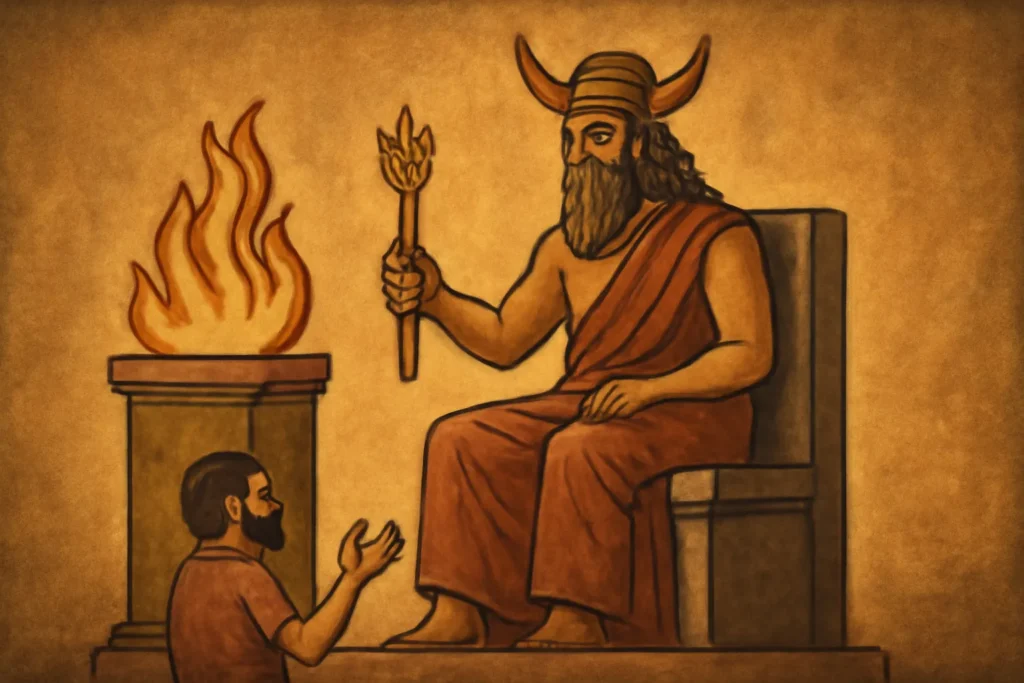
The bull is a recurrent animal symbol associated with Baal in several regional epitomes, illustrating strength, fertility, and the fecundity of the land. The bull’s vigor embodies the agrarian ideal of robust harvests. Some cult images and seals also depict Baal or Baalic traits with horned representations, visually linking the deity to power and vitality.
Temple Architecture and Sacred Space
The physical spaces dedicated to Baal worship—temples, high places, and sacred groves—were designed to reflect order and access to the divine. Altars, offering tables, ritual candles, and symbolic trees or columns often marked the boundary between the profane world and the sacred realm where Baal’s presence was invoked.
Textual Imagery: Names, Epithets, and Theophoric Elements
Epithets and theophoric names invoking Baal appear across inscriptions and inscriptions’ fragments, revealing a network of relationships and divine favors. The name “Ba’al” itself functions as a descriptor of lordly authority, while specific epithets—such as “Hadad” for the storm aspect—helped worshippers identify which facet of Baal they addressed in prayer or ritual.
Textual Evidence, Archaeology, and Intercultural Exchange
Our understanding of Baal worship rests on a multidisciplinary corpus that includes texts, inscriptions, seals, and architectural remains. Three major lines of evidence shape the picture:
Ugaritic literature: The Ugaritic tablets provide a rich mythic and ritual vocabulary surrounding Baal, including the Baal Cycle and his conflicts with Mot, his death, and eventual renewal. These texts illuminate the theological framework in which Baal functioned and how worshipers conceptualized divine power.
Biblical and post-biblical sources: The Hebrew Bible contains numerous critiques and theological polemics against Baal worship, revealing how this cult intersected with Israelite and Judahite religious life. Later Roman and Christian authors also echoed debates about Baal and related fertility cults.
Archaeology and iconography: Temples, altars, inscriptions, and figurines offer tangible evidence of altars, offerings, and ritual acts. In some urban centers, material culture attests to a thriving priesthood and temple economy that supported communal worship and ritual performance.
A key challenge in interpreting this evidence is disentangling parallel cultic practices across different regions that may share a common “Baal” label but differ in details. Modern scholars emphasize both the diversity of Baal worship and the continuity of its underlying motifs—divine sovereignty over nature, communal fertility, and the recurring need to reaffirm cosmic order through ritual acts.
Conflict, Reform, and Opposition: The Biblical Perspective
The relationship between Baal worship and the biblical prophets is often framed as a struggle between competing religious frameworks within the same cultural sphere. On one side stood the reformers who pursued exclusive devotion to Yahweh, while on the other stood temple networks, priesthoods, and royal patrons who maintained Baal-centered practices as a source of political legitimacy and communal identity.
Elijah, Mount Carmel, and the Contest of Powers
The episode of Elijah on Mount Carmel is one of the most famous polemical scenes featuring a Baal-themed confrontation. In that narrative, the prophets of Baal fail to elicit Baal’s response, while Elijah’s prayer is answered by Yahweh, underscoring the biblical claim of Yahweh’s supremacy over Baal across the Israelite imagination. This story is representative of a broader pattern in which prophetic voices critique Baal worship as a deviation from the covenantal path.
Political Realignments and the Endurance of Local Cults
While prophetic reformers often sought to suppress Baal-centered rites, the persistence of Baal cults in various regions reveals a more complex dynamic. In some urban centers, Baal worship persisted alongside Yahwistic or monotheistic currents, reflecting pragmatic adaptations to local politics, economic needs, and cultural memory. The fate of Baal-worshipping communities varied: exile or assimilation, reformist decrees, and the rebranding of sacred space into new forms of worship all illustrate how religious landscapes evolve under pressure.
Associations with Other Deities and Ritual Network
Because Baal worship often existed within a broader pantheon, its actors frequently interacted with other religious currents, including fertility goddesses, kings, and priestly orders. The interplay between Baal, Asherah, Anat, and other deities created a dynamic religious ecosystem in which ritual offerings, political alliances, and ritual purity laws could shape a community’s sense of divine favor and social cohesion.
Legacy and Modern Scholarship: How We Study Baal Worship
In modern scholarship, the study of Baal worship has shifted from simplistic portrayals of “barbaric fertility rites” to nuanced reconstructions that emphasize historical context, regional variation, and the interplay of religion with politics and economy. Key themes in contemporary research include:
Regional specialization: Recognizing that Baal variants were not identical across every city, scholars emphasize local cultic forms and names, such as Baal Hadad in some contexts and Baal Melqart in others.
Textual synthesis: Integrating Ugaritic, Hebrew Bible, Phoenician inscriptions, and archaeological data provides a more complete picture of how Baal worship functioned in daily life and state ritual.
Iconographic interpretation: Examining the symbolic language of images—thunder, rain, bulls, horns—helps explain how communities publicly displayed divine favor and political power.
Thematic continuity and change: While some ritual forms may have changed or been suppressed, the underlying human concerns—prosperity, security, and natural order—continued to shape religious behavior across centuries.
For students of religion and archaeology, Baal worship offers a valuable case study in how polytheistic systems organize themselves around natural phenomena and how religious institutions negotiate power, memory, and identity within broader ancient societies.
Conclusion: The Meaning of Baal Worship in the Ancient World
Baal worship, in its many regional avatars, represents a key thread in the tapestry of the ancient world’s religious life. It reveals how communities sought to explain and influence the forces of nature that governed their crops, weather, and political fortune. It shows the importance of ritual spaces, priestly offices, and festival calendars in shaping communal memory and social order. It also illustrates how later religious movements—whether in the biblical tradition, or in the later Roman and medieval receptions of Near Eastern cults—reinterpreted Baal’s legacy to address new social realities and theological questions.
By examining the history, beliefs, and symbolism of Baal worship, readers gain insight into the complexity of ancient religiosity: a polytheistic world where deities were invoked to secure daily life, agricultural abundance, and the political vitality of cities. The story of Baal is not simply a tale of error or heresy dismissed by reformers; it is a story about how communities navigated power, seasonality, and the ever-present human desire to appease forces larger than themselves.
Whether you approach this topic from a literary-historical perspective, an archaeological angle, or a theological inquiry, the study of Baal worship remains a compelling lens for understanding ancient religion as a living, social, and culturally embedded phenomenon.









Leave a Reply