Benediction with the Blessed Sacrament: Meaning and How to Pray
Benediction with the Blessed Sacrament is a solemn Catholic practice that gathers worshippers for intimate
encounter with the Real Presence of Christ in the Eucharist, followed by a blessing that extends Christ's grace to the church and the world.
This article explores what the blessing with the Blessed Sacrament means, how the rite developed, what to expect when you participate,
and practical guidance for praying and growing in devotion during expository adoration and sacred blessing.
What is this practice and why does it matter?
In everyday language, people often refer to benediction with the Blessed Sacrament as the rite of Exposition and Benediction, a liturgical
sequence in which the Eucharist is exposed for adoration, reverence is shown through acts like kneeling or bowing, and the faithful receive a formal
blessing with the monstrance containing the consecrated Host. The term bendiction (from the Latin benedictionem) captures the act of calling down grace upon the people—an act that closes a period of Eucharistic prayer with the sanctifying sign of the cross.
The practice is deeply rooted in the Catholic understanding of the Real Presence of Christ in the Eucharist. It is not merely a symbol or a
decorative ceremony; it is a point of encounter—where the Lord of life is believed to be truly present, body, blood, soul, and divinity. The
blessing at the end of the rite is a way of sending grace outward into our homes, churches, and neighborhoods.
Historical and theological background
Origins of the rite and the language of blessing
The practice of venerating the Blessed Sacrament through exposition and blessing grew in the context of the medieval Church’s deepening
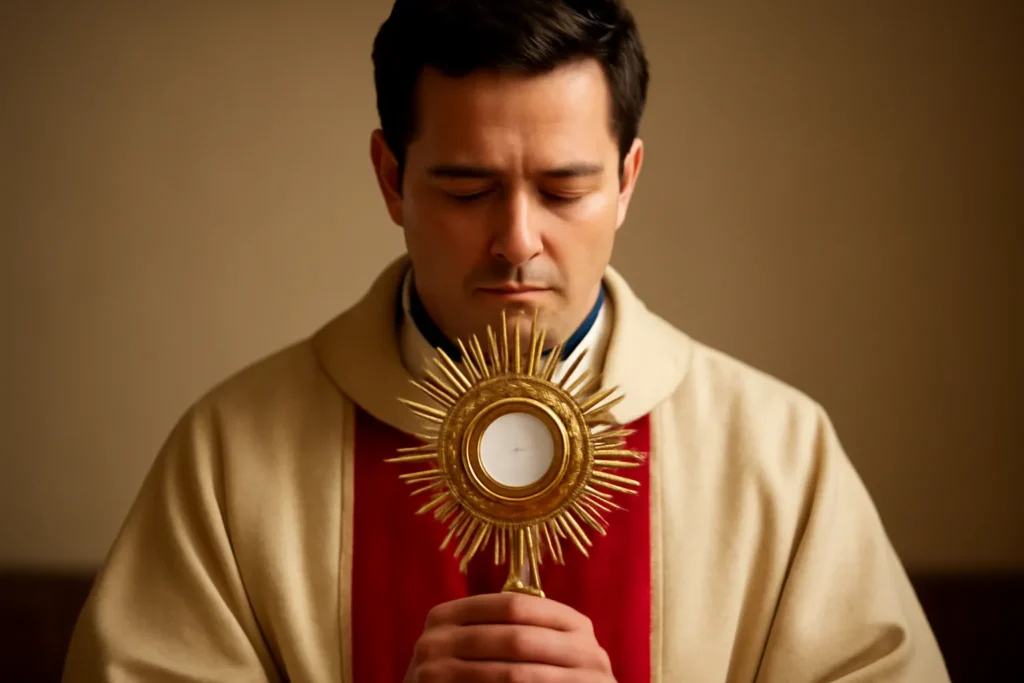
eucharistic devotion. The term Exposition of the Blessed Sacrament describes the period when the consecrated Host is placed in a monstrance on the altar
for the faithful to adore. The practice culminates in a blessing with the Blessed Sacrament, during which the priest blesses the people with the
monstrance held aloft or placed upon the altar.
A watershed moment in the public devotion came with the devotion to Corpus Christi, whose liturgical formalization helped popularize
the sense that Christ’s presence is not only in the liturgical sacrifice but also in the opportunity for personal and communal encounter
through adoration. The feast and the associated rites helped ordinary believers participate more fully in the mysteries of the faith
through contemplative prayer, hymn, and silent adoration.
Theology of the Real Presence and the purpose of adoration
Central to benediction with the Blessed Sacrament is the Church’s teaching on the Real Presence of Jesus in the Eucharist. The
faithful are invited to encounter Christ not only in Mass but in moments of quiet prayer before the exposed Host. Adoration is a form of worship
that acknowledges Jesus as truly present, not symbolic, and it seeks to align the heart with the will of the Eucharistic Lord. The blessing that follows
is a pastoral act of spiritual sending, a commissioning to be witnesses of mercy, truth, and charity in daily life.
The rite also communicates a theology of communion and worship. When the Blessed Sacrament is exposed, the community engages in a
shared act of adoration; when it is blessed, a visible sign of grace is given to all present. This cadence—adore, bless, go forth—frames the spiritual
life of many parishes, especially during evenings of contemplation or during Holy Hours organized around Eucharistic devotion.
Structure of the rite: what happens during Exposition and Benediction
Exposition and adoration
The sequence typically begins with a gathering prayer, hymn, and procession to the altar, where the priest or deacon places the Blessed Sacrament in the monstrance
for public adoration. Elements often present include:
Incense as a sign of reverence and the sanctity of the Eucharistic presence.
Kneeling or deep bowing as a sign of worship and prostration before Christ present in the Host.
Silence for personal prayer, reflection, and listening to the prompting of the Holy Spirit.
Readings and hymns that focus on the mystery of the Eucharist and the call to holiness.
During this time, the faithful may offer prayers of intercession, gratitude, repentance, or simple praise. The length of time for exposition can vary from parish to parish and from occasion to occasion, ranging from a modest quarter-hour to a longer Holy Hour.
The moment of Benediction
The canonical moment at which the blessing occurs is the bendiction with the Blessed Sacrament, when the celebrant raises the monstrance and blesses the people with
the Sign of the Cross. The blessing is both a public act of grace and a visible reminder of Christ’s mission to the world. The words used in the rite
emphasize Christ’s presence and the desire for God’s blessings to reach every corner of life: home, work, school, and community.
The blessing is often preceded by brief prayers or hymns that prepare the heart for receiving grace.
Sacred music during this moment typically includes lines from classic hymns, such as Tantum Ergo or other hymnody that orients the heart toward adoration.
The faithful may make the sign of the cross as a sign of assent to the blessing and as a personal profession of faith.
Concluding customs
After the blessing, the monstrance is returned to the corporal on the altar and the rite concludes with a closing prayer, Divine Praises (where used),
or a short benediction, followed by a solemn recessional hymn. Many parishes offer a period of quiet departure, allowing congregants to carry the grace
of the moment into daily life.
Meaning and significance of benediction with the Blessed Sacrament
The practice carries multiple, complementary meanings that enrich both personal spirituality and communal life. Here are some central aspects:
Real Presence made tangible: The visible exposure and the subsequent blessing underscore the Catholic belief that Jesus Christ is truly present in the Eucharist.
Adoration as formation: Quiet adoration forms the heart by turning attention away from distractions and toward the One who calls us to holiness.
Spiritual refreshment and renewal: The blessing is a moment of grace that replenishes faith, hope, and charity, renewing trust in God’s providence.
Public proclamation of faith: In a communal setting, the rite witnesses to Christ’s lordship and invites others to encounter Him, whether inside a church or in daily life.
Mission and outreach: The blessing extends to the world, pushing believers to live witness and service beyond the church walls.
The devotion also invites believers to consider the Eucharist not only as a sacrifice celebrated at Mass but as a living presence that accompanies them as they navigate
daily decisions, relationships, work, and service. In this sense, benediction with the Blessed Sacrament becomes a weekly, or even daily, rhythm of
contemplative life and active charity.
How to participate: practical guidance for praying during Benediction
Whether you are a veteran of Eucharistic devotion or a newcomer, these practical steps can help you enter more deeply into the experience of Exposition and Benediction:
Prepare your heart before you leave home. Bring a pocket card with a brief personal intention or a short scripture verse to reflect on, such as a line from Psalm 46 or John 6.
Arrive early to settle into the church’s quiet or the designated praying space. A calm space helps you listen to God’s voice more readily.
Enter with reverence. Approach the altar with a gesture of respect—genuflection if you are able or a deep bow—that acknowledges Christ’s presence.
Participate in the prayerful choreography. If the liturgy includes a responsorial psalm, a sung hymn, or a brief reading, join in with heart and voice as you can.
Adore in silence. Let the mind rest on the mystery of the Eucharist. If thoughts wander, gently bring them back to the presence of Christ.
Offer simple prayers. You may say a personal prayer, recite the Latin “Tantum Ergo” and “O Salutaris Hostia” prayers, or simply speak words of gratitude.
Move to intercession. Bring to mind loved ones, the ill, the needy, and those who do not yet know Christ. Ask for grace for them and for the world.
Receive the blessing with attention. When the priest blesses with the monstrance, respond with faith; you may make the Sign of the Cross or bow your head in gratitude.
Carry the grace into daily life. After the rite, consider how to translate contemplation into concrete acts of charity, patience, and mercy.
Conclude with gratitude. Offer thanks to God for the gift of the hour and the grace received.
For those seeking a more structured approach, a simple framework might be: Adoration, Petition, Thanksgiving, and Commission—a rhythm that can anchor your
prayer during the Exposition and Benediction.
Texts and prayers commonly used in Benediction with the Blessed Sacrament
The rite often includes traditional prayers and canticles that have become standard across many parishes. Here are some of the familiar elements you may encounter:
O Salutaris Hostia (O Saving Victim) – a hymn of thanksgiving and praise sung as the Eucharist is exposed.
Tantum Ergo (Down in Adoration) – a hymn that accompanies the act of adoration and is often sung during the exposition or just before the blessing.
Divine Praises – a litany-like metrical proclamation of praise that is sometimes recited after the blessing.
Laudes or lamentations in some communities may replace or accompany the hymns, depending on regional tradition and parish preference.
Short prayers for intention or brief readings from Scripture, such as a Psalm or Gospel verse related to Christ’s presence in the Eucharist.
While the exact texts can vary by diocese and tradition, the overarching pattern remains the same: exposit, adore, bless, and send forth.
If you participate regularly, you may become familiar with the flow and gradually grow in familiarity with the prayers that your parish uses.
Variations and ecumenical perspectives
Roman Rite and other Catholic rites
In the Roman Rite, the sequence is standard and widely observed in many parishes. However, similar forms of Eucharistic devotion appear
in other Catholic rites around the world, including Ambrosian, Syro-Malabar, and some Byzantine-influenced liturgies, each with its own
musical and ceremonial emphases. The core idea remains: a period of Eucharistic exposition followed by a blessing with the Blessed Sacrament.
In some Ambrosian Rite communities, there are distinctive musical and ceremonial customs for exposure and benediction.
In Eastern Catholic traditions, adoration of the Blessed Sacrament is often integrated with other forms of Eucharistic devotion, though the explicit “Benediction”
with the monstrance as practiced in the Latin Rite may be less common.
Ecumenical and inter-denominational considerations
Some Anglican communities with rich Eucharistic devotion maintain a form of Adoration and Benediction, especially in parishes with Anglo-Catholic
leanings. In these contexts, the language may echo Catholic prayers and sacral imagery, while remaining anchored in Anglican ecclesiology.
For other Christian families or seekers, the practice can still offer a window into the beauty of liturgical worship and a model for deep prayer before God. It can
help people articulate a desire for intimate encounter with Christ and a disciplined practice of prayer within a liturgical setting.
Practical considerations for churches and worship leaders
If your parish or community is new to Exposition and Benediction, you may find it helpful to keep a few practical guidelines in mind:
Clarity of leadership: A clear liturgical guide and a brief explanation at the outset help worshippers participate with confidence.
Music and silence balance: Use music to accompany the moments of adoration, with ample time for silent prayer between hymns.
Sanctuary setup: The monstrance should be prominently displayed, with appropriate lighting and minimal distractions in the sanctuary.
Ritual pacing: Allow generous time for silence after the exposition and before the blessing so people can interiorly respond to grace.
Practical accessibility: Ensure that the service is welcoming to families, youth, and first-time participants, with simple explanations or handouts.
In planning a benediction service, it can be helpful to coordinate with musicians, lectors, and sacristans to ensure the flow is smooth and the sacred action remains the
central focus of the hour.
Frequently asked questions about Benediction with the Blessed Sacrament
What does benediction with the Blessed Sacrament signify?
It signifies a twofold action: adoration of Christ present in the Eucharist and the blessing of the faithful with the Eucharist, sending grace outward into the world.
Is the Eucharist still present after the blessing?
Yes. The Eucharist is exposed for adoration during the Exposition and remains present in the monstrance during the blessing. After the blessing, the monstrance is returned to the tabernacle in many places, and the faithful continue to be spiritually connected to that moment.
Who can participate?
All who are drawn to contemplation and prayer. Children, families, and individuals of every age are welcome, with appropriate guidance for younger participants.
How long does a typical benediction last?
Most services run between 25 and 50 minutes, depending on local custom, the inclusion of Divine Praises, and the duration of the exposition and hymnody.
What prayers are commonly used?
Common prayers include O Salutaris Hostia, Tantum Ergo, the Divine Praises, and biblical or liturgical readings appropriate to the occasion.
Closing reflections: living the blessing in daily life
A meaningful practice of Benediction with the Blessed Sacrament invites believers not only to encounter Christ in church but to bring that encounter
into the rest of life. If you attend benediction regularly, you may notice a growing sense of peace, attention to conscience, and readiness to serve others.
Consider the following as natural extensions of the rite:
Prayerful generosity: Let the grace received through the blessing motivate acts of charity and service in daily life.
Holiness of daily duties: See ordinary tasks—work, family life, studies—as opportunities to love God and neighbor.
Continued Eucharistic life: Maintain a personal practice of daily prayer, reading Scripture, or short moments of quiet before the Blessed Sacrament when possible.
Community witness: Invite others to join in adoration or to share in the experience of the Eucharist through service or outreach.
In sum, the practice of benediction with the Blessed Sacrament is more than a liturgical moment—it is a living invitation to
encounter Christ, to respond in faith, and to let grace shape the way believers think, act, and relate to one another and to the world.








Leave a Reply