The Eucharist, often referred to as the Sacrament of the Body and Blood of Christ, is the centerpiece of Catholic worship and a source of grace for daily Christian living. In Catholic teaching, this sacred action—also known as Holy Communion, the Blessed Sacrament, or simply the Eucharistic Celebration—is not a mere symbol or memory. It is a real encounter with Christ that sustains faith, nourishes charity, and binds the Church together in one body. This article explores the many facets of the communion rite, its theology, its liturgical fullness, and its pastoral implications for believers and communities.
Across centuries, Christians have reflected on how to approach the Lord’s Supper with reverence and a lived sense of discipleship. The Catholic understanding of the communion rite emphasizes both the mystery of God’s grace and the responsibility of the faithful to participate worthily. In practical terms, this means recognizing the sacrament’s beauty, its obligations, and its transformative power. The following sections offer a comprehensive overview designed for readers who wish to understand not only what happens during the rite, but why it matters for faith, worship, and daily life.
Origins and Meaning: The Theological Foundations of the Eucharist
Historical roots in the apostolic era
The Catholic Church understands the Eucharist as rooted in the life of Jesus and his apostles. The Gospel accounts of the Last Supper describe Jesus taking bread and wine, giving thanks, and declaring them to be his Body and Blood for the community’s salvation. The apostolic practice of breaking the bread and sharing the cup is documented in the New Testament, and early Christians gathered as a single, unified meal that combined the Liturgy of the Word with the Liturgy of the Eucharist.
Continuity of faith through the ages
As the Church moved from the early centuries into the medieval period and beyond, theologians and bishops reflected on what happens at the altar. The Eucharist was consistently understood as a mystery of Christ’s saving work made present under the appearances of bread and wine. The central conviction has remained the same: Jesus Christ is truly present in the sacrament, and the faithful are invited to commune with him in faith, hope, and love. This continuity has shaped the sense of reverence, devotion, and liturgical formation that characterize Catholic practice today.
Key ideas that shape Catholic understanding
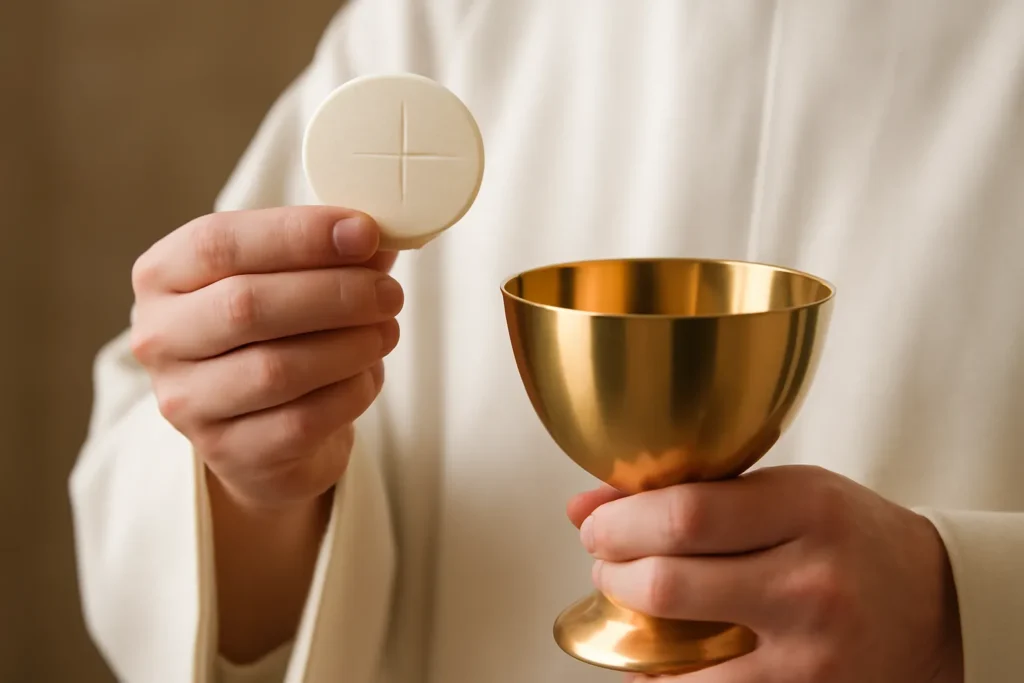
Real Presence: Christ is truly present in the consecrated bread and wine.
Transubstantiation: the substance of bread and wine changes into the Body and Blood of Christ, while the appearances of bread and wine remain.
Memorial, sacrifice, and banquet: the Eucharist fulfills the command to remember Christ’s saving deed, participates in his sacrifice on the Cross, and provides spiritual nourishment for the faithful.
The long arc of Christian reflection, including the doctrinal formulations of the Councils and the liturgical practices of parishes, has clarified that the Eucharist is more than symbolic memory. It is a living encounter that builds the Church as the body of Christ and fosters a sanctified way of life for believers.
Names, Terms, and Variations: How Catholics Speak of the Sacrament
Catholic communities consistently use a range of terms to describe this sacrament. Each expression highlights a different facet of the same mystery. Understanding these terms helps in recognizing how the Eucharist is celebrated, taught, and received in diverse settings.
Eucharist: the celebratory act central to the Mass; emphasizes thanksgiving to God.
Holy Communion: emphasizes reception by the faithful and the sharing of Christ’s life.
Blessed Sacrament: often used for the Eucharist reserved in the tabernacle for prayer or adoration.
Body of Christ and Blood of Christ: phrases that underscore the real presence of Christ in the elements.
The Most Blessed Sacrament: a reverent title reflecting the sacredness of what is received and adored.
In addition to these common descriptors, Catholics also refer to the event as the Eucharistic Celebration, the Mass (especially in reference to the full liturgical action), or the Institution Narrative (the moment Jesus gave the command, “Do this in memory of me”).
What Happens: The Rite and Its Liturgical Shape
The Eucharist is not a single moment but a comprehensive liturgical form that unfolds in stages. The Mass, in particular, is divided into two principal parts: the Liturgy of the Word and the Liturgy of the Eucharist. Each part has its own prayers, readings, and gestures, yet they are united in purpose—to proclaim the Word, celebrate the sacrifice of Christ, and nourish the assembly with grace.
This initial segment centers on Scripture and proclamation. It generally includes:
The Introductory Rite, which gathers the assembly and prepares hearts for worship.
The Penitential Act, inviting conversion and mercy.
The Gloria (on certain days) and the Collect prayer, which gathers the prayers of the congregation.
The Readings from Scripture, typically including a first reading, a responsorial Psalm, a second reading, and the Gospel.
The Homily or catechetical reflection, which helps the assembly apply God’s Word to daily life.
The Profession of Faith and the Prayer of the Faithful, which sustain communal belief and petition.
The Liturgy of the Eucharist
This central movement centers on the offering, consecration, and communion. It typically includes:
The Offertory and the Preparation of the Gifts, wherein bread and wine are brought to the altar and transformed into instruments of grace.
The Consecration, in which the words of Institution are spoken by the validly ordained minister, making the bread the Body and the wine the Blood of Christ.
The Elevation of the consecrated elements, inviting reverence and adoration.
The Memorial Acclamation and the Great Amen, which express the believers’ consent to the mystery being revealed.
The Communion Rite, including the Lord’s Prayer, the sign of peace, and the distribution of Communion to the faithful.
The Prayer after Communion, which concludes the sacramental act and sends the faithful back into the world to live the gospel.
Theology of Real Presence: Transubstantiation and the Mystery
A defining doctrine of Catholic Eucharistic faith is the Real Presence of Christ in the Eucharist. This belief holds that during the consecration, the substance of bread and wine is transformed into the Body and Blood of Christ, while the appearances (the look, taste, and texture) of bread and wine remain. The technical term often associated with this teaching is transubstantiation.
This understanding emerged in formative discussions and formalized doctrinal statements, notably during the Council of Trent (16th century) as a response to various theological debates. The Catholic Church’s teaching affirms that Christ is contained, offered, and received under the species of bread and wine, making the Eucharist a true sacrificial meal and a communion with the living Christ for the faithful.
It is important to note that statements about the Real Presence are doctrinally specific to Catholic Tradition. Other Christian communities describe the event differently—some emphasize memory, some emphasize symbol, some emphasize spiritual presence—but Catholic teaching preserves the sense of a real, substantial change that makes Christ truly present.
Matter, Form, and Ministers: How the Sacrament Is Validly Celebrated
In Catholic theology, the sacraments require certain proper matter, form, and ministry to be considered valid and licit. These elements ensure that the Eucharist remains the true instrument of grace that Christ willed for the Church.
Matter
The approved matter for the Eucharist is:
Bread made from wheat and unleavened at least in form, suitable for use in the sacramental action.
Wine from grapes, which may be fortified or standard in most liturgical settings.
The fullness of the sacramental act depends on these proper substances being used with reverence and in faith.
Form
The form consists of the words of consecration spoken by a validly ordained priest (or bishop). In the Roman Rite, the priest says the words of Jesus at the Last Supper over the bread and wine: “This is my Body,” “This is the chalice of my Blood.” Through these words, Catholics believe the bread becomes the Body of Christ and the wine becomes the Blood of Christ.
Minister
The ministerial state for the Eucharist is reserved to those ordained as bishops or priests, who act in the person of Christ. In ordinary circumstances, only a priest (or bishop) can consecrate the Eucharist. In certain circumstances, deacons may assist in distributing Communion, and special lay ministers may help with the distribution of Holy Communion under the direction of the pastor. The Church teaches that the sacrament must be celebrated within proper canonical and sacramental norms to preserve its integrity and unity.
The reception of the Eucharist is not automatic but requires proper disposition and preparation. Catholics believe that receiving the Body and Blood of Christ should be done with faith and reverence, in a state of grace, and free from grave sin.
Dispositions for reception
Fasting for a period before Holy Communion (traditionally, one hour, though local norms may vary).
Being in a state of grace (free from mortal sin) and having the intention to receive the sacrament as nourishment for faith.
Expresing reverence through posture, attire, and inner disposition—recognizing the sacredness of the moment.
Modes of reception
Reception on the tongue or in the hand (the latter typically with a reverent approach and after receiving the communicant shows proper reverence).
Communicants may receive under one species, or both the Body and Blood if the form is distributed with appropriate care.
Who should not receive
The Church teaches that those in grave sin or those not in communion with the Catholic Church should not receive until they are reconciled. In mixed or ecumenical settings, non-Catholic Christians may participate in the Mass and receive the Eucharist only if their own church permits and certain conditions are met; otherwise, they may partake in a spiritual communion or receive a blessing instead.
Reception as Mission: The Effects and Graces of the Eucharist
The Catholic tradition emphasizes that the Eucharist confers grace that strengthens the soul to live in holiness and to witness to the Gospel in concrete ways. The sacrament is said to have several interrelated effects:
Unification: strengthens the bond among members of the Church, forming one body in Christ.
Spiritual nourishment: sustains the believer in the daily struggle of faith and authentic Christian life.
Remission of venial sins (to a certain degree) and its continuing cleansing power when coupled with repentance and confession.
Grace for charity: fosters love toward God and neighbor, prompting acts of service and justice.
Hope and consolation: in times of trial, the Eucharist offers the strength of Christ’s presence and promise.
Participation and fruitfulness
Active participation is a persistent emphasis in Catholic pedagogy: listeners become doers, and the Eucharist becomes the source and summit of Christian life. Catholics are encouraged to approach the sacrament with attentiveness—listening to the readings, praying, fasting, and then going forth to imitate Christ in daily vocation.
The Sacrament in the Life of the Church: Liturgical Rhythm and Pastoral Practice
The Eucharist shapes the life of parishes, dioceses, and families. It is central to the Sunday cycle, feast days, and seasonal celebrations, and it has a distinctive place in marriage preparation, rituals of initiation (baptism and confirmation), and ministry formation programs.
Communion as participation in the Church’s mission
Those who approach the Eucharist are not simply receiving grace for themselves; they are being incorporated into the Body of Christ for the sake of the world. The faithful are sent back into daily life to embody the Gospel, work for peace, care for the poor, defend human dignity, and build communities where justice and mercy reign.
Adoration, reverence, and devotion outside Mass
Beyond the Mass, Catholics practice adoration before the Blessed Sacrament, a form of contemplative prayer that honors Christ truly present in the sacrament reserved in the tabernacle or exposed for worship. This practice deepens reverence and invites personal conversion, gratitude, and intercession.
Historical Development: How the Understanding of the Eucharist Has Shaped Catholic Teaching
The Catholic understanding of the Eucharist has evolved in response to theological, liturgical, and pastoral questions. From the early centuries to the present day, Church leaders and theologians have sought to articulate what happens when bread and wine are offered and accepted as the Body and Blood of Christ.
Early practice and Patristic voices
In the earliest centuries, Christians celebrated the Eucharist with a strong sense of communal identity and memory of Christ’s saving actions. The patristic writers often spoke of the Eucharist as a communion with the risen Lord and a sign of the unity of the Church.
Medieval to modern formulations
Over time, the Church clarified the mechanics of the sacrament through theological reflection and canonical discipline. Debates and councils contributed to a richer articulation of the Real Presence, the role of the minister, and the appropriate reception of the sacrament by the faithful. The Council of Trent, in particular, framed a robust doctrinal understanding that has continued to guide Catholic teaching and practice.
The Second Vatican Council (1962–1965) renewed attention to the liturgy, including greater participation by laypeople, clarifications on active participation, and adaptations that emphasized the communal and communal-enacted nature of the Eucharist. The post-conciliar era has seen renewed attention to liturgical translation, vernacular languages, and inclusive practices while preserving essential doctrinal truths about the Eucharist.
Common Questions and Clarifications
Many readers have questions about how Catholics understand and practice the Eucharist. Here are some common inquiries, along with clear Catholic responses.
Is the Eucharist symbolic or truly present?
In Catholic teaching, the Eucharist is more than symbolic. It is a true presence of Christ in the consecrated bread and wine, made possible by the consecration spoken by a validly ordained minister. The catechetical language often uses the phrase Real Presence to capture this transformation.
Can non-Catholics receive Holy Communion?
The general rule in the Catholic Church is that only Catholics in a state of grace and who are properly disposed may receive the Eucharist. In some ecumenical contexts, exceptional arrangements may be made, but ordinarily non-Catholic Christians should participate in the Mass and prayer, but not receive the sacrament unless invited by the local bishop and participating within proper norms.
What about transubstantiation—is it a metaphor?
Transubstantiation is not a metaphor but a doctrinal statement about the change of the substance of bread and wine into the Body and Blood of Christ, while the visible accidents (taste, texture, appearance) remain. This distinction helps Catholics appreciate the mystery while participating in a tangible sacramental act.
How often can Catholics receive the Eucharist?
The Church encourages regular reception of the Eucharist—especially on Sundays and Holy Days of Obligation—provided the recipient is properly disposed. Some receive weekly, others more or less often, depending on personal conscience, parish customs, and pastoral guidance.
Practical Guidance for Parishes and Families
For pastors, catechists, and lay leaders, the Eucharist presents both a deep source of grace and a set of responsibilities. The following practical notes may help communities foster reverence, understanding, and faithful participation.
Formation and catechesis
Offer regular catechesis on the meaning of the Eucharist, including the Real Presence, the consecration, and the call to living communion.
Provide resources for families to talk about the Eucharist at home, using simple explanations and connections to daily life.
Explain the fasting rules and other dispositions so that communicants understand the preparation required for the sacrament.
Liturgical integrity and accessible worship
Preserve the dignity of the liturgy by ensuring reverent posture, orderly distribution of Communion, and appropriate music and silence surrounding the Eucharist.
Encourage active participation—response, singing, and attentive listening—so that the faithful are not merely observers but participants in the sacred action.
Pastoral care and inclusion
Provide pastoral care for penitents, the sick, and those unable to attend Mass, including opportunities for spiritual communion and home sacramental piety.
Address questions about ecumenical sharing of the Eucharist with sensitivity to diverse church traditions and to the unity of the body of Christ.
Conclusion: The Eucharist as Source, Summit, and Calling
The Catholic understanding of the Eucharist presents it as a multifaceted act that gathers, transforms, and sends forth. It is the source of grace because it nourishes the life of faith; it is the summit of the Church’s worship because it makes present the saving work of Christ; and it is a powerful calling to live as disciples in the world, bearing witness to love, truth, and justice.
The Communion Eucharist—in its many names and expressions—invites every Catholic to approach the altar with faith, to grow in understanding through thoughtful catechesis, and to embody the grace they receive by serving others. In a church that spans cultures, languages, and generations, the Eucharist remains the living bond that unites believers with Christ and with one another. By honoring its mystery, practicing its discipline, and cultivating its fruits, Catholics continue a tradition that has sustained the faithful for two millennia.






Leave a Reply