Baptism in the Catholic Church: Understanding the Sacrament
In the Catholic Church, baptism is the foundational sacrament of Christian life. It is not merely a symbolic rite but the moment at which a person is brought into the life of Christ, incorporated into the Church, and opened to the grace that sustains a life of faith. This article explores the theological meaning, the practical rite, who may participate, and the lasting effects of baptism in the Catholic tradition. By examining its scriptural roots, liturgical form, and pastoral dimensions, readers can gain a fuller sense of why this sacrament remains central to Catholic worship and daily Christian living.
Theological Foundations of Catholic Baptism
The Catholic understanding of baptism rests on the conviction that God’s grace is communicated through visible signs. In the sacrament of baptism, grace is conferred in a way that meets a person where they are—whether as an infant, a child, or an adult—so that one is born into a new life in Christ. The Church teaches that baptism washes away the debt of sin, heals the wounded human will, and makes the believer a member of the Body of Christ, which is the Church.
Scriptural roots and the apostolic witness
The rite of baptism is deeply rooted in Scripture and in the early Christian witness. Central biblical frames include:
Matthew 28:19–20, the Great Commission, which commands the Church to baptize “in the name of the Father, and of the Son, and of the Holy Spirit.”
John 3:5, where Jesus speaks of being born of water and the Spirit as essential for entry into the kingdom of God.
Romans 6:3–4, which speaks of dying and rising with Christ through baptism, a symbol of new life.
Titus 3:5, which emphasizes salvation through the washing of regeneration and renewal by the Holy Spirit.
The sacramental nature and the connection to the other mysteries
Baptism is the first of the sacraments of initiation, the doorway through which a believer is introduced to the other sacraments—Confirmation and the Eucharist. It inaugurates a lifelong journey of discipleship, sanctifying grace, and union with the Church. In Catholic theology, baptism not only cleanses from sin but also imprints a spiritual character, a seal that marks the person as belonging to Christ and called to share in the mission of the Church.
The Catholic Church welcomes both infants and adult converts into baptism. The process aims to sustain faith formation and ensure a lifelong fidelity to Christ and the Church. While the circumstances differ, the fundamental meaning remains the same: the person is initiated into a life shaped by grace, worship, service, and communion.
Infant baptism and the domestic church
Infant baptism is practiced to welcome a child into the Christian community as early as possible, so that the grace of God may begin to work in the child’s life from the outset. Parents are the principal faith witnesses for their child, and the baptism is deeply connected to family life. The practice also acknowledges that faith is nurtured within the community—the domestic church—which supports the child’s ongoing catechesis and prayer life.
In infant baptisms, there are typically godparents or sponsors who accompany the family, affirm the faith, and commit to helping raise the child in the Catholic tradition. Sponsors must generally be Catholics in good standing, prepared to live as examples of faith, hope, and charity for the baptized.
Adult baptism occurs within the context of the Church’s program of formation, commonly known as the Rite of Christian Initiation for Adults (RCIA). In this pathway, a seeker slowly enters into the faith through stages of inquiry, catechesis, and discernment, culminating in the reception of the sacraments of initiation—Baptism, Confirmation, and the Eucharist—at the appropriate liturgical moment.
The RCIA process honors the dignity of the person’s conversion and provides formation that aligns with Catholic teaching, preaching, liturgy, and community life. It is possible for an adult who has been baptized in another Christian tradition to join the Catholic Church without re-baptism, through the rite of full communion (or, under certain circumstances, via conditional baptism if a doubt remains about the validity of a prior baptism). In such cases, the reception emphasizes the unity of Christian baptism rather than repeating it.
The Rite and Its Symbols
The Catholic baptismal rite is rich with signs that convey the meaning of the sacrament. Each symbol points toward grace and the life of faith that follows. The essential act—water—expresses cleansing, rebirth, and incorporation into Christ.
Water, exorcisms, and the blessing of the font
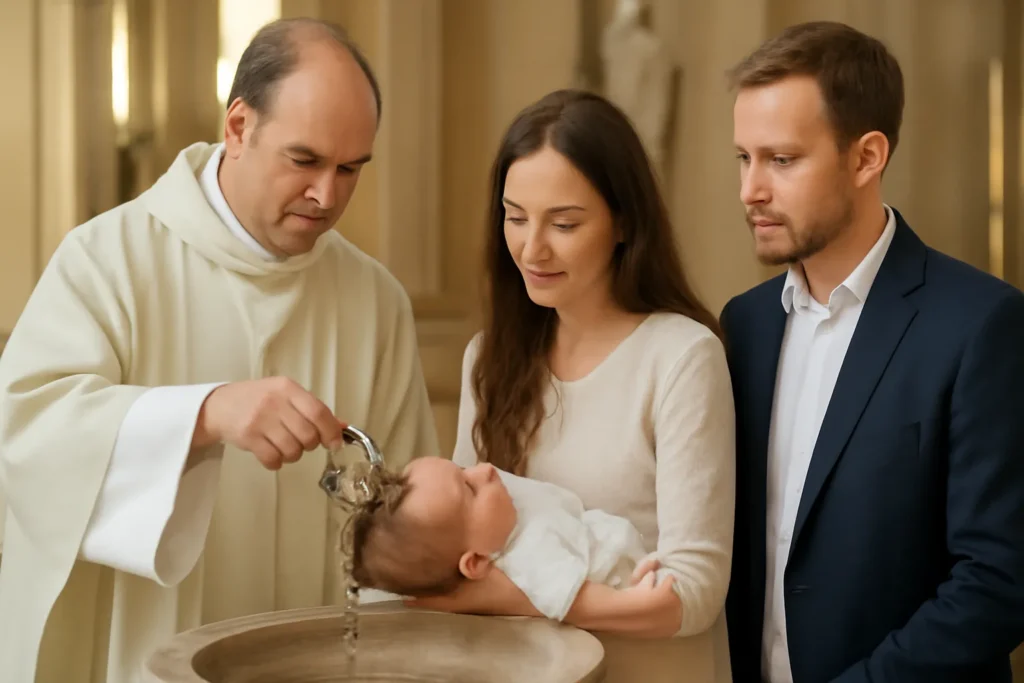
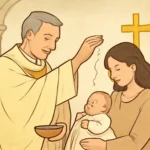
The water used in the rite is blessed by the presiding minister, often a priest or deacon, and is understood as the instrument by which God’s grace is poured out. In preparation, the celebrant may perform exorcisms and blessings of the water to signify liberation from sin and turning toward God. The act of pouring water over the head (or, in some traditions, immersion) is accompanied by the baptismal formula.
Chrism, the white garment, and the candle
After the water, the newly baptized person is anointed with sacred chrism, signifying a consecration to God and an empowerment to participate in Christ’s mission. A white garment is placed on the person, symbolizing the dignity of new life in Christ and the wearing of the “garment of light.” A baptismal candle, lit from the Paschal candle, is given to signify that the newly baptized has begun a journey as a light in the world, to be kept burning through prayer and good works.
While the exact order can vary slightly by liturgical rite and local custom, the Catholic baptism follows a consistent structure that emphasizes both the person’s conversion and the Church’s mission to pass on the faith.
Reception or presentation of the candidate (or child) by the family or catechumens.
Renunciation of sin and profession of faith by the parents and godparents on behalf of the child or by the adult candidate personally.
Liturgical blessing of the water and the invocation of the Holy Spirit to sanctify the waters for this sacramental work.
Immersion in water or a triple pouring of water over the head, accompanied by the baptismal formula: “I baptize you in the name of the Father, and of the Son, and of the Holy Spirit.”
Anointing with sacred chrism, which seals the baptized with a special character and calls them to a life of service in Christ.
Reception of the white garment and the lighted baptismal candle as signs of new life in Christ and the ongoing call to enlightenment.
The prayers of the community, blessings, and a concluding commissioning to live out the baptismal vocation in daily life.
In emergency situations, baptism can be administered by anyone who intends to do what the Church does, using the correct words and water. The Holy Spirit works through the signs even when a priest is not immediately available, reflecting the Church’s universal concern for the salvation of every person.
What happens to a person through baptism is both a past reality and a present vocation. It makes a person a member of Christ and of the Church, while nourishing a life of ongoing conversion and mission.
Sanctifying grace is conferred, configuring the believer to Christ and enabling participation in the divine life.
Remission of sins, including original sin (in infants) and any personal sins (if the candidate is an adult seeking baptism).
Adoption as God’s child and incorporation into the Body of Christ—the Church.
Charter of Christian life, a seal that marks the baptized as belonging to God and called to a life of discipleship and service.
Grace-filled identity, which orients the baptized toward ongoing faith formation, confession, prayer, and participation in the liturgy.
Pathway to the other sacraments, particularly Confirmation and the Eucharist, which deepen and mature the life of grace begun in baptism.
Infant Baptism: Parents, Godparents, and Community Support
The baptism of infants embodies the Church’s teaching that grace precedes human effort. The parents, together with the godparents, vow to raise the child in the faith and to form a home where prayer, worship, and service to others are real and ordinary parts of daily life.
Responsibilities of parents and sponsors
Parents are called to nurture the child’s faith through regular prayer, instruction, and participation in the life of the parish. Godparents (sponsors) bear witness to the child’s new Christian identity and commit to supporting the family in faith. In practice, the godparents are typically Catholic, confirmed, and living in a way that models faithful discipleship.
The celebration itself is a communal event. While the sacrament is deeply personal for the child, it is also a public affirmation of faith by the entire faith community, which pledges to support the child’s growth in the faith.
Baptism for Adults: The RCIA Path to Initiation
For adults who have not yet been baptized, the Church invites a patient, catechetical journey through the RCIA program. This path emphasizes conversion, learning the Catholic faith, and embracing a life shaped by the Gospel.
The RCIA path typically includes periods of inquiry, catechesis, and a formal discernment about entering into the Church. The journey culminates in the reception of the sacraments of initiation at the Easter Vigil or another liturgical moment that aligns with the parish’s plan.
For those who have already been baptized in a Christian tradition, reception into full communion may occur without re-baptism. In certain cases, a conditional baptism might be requested when there are questions about the validity of an earlier baptism; this remains a sensitive pastoral decision made in cooperation with the local bishop or pastor.
Rites, Rights, and Pastoral Considerations
The Catholic Church views baptism as the gateway to a life of faith that continues through catechesis, liturgy, and service. Pastoral care around baptism emphasizes welcome, education, and ongoing formation for both the newly baptized and the entire parish community.
Godparents’ role is to witness to the faith and help raise the child in the Catholic tradition.
Parish involvement is encouraged to sustain the faith formation of the child or adult convert.
Liturgical continuity links baptism to the life of the Church year, including the seasons of Advent, Christmas, Lent, and Easter, so that the sacrament is not an isolated moment but a living reality.
Emergency baptism remains an option when death is imminent, underscoring the Church’s commitment to saving every soul entrusted to her care.
Common Questions and Clarifications
Is baptism necessary for salvation? The Catholic Church teaches that baptism is the ordinary means by which salvation is dispensed. However, the Church also recognizes baptism of desire and baptism of blood in certain circumstances, as well as the possibility of salvation for those who, through no fault of their own, do not know Christ or His Church but seek God sincerely.
Can infants be baptized? Yes. Infant baptism acknowledges the gravity of original sin and begins the spiritual formation of the child within the faith community.
Can someone be baptized again? Generally, a baptized person who has received a valid Christian baptism does not need to be re-baptized. If there is doubt about the validity of a prior baptism, a conditional baptism may be considered.
What about immersion vs pouring? The official Catholic practice in the Latin rite uses the pouring of water, but immersion has historical and liturgical precedent in certain rites. The essential element is the invocation of the Trinity and the baptizing action, not the specific mode of water application.
What happens after baptism? The baptized participate in the ongoing life of the Church through the sacraments, prayer, and service. The subsequent years involve formation, catechesis, and participation in the liturgy, especially the Eucharist and Confirmation.
A Living Tradition: Baptism in Today’s Catholic Life
Across cultures and languages, the Catholic Church interprets baptism as a living invitation to disciple Christ. Parishes celebrate each baptism as a sign of new life and a reminder of the Church’s universal mission: to proclaim the Gospel, to catechize new generations, and to serve the vulnerable and the world with mercy.
The ongoing formation of the baptized—through catechesis, participation in the liturgy, sacramental reconciliation, and works of charity—confirms that baptism is not a one-time event but the beginning of a lifelong journey. In this sense, baptism is paradoxically simple and profound: a faithful response to God’s grace that unfolds in prayer, community, and service.
Closing Reflections: Living Out the Gift of Baptism
For families, catechists, priests, and parish communities, the baptismal bond challenges each person to live as a member of the Church and a witness to the Gospel. The signs—water, oil, white garment, candle, and the prayers of the faith community—invite ongoing conversion and sustained action: prayer, catechesis, and service to others. When a person is baptized, a new chapter begins—one that invites daily conversion, steadfast hope, and a generous response to God’s call to love.






Leave a Reply