Bible Dry Bones Story: Ezekiel 37 Explained, Meaning & Symbolism
Bible Dry Bones Story: Ezekiel 37 Explained, Meaning & Symbolism
Across biblical literature, few images are as striking as the valley of dry bones. The Ezekiel 37 vision, often called the bible dry bones story or the dry bones prophecy, presents a dramatic tableau of death, restoration, and renewed life. This article explores the full spectrum of the dry bones narrative—its historical setting, literary design, symbolic meaning, and ongoing significance for faith communities today. We will traverse multiple angles of interpretation, offering a comprehensive look at how the Ezekiel 37 vision has shaped theology, worship, and personal hope for generations.
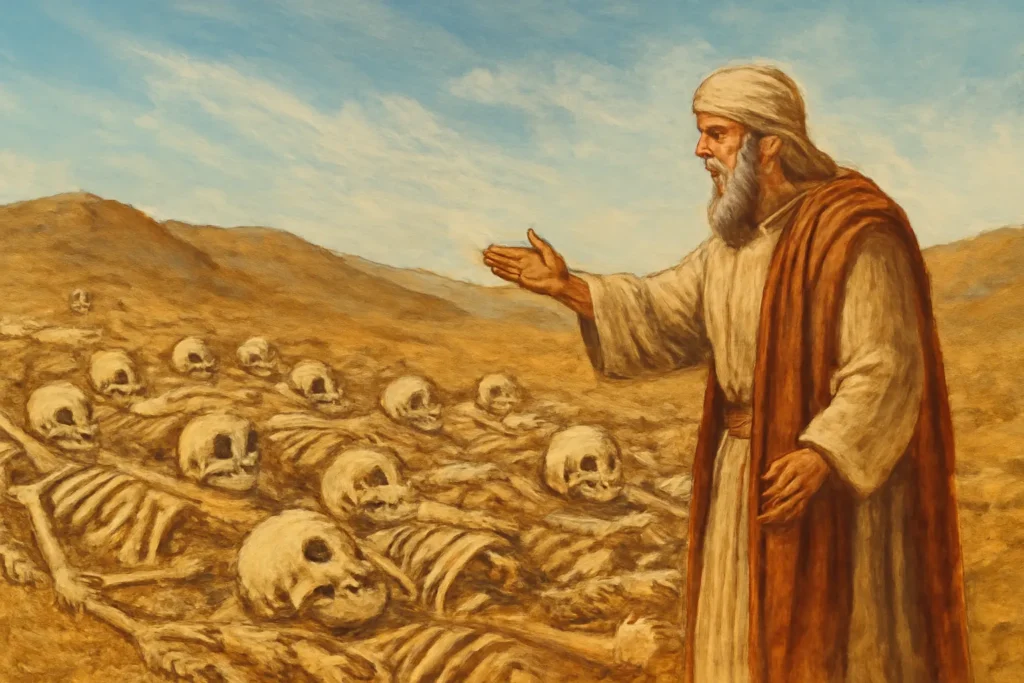
In Ezekiel’s prophetic book, the dry bones episode stands out as a clarion call to life in the face of collective despair. The scene begins with a prophet who is carried by the Spirit into a valley filled with bleached remains. This is not merely a natural landscape but a symbolic stage where the Lord will demonstrate the power to restore not only bodies but a people. The core elements—the bone, the sinew, the breath, and the assembly of a living army—are arranged in a choreography that moves from death to vigor, from fragmentation to unity, from judgment to forgiveness. In popular retellings, critics and preachers alike speak of the vision as a window into how God revives communities, restores national identity, and awakens spiritual life within individuals.
Historical and literary context
Setting in Ezekiel’s prophetic ministry
The prophet Ezekiel, a priest taken into exile in Babylon around 597 BCE, speaks into a period of profound crisis for Judah. The people have faced conquest, exile, and dislocation. In this milieu, the dry bones story becomes a vehicle for addressing questions of identity, hope, and future hope beyond catastrophe. Ezekiel’s career as a prophet includes vivid symbolic acts, parables, and visionary experiences. The bone vision fits within a larger arc that invites listeners to imagine a future where God’s promises are fulfilled, even after radiating defeat.
From a literary standpoint, the text employs symbolic imagery that was common in ancient Near Eastern prophecy but rearranged to convey a distinctly Yahwistic message. The dry bones motif stands as a dramatic foreground for a larger argument: without God, even a nation’s bones are dry; with God, even dead possibilities can be reconstituted into a living, marching people. The sense of timing—“these bones shall live” and the subsequent release of the breath—underscores the interplay between divine initiative and human receptivity.
Textual walk-through of Ezekiel 37
The chapters unfold through a sequence that can be understood in several systematic steps. Here is a structured walk-through of the vision, with emphasis on the key stages and their meanings.
Introduction to the vision: Ezekiel is set beside a valley of dry bones, an image that immediately communicates lifelessness and hopelessness. The bones represent a people—likely the exiles—who feel scattered, separated, and spiritually inert. This imagery invites readers to consider what it means for a culture or a person to be spiritually desiccated and cut off from hope.
Prophecy to the bones: The command to prophesy is pivotal. The prophet’s words, rather than human effort alone, are the means by which God invites restoration. The act of proclaiming life to lifeless remains reveals a central theological principle: God’s word has the power to create, to reassemble, and to reanimate what is broken.
Reassembly of the skeletons: The bones come together, a process that might be imagined as a choreography of skeletal reunion. This stage emphasizes God’s orderly design even within chaos. The sinews and flesh that follow signify a deliberate, progressive reconstruction, underscoring that restoration is comprehensive, not superficial.
Covering with skin: The addition of skin over the restored bodies signals completion of the physical revival. The vision insists that what once seemed lifeless can be inhabited by life-giving potential, setting the stage for the final act of breath.
The breath of life (the ruach or wind)
The Lord commands the winds to enter the bodies, and the living beings stand up on their feet, an army. This breath of life is more than a physical revival; it is the infusion of divine vitality that reconstitutes identity, purpose, and destiny.
A restored community: The vision concludes with a palpable outcome: a vast army restored to life, ready to inhabit the land. The people are not merely alive but organized for purposeful action. This “standing up” as an army becomes a powerful metaphor for national revival and spiritual renewal that can serve as a pattern for contemporary faith communities.
Throughout the narrative, the sequence—bones, sinews, flesh, skin, breath, and life—operates as a symbolic ladder from desolation to vitality. The repetition of action verbs, the tactile details, and the communal dimension of the army all reinforce a theology of restoration as a communal act that concerns both God and people.
The symbolism and meanings
What does the dry bones vision symbolize? The interpretation varies across traditions, yet several core meanings recur across readings:
National restoration: The primary historical reading of Ezekiel 37 frames the bones as the people of Israel who have been scattered by exile. The vision forecasts a future when they are gathered again, their land re-inhabited, and their religious and civic life renewed. The prophesied return is not merely geographical; it is a restoration of covenantal relationship with God, with the land, and with one another.
Spiritual revival: Beyond national boundaries, the dry bones story has served as a paradigm for personal conversion and spiritual renewal. Individuals who feel spiritually depleted can read this as an invitation to hear God’s word, to receive the breath of life, and to stand up in newness of life.
Power of the Spirit: The breath or ruach of God operates as the decisive agent of life. This breath is not a mere wind but the divine breath that animates, energizes, and gives new possibility. In Christian readings, the Holy Spirit is often linked with this breath, connecting Ezekiel’s vision to New Testament themes of resurrection and empowerment (for example, in Acts where breath and spirit energize the early church).
Reunification: The later portion of Ezekiel 37 introduces the idea that two separate ephod-like sticks—one for the house of Judah, one for the house of Israel—will become one in God’s hand. The two sticks becoming one speaks to a broader symbol of reunification, not only of political entities but of diverse communities within a shared covenantal future.
Resurrection-like hope: While not a scientific claim about biology, the vision is often read as a form of resurrection—an assurance that what is dead can be renewed to life with divine intervention. This has resonated deeply in Christian theology, where the language of life from death echoes the resurrection of Jesus and the promise of eternal life for believers.
Meanings across traditions
Judaism and the dry bones
In Jewish interpretation, the Ezekiel 37 prophecy has long been read as a powerful metaphor for national restoration after exile. It speaks to a people who have faced catastrophe and dislocation, offering a divine guarantee that someday God will gather the people, renew their covenant, and reestablish a thriving national life. The valley of dry bones becomes a canvas on which the hope of a settled and righteous homeland is painted—not merely as a political project but as a spiritual revival rooted in the law and presence of God.
Christian interpretations
In Christian readings, Ezekiel 37 often functions as a template for understanding the Holy Spirit’s work in bringing life to believers and churches. The dry bones are a vivid illustration of human humanity—dead in sin—being brought into a vibrant community through the Spirit’s indwelling. The narrative thus becomes a bridge between the Old Covenant imagery and New Covenant realities, paralleling the Spirit’s empowerment at Pentecost, and underscoring the ongoing practice of spiritual renewal in the church.
Scholarly perspectives
Scholars emphasize the historical situation behind Ezekiel’s prophecy, noting that the exilic context provides a rich background for understanding the demand for national and spiritual revival. Some interpret the vision as an assurance to a traumatized society and a critique of despair. Others highlight the symbolic use of anatomy and physiology to communicate wholeness—how God’s restoration is not merely a return to life but a reconstitution of identity, purpose, and governance within the community. In this light, the two sticks prophecy becomes a sophisticated political-theological statement about unity and the future of Israel.
Several motifs recur in the dry bones narrative and invite reflection beyond the immediate text:
Desolation and hope: The bones are starkly desolate, yet the vision ends in hope. The juxtaposition affirms that despair is not the final word when God acts.
Divine initiative: The bone-to-breath sequence makes it clear that restoration begins with God’s command and Spirit, with human participation following in faithfulness and proclamation.
Creation language: The imagery of creation—bones assembling, flesh covering, life entering—echoes Genesis themes, reasserting that God’s work of creation is ongoing and restorative, not exhausted by past judgments.
Community formation: The outcome is not a collection of individuals but an organized assembly—an army—ready to fulfill a shared mission. This emphasizes communal identity and responsibility within the restored people.
Hope for all ages: While rooted in a particular historical moment, the vision speaks in universal terms about life, breath, and belonging that can inspire future generations facing their own deserts.
Impact on theology and faith practice
The dry bones story continues to impact theology and religious practice in several ways. For congregations and communities that face decline or fracture, Ezekiel 37 offers a language of revival. It invites a posture of listening for God’s word, inviting the Spirit to renew and energize, and participating in the healing of relationships—whether within a nation, a church, or a family. The vision has been used in sermons, expository studies, and devotional writings to illustrate:
The possibility of national revival after catastrophe or exile.
The need for spiritual renewal through prayer, repentance, and obedience.
The transformative power of God’s Spirit to reconstitute communities that feel lifeless or divided.
Hope in times of political uncertainty, social decay, or collective grief.
Common misinterpretations and clarifications
As with any ancient visionary text, some readers arrive at the dry bones narrative with questions or misreadings. A few clarifications help keep interpretation grounded:
Not a literal anatomy lesson: The bones‑to‑breath sequence is symbolic and theological, not a forensic description of how bodies regenerate. The value lies in the meaning of life restored by divine action.
Not about zombies or magic tricks: The revival is purposeful and oriented toward mission—the creation of an “army” that will serve God and fulfill a covenantal vocation—rather than a mere spectacle of reanimation.
Historical realism paired with prophecy: The vision speaks to a concrete historical situation (exile and return) while also projecting a future that can be interpreted spiritually. The dual focus helps readers connect past events with enduring spiritual truths.
Ethical implications: The revival in Ezekiel carries an ethical call—to unity, justice, and responsibility toward one another, including the vulnerable and marginalized within the community.
Variations on the theme: different ways to describe the dry bones
To capture the breadth of interpretation, readers often phrase the narrative in various ways while preserving its core meaning. Here are several variations on the bible dry bones story that scholars, preachers, and teachers use in different contexts:
Dry bones prophecy as a blueprint for revival: Emphasizes the practical steps of spiritual renewal—hearing God’s word, seeking the Spirit, and rebuilding a community with shared purpose.
Prophetic drama of restoration: Focuses on the performative aspect of Ezekiel’s actions—prophecy, gesture, and breath—as a dramatic pedagogy to teach about God’s power.
Symbolic anatomy of renewal: Treats the sequence of bones, sinews, flesh, and skin as a metaphor for growth from disintegration to integrity, from fragmentation to unity.
Political-religious reconciliation: Highlights the reunification motif—the two sticks becoming one—applied to modern discussions of national or community reconciliation.
Spiritual awakening in exile and return: Connects the vision to experiences of displacement, longing, and eventual restoration that many communities face in diaspora or persecution contexts.
Practical takeaways for readers today
Readers looking for practical applications can draw several principles from the dry bones vision:
Trust in God’s timing: Restoration unfolds in God’s timing, not always on human schedules. Patience, prayer, and faithful obedience matter.
Value of communal healing: The vision emphasizes that restoration is communal. Rebuilding relationships, forgiving past grievances, and working toward shared goals are essential steps toward vitality.
Empowerment by the Spirit: The breath of life underscores the essential role of the Spirit in empowering believers for mission, service, and leadership.
Hope amid exile: Even when life feels dispersed or defeated, the narrative suggests that future hope is possible through God’s initiative and people’s faithful participation.
Conclusion: the enduring resonance of Ezekiel’s dry bones
The bible dry bones story in Ezekiel 37 remains one of the most provocative and hopeful visions in Scripture. Its potent imagery—bones coming together, sinews forming, breath entering, and an army standing in readiness—offers a framework for understanding how God works through desolation to bring about renewal. Across religious traditions and time periods, the core message endures: life arises when God speaks, when people listen, and when Spirit-filled community acts with courage and compassion. The valley of dry bones is not merely a memory from an ancient text; it is a living invitation to participate in God’s ongoing project of restoration—individually, communally, and universally.
As you reflect on Ezekiel’s vision, consider how the dry bones narrative speaks to your own life or the communities you care about. Are there areas of desolation that need a fresh breath? What would it look like for a divided group to become an unified army of purpose? In what ways can the Spirit’s wind—this ruach—move through your life to bring about transformation? The answer is rarely instantaneous, but the promise remains: with God, even dried bones can live, and with the Spirit, a scattered people can become a resilient, hopeful community ready to fulfill its calling.








Leave a Reply