Celtic Cross Scotland: History, Locations and Symbolism
The Celtic Cross Scotland is not a single monument but a family of sculptural forms that emerged from the cross-cultural flows of the early medieval British Isles. In Scotland, these crosses blend insular art traditions with Pictish and Gaelic influences, producing a distinctive strand of monumental stone sculpture. The term celtic cross scotland today can refer to ancient ringed crosses carved on limestone and sandstone, carved gravestones in churchyards, or the more towering high crosses set in monastic precincts. Across the country, you will find a thread of religious art that connects remote isles, highland glens, and urban churchyards through a shared language of geometry, knotwork, and faith.
History of the Celtic Cross in Scotland
The history of the Scottish Celtic cross is a story of crossing currents: Pictish stone craft meeting Celtic Christian practice, and later medieval church architecture absorbing insular motifs. The ringed cross — the classic form most people recognize as a celtic cross — did not appear fully formed in one place but grew out of a long evolution in the early medieval landscape.
Origins and early forms
In Scotland, as in other parts of the British Isles, the earliest carved crosses are often linked to the monumental cult of early Christian communities. The earliest surviving cross-like stones in the region tend to be elements of Pictish art, which flourished from roughly the 6th to 9th centuries. These stones frequently combine animal forms, abstract interlace, and symbolic motifs with carved symbols that may reflect a Christian message. The ringed cross motif began to appear as a recognizable form in later years, helping to unify the cross’s symbolism with the circular motif that many scholars interpret as a solar sign or a unifying ring that binds the arms to the shaft.
As monastic networks grew — with influential centers along the eastern and northern fringes of Scotland — crosses became markers of sacred space, boundaries, and pilgrimage routes. The ringed cross in particular served as a durable emblem for communities seeking to mark their Christian identity while preserving a connection to older, nature-oriented symbolism that predated the church.
Pictish artistry and the ringed cross
The Pictish stones of eastern Scotland provide a crucial bridge between earlier pagan-marked monuments and later Christian sculpture. While not all Pictish crosses bore a full ring, several cross-slabs from Angus and Aberdeenshire reveal ringed designs that influenced later high crosses. In practice, Scottish high crosses often fuse Pictish animal-and-interlace motifs with Christian iconography, creating a hybrid aesthetic that is especially characteristic of celtic cross Scotland in the early medieval period.
This synthesis is visible in places where churchyards and monastic sites preserve multi-layered carvings: the ring anchors the cross visually, while knotwork and interlace convey a sense of permanence and unity that was highly valued in Insular art. The result is a cross form that feels both liturgical and monumental, suitable for processions, blessing, and public memory.
Medieval to early modern transitions
By the high medieval era, the celtic cross Scotland landscape had expanded to include more specialized high crosses and monumental wayside crosses. Many cross heads and shaft fragments were positioned near abbeys, monasteries, and parish churches. Over the centuries, some crosses were damaged by weather or conflict, while others were relocated or repurposed as ecclesiastical needs shifted. The result is a dispersed field of crosses that range from simple gravestone markers to large, freestanding high crosses that stand as cultural landmarks.
The later medieval and early modern periods saw a softer, more ornamental approach in some places, with crosses that participated in architectural ensembles rather than standing as independent monuments. The Scottish Celtic cross tradition thus demonstrates continuity and change: continuity in symbol and craftsmanship, and change in social function and placement.
The revival and contemporary usage
In the 19th and 20th centuries, the broader Celtic Revival brought renewed attention to cross motifs as expressions of national and regional identity. In Scotland, new crosses and cross-inspired sculptures were erected in churchyards, universities, gardens, and public spaces. These modern iterations often honor historical imagery while serving contemporary commemorative or decorative purposes. Today, the Celtic Cross Scotland landscape includes not only ancient cross-slabs and high crosses but also modern interpretations that carry forward the material and symbolic vocabulary of insular art.
Symbolism and design features
The Celtic cross, especially as it appears across Scotland, is a compact school of symbolism. While regional variations exist, several core design features recur, giving the form its recognizable character. Understanding these elements helps explain why the cross became such a durable symbol in Scottish Christian art.
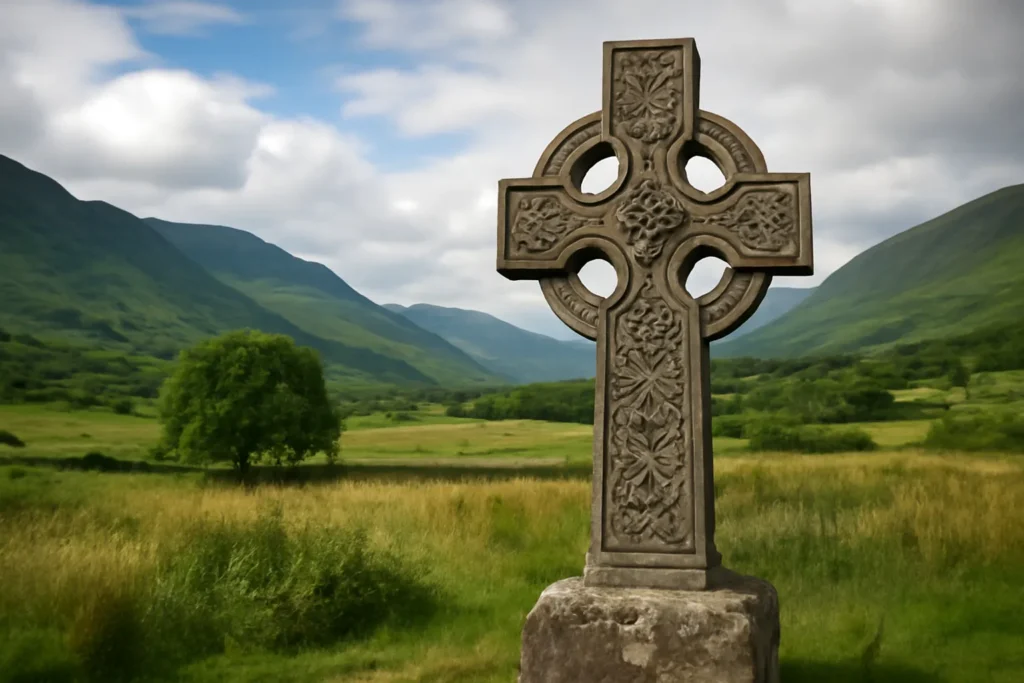
Ring or wheel around the intersection of arms and shaft: The defining feature of the Celtic cross, this ring is commonly interpreted as a symbol of eternity or unity. In Scotland, the ring also helps stabilize the stone and adds a visual counterpoint to the straight lines of the arm and shaft.
Knotwork and interlace: Intricate interlaced patterns cover the arms, the ring, and sometimes the shaft. This knotwork is a hallmark of Insular art and reflects continuity, protection, and the interconnection of divine and human realms.
Naturalistic and zoomorphic motifs: Some Scottish crosses incorporate animals, birds, or serpentine forms woven into the interlace. These motifs can carry memory, guardianship, or allegorical meanings tied to local lore and biblical narratives.
Monastic and monumental contexts: Crosses in Scotland frequently stood near abbeys, churches, and monastic sites, underscoring their liturgical function as well as their role as public monuments of faith and learning.
Material and method: Scottish crosses were carved from durable stone such as granite or sandstone, chosen for longevity in harsher climates. The carving technique combined careful planning with sharpened tools to achieve crisp outlines for the knotwork and figures.
In terms of interpretation, scholars often emphasize that the celtic cross Scotland form served multiple purposes: it marked sacred space, communicated doctrinal ideas through iconography, and offered a visual anchor for monastic and lay communities alike. The circle’s presence can be read as a theological symbol — sometimes linked to the Sun or to eternal life — while the cross arms convey Christian faith. In Scottish contexts, the cross also functioned as a public marker of settlement, property boundaries, and communal memory.
Differences between high crosses and crosses in churchyards
Within Scotland, you’ll encounter two broad kinds of crosses: high crosses and graveyard crosses. The former are typically tall, protruding from a stone base or pedestal, often with a sheltered niche or sermon scene carved high on the shaft. The latter are more modest, placed at church entrances or along paths tomark burial grounds and serve as a daily visual reminder of mortality, faith, and heritage. Both forms share the same symbolic vocabulary, yet their scale and function highlight different aspects of spiritual life in medieval and post-medieval Scotland.
While the language of the Celtic cross Scotland is robust and widespread, certain places are especially productive for study and appreciation. Their crosses, slabs, and reliefs illuminate how the cross functioned across landscapes—from windy coastlines to tranquil churchyards.
Aberlemno, Angus: The Aberlemno group of Pictish cross-slabs is among the most studied in Scotland. Here, the rocks preserve ringed cross designs and intricate interlace that reveal how Pictish and Insular motifs fused in a regional context. The site offers a powerful window into how a rural parish could be a repository for a grand symbolic program.
Iona (Inner Hebrides): The island of Iona had a pivotal role in early Scottish Christianity. The crosses and cross-slabs connected to the monastic community there reflect the fusion of Gaelic, Pictish, and Irish influences. Today’s visitors can trace the lineage of cross symbolism from Iona to the broader Scottish landscape.
Perthshire and the central Highlands: Across this region there are several important cross-headed pieces and high crosses associated with ecclesiastical centers and waypoints along pilgrimage routes. While some crosses survive only as fragments, their surviving forms reinforce the idea that Scotland’s landscapes were deeply imbued with sacred memory.
Islands and coastal sites: The rugged coastal zones and island communities of Scotland preserve cross fragments and full crosses that speak to maritime routes, monastic networks, and local devotion. These maritime crosses contribute to a broader narrative about Scottish Christianity’s reach across sea-swept communities.
Monastic precincts and parish churches: In many towns and villages, the churchyard cross or the remains of a high cross near a cathedral or abbey continue to anchor local history, heritage tourism, and educational programs. These sites illustrate how the cross served both religious and civic functions.
It is important to note that not all crosses survive in full; some appear as fragments or incorporated into later structures. Yet even fragments carry a wealth of information about artistry, worship, and social organization in Scotland’s past. The existence of these crosses in diverse settings shows how the celtic cross scotland form was versatile enough to span multiple centuries and communities.
Experiencing the Celtic Cross Scotland today
For modern readers and travelers, the Scottish Celtic crosses offer a tangible link to a past where art, faith, and daily life intersected. If you plan a focused visit, consider these approaches to appreciating the crosses:
Plan a regional itinerary: Concentrate on one region at a time, such as Angus and the east coast, or the Inner and Outer Hebrides, to observe regional stylistic differences and conservation strategies.
Consult local guides: Local historians and archaeologists can interpret the iconography and historical context beyond what plaques provide.
Respect the sites: Many crosses sit in churchyards or near fragile ruins. Move gently, avoid climbing on stones, and observe any posted guidelines for visitors.
Combine with other Insular art: While exploring, look for manuscript illuminations, carved stones, and metalwork that display similar knotwork patterns and Christian symbolism; this helps you understand the broader aesthetic of the era.
Photography and preservation: If you photograph or sketch crosses, document their positions and condition. Preservation agencies often rely on public awareness to protect these monuments for future generations.
For the scholarly-minded, many of these sites have associated catalogs, visitor centers, or interpretive panels that place the celtic cross Scotland within the larger framework of medieval art, local history, and church architecture. In modern practice, the cross remains a potent symbol for cultural heritage, often incorporated into commemorative spaces, public sculpture, and educational exhibits in Scotland and beyond.
The symbolism of the Celtic cross in a Scottish context
The meaning behind the Celtic cross in Scotland rests on a layered set of associations—some theological, some cultural, and some personal. Across the country, people have used and interpreted the cross in ways that reflect both continuity with the past and adaptation to new circumstances.
Christian faith: The cross is a clear sign of Jesus Christ’s crucifixion and the salvation narrative central to church life. In Scotland, as elsewhere in the Christian world, crosses mark sacred spaces and remind communities of spiritual commitments.
Heritage and identity: The cross is a visible marker of Scottish history and the enduring presence of Christianity in the landscape. It has become a symbol of local identity, especially in regions with strong Gaelic heritage and Pictish lineage.
Artistic tradition: The knotwork and interlace patterns reflect a long tradition of insular art. By studying them, observers gain insight into medieval aesthetics, artistic workshops, and the cross-cultural exchanges that shaped Scotland’s visual culture.
Memorial and memory: In modern times, Celtic crosses serve as memorials in cemeteries and public spaces, linking contemporary remembrance with medieval iconography.
Education and tourism: The crosses function as educational touchpoints, inviting visitors to learn about archaeology, religious history, and landscape archaeology in Scotland.
When thinking about the celtic cross Scotland, it is helpful to remember that the form has proven adaptable: it can be solemn, public, commemorative, or intimate. This versatility helps explain why the cross remains a dominant motif in Scotland’s artistic and spiritual repertoire.
In many instances, the cross’s iconography is practical as well as symbolic. Carvers used the ring to anchor delicate knotwork, ensuring the structure’s durability in Scotland’s climate. The interlace patterns serve not only as decoration but as a mnemonic device that reflects a worldview in which creation is interwoven and interdependent. From a scholarly perspective, studying the Scottish high cross tradition reveals how communities expressed theology, memory, and civic pride in durable stone.
Preservation, challenges, and the road ahead
The maintenance of Celtic crosses in Scotland faces challenges typical of historic stonework: weathering, biological growth, and the risk of vandalism or accidental damage in busy public spaces. Conservation approaches prioritize surface cleaning, structural stabilization, and careful restoration that respects the originals’ artistic integrity. In several regions, local councils, heritage bodies, and community groups collaborate to interpret and protect their crosses for future scholars and visitors.
Documentation: Detailed surveys, 3D scans, and photographic records help monitor condition and guide conservation decisions.
Public engagement: Museums, interpretation panels, and educational programs raise awareness about the crosses’ significance and the importance of safeguarding them.
Ethical restoration: Conservators aim to avoid over-restoration, keeping the crosses legible while preserving their historical patina and evidence of age.
Community stewardship: Local communities often take an active role in protecting and presenting crosses within churchyards and villages, ensuring they remain meaningful to residents today.
The future of the Celtic Cross Scotland tradition will depend on careful balance: honoring the crosses’ origins while allowing new generations to connect with them. As public interest grows, there is a growing recognition that these monuments are not relics of a distant past but living points of contact between history, art, faith, and landscape.
Conclusion: Why the Celtic Cross Scotland continues to captivate
The Celtic Cross Scotland stands at the crossroads of art, religion, and identity. Its form — a cross with a ring, adorned with knotwork, set against the Scottish landscape — embodies a fusion of cultures and centuries. From the Pictish stone slabs of Aberlemno to the monastic memorials on Iona and the regional crosses tucked into parish churchyards, this symbol has persistently asserted its presence in Scotland’s public memory. The enduring appeal of the cross lies in its adaptability: it can function as a sacred sign, a marker of place, a piece of art, and a historical record all at once.
For readers and travelers, exploring the celtic cross scotland landscape offers more than a visual feast. It invites contemplation of how communities in the past met the landscape with faith, how art transmitted ideas across generations, and how modern Scotland continues to engage with its ancient roots. Whether approached as a scholarly subject, a cultural symbol, or a road-trip itinerary, the Celtic cross in Scotland reveals a rich, layered story that remains relevant today.





Leave a Reply