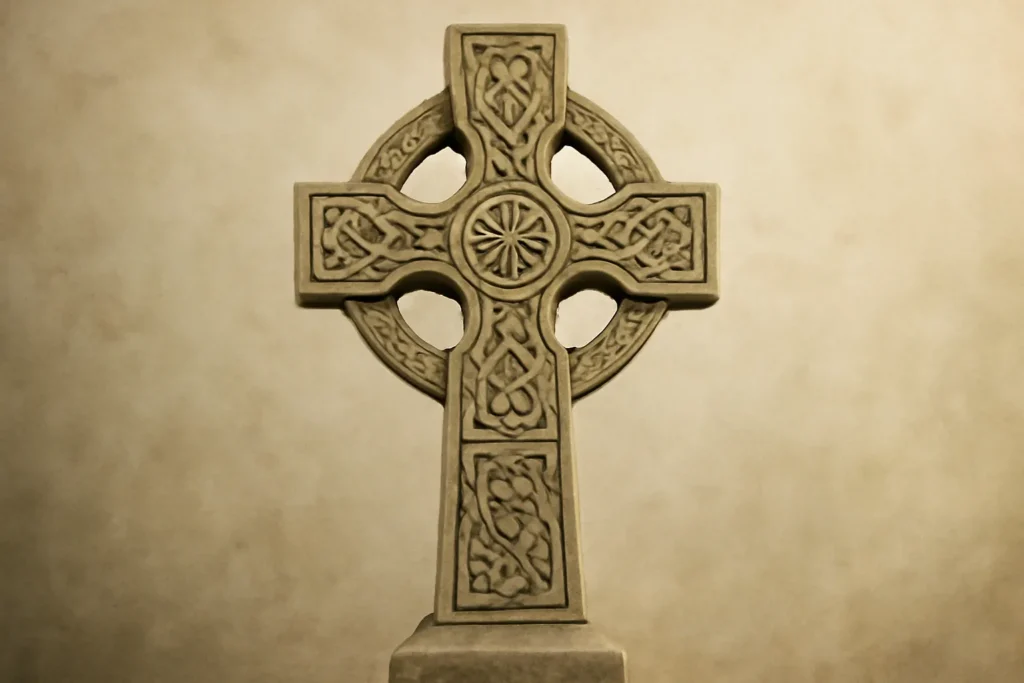
The Celtic Christian cross is a powerful symbol that blends Christian iconography with the distinctive art of the early medieval Celts. Often recognized by its tall, slender form and a distinctive circular ring that intersects the arms, this cross is more than just a religious emblem. It functions as a visual record of a cultural moment when monastic scholarship, missionary work, and local artistic traditions converged. In many traditions, the term ringed cross is used interchangeably with Celtic cross, highlighting the central feature that sets it apart from the plain Latin cross. Across different regions—especially Ireland, Scotland, and parts of Britain—the symbol appears in stone carving, metalwork, illuminated manuscripts, and modern jewelry, testifying to its enduring resonance.
Pre-Christian Roots and Early Christian Adaptation
Scholars often describe the Celtic cross as standing at the intersection of late antique Christian practice and earlier Celtic artistic sensibilities. While the exact moment when the distinctive ring began to appear is debated, most agree that the circle functions as a symbolic bridge between two worlds: the universal Christian cross and the local, time-honored Celtic iconography. The circle—sometimes interpreted as a halo, a solar symbol, or a representation of eternity—precedes the institutional Christianization of the Celtic-speaking peoples and persists as a familiar motif in early medieval art. In this way, the ringed cross embodies a fusion: the standard cross symbolizing the crucifixion and resurrection, with circle motifs that evoke continuity, unity, and divine light.
Emergence of the Cross and Sheepfolds: The High Crosses of Ireland and Britain
By the early medieval period, artists in monasteries across Ireland and parts of Great Britain began to sculpt tall stone crosses that combined monumental form with intricate decoration. These stone crosses—often called the high crosses or Irish crosses—were typically placed at pilgrimage routes, churchyards, or monastic enclosures. The presence of the round ring at the center or near the intersection of the arms became a defining feature in many examples. The Cross of Muiredach at Monasterboice (nine to tenth century, albeit with later restoration) and the crosses at Clonmacnoise, Ahenny, and Kells illustrate how architectural scale and sculptural detail were used to teach and inspire visitors. In these works, the Celtic cross moves beyond a mere symbol to become a narrative device: biblical scenes, interlaced knotwork, and inscriptions communicate a Christian story to an audience that included both monastic scholars and traveling laypeople.
Iconic Examples and Places
Monasterboice in County Louth, Ireland, with Muiredach’s Cross as a premier example of the high cross tradition and a touchstone for how vertical stone sculpture conveyed Christian teaching.
Clonmacnoise in County Offaly, with crosses that reflect a synthesis of insular art and scriptural iconography.
Ahenny in County Tipperary and County Kilkenny, where regional variations in the relief carving and ring placement demonstrate local workshop practices.
Kells and Kildare in Ireland, where illuminated manuscripts and stone sculpture together shaped the visual vocabulary of the Celtic Christian cross.
Across Scotland and parts of Britain, examples of ringed crosses appear in early medieval cathedral precincts and monastic sites, sometimes bearing ogham inscriptions or Latin commentary joined with knotwork.
Symbolism and Meaning
The Circle: Eternity, Divine Light, and Unity
The circle, or ring, is the most conspicuous feature of the Celtic Christian cross. The circle is commonly interpreted as a symbol of eternity—an endless loop with no beginning and no end. For early Christian communities, the ring could also represent divine light, the halo of saints, or the unbroken presence of God. Some scholars see the circle as an emblem of the sun or cosmic time, suggesting a reconciliation of Christian doctrine with older, nature-based or solar symbolism found in Celtic lands. In practical terms, the circle serves as a visual anchor for the cross’s arms, creating a sense of wholeness and continuity that mirrors the Christian claim of universal salvation extending to all nations and ages. When we encounter a ringed cross in stone, we are witnessing a deliberate attempt to fuse two layers of meaning: the cross’s redemptive symbol and the circle’s representation of eternity and divine radiance.
Interlace Knotwork: Continuity, Interconnectedness, and the Sacred
Another defining element of the Celtic cross is the complex interlace or knotwork that fills the arms and the ring, and often the shaft as well. These knot patterns are characteristic of insular art, a distinctive blend of Celtic and Christian aesthetics that flourished from the early medieval period onward. The continuous, unbroken lines of the knots symbolize the idea of eternity and, in a religious context, the eternal life promised by faith. They also convey a sense of interconnectedness—between heaven and earth, between the divine and the human, and among people who pass by the cross on a pilgrimage or daily walk to church. The intertwining strands can suggest that Christian life is a path of turning, returning, and merging with a larger narrative rather than a single, isolated event. This interpretive layer makes the Celtic Christian cross a teaching tool as well as a devotional emblem.
In the Christian tradition, many scholars propose that the central ring and the fourfold arms can be read as four cardinal directions or four elements: earth, air, fire, and water. Some also see the cross as representing the four Gospel writers, the four corners of the earth, or the four seasons over the fourfold cycle of time. While not all discussions agree on a single, definitive fourfold reading, the frequent association with cardinal directions and elements underscores the cross’s role as a model for Christian cosmology: a symbol that orients the believer toward spiritual and moral directions while rooted in the earthly world.
Materiality, Craft, and Preservation
Stone High Crosses as Public Teaching Tools
Stone high crosses were meant to be public, legible, and durable. Carved from local stone, often sandstone or limestone, these crosses could withstand centuries of exposure to rain, wind, and seasonal changes. The process required skilled masons who could translate manuscript and decorative patterns into three-dimensional sculpture. The craftsmanship involved not only carving but also planning the composition to ensure legibility from a distance. The vertical shaft and the crossbar form a cross that is elevated, casting a silhouette that could be seen from far away, encouraging travelers to pause for contemplation or prayer. Bold messages—biblical scenes, saints, or iconographic motifs—could saturate the surface, ensuring that even a passerby with little literacy could glean a narrative about faith and salvation.
Metalwork, Manuscripts, and Decorative Programs
Beyond monumental stone, the vernacular tradition of the Celtic cross extended into metalwork, jewelry, and manuscript illumination. In illuminated manuscripts, such as the Book of Kells and other Insular manuscripts, the cross bears knots and interlace that echo the same motifs found on stones. The cross’s circular form also appears in metalwork, including brooches, clasps, and rings worn by clergy and laity alike. The continuity of design across materials testifies to a broad cultural appreciation for the symbol’s beauty and meaning—an emblem that could be worn, carried, or displayed in a central place in a church or home. In modern contexts, contemporary artists and designers reuse the Celtic cross motif to express identity, faith, and a sense of historical continuity with the medieval past.
Variations and Nomenclature
Because the symbol appears in many regions and in different media, it accrues a number of names and slight design variations. The following terms describe the same broad symbol in various contexts, and each term carries subtle emphases about origin, function, or style:
Celtic cross — The most common name in modern usage, emphasizing the fusion of Celtic art with Christian symbolism.
Celtic Christian cross — A more explicit formulation that highlights the symbol’s religious purpose within Celtic Christian communities.
Irish cross — A regional descriptor that often implies the cross’s prominence in Irish monastic settings and public spaces.
Ringed cross — A focus on the distinctive circular ring; used when the circle is especially prominent or emphasized in the design.
High cross — A term used for the tall, freestanding stone crosses that stand in churchyards and monasteries; sometimes the cross is part of a larger sculptural context with relief panels.
Insular cross — A descriptor that emphasizes the broader Insular art tradition, including knotwork and interlace patterns that cross the form of the cross.
Gaelic cross — Another regional term linking the symbol to Gaelic-speaking cultures within Ireland and Scotland.
Cross of Muiredach or Monasterboice Cross — Names tied to famous individual crosses that serve as archetypes for the genre.
These variants reflect both geography and materiality: ringed stone crosses on hilltops; metalwork brooches bearing the same motifs; illuminated manuscripts with miniatures of the cross; and modern adaptations in contemporary art. While the form can vary—some crosses are taller and more slender, others shorter and broader—the core combination of cross and circle remains a unifying signature that signals a shared heritage.
Geography, Influence, and Cultural Memory
The legend and lore of the Celtic cross extend beyond its original churchyard locations. In Ireland and Scotland, the cross became a symbol of regional identity, monastic learning, and national heritage. In Ireland, the cross often appears alongside ogham inscriptions, saints’ lives, and biblical episodes that a medieval audience could recognize. In Scotland, the cross sometimes merges with Pictish or Gaelic motifs, reflecting a broader syncretism across the islands. The symbol’s reach into Cornwall, Wales, and parts of northern England illustrates how insular artistic traditions traveled, adapted, and persisted, echoing a shared medieval imagination that valued mobility, mentorship, and the dissemination of Christian teaching along pilgrimage routes, monastic libraries, and cathedral precincts. In modern times, diaspora communities have carried the Celtic cross into new contexts—university crests, national monuments, and public art—where it continues to speak of faith, endurance, and cultural continuity.
Iconography, Commemoration, and Meaningful Use
In its iconographic program, the Celtic cross often served multiple purposes: as a liturgical object, as a place marker, as a pedagogical device, and as a symbol of communal memory. For people visiting a monastic site, the cross would present scenes from Scripture on the shaft or surrounding panels, while the knotwork would invite contemplation of eternal life through the complexity of the design. The cross’s form also served as a mnemonic device: its vertical axis pointed toward heaven; its horizontal arms reminded viewers of the relationship between God and humanity; and the circle drew the eye inward to the center, suggesting a focal point where contemplation intensifies. In ecclesiastical contexts, such as during processions or feasts, the cross could be paraded, venerated, or placed in a position of prominence, reinforcing the idea that faith is both a personal commitment and a communal witness.
Construction Practices and Workshop Traditions
In the workshop context, the creation of a high cross or insular cross involved several stages. Stone selection was important, as the durability and weathering resistance of the material affected the cross’s longevity. The artist would sketch the interlace and figurative scenes on the stone’s surface, often using a grid to maintain proportional relationships between the ring, arms, and shaft. Then would come the relief carving of geometric patterns, animal forms, biblical narratives, or saints’ images. In some instances, the cross’s surface would be painted with pigments that added color to the knotwork and figures, though much of this paint has worn away over the centuries. The overall effect was never merely decorative: it was meant to be legible from a distance, a property that helped a cross serve as a visible catechism for followers and travelers alike.
Today, the Celtic Christian cross remains a potent symbol for both faith and heritage. It appears in church architecture, in academic insignia, and in popular culture as a motif that connotes antiquity, spirituality, and a particular geographic lineage. In scholarly discourse, the cross is also a focus of studies about the transmission of Christian ideas into Celtic lands and how local artisan traditions shaped how faith was visualized and taught. For individuals, wearing or displaying a ringed cross can express a personal sense of continuity with ancestors, a commitment to Christian doctrine, or an appreciation for the aesthetic complexity of Insular art. In art and design, contemporary creators reinterpret knotwork and ring motifs to explore themes such as identity, memory, and resilience, thereby keeping the symbol alive in new cultural conversations.
Architectural Contexts and Sacred Spaces
Across Ireland, Scotland, and northern Britain, the Celtic cross occupies a distinct architectural niche. In sacred spaces, it can serve as a boundary marker, a focal point for liturgical drama, or a visual anchor within a monastery’s precinct. The cross often participates in a larger ensemble that includes capitals carved with interlace, arches, and carved tympana that echo the cross’s decorative vocabulary. In some places, modern restorations or discoveries have revealed earlier forms of the cross, prompting revisions to how scholars understand the cross’s development and its interactions with other early medieval art forms. The cross’s presence in churchyards and ceremonial grounds continues to invite reflection on the relationship between Christian faith, local culture, and the built environment.
A Comparative Perspective: Celtic Cross and Other Christian Symbols
To appreciate the distinctive character of the Celtic cross, it helps to contrast it with other Christian symbols. The plain represents sacrificial suffering and salvation in a straightforward, vertical-horizontal form. The Celtic cross, with its ring and intricate knotwork, communicates a broader aesthetic and spiritual program: an invitation to contemplative reading, a sense of integral unity, and a link to a regional artistic tradition. In some settings, the ringed cross is used alongside other insular motifs—such as spirals, rosettes, or animal interlaces—that reflect a distinctive Celtic phenomenology. The result is a symbol that is both universal in its Christian message and particular in its cultural expression.
Further Readings and Resources for Enthusiasts
For readers who wish to deepen their understanding of the Celtic cross, several avenues offer rich material. Museums with medieval art collections often display high crosses or fragments that reveal the craft techniques used by early medieval artisans. Folklore compilations and scholarly monographs on Insular art discuss knotwork, color usage, and the symbolism of circles in greater detail. Additionally, heritage organizations in Ireland, Scotland, and the UK frequently publish guides to local crosses, including maps, iconographic catalogs, and conservation notes that illuminate how these artifacts have survived for centuries. Visiting sites such as Monasterboice, Clonmacnoise, Ahenny, and Kells provides a tangible sense of how the cross functioned as a living feature of religious life and community memory.
Frequently Asked Questions
What distinguishes a Celtic cross from a standard Latin cross?
The defining feature is the circular ring that intersects the arms, a hallmark of the Celtic cross, often accompanied by intricate knotwork. This combination creates a symbol with distinct aesthetic and symbolic layers beyond the plain Latin cross.
Why is the circle so important in the Celtic cross?
Interpretations vary, but the circle is commonly understood as a symbol of eternity, divine light, and the unity of creation. It also visually anchors the cross’s arms, creating a cohesive, holistic form that invites contemplation.
Are there regional differences in how the Celtic cross is depicted?
Yes. While the overall motif remains consistent, local workshops emphasized different patterns, scenes, and knot configurations. Irish crosses may differ from Scottish or Welsh inscriptions in the style of relief carving and the choice of iconographic programs.
What is the relationship between the cross and monastic education?
High crosses often served as public “books” in stone: their relief panels told biblical stories and saints’ lives to a largely illiterate audience. This pedagogical function made the cross a powerful tool for catechesis and inspiration along monastic routes.
Conclusion: The Living Line of a Rich Tradition
The Celtic Christian cross, in its many forms and contexts, stands as a testament to a historical moment when faith, art, geography, and language fused into a distinctive visual language. The ring around the cross’s arms is more than a decorative flourish; it is a symbolic pivot that invites viewers to contemplate eternal themes within a landscape of knotwork, scripture, and community memory. From the monumental stone crosses that rise along Irish roadsides to the elegant lines of modern jewelry and decorative arts, the Celtic cross remains a vibrant link to a world where learning, travel, and spiritual life intertwined. Its enduring appeal lies in this very synthesis: a cross that proclaims Christian faith while bearing the intimate imprint of a Celtic cultural identity—an emblem of continuity, resilience, and creative adaptation across centuries.






Leave a Reply