Have you ever wondered where the phrase “the writing on the wall” comes from, or what Daniel 5 actually means? The expression comes from the biblical account of a royal feast interrupted by mysterious writing on a palace wall. Daniel explains that the message announces judgment on Belshazzar, Babylon’s ruler, because his pride and defiance have reached their limit.
The chapter is not mainly about deciphering a strange prophecy. It is about how a powerful ruler treats God, how he responds when confronted with the truth, and how quickly human security can collapse. Daniel 5 presents God as the judge of kings, while also showing Daniel as a calm and faithful witness in a frightening public moment.
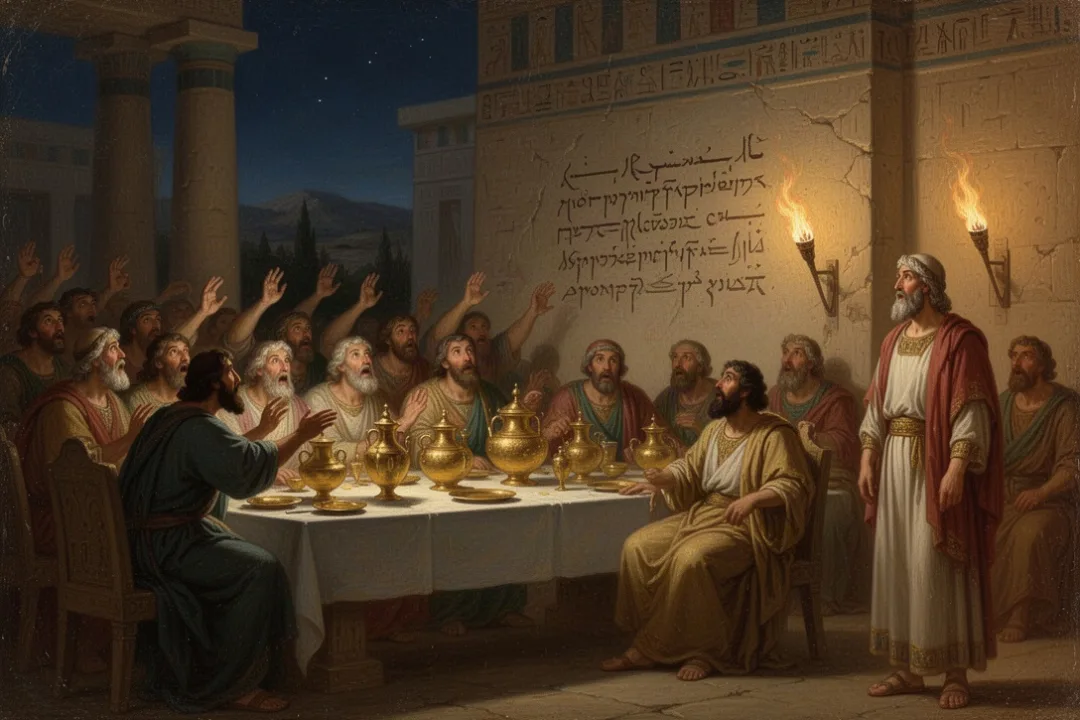
Daniel 5 opens with Belshazzar hosting a huge feast for his nobles. The setting communicates wealth, confidence, and political power. Babylon appears secure, and the king behaves as though neither enemies nor divine judgment could reach him inside the city.
During the banquet, Belshazzar orders servants to bring the gold and silver vessels that Nebuchadnezzar had taken from the temple in Jerusalem. These objects were not ordinary cups. They had been dedicated to worship in the temple, so using them for a royal drinking party was a deliberate act of contempt.
The guests drink wine from the sacred vessels while praising gods made of gold, silver, bronze, iron, wood, and stone. The contrast is central to the story: the banquet celebrates lifeless idols, while the living God is treated as though he has no authority over the king.
The central offense: Belshazzar’s problem is not simply that he holds a lavish party. He knowingly turns objects associated with holy worship into instruments of self-glorification and idol worship.
At that moment, a hand appears and writes on the plaster of the palace wall. The text is visible, but its meaning is not. The king reacts with immediate terror. His face changes, his thoughts alarm him, and his knees shake. The confident ruler who was giving orders now needs someone else to explain what is happening.
Belshazzar summons his wise men and promises generous rewards to anyone who can read and interpret the writing. The winner will receive purple clothing, a gold chain, and authority as the third-highest ruler in the kingdom. The offer shows how earthly power works in the chapter: the king can distribute honors, but he cannot produce wisdom.
The experts cannot read the message in a way that satisfies the king. The queen then remembers Daniel, who had served during Nebuchadnezzar’s reign. She describes him as a man with exceptional insight, understanding, and wisdom. Daniel is brought before Belshazzar, although the king seems to know little about him personally.
Daniel’s arrival changes the mood from frantic speculation to moral confrontation. The king offers him the same rewards offered to the other wise men. Daniel refuses to make his interpretation dependent on payment, saying that the gifts may be given to someone else. He will explain the message because it must be spoken, not because it will improve his position.
Why Daniel reminds Belshazzar about Nebuchadnezzar
Before interpreting the writing, Daniel recounts what happened to Nebuchadnezzar, Belshazzar’s predecessor. Nebuchadnezzar had been given extraordinary power, greatness, and glory. People feared him, and he could elevate or remove individuals as he wished.
According to Daniel’s account, Nebuchadnezzar became proud. His heart was lifted up, and he acted as though his royal authority belonged entirely to him. God humbled him, and he experienced a period of living like a wild animal until he recognized that the Most High rules over human kingdoms and gives authority according to his will.
Daniel’s point is not simply that Belshazzar should remember an interesting event from the past. Nebuchadnezzar’s story is a warning placed directly in front of him. Belshazzar has had access to the evidence, but he has not learned from it.
Daniel tells the king that Belshazzar knew these things and still did not humble himself. This makes his offense distinct from simple ignorance. He has seen the consequences of arrogance and has chosen the same path, perhaps with even greater contempt because he profanes the temple vessels during the feast.
The rebuke also clarifies the biblical meaning of pride. Pride in Daniel 5 is more than confidence, ambition, or enjoyment of success. It is the refusal to acknowledge that human authority is limited and accountable. Belshazzar acts as though his life, kingdom, and future are under his control alone.
Daniel then identifies the God whom Belshazzar has dishonored as the God who holds the king’s breath and all his ways in his hand. The statement reaches beyond the banquet. Every person depends on God for life and existence, even while making plans, exercising influence, or celebrating success.
That detail gives the chapter a sharp moral focus. Belshazzar is not merely guilty of bad manners toward a religious object. He is ignoring the God on whom his very life depends. His authority is real but temporary; his breath is sustained but not self-created.
Knowledge increases responsibility: Belshazzar has seen an earlier warning and refuses to respond.
Power does not remove accountability: A king remains answerable to God.
Religious contempt exposes moral pride: The sacred vessels become props in the king’s display of superiority.
Humility means recognizing dependence: Human life and authority are received, not ultimately possessed.
Daniel’s speech is also an example of courageous truth-telling. He speaks directly to a monarch who can reward or punish him. He does not soften the message to protect himself, yet he does not become theatrical or insulting. His authority comes from accurately delivering the warning.
What “Mene, Mene, Tekel, Upharsin” means
The writing on the wall consists of four Aramaic terms or related forms: Mene, Mene, Tekel, and Upharsin. Daniel explains the message rather than treating it as a magical code. Each term points to a judgment concerning the length, quality, and division of Belshazzar’s kingdom.
Mene is explained as meaning that God has numbered the days of Belshazzar’s kingdom and brought them to an end. The repetition of “Mene” intensifies the announcement. The kingdom’s time has been counted, and the limit has now been reached.
This is a powerful image because kingdoms often appear permanent to the people living inside them. Babylon has impressive walls, military resources, wealth, and an established ruling class. Yet Daniel insists that political power has a boundary that no ruler can extend indefinitely.
Tekel means that Belshazzar has been weighed and found deficient. The image is one of evaluation. The king’s public status, wealth, and authority do not determine his true worth before God. He is measured by a standard beyond royal ceremony and popular acclaim.
The phrase does not mean that human beings earn salvation by accumulating enough good deeds. In the immediate context, it describes the king’s moral failure: his arrogance, his refusal to humble himself, and his misuse of sacred things. His royal image is impressive, but his character fails under divine examination.
Upharsin, explained through a related form as “divided,” announces that the kingdom will be divided and given to the Medes and Persians. The wording points to the transfer of Babylonian power. What seemed fixed will be broken apart and placed under another empire.
Some readers wonder whether the terms are simply measurements or weights. They may have sounded like names of units to those present, which helps explain why the wise men could see the words but could not provide the intended interpretation. Daniel connects the words to a complete message of judgment rather than offering a narrow dictionary definition.
Reading the message as a whole: The words announce that Babylon’s time is over, Belshazzar has failed God’s examination, and the kingdom will pass to another power.
The message is brief, but it addresses three questions that matter in every age: How long will power last?What is a ruler truly worth? And who controls the future of nations? Daniel’s answer is that God numbers the days, weighs human conduct, and governs the rise and fall of kingdoms.
The writing also overturns the atmosphere of the feast. The guests had been celebrating possession and permanence. The wall reveals limitation and approaching loss. The banquet is not protected from judgment simply because it is held in a palace.
How Babylon falls that night
After Daniel interprets the message, Belshazzar orders that he be clothed in purple, given a gold chain, and proclaimed the third-highest ruler. The response is striking because the king appears to honor Daniel even after receiving a devastating interpretation.
The text does not present Belshazzar as having truly repented. He rewards Daniel, but there is no clear statement that he humbles himself, seeks forgiveness, or changes his attitude toward God. Recognition of a messenger is not the same as submission to the message.
That same night, Belshazzar is killed, and the Babylonian kingdom comes under new rule. The speed of the change is part of the chapter’s force. A ruler can hold a public celebration at dusk and lose his life and kingdom before morning.
Daniel 5 is set against the historical transition from Babylonian power to Medo-Persian power. The chapter identifies Darius the Mede as the ruler who receives the kingdom. The precise relationship between Darius the Mede and other known figures in the transition has been discussed by interpreters and historians, but the narrative’s main concern is clear: Babylon falls as Daniel’s interpretation said it would.
Belshazzar’s position also requires some historical explanation. Daniel 5 calls him king, while ancient records identify Nabonidus as the senior king of Babylon. Belshazzar appears to have exercised royal authority in Babylon while Nabonidus was elsewhere, functioning as a co-regent or acting ruler. This helps explain why Belshazzar offers Daniel the position of third ruler rather than second.
The detail makes the narrative more coherent. If Belshazzar is the second-highest authority, the highest position belongs to Nabonidus, and Daniel’s promised rank would be third. The offer is still generous, but it is also a sign of how the political structure operated.
Belshazzar’s feast may have been especially reckless because Babylon was facing external danger. The account does not require the king to be unaware of every military development. It emphasizes the larger reality that the palace’s confidence is misplaced. Walls, wealth, and ceremony cannot prevent a kingdom from reaching the end appointed for it.
Several details in the chapter create this contrast:
The banquet suggests abundance, but the king is about to lose everything.
The palace represents security, but judgment enters through an ordinary wall.
The king can promise status, but he cannot preserve his own life.
The wise men have public prestige, but they cannot interpret the message.
Daniel has no visible army, yet he speaks the truth that determines the moment.
The fall of Babylon illustrates the difference between visible control and ultimate authority. Belshazzar controls the banquet, the rewards, and the audience. God controls the limits of the kingdom and the meaning of the writing.
What Daniel 5 teaches about pride and accountability
Daniel 5 is often remembered as a warning that danger is near, but its deeper lesson concerns accountability. The chapter asks readers to consider what happens when success becomes a reason to ignore God rather than an opportunity to practice humility.
First, past warnings are meant to shape present choices. Belshazzar has knowledge of Nebuchadnezzar’s humiliation, yet knowledge alone does not change him. A person can be familiar with religious truth and still refuse to act on it.
Second, the chapter separates external honor from internal character. Belshazzar has royal clothing, servants, nobles, and the ability to give orders. None of those things can conceal his moral condition from God.
Third, sacred things should not be treated as instruments for self-display. The vessels from Jerusalem represent worship and reverence. Belshazzar uses them to intensify his party, turning what is holy into something that serves his pride.
Fourth, judgment may arrive after a long period of apparent stability. Babylon does not look fragile at the beginning of the feast. Daniel 5 does not encourage panic about every political event; it does insist that no human system is beyond God’s evaluation.
Fifth, faithful speech may require courage. Daniel does not control the king, command an army, or determine the outcome through political influence. His responsibility is to speak accurately and without compromise. The chapter gives dignity to that kind of faithfulness.
For personal reflection, the passage can prompt questions such as these:
Have success, comfort, or status made you less aware of your dependence on God?
Are you ignoring a warning because responding would require humility or change?
Do you measure yourself mainly by public recognition rather than character?
Are your words and choices treating sacred commitments seriously?
When truth challenges you, do you reward the messenger while resisting the message?
These questions should not be used to speculate about when a modern nation or individual will be judged. Daniel 5 is not a timetable for predicting every crisis. It is a call to recognize that human power is temporary, God sees the truth about a person, and humility cannot be postponed indefinitely.
How to read the writing on the wall in its biblical setting
In ordinary speech, “the writing on the wall” means an unmistakable sign that trouble or failure is approaching. That usage captures part of Daniel 5, because the writing does announce an imminent end. But the biblical passage contains more than a general warning sign.
The message is addressed to a specific ruler whose conduct has crossed a moral boundary. It explains why judgment has come: Belshazzar has become proud, has failed to learn from Nebuchadnezzar, and has dishonored God while praising idols.
That context keeps the expression from becoming a vague slogan. The “writing on the wall” is not merely bad news that appears without explanation. It is an interpreted verdict. Daniel explains the evidence, identifies the offense, and declares the consequence.
The chapter also avoids presenting Daniel as a fortune-teller. He does not claim personal power over the writing. He gives credit to God for the wisdom required to understand it. His role is that of a servant and witness, not the source of the judgment.
For Christian readers, Daniel 5 fits a wider biblical theme: rulers and nations remain under God’s authority, and pride invites downfall. The chapter can be read alongside other passages that emphasize humility, responsible leadership, and the limits of earthly glory without turning it into a formula for assigning blame to every modern event.
Its final emphasis is both sobering and practical. A person may have influence, resources, intelligence, and a secure-looking position, yet still need humility before God. The appropriate response is not fear of mysterious signs but honest self-examination, reverence, and a willingness to respond when truth exposes pride.
Daniel 5 therefore answers the reader’s original question on several levels. The writing on the wall means that Babylon’s time has ended; Belshazzar has been judged deficient; and his kingdom will be transferred to another power. More broadly, the chapter warns that no celebration, palace, or political title can shield a person from accountability before the God who gives life and governs kingdoms.
Frequently asked questions
Who was Belshazzar in Daniel 5?
Belshazzar was the Babylonian ruler holding authority when the writing appeared on the wall. Nabonidus was the senior king, while Belshazzar appears to have governed in Babylon as a co-regent or acting ruler. This likely explains why Daniel was offered the position of third ruler rather than second.
What does “the writing on the wall” mean today?
The expression refers to a clear warning that failure, danger, or major change is approaching. In Daniel 5, it has a more specific meaning: God announces that Belshazzar’s kingdom has been measured, found deficient, and brought to its appointed end.
Did Daniel interpret the writing because he knew the language?
The chapter emphasizes that Daniel received understanding from God rather than presenting him as merely a skilled linguist. The Babylonian wise men could not provide the needed interpretation, while Daniel explained both the words and the judgment they announced.
Why did Belshazzar use the Jerusalem temple vessels?
Belshazzar used them during his feast to display wealth and power while honoring Babylonian gods. Because the vessels had been dedicated to worship in Jerusalem, this act represented deliberate contempt for the God of Israel, not simply ordinary use of valuable drinking cups.








Leave a Reply