Horn in the Bible: Meaning, Symbols, and Key Verses
Horn in the Bible: Meaning, Symbols, and Key Verses
In the Bible, a horn usually symbolizes strength, power, authority, or victory, but its meaning depends on the passage. A horn may also refer to a literal animal horn, a musical instrument, a container for oil, or the horn-shaped projections on the altar.
Scripture uses horn imagery in several connected ways. Since animals used their horns to defend themselves and overcome rivals, the image became a natural picture of might and royal power. At the same time, a ram’s horn could call people to worship or announce an important event, while an altar’s horns were associated with sacrifice, refuge, and sacred authority.
The main Hebrew word translated as horn is qeren. In the New Testament, the corresponding Greek word is keras. Both words can describe a physical horn, but biblical writers also use them figuratively for strength, prominence, military power, and political rule.
The original meaning is usually clear from the setting. A passage about cattle or rams may be speaking about an actual body part. A psalm about God lifting someone’s horn is using symbolic language for renewed strength or honor. A vision involving several horns may represent kings, kingdoms, or rulers rather than animals.
That range of meaning explains why a single definition does not work in every passage. Reading “horn” as a symbol of evil in every instance would be just as misleading as treating every horn in prophecy as a literal object.
Reading tip: Ask what the horn is doing in the passage. Is it sounding, rising, being cut off, used for oil, attached to an altar, or appearing on a beast? The action and surrounding imagery usually reveal its meaning.
Horns represent strength and power
Many biblical references use the horn as a picture of physical strength and personal power. A horned animal could push, wound, or drive away an opponent, so “raising the horn” became an image of becoming strong, honored, or victorious.
Hannah’s prayer in 1 Samuel 2:1-10 celebrates God’s ability to reverse human circumstances. In that prayer, the horn represents strength and dignity that come from God rather than from human achievement. Hannah contrasts the proud and powerful with those whom God raises up.
Psalm 75:4-5 warns the arrogant not to lift their horns defiantly. In that setting, a raised horn pictures self-exalting pride. The passage teaches that people should not boast as though their position or success gives them absolute authority.
Other psalms use the same image positively. Psalm 92:10 describes strength being exalted like the horn of a wild ox, while Psalm 112:9 connects the righteous person’s horn with honor. These passages do not promise that every faithful person will gain political influence. They express the broader biblical idea that God can give dignity, endurance, and public vindication to those who trust him.
Deuteronomy 33:17 compares Joseph’s glory and power to the horns of a firstborn bull. The poetic image points to influence and strength extending outward. It reflects the prosperity and prominence associated with Joseph’s descendants, especially Ephraim and Manasseh.
Horns symbolize kings, kingdoms, and political authority
In prophetic visions, horns commonly represent rulers or kingdoms. Daniel 7 describes a terrifying beast with ten horns, and the interpretation connects the horns with kings. Daniel 8 presents a ram with two horns and a goat with a prominent horn; the vision represents imperial powers and the conflict between them.
The horn is a useful symbol for political authority because a ruler can use power to protect, conquer, or oppress. A horn may therefore represent a legitimate kingdom, an aggressive empire, or an individual ruler who rises above others.
Daniel 8:9-12 describes a small horn that grows in power and acts against God’s people and the sanctuary. The passage presents a ruler or ruling power marked by arrogance and opposition to worship. The precise historical interpretation has been debated, but the symbolic pattern is clear: a horn can picture authority that becomes rebellious and destructive.
Revelation continues this prophetic symbolism. The dragon and the beasts are shown with multiple horns, and Revelation 17:12 explicitly associates ten horns with kings who receive authority for a limited period. The horns emphasize concentrated political power and cooperation among rulers.
These passages should be read carefully. Not every reference to multiple horns gives the same number or carries the same interpretation. The surrounding vision, its explanation, and related passages determine what the symbol means.
The horn of salvation points to God’s deliverance
Luke 1:68-79 records Zechariah’s prophecy after the birth of John the Baptist. He praises God for raising up a horn of salvation in the house of David. The phrase draws on Old Testament imagery in which a horn represents strength, royal authority, and the ability to save.
For Christians, this prophecy points to Jesus as the promised Davidic king. “Horn of salvation” does not mean that Jesus is an animal or that the phrase describes his physical appearance. It is a royal metaphor declaring that God has brought powerful deliverance through the Messiah.
The image connects with passages such as Psalm 18:2, where God is described as a rock, fortress, deliverer, shield, and stronghold. Psalm 18 uses several images together to show that God protects his people. The horn adds the idea of saving power that can defeat danger and establish justice.
Psalm 132:17 similarly speaks of a horn growing for David and describes a lamp prepared for God’s anointed king. The language joins royal promise with hope. In the biblical story, salvation is not merely escape from trouble; it also includes God’s faithfulness to his covenant and his promise to establish righteous rule.
The ram’s horn calls people to worship and action
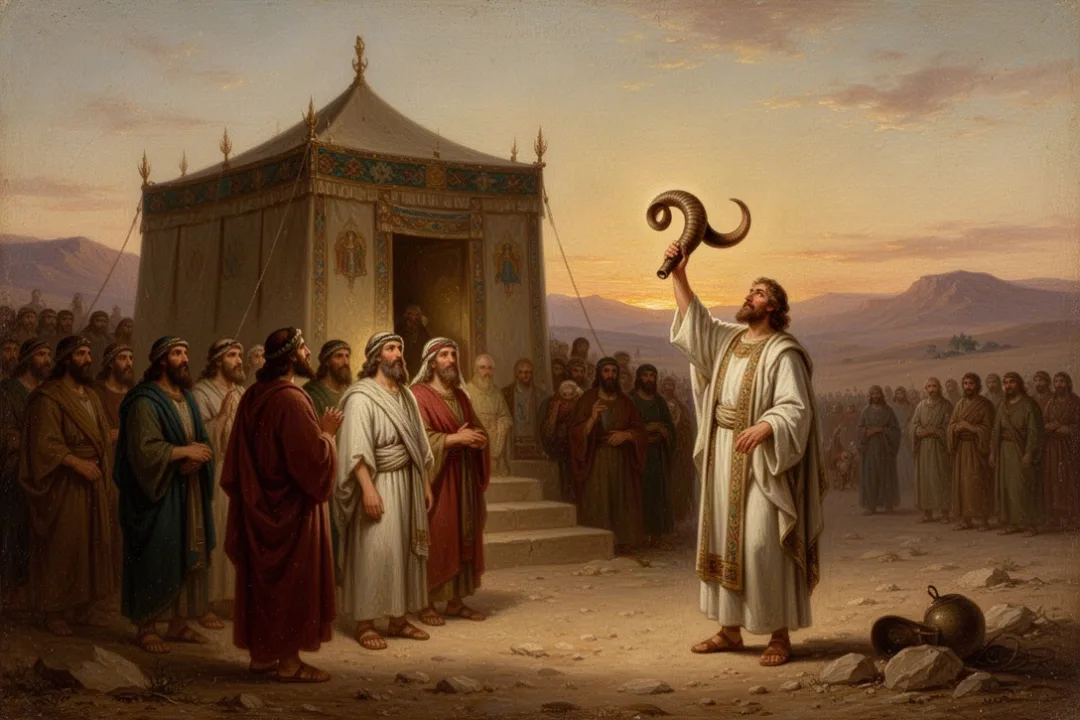
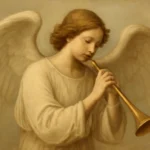
A ram’s horn, often called a shofar, was used as a signal in ancient Israel. It could announce movement, gather the community, warn of danger, mark a celebration, or accompany worship. When the Bible mentions a trumpet or horn, the instrument may be a ram’s horn, a metal trumpet, or another type of signal instrument, so the exact object should be determined from the context.
At Mount Sinai, a loud trumpet or horn sound accompanies God’s appearance and the giving of the covenant in Exodus 19. The sound marks the holiness and seriousness of the encounter. It signals that the people are approaching a sacred boundary and must respond with reverence.
Joshua 6 describes priests carrying ram’s horns around Jericho. The sound of the horns forms part of Israel’s obedience to God’s instructions before the city’s defenses fall. The story does not present the horn as a magical weapon. Its role is a public sign of faith, obedience, and divine intervention.
Leviticus 25:9 commands the sounding of the jubilee trumpet on the Day of Atonement during the jubilee year. That sound announced release, restoration, and the return of property and family relationships according to the laws of the jubilee. The horn therefore became connected with freedom and social renewal.
Joel 2:1 commands the trumpet to be sounded in Zion because the day of the Lord is approaching. Here the horn is an alarm. It calls the people to recognize danger, gather, and turn back to God. The same instrument can signal joy in one setting and urgent repentance in another.
Gathering: the sound could call the community together.
Warning: it could announce military danger or divine judgment.
Worship: it could accompany praise and sacred celebrations.
Transition: it could mark a new season, festival, or public proclamation.
The horns of the altar have sacred significance
The tabernacle and temple altars had four horn-shaped projections, one at each corner. Exodus 27:1-8 describes the bronze altar, while Exodus 30:1-10 describes the incense altar. These altar horns were not decorative details without meaning; they formed part of the altar’s prescribed design and became important in several biblical scenes.
The altar was connected with sacrifice, prayer, forgiveness, and approach to God. Its horns therefore stood within a sacred setting where human beings sought mercy and reconciliation. Psalm 118:27 refers to binding the sacrifice to the altar’s horns, reflecting the language of worship and festal sacrifice.
At times, a person fleeing danger could seize the horns of the altar. Adonijah does this in 1 Kings 1:50 when he fears Solomon, and Joab later takes hold of the altar in 1 Kings 2:28. These scenes show that the altar could be treated as a place of refuge, although the narrative also makes clear that holding the altar did not automatically protect someone guilty of serious wrongdoing.
Exodus 21:12-14 distinguishes between an accidental killing and deliberate murder. A person who killed intentionally was not to receive protection simply by fleeing to the altar. The passage prevents a sacred place from being used as a way to defeat justice.
The altar horns can therefore suggest sanctuary and access to God, but they should not be reduced to a promise that any religious symbol will shield a person from accountability. Biblical refuge includes both mercy and moral seriousness.
Oil in a horn represents anointing and calling
Several important anointings in the Old Testament involve oil kept in a horn. Samuel carries a horn of oil when he anoints David in 1 Samuel 16:1-13. The act identifies David as the one God has chosen to become king, even though David does not immediately take the throne.
The horn functions as a practical container, but the scene also reinforces the symbolism of royal strength. Oil marks consecration, while the horn suggests the authority associated with kingship. The text emphasizes that God looks at the heart rather than relying on outward appearance.
In 1 Samuel 10:1, Samuel anoints Saul with oil and announces that the Lord has appointed him ruler over Israel. Saul’s anointing and David’s later anointing show that kingship in Israel was understood as a responsibility received under God’s authority, not merely a possession won through personal ambition.
Oil from a horn is also associated with priests and sacred service in other biblical descriptions, though the exact container may vary by passage. The larger theme is being set apart for a God-given task. Anointing does not mean the individual becomes flawless; both Saul and David’s stories show that calling and character must be considered together.
Broken horns show judgment and the end of power
If a raised horn represents strength, a broken or cut-off horn represents humiliation, defeat, or the removal of authority. Psalm 75:10 says that God will cut off the horns of the wicked while the horns of the righteous will be lifted. The contrast presents judgment as a reversal of human power.
Jeremiah 48:25 uses the image of a horn being cut off to describe the collapse of Moab’s strength. Lamentations 2:3 says that the Lord has cut off Israel’s horn in anger, portraying national disaster as the loss of military power and public honor.
These passages use vivid poetry rather than technical descriptions of weapons. They communicate what political defeat feels like: the ability to resist is gone, status has fallen, and the proud can no longer act as before.
Hosea 5:8 tells the people to sound a horn as a warning about approaching judgment. The horn is not broken in that verse, but its alarm announces that national strength is about to be confronted. The image links the public sound of warning with the moral reality of consequences.
Horns in Revelation and apocalyptic visions
Revelation uses horn imagery in a highly symbolic style. The dragon has ten horns in Revelation 12:3, the beast from the sea has ten horns in Revelation 13:1, and the beast in Revelation 17 has ten horns connected with kings. These horns communicate organized opposition, authority, and concentrated worldly power.
Revelation 5:6 describes the Lamb with seven horns and seven eyes. The image combines the Lamb’s sacrificial identity with complete power and complete insight. The horns do not change the Lamb into a literal horned creature; they communicate that Christ possesses fullness of authority and is fully able to accomplish God’s purposes.
The contrast is central to the book’s message. Violent beasts may appear politically dominant, but the Lamb ultimately holds true authority. The imagery encourages faithful endurance by showing that visible power is not the same as final power.
Revelation 9 includes trumpet judgments and creatures described with horns. These passages belong to a series of visions filled with symbolic numbers, animals, heavenly beings, and judgments. Readers should avoid assigning a fixed modern meaning to every horn without considering the whole vision and its literary setting.
Important warning: Apocalyptic horns are symbols within visions, not automatic predictions about a particular modern country, leader, or event. Sound interpretation begins with the biblical passage and its context rather than with a current headline.
How horn imagery connects strength, worship, and justice
At first, the Bible’s uses of horns may seem unrelated. A horn on an altar, a horn used to anoint a king, and a horn in a prophetic beast appear in very different settings. They are connected by the central idea of power expressed in a particular direction.
Power can protect the vulnerable, as in the image of God lifting a person’s horn. It can serve worship, as when a shofar gathers the people. It can legitimize royal responsibility, as in David’s anointing. But power can also become arrogant, oppressive, and hostile to God, as in the horns of Daniel’s and Revelation’s beasts.
This contrast gives the symbolism moral depth. The Bible does not praise strength simply because it is strength. It asks whether power is exercised under God’s authority, for the good of others, and with humility.
The theme also explains why the “horn of salvation” is such a significant phrase. Salvation is portrayed as God’s strong intervention on behalf of his people, yet the surrounding biblical story defines that strength through covenant faithfulness, justice, mercy, and the reign of the Messiah.
Common mistakes when interpreting horns in the Bible
Horn symbolism is memorable, but it is easy to overgeneralize. A careful reader can avoid several common errors by checking the genre, the immediate context, and the passage’s explanation.
Assuming every horn means evil: Horns often symbolize strength, kingship, salvation, worship, or honor. Their meaning is not negative by default.
Treating every horn as a shofar: Some references concern animal horns, altar horns, oil containers, or visionary symbols. Do not assume the object is a musical instrument.
Ignoring the action: A lifted horn, broken horn, sounding horn, and horn used to pour oil communicate different ideas.
Reading prophecy in isolation: Compare the interpretation given in Daniel or Revelation with the surrounding vision before making a claim about a horn.
Confusing metaphor with physical description: “Horn of salvation” describes powerful deliverance; it does not describe Jesus’ appearance.
Using one verse to define every occurrence: Biblical symbols can have related but distinct meanings in different genres and settings.
A practical method for studying a horn passage
When you encounter the word “horn” in a Bible study, begin by reading several verses before and after it. Notice who possesses the horn, what happens to it, and whether the passage is narrative, poetry, prophecy, law, or apocalyptic vision.
Identify the literal object. Decide whether the text describes an animal horn, a musical horn, an altar feature, a container, or a symbolic horn.
Observe the verb. Words such as lift, cut off, sound, grow, break, or pour can point toward the intended meaning.
Look for an interpretation. Daniel and Revelation sometimes explain what symbolic horns represent. Give those explanations priority.
Compare related passages. Psalms, prophetic books, and New Testament writings often develop the same images in different ways.
Ask the theological question. Does the horn show God’s power, human pride, royal authority, judgment, refuge, or deliverance?
Apply the passage carefully. Let the text shape your understanding rather than forcing a personal prediction onto a symbolic image.
A concordance or Bible word-study tool can help you find related references, but word searches alone are not enough. The same translated word may refer to several objects, and a list of occurrences cannot replace attention to literary context.
What the biblical horn means for readers today
The Bible’s horn imagery invites a balanced view of strength. Human authority is temporary and accountable, while God’s power is presented as dependable and directed toward justice and salvation. A person may gain influence, but that influence is not proof of righteousness.
The image also offers comfort to people who feel weak or overlooked. In the biblical pattern, God can lift the horn of the lowly, defend those who are oppressed, and bring down arrogant power. That hope does not deny suffering; it places suffering within a larger conviction that evil does not have the final word.
For Christian readers, the horn of salvation points to Jesus as the promised king whose authority brings deliverance. For anyone studying the Bible, the broader lesson remains clear: power should be understood in relation to character, justice, worship, and accountability.
When you read a passage about a horn, look beyond the striking image. Determine whether the horn announces, protects, rules, anoints, warns, judges, or saves. That simple distinction turns a confusing symbol into a meaningful part of the Bible’s larger message.
Frequently asked questions
Is the horn in the Bible always a symbol of strength?
No. Strength is one of the most common meanings, but a horn can also be a literal animal part, a musical instrument, an altar projection, or a container for oil. In prophetic visions, it may represent a ruler or kingdom. The passage’s action and setting determine whether the emphasis is strength, worship, warning, kingship, judgment, or salvation.
What is the horn of salvation in Luke 1?
In Luke 1:68-79, Zechariah describes God raising a horn of salvation in David’s house. This is a royal metaphor for powerful deliverance through the promised Davidic king. Christian interpretation identifies that king with Jesus. The phrase emphasizes God’s saving authority and faithfulness to his covenant rather than describing a physical horn.
What does a shofar represent in the Bible?
A shofar, usually made from a ram’s horn, could gather people, announce danger, accompany worship, or mark a major religious occasion. Its meaning changes with the setting. At Sinai it accompanies a solemn encounter with God; at Jericho it participates in Israel’s commanded action; in Joel it functions as an alarm calling people to respond.
Why do beasts in Daniel and Revelation have horns?
In these prophetic visions, horns generally represent political rulers, kingdoms, or concentrated authority. Multiple horns can show several rulers or powers operating together. The imagery also contrasts worldly domination with God’s ultimate rule. Interpretations should follow the explanations within the biblical text rather than automatically identifying every horn with a modern leader or nation.






Leave a Reply