Thyatira was the fourth of the seven churches addressed by Jesus in Revelation. Its believers were commended for growing in love, faith, service, and perseverance, yet they were also rebuked for allowing a false teacher—symbolically called Jezebel—to influence the church toward idolatry and sexual immorality.
The message to Thyatira appears in Revelation 2:18–29. It speaks both to a first-century Christian congregation in a real Roman city and to churches in every age that must balance compassion with spiritual discernment. The central warning is clear: patient love is good, but love must not become permission for teaching or behavior that contradicts faithfulness to Christ.
The letter begins with a description of Jesus as the Son of God, whose eyes are like a flame of fire and whose feet resemble burnished bronze. These images present him as one who sees through appearances and judges with strength and authority. The language is especially fitting for Thyatira, a city associated with metalworking and trade.
Jesus first recognizes the church’s good qualities. The believers show love, faith, service, and endurance, and their later works exceed their earlier ones. This is unusual among the seven messages because Thyatira is portrayed as a church whose active faith is increasing rather than fading.
The problem is that the congregation tolerates a woman called Jezebel. Revelation says she claims to be a prophet and leads servants of Christ into sexual immorality and food connected with idols. The name may point to the Old Testament queen Jezebel, whose story is told especially in 1 Kings, rather than identifying the woman’s literal name.
Jesus gives her time to repent, but she refuses. Judgment is therefore announced against her and those who follow her teaching unless they turn away from it. The church is told to hold firmly to what it has until Christ comes, and faithful believers are promised authority over the nations and the “morning star,” an image associated with Christ’s own victory and presence.
Central idea: Thyatira shows that a church can be active, loving, and growing while still needing to confront serious moral and doctrinal compromise.
Where Thyatira was and why its setting matters
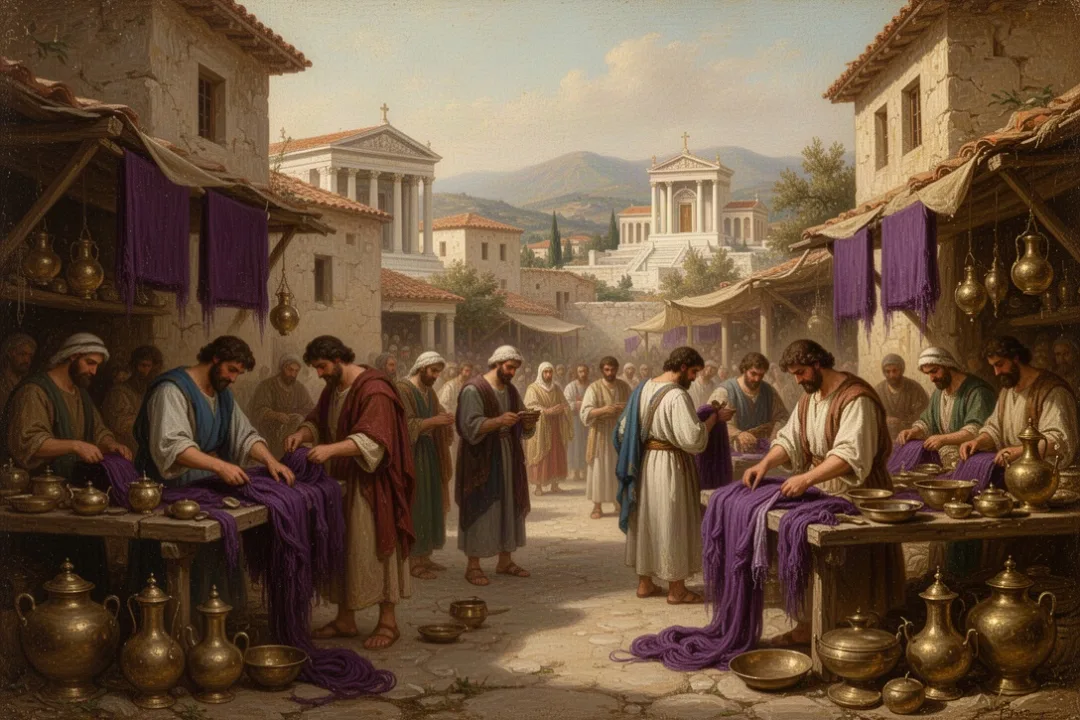
Thyatira was an ancient city in western Asia Minor, in what is now Turkey. It lay in the region of Lydia and was positioned along routes that connected larger centers. Unlike cities such as Ephesus and Pergamum, Thyatira was not primarily famous for a major imperial monument or a dominant philosophical school. Its importance came largely from commerce, manufacturing, and local associations.
The city was known for trade guilds, which were organized groups connected with particular crafts or businesses. Ancient evidence associates Thyatira with occupations such as textile production, dyeing, leatherworking, pottery, metalworking, and other skilled trades. The exact influence of each guild varied, but membership could affect a person’s business relationships and social standing.
Guild meals sometimes took place in settings connected with pagan worship. A Christian whose livelihood depended on a guild could face pressure to attend meals, honor a local deity, or participate in conduct that conflicted with Christian convictions. This background helps explain why the message focuses on idolatry, food sacrificed to idols, and sexual immorality.
The letter does not mean that every worker in Thyatira faced the same situation or that every trade organization was equally corrupt. It does show the practical tension between following Christ and participating in social or economic customs that carried religious meaning. Faithfulness was not merely a private belief; it affected work, meals, relationships, and public identity.
How to understand the message to Thyatira step by step
Identify the speaker. Jesus is introduced as the Son of God, with penetrating sight and firm authority. The church is not evaluating itself by its own standards; it is being examined by Christ.
Recognize the commendation. Thyatira has love, faith, service, and endurance. Its recent works are greater than its earlier ones, suggesting genuine spiritual growth.
Locate the failure. The church tolerates a person whose influence encourages idolatry and sexual immorality. The issue is not simple weakness but teaching that normalizes disloyalty to God.
Consider the opportunity to repent. Jesus describes a period of patience before judgment. Mercy is offered, but persistent refusal makes judgment unavoidable.
Distinguish the faithful remnant. Some in Thyatira have not accepted the false teaching. They are not given a new burden but are told to hold firmly to what they have.
Receive the promise. Those who remain faithful share in Christ’s victorious rule and receive the morning star, pointing to participation in his final triumph.
Listen personally. Each message ends with a call for anyone who has ears to hear what the Spirit says to the churches. The message applies beyond Thyatira.
What Jesus praised in the church at Thyatira
Love that produced action
Thyatira’s love was not described as a feeling without substance. It appeared through service and perseverance. The believers were doing work for Christ and apparently continuing in it despite difficulty. Their faith had practical results in the way they treated others and remained committed to their calling.
This commendation challenges the idea that a church’s spiritual condition can be measured only by its teaching reputation or public influence. Thyatira may not have been the most prominent congregation, but Jesus noticed its active love. A church can serve quietly and still be seen clearly by Christ.
Faith that endured pressure
The letter joins faith with endurance. In a city where commercial life could overlap with pagan customs, Christians may have faced pressure to fit in. Their faith required more than agreement with Christian beliefs; it required loyalty when conformity seemed easier or more profitable.
Endurance does not necessarily mean dramatic persecution. It can include refusing participation in practices that violate conscience, accepting lost opportunities, remaining honest in business, or continuing Christian service when recognition is limited. Thyatira’s faith was visible in its ability to continue.
Growth rather than stagnation
Jesus says the church’s later works are greater than its earlier works. This suggests healthy spiritual development. The congregation was not resting on an impressive past. It was continuing to grow in service and faithfulness.
That praise gives a useful standard for evaluating Christian maturity. Growth is not simply larger attendance, more programs, or greater visibility. It may be seen in deeper love, steadier obedience, more generous service, wiser discernment, and greater courage under pressure.
Why the figure called Jezebel is so serious
The name Jezebel recalls the queen associated with King Ahab in the Old Testament. She promoted the worship of Baal and opposed the worship of the Lord, while the prophet Elijah confronted her influence. By using this name, Revelation presents the Thyatiran teacher as someone whose influence pulls God’s people toward religious compromise.
Scholars differ on whether “Jezebel” was a symbolic nickname, a known individual’s name, or a prophetic label for a broader movement. The text does not provide enough information to identify her with certainty. What is clear is the effect of her teaching: it persuaded some believers that participation in idolatrous and sexually immoral practices could be accepted within Christian life.
The warning concerns more than private misconduct. False teaching is dangerous because it reshapes a community’s moral judgment. If a teacher uses spiritual authority to excuse disobedience, the damage can spread from one person to many. The problem at Thyatira was not merely that sin existed; it was that sin was being defended as compatible with faithfulness.
The reference to sexual immorality may involve both literal conduct and, as elsewhere in biblical imagery, unfaithfulness to God. In this passage, the connection with idol worship and guild practices suggests a concrete moral problem, while the Jezebel comparison also gives it a spiritual dimension. The two ideas should not be separated too sharply: bodily actions, public worship, and covenant loyalty were connected.
What “tolerating” means in the Thyatira message
Jesus does not condemn the church because every member followed Jezebel’s teaching. He condemns it for allowing the influence to remain. The language raises a difficult question for churches: when does patience become harmful tolerance?
Christian communities are called to show patience toward people who are learning, struggling, or seeking restoration. That patience is different from granting an influential teacher permission to redefine sin as obedience. Forgiveness and accountability belong together. A church can care for a person while still refusing to endorse destructive teaching.
The message also warns against a shallow idea of unity. Unity is not maintained by ignoring every serious disagreement or by treating truth as unimportant. Biblical unity includes shared loyalty to Christ and a willingness to protect vulnerable people from spiritual harm.
At the same time, Thyatira should not be used as an excuse for suspicion, harshness, or control. The letter recognizes the faithful members who have not accepted the teaching. Discernment should be based on clear evidence, consistent conduct, and the teaching of Scripture—not on personality conflicts or minor differences of preference.
Practical distinction: Patience gives people room to repent; compromise treats harmful teaching as acceptable. Thyatira is warned against the second response.
What “the deep things of Satan” may mean
Jesus refers to what some call the deep things of Satan. The phrase may describe the false teacher’s claim to possess special spiritual knowledge or insight. It may also be a sarcastic description of teachings that led believers into Satan’s sphere rather than into genuine spiritual depth.
Some early Christians may have argued that mature believers could enter pagan settings without being contaminated because they understood that idols were powerless. Under that reasoning, a Christian might attend an idol-related meal or participate in associated practices while claiming inward loyalty to God. Revelation rejects the idea that intellectual confidence makes disobedience harmless.
The exact historical argument cannot be reconstructed with certainty, so the phrase should not be assigned a detailed theory that the passage itself does not provide. Its main force is clear: claims of hidden wisdom do not excuse conduct that betrays Christ. Spiritual depth is measured by truth and obedience, not by the boldness of a teacher’s claims.
How the promise to Thyatira points to Christ’s victory
Authority over the nations
Faithful believers are promised authority over the nations, using imagery drawn from Psalm 2. The promise is not a license for personal domination. It is connected to sharing in the Messiah’s victorious reign after evil has been judged.
For a small Christian community facing pressure from surrounding society, this promise would give a different perspective on power. The church might appear weak in the present, while pagan institutions and economic systems seemed influential. Revelation assures faithful believers that Christ’s authority, not present social status, determines the final outcome.
The morning star
The promise of the morning star appears near the end of the message. Later in Revelation, Jesus identifies himself with the bright morning star. The image can suggest the arrival of a new day, the certainty of victory, and the believer’s share in Christ’s life and reign.
The promise is therefore personal as well as public. Faithful Christians are not merely promised a position in a future order; they are promised Christ himself. Their endurance leads toward deeper fellowship with the victorious Lord.
What Thyatira teaches churches today
Good works do not cancel the need for discernment. A church may be generous, active, and compassionate while still tolerating teaching that must be confronted.
Growth should be measured by faithfulness. Increasing activity matters when it reflects deeper obedience, love, and service rather than simple expansion.
Economic pressure can test spiritual conviction. Decisions about work, business, entertainment, and social belonging may involve questions of worship and conscience.
Influence increases responsibility. Teachers and leaders shape the moral imagination of a congregation, so their doctrine and conduct require careful evaluation.
Repentance should be offered seriously. Jesus gives time to turn back, showing both the reality of judgment and the generosity of divine patience.
Faithful minorities should not be overlooked. Even within a compromised church, some people may be resisting the prevailing pressure and deserve encouragement rather than suspicion.
Christian unity has moral boundaries. Peace is not preserved by approving everything; it is strengthened by truth, humility, and accountable love.
How to apply the Thyatira message personally
Begin by examining the influences you have accepted without much thought. Ask whether your workplace, friendships, entertainment, financial choices, or social ambitions are gradually shaping your worship and moral decisions. The question is not whether every contact with wider culture is wrong. The question is whether participation is teaching you to treat disobedience as normal.
Next, examine the voices you trust. A persuasive Christian teacher may be knowledgeable, compassionate, or successful and still promote an unhealthy message. Compare claims with Scripture, observe the teacher’s character, and pay attention to whether the teaching produces humility and holiness or pride and permission.
Then separate weakness from deliberate defense of wrongdoing. A believer who confesses sin and seeks help needs patience and restoration. A person who repeatedly uses spiritual authority to justify sin is creating a different kind of danger. The Thyatira message calls for both mercy toward repentant people and firmness toward corrupting influence.
Finally, hold firmly to what is true and good. The faithful in Thyatira were not told to chase every controversial teaching or construct an elaborate response to every claim. They were told to remain faithful to what they had received. Steadfastness often involves ordinary practices: prayer, honest work, worship, wise community, confession, and obedience.
How Thyatira connects with Lydia in Acts
Thyatira is also mentioned in Acts 16:14–15, where Lydia is described as a seller of purple cloth from that city. She encounters Paul and his companions in Philippi, responds to the gospel, and offers hospitality to the missionaries. The passage does not say that Lydia founded the church in Thyatira, so that connection should not be claimed as fact.
Her story does, however, show that people from Thyatira participated in regional trade and could travel for business. It also provides a helpful picture of a woman involved in commerce who became a committed follower of Christ. The same wider world of trade and social networks that carried goods could also carry the Christian message.
Lydia and the church in Revelation should be kept as separate biblical accounts unless the text itself connects them. Still, both passages help readers see Thyatira not as an abstract name but as a real commercial city whose residents moved through the economic and religious life of the Roman world.
Common misunderstandings about Thyatira
“Thyatira was entirely corrupt”
No. Jesus praises significant virtues in the church and distinguishes faithful believers from those who accepted the false teaching. The congregation had a real problem, but it was not uniformly faithless. This distinction matters because biblical correction often addresses a community with both genuine strengths and serious weaknesses.
“Jezebel must be the woman’s actual name”
That cannot be established from the passage. The name most likely evokes the Old Testament Jezebel and describes the teacher’s spiritually destructive role. Treating the label as certain biographical information goes beyond what Revelation tells us.
“The passage condemns all contact with pagan society”
The issue is not ordinary contact with non-Christians or participation in every form of public life. The concern is worshipful or morally compromising participation that conflicts with loyalty to Christ. Christians can work, trade, and live among people of different beliefs while still exercising discernment about what they affirm and practice.
“The promise of authority encourages domination now”
The promise belongs within Revelation’s picture of Christ’s final victory. It does not authorize believers to pursue coercive power or treat other people as enemies to control. The church’s present calling remains faithful witness, patient endurance, holy living, and service shaped by Christ.
Questions for studying Thyatira carefully
When reading Revelation 2:18–29, several questions can keep interpretation grounded:
What does Jesus praise before he gives correction?
What specific teaching and conduct does he oppose?
How does the city’s economic and religious setting clarify the warning?
What distinction does the passage make between corrupt teachers and faithful believers?
How do patience, repentance, judgment, and promise appear together?
What does the message reveal about Christ’s knowledge and authority?
Which current pressures tempt Christians to rename compromise as wisdom?
These questions prevent the passage from becoming merely a label for other people. Thyatira is not useful only when applied to an obviously corrupt church or a disliked leader. Its sharper purpose is self-examination: a growing church, a serving Christian, or an established teacher can still need correction.
Why Thyatira remains a needed warning
Thyatira offers a balanced picture of Christian faithfulness. It refuses to reduce the church to its failure, because Jesus sees its love, faith, service, and endurance. It also refuses to excuse the failure, because sincere ministry does not make false teaching harmless.
The message calls for a church that is generous without being gullible, patient without being permissive, and courageous without becoming cruel. Its hope rests not in the church’s ability to manage every threat but in the authority of Christ, whose judgment is clear and whose promise belongs to those who remain faithful.
For readers today, Thyatira asks a direct question: are your good works accompanied by a willingness to test what you believe and practice? The church’s answer must include both active love and determined loyalty to Christ.
Frequently asked questions
What is the main message of the church at Thyatira?
The main message is that Christians should continue growing in love, faith, service, and endurance while rejecting teaching that excuses idolatry and sexual immorality. Jesus praises the church’s good works but rebukes its willingness to tolerate a corrupting influence. The passage combines encouragement, a call to repentance, a warning about judgment, and a promise to those who remain faithful.
Who was Jezebel in the church at Thyatira?
Revelation does not establish whether Jezebel was the woman’s actual name. The term likely recalls the Old Testament queen Jezebel and describes a teacher whose influence led Christians toward idolatry and sexual immorality. Her exact identity and historical background are uncertain, but the passage clearly condemns her teaching and the church’s failure to confront it.
What was Thyatira known for in the Bible?
Thyatira was a commercial city in Asia Minor associated with trade guilds and skilled occupations, including textiles and dyeing. Acts mentions Lydia, a seller of purple cloth from Thyatira, who became a Christian in Philippi. Revelation addresses a Christian congregation there, focusing on its faith, service, endurance, and struggle with religious and moral compromise.
What does the morning star symbolize in Revelation’s message to Thyatira?
The morning star symbolizes Christ’s victory, presence, and the faithful believer’s share in his triumph. Revelation later uses the morning-star image for Jesus himself. In the message to Thyatira, the promise encourages Christians who resist compromise by directing their hope toward Christ’s future reign rather than present social influence or economic security.











Leave a Reply