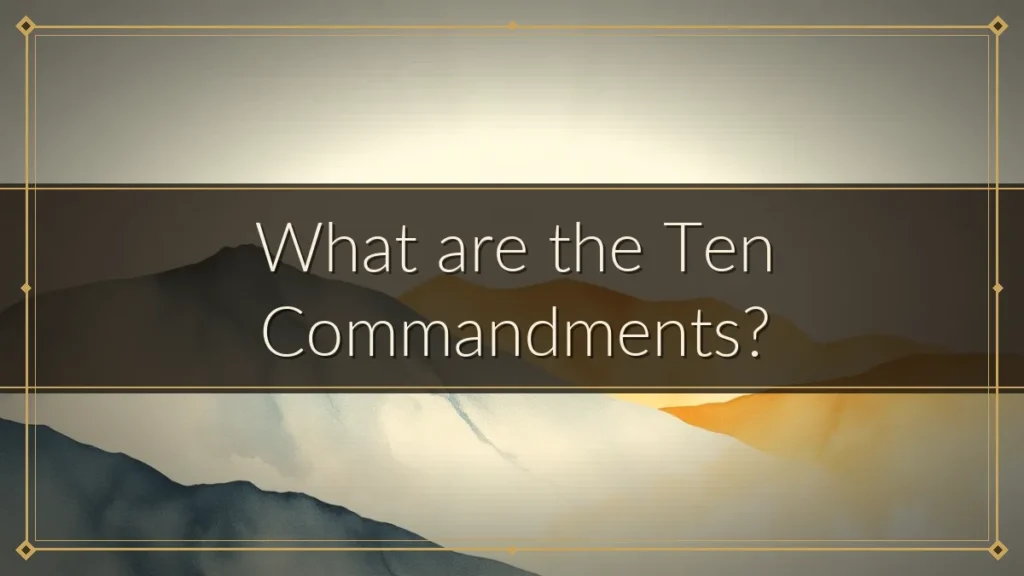
The Ten Commandments are ten foundational instructions God gives to Israel in the Bible. They appear in Exodus 20 and are repeated with some wording differences in Deuteronomy 5, covering devotion to God, worship, family responsibility, human life, marriage, property, truth, and desire.
Different Jewish and Christian traditions number and phrase the commandments somewhat differently, but they draw from the same biblical passages. The list below follows the common Protestant ordering and paraphrases the meaning rather than reproducing a particular Bible translation.
The commandments are given after the Israelites leave slavery in Egypt and arrive at Mount Sinai. In the biblical account, God establishes a covenant with the people: he has rescued them, and they are to live as a distinct community shaped by worship, justice, and faithfulness.
Exodus 20 presents the commandments in the context of that covenant. Deuteronomy 5 records Moses repeating them to a later generation before the Israelites enter the Promised Land. The two passages agree on the central principles, although some explanations and details differ.
The commands are often called the Decalogue, a word meaning “ten words” or “ten statements.” They are not the whole of biblical law. The books of Exodus, Leviticus, Numbers, and Deuteronomy contain many additional instructions about worship, courts, farming, festivals, priests, public health, and community life.
How to read the list: The Ten Commandments are best understood as covenant responsibilities, not merely a list of isolated rules. The first commands establish loyalty to God; the later commands describe how that loyalty should shape relationships with other people.
The Ten Commandments in order
Here is a clear breakdown of the commandments as they are commonly numbered in many Protestant traditions. The wording is a faithful explanation of each command’s meaning, not a quotation from a specific translation.
Do not put any other gods before God. Israel is to worship the one true God rather than treating other deities, powers, or authorities as equal to him. The command calls for exclusive loyalty, not divided allegiance.
Do not make or worship idols. The people must not represent God through an image and then treat that object as divine. The command also warns against reducing God to something humans can manufacture, control, or manipulate.
Do not misuse God’s name. God’s name must not be used carelessly, deceptively, or to give false authority to a promise, oath, threat, or religious claim. The principle includes treating what is holy with reverence and integrity.
Keep the Sabbath holy. The Sabbath is set apart as a day of rest and worship. Israel is told to stop ordinary work and to extend that rest to household members, servants, animals, and resident foreigners within the community.
Honor your father and mother. Children are to show appropriate respect and care for their parents. In its original setting, the command also supports the stability of family and community across generations.
Do not murder. Human life must not be deliberately and unlawfully taken. This command affirms the value of people made by God and provides a foundation for protecting life and pursuing justice.
Do not commit adultery. Marriage must be treated as a faithful covenant rather than a relationship to be violated through sexual unfaithfulness. The command protects spouses, families, and the trust that marriage requires.
Do not steal. People must not take another person’s property, possessions, freedom, labor, or livelihood through deceit or force. The principle supports respect for ownership, work, and economic fairness.
Do not give false testimony against another person. In its immediate legal setting, this prohibits lying about someone in a court case. Its broader application includes false accusations, deliberate deception, and speech that unjustly harms another person.
Do not covet what belongs to someone else. People must not nurture a grasping desire for another person’s home, spouse, workers, animals, or possessions. The command reaches beneath outward behavior to the attitudes that can lead to theft, adultery, resentment, or exploitation.
What each group of commandments teaches
The commandments can be read in two broad movements. The first emphasizes a person’s relationship with God; the second governs relationships with other people. This division helps explain why the list moves from worship and sacred time to family, life, marriage, property, truth, and desire.
Commands about loving and honoring God
The first four commandments address worship, loyalty, God’s name, and the Sabbath. They ask who has ultimate authority in your life, how you represent God, how seriously you speak about him, and whether you accept limits on work and productivity.
These commands are not only about private religious ceremonies. They challenge idolatry in a wider sense: giving ultimate value to money, status, political power, success, pleasure, or personal control. Anything treated as more important than God can function as a substitute for God.
The Sabbath command adds a practical rhythm to that loyalty. Rest recognizes that human beings are not machines and that their value does not depend entirely on output. It also places limits on the powerful by requiring rest for people who might otherwise be expected to work continuously.
Commands about loving and protecting other people
The remaining six commandments address family, life, sexual faithfulness, property, truth, and desire. They move from the most visible social relationships to the inner motives that influence conduct.
Honoring parents does not mean approving abuse or obeying every demand without question. The command describes a responsibility to respect and care for parents, while the Bible also contains teachings about justice, protection of the vulnerable, and accountability for wrongdoing.
The commands against murder, adultery, stealing, and false testimony protect people from direct harm. The command against coveting goes further by addressing the discontent and envy that can motivate those actions. The biblical pattern is therefore both outward and inward: conduct matters, but so do the desires that shape conduct.
Why the commandments begin with worship
The opening commands establish the identity of the God who gives the covenant. In Exodus 20, the commandments begin by recalling God’s act of bringing Israel out of slavery. Obedience is presented as a response to deliverance, not as a way for enslaved people to earn rescue.
That order matters. The commands are not simply a universal list of moral advice detached from the biblical story. They belong to a relationship between God and a particular people, while many of their moral principles have influenced Jewish, Christian, and broader Western discussions of ethics.
The command against idols also has a deeper point than avoiding statues. An idol is something created that receives the trust, devotion, or dependence that belongs to God. Ancient idols were physical images, but the underlying temptation can appear in many forms, including wealth, influence, ideology, or the belief that human strength is sufficient for every need.
What “do not misuse God’s name” means
The third commandment is often reduced to avoiding profanity, but its meaning is broader. To misuse God’s name is to employ it for a false, empty, or dishonest purpose. That may include a fraudulent oath, a religious claim made to control others, or a promise that invokes God while the speaker has no intention of keeping it.
God’s name represents God’s character and authority. People who claim to speak for God therefore carry a serious responsibility to speak truthfully and avoid using religion to excuse cruelty, manipulation, or self-interest.
The command also invites care in everyday religious language. Reverence is not merely a matter of vocabulary; it includes whether your worship, promises, public statements, and treatment of others accurately reflect the God you claim to honor.
What keeping the Sabbath means
The Sabbath command calls Israel to set aside the seventh day as holy and to rest from ordinary work. Exodus connects the pattern with God’s rest after creation, while Deuteronomy connects it especially with Israel’s memory of slavery. Together, these explanations present rest as both worship and liberation.
For ancient Israel, the command had a communal reach. It included family members, servants, livestock, and foreigners living among the people. Rest was therefore not meant to be a privilege reserved for the wealthy or powerful.
Jewish communities continue to observe Shabbat with practices that vary by tradition and family. Most Christians worship on Sunday and differ over how the Sabbath command applies under the new covenant. Some regard Sunday as a Christian Sabbath, some emphasize a general principle of regular rest and worship, and others do not treat a particular day as binding in the same way.
Practical principle: Even when traditions differ about the required day, the command raises lasting questions about worship, rest, limits on work, care for workers, and resistance to a life organized entirely around productivity.
How the commandments protect human relationships
The commandments concerning parents, murder, adultery, stealing, and false testimony create a framework for a stable community. Each one protects a relationship or good that people need in order to live together: family continuity, physical safety, marital trust, personal security, and access to justice.
The command against murder does not mean every killing is treated identically in every biblical passage. The Old Testament distinguishes murder from other situations, including warfare, accidental death, and legal punishment, though those passages raise difficult questions and are interpreted differently. The central moral claim remains clear: deliberate unlawful killing is a grave wrong because human life has God-given value.
The command against adultery likewise concerns more than private behavior. In the ancient setting, adultery could destabilize households and violate covenant obligations. Its continuing ethical force lies in the demand for sexual faithfulness, honesty, consent, and responsibility within marriage.
Stealing can also take forms beyond taking an object from someone’s home. Wage theft, fraud, identity theft, extortion, and the exploitation of another person’s labor all violate the principle that people and their resources must not be taken unjustly.
Why the last command addresses desire
The final command is distinctive because it concerns an inner attitude rather than a plainly visible act. Coveting means cultivating an excessive, resentful, or possessive desire for what belongs to someone else. It is not the same as noticing another person’s success or wanting to improve your circumstances.
The problem is the demand that another person’s possessions, relationships, or position should become yours. That desire can distort judgment and prepare the way for more obvious wrongdoing. A person may begin with envy and then justify deception, theft, adultery, or abuse to obtain what they want.
Because coveting concerns the heart, it cannot be addressed only through external enforcement. Laws can punish theft or fraud, but they cannot fully transform resentment or greed. The command points toward contentment, gratitude, self-control, and respect for the boundaries of other people’s lives.
How Jewish and Christian traditions number the commandments
The Bible presents the commandments as ten statements, but it does not label each line with a number in the way many modern lists do. Jewish and Christian communities have therefore developed different numbering systems while preserving the same source texts.
Jewish traditions commonly treat the opening statement about God bringing Israel out of Egypt as the first of the Ten Statements. The prohibition of other gods and the prohibition of idols are then considered together in a different arrangement from many Christian lists.
Many Protestant traditions count the prohibition of other gods as the first commandment and the prohibition of idols as the second. They typically place coveting in the tenth position.
Roman Catholic and Lutheran traditions commonly combine the commands about other gods and idols as the first commandment, then divide the material about coveting into two commands: one concerning a neighbor’s wife and one concerning a neighbor’s goods.
Eastern Orthodox traditions generally use a numbering close to the Jewish and Reformed Protestant patterns, though wording and teaching explanations can differ by church.
These differences do not mean that one group has eleven commandments or another has only nine. They reflect different ways of dividing and organizing the same biblical material. When comparing a list, check both the numbering and the underlying text.
How Jesus relates to the Ten Commandments
In the Gospels, Jesus refers to several commandments when answering questions about eternal life and faithful living. He also teaches that the commandments must be understood alongside wholehearted love for God and love for one’s neighbor. These themes appear in passages such as Matthew 19, Mark 12, and Luke 10.
Jesus’ teaching does not treat obedience as a matter of outward compliance alone. In Matthew 5, he interprets prohibitions against murder and adultery in relation to anger, contempt, lust, and the condition of the heart. The point is not that every feeling is identical to an action, but that wrongdoing often begins in attitudes that deserve serious moral attention.
When asked about the greatest commandment, Jesus identifies love for God and then connects it with love for one’s neighbor, as recorded in Matthew 22. In this framework, the Ten Commandments are not a substitute for love. They give concrete shape to what love for God and other people requires.
How Christians understand the commandments today
Christian denominations do not all explain the role of the Ten Commandments in exactly the same way. Many teach that the commandments reveal God’s moral will, expose human sin, and guide believers toward faithful living. Christians may disagree about the continuing obligation to keep the Sabbath on a particular day or about how Old Testament civil and ceremonial laws relate to the church.
Many Christians also distinguish between moral principles and the specific covenant regulations given to ancient Israel. They may see prohibitions against murder, adultery, theft, and false testimony as enduring moral instruction while understanding Israel’s agricultural, judicial, and ritual rules within their original historical setting.
Christian teaching commonly emphasizes that keeping commandments cannot earn salvation. In the New Testament, salvation is associated with God’s grace and faith, while obedience is described as the response and fruit of a transformed life. The exact language and theological explanation vary among churches.
How to apply the commandments in everyday decisions
Reading the commandments well means asking how their principles apply to real choices rather than treating them as decorative words. A useful approach is to examine both the action under consideration and the attitude behind it.
Identify the relationship involved. Ask whether the decision concerns your relationship with God, family, a spouse, a coworker, a customer, a neighbor, or the wider community.
Check for divided loyalty. Consider whether money, approval, comfort, power, or fear has become more important to you than faithfulness to God and responsible treatment of people.
Look for hidden harm. A choice may not resemble theft or false testimony at first, but it could still involve exploitation, deception, coercion, or taking advantage of someone with less power.
Examine your motives. Ask whether anger, envy, pride, greed, lust, or resentment is influencing the decision. Inner motives do not excuse every action, but they can reveal where correction is needed.
Repair harm when possible. Honest obedience may require returning what was taken, correcting a lie, apologizing without excuses, honoring a commitment, or seeking help to change a damaging pattern.
For example, the command against false testimony applies when a person knowingly gives a misleading account in court, but its principle also matters in a workplace investigation, an online accusation, a family dispute, or a business advertisement. The command against stealing can shape decisions about fair pay, borrowed property, intellectual work, and the use of another person’s private information.
Common misunderstandings about the Ten Commandments
They are not ten unrelated prohibitions. The commandments form a moral pattern. Worship shapes how people view authority, and that view influences how they treat parents, spouses, neighbors, workers, and strangers.
They are not only about public behavior. The prohibition against coveting shows that the commandments address desire as well as action. The teachings of Jesus further emphasize that anger, contempt, and lust deserve moral examination.
They are not the entire Bible’s teaching about right and wrong. They are a central summary of covenant responsibilities, but the Bible also teaches about justice, generosity, care for the poor, treatment of immigrants, forgiveness, humility, and love.
They do not remove the need for judgment and context. Applying a command may require distinguishing an accidental mistake from deliberate deception, a protective boundary from selfishness, or a lawful transfer from theft. Wisdom includes understanding circumstances without using circumstances as an excuse for wrongdoing.
The numbering differences do not change the central message. Whether a tradition combines the first two commands or divides the final command differently, the list still calls people to exclusive devotion to God and faithful love toward others.
Why the Ten Commandments still matter
The Ten Commandments continue to matter because they address basic questions that every community faces: What deserves ultimate loyalty? How should people treat sacred things? What protects human life, family trust, property, justice, and personal freedom?
They also connect public conduct with private character. A society may prohibit murder and theft, but the commandments ask people to consider the anger, greed, dishonesty, and envy that can produce those acts. That combination of social responsibility and inner integrity gives the Ten Commandments their lasting moral force.
At their center, the commandments call for a life ordered by loyalty to God and expressed through truthful, respectful, and faithful relationships. Their details are read differently across Jewish and Christian traditions, but their central concerns remain clear: worship God faithfully, honor human life, keep commitments, tell the truth, respect what belongs to others, and govern desire with self-control.
Frequently asked questions
Are the Ten Commandments the same as the laws of Moses?
No. The Ten Commandments are the best-known summary of covenant obligations given at Mount Sinai, while the laws of Moses include many additional instructions. Those laws address worship, sacrifices, festivals, priests, courts, agriculture, property, food, and community responsibilities. The commandments form a central moral foundation within that larger body of biblical teaching.
Why do some lists of the Ten Commandments look different?
The biblical passages do not number each command in a modern numbered format. Jewish, Catholic, Lutheran, Orthodox, and Protestant traditions divide the statements differently. Some combine the commands about idols with the command about other gods, while others count them separately. Some divide the final teaching about coveting into two commands.
Did Jesus replace the Ten Commandments with one command?
Jesus summarized faithful living through love for God and love for one’s neighbor, but he did not present love as permission to ignore morality. His teaching gives the commandments their deeper purpose: devotion to God should produce truthful, merciful, faithful, and just treatment of other people.
Do Christians have to observe the Sabbath on Saturday?
Christian denominations answer this differently. Some observe Saturday, some treat Sunday as a Christian Sabbath, and others emphasize regular worship and rest without requiring one particular day. Jewish Shabbat observance remains distinct from most Christian practices. The disagreement concerns how the command applies under the new covenant, not whether rest and worship have value.









Leave a Reply