What makes Amazing Grace tablature a timeless resource for guitarists and pianists
Amazing Grace is one of the most enduring hymns in the Western musical canon. Its simple, memorable melody and
heartfelt lyrics have helped generations learn to sing, strum, and play along. For musicians who prefer visual cues, tablature—often shortened to «tab»—offers a direct way to map pitches to frets, strings, and
piano keys without requiring fluent reading of standard musical notation. When you combine free guitar tablature
and piano sheet music for Amazing Grace, you gain practical, beginner-friendly access to a wide
range of arrangements: from bare-bones melody lines that guide practice to full-fledged splashes of accompaniment and
accompaniment-with-molo-to-oohs and ahhs for church, classroom, or home performance.
This article explores Amazing Grace tablature variations across guitar and piano, explains how to read
the tab and the sheet music, points to reputable sources for free sheet music, and offers practical tips
for learning, transposing, and adapting tunes for different skill levels. Whether you are a beginner learning the
basics or a more experienced player seeking refined arrangements, you’ll find guidance that helps you approach Amazing Grace tabs with confidence.
Understanding the types of tablature and sheet music for Amazing Grace
The term Amazing Grace tablature can refer to several related formats. Here are the most common
categories you will encounter:
Guitar tab (tabulature): a line-based representation of string and fret positions. Tabs show six lines representing the
six guitar strings, with numbers indicating frets. This format is excellent for beginners who want to learn the melodic line
or simple chord shapes without reading standard notation.
Guitar chord-and-tab notation: a combination of chord symbols (e.g., G, D, Em, C) with line tabs that show
the melody or an accompanying pattern. This is very common in free guitar tab collections online.
Piano sheet music: not typically called «tablature,» but many free arrangements pair treble-clave melody lines with
bass-clef accompaniment. These sheets often include chord symbols and may present simplified or advanced piano parts.
When a piano version is labeled as “tabbed,” it usually means a simplified, note-for-note melody line or a reduced right-hand
line that mirrors the vocal tune.
Fingerstyle tabs: for guitar players who want to pluck the melody with the thumb plus fingerstyle
accompaniment. These arrangements can be more challenging but yield a richer, more intimate sound when played cleanly.
PDF and image sheets: many sites offer downloadable PDF sheet music or scanned images of
traditional hymn arrangements. These are particularly handy for printing practice copies or for worship planning.
Regardless of the format you choose, the goal of Amazing Grace tablature is to provide a practical
map from the sonic idea you hear to the physical actions you perform on your instrument. While guitar tablature is
inherently different from standard piano notation, both are legitimate tools that, when used together or in
alternation, can deepen your understanding and enhance your performance potential.
Guitar tablature for Amazing Grace: getting started
If you are exploring Amazing Grace tab for guitar, here are essential elements to know and steps to practice:
Reading the tab: the six lines correspond to the low E string through the high E string (from bottom to top). A number on a line tells you which fret to press on that string.
Open strings: a 0 on a line means you play the string open (no fretting).
Rhythm is implied: most beginner tabs do not show rhythm values. You’ll need to listen to the audio or refer to hymn timing (e.g., common 4/4 time) to keep tempo.
Melody first, then harmony: for a simple approach, start by playing the melody line on the high E and B strings, then gradually add harmony on lower strings or a simple chord accompaniment pattern.
Common keys: many Amazing Grace arrangements are in G major or D major, because the melody lies comfortably for many singers. Transposing to your vocal range is a common practice.
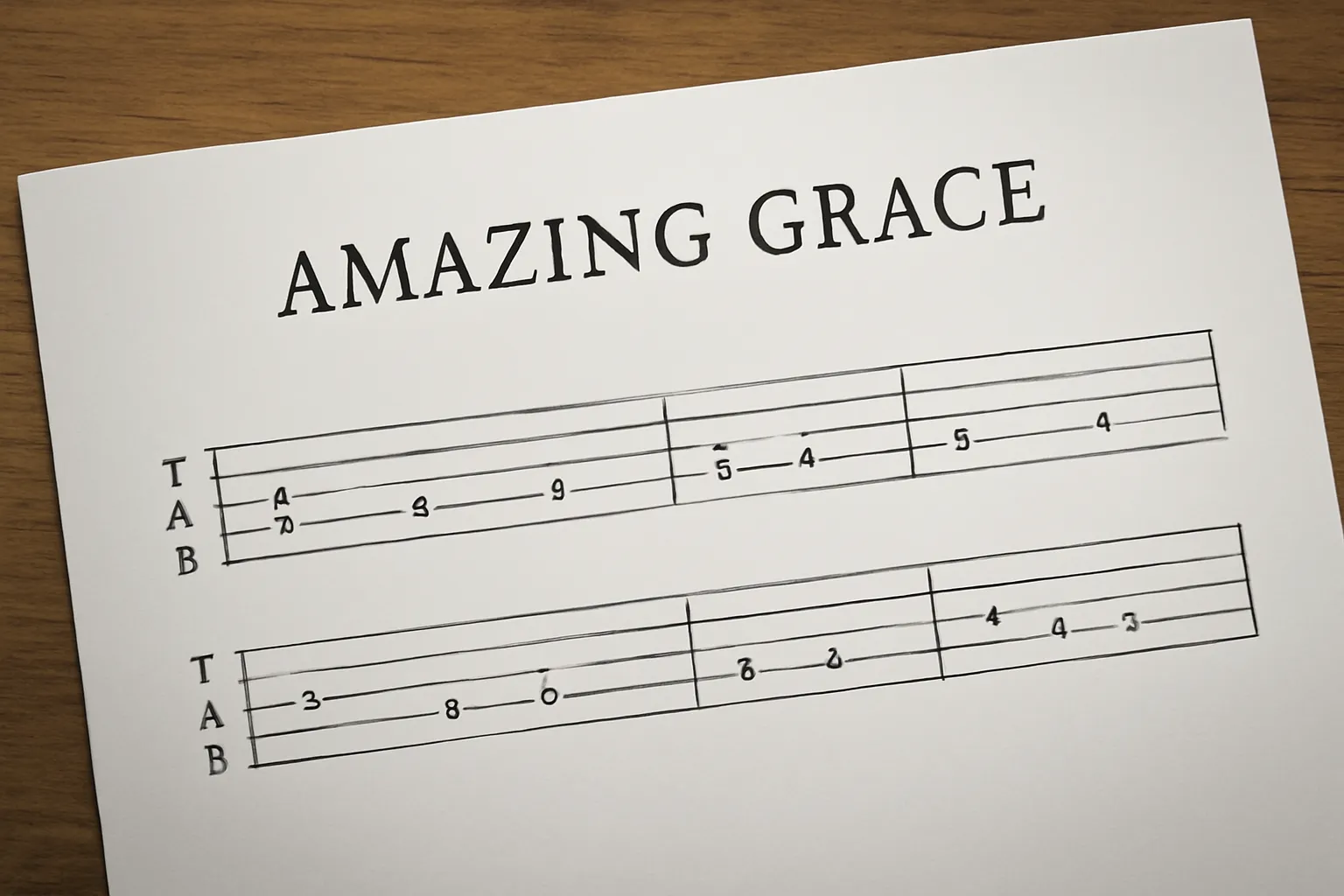
Here is a compact guitar tab sample that demonstrates a straightforward melody line in G major. Note that this is a simplified excerpt intended for practice; real
full versions may include more complete chord voicings and rhythmic notation.
For beginners, this kind of melodic tab helps you internalize the tune before adding a more elaborate
accompaniment. As you grow more confident, you can experiment with simple chord shapes in the left hand while retaining
the melody in the right hand, or with fingerstyle patterns that emphasize the tune while still providing harmony.
Common guitar chords to accompany Amazing Grace
G major
D major
Em (E minor)
C major
Am (A minor)
A practical approach is to practice the melody on the top strings, then add a basic I–IV–V progression in the key you
prefer. In G major, for example, you might use G–C–D as your foundational progression. This approach yields a
clean, hymn-like sound suitable for worship settings or quiet practice at home.
Piano arrangements and sheet music for Amazing Grace
While guitar tablature focuses on frets and strings, piano sheet music presents a different path to reach
the same musical destination: a faithful rendering of the melody, often with accompaniment. In many free piano
sheet music collections, you’ll encounter:
Single-line melodic arrangements: the right hand plays the main theme while the left hand supplies a simple
chordal or bass pattern. These are particularly accessible for late-beginner to early-intermediate players.
Three-part textures: arrangements that add an inner voice or counter-melody, offering a fuller sound when you are
comfortable with two hands and independent lines.
Lead sheets: notated melody with chord symbols, allowing you to improvise accompaniment or harmonize in the moment.
Public-domain formats: because Amazing Grace is in the public domain in many places, many
sites offer free, legal PDF downloads or instrument-friendly transcriptions without licensing concerns.
In a typical beginner-to-intermediate piano arrangement, you might see the melody in the right hand with a simple
left-hand pattern such as a broken-chord accompaniment or a walking bass line. The tempo is often moderate to preserve legato
phrasing, an essential feature of this hymn’s emotional arc.
Reading a basic piano sheet for Amazing Grace
A common layout is a grand staff (treble and bass clef) with both hands. Here is a hypothetical beginner-friendly excerpt idea –
again, this is illustrative and not a full score:
Treble (right hand): G A B C D B A G F# E
Bass (left hand) : D D G G A G D
When you learn piano music, focus on:
Rhythm and phrasing: listen to the hymn to capture its legato feel.)
Hand independence: practice hands separately before combining them.
Dynamics: crescendos and diminuendos give the tune a singing quality.
Where to find free Amazing Grace tabs and sheet music
The internet hosts a wealth of free resources for Amazing Grace tablature and free piano sheet
music. When searching, keep an eye out for arrangements that match your skill level and your instrument:
Guitar websites offering user-submitted Amazing Grace tab collections, beginner-friendly tabs, and
chord-based accompaniments. Look for tabs labeled as “easy,” “beginner,” or “melody with chords” for a gentle start.
Sheet music hubs that host Amazing Grace piano sheet music in PDF format, often with multiple
keys and levels of difficulty. These sites frequently categorize hymn tunes by tempo, key, and difficulty.
Music notation communities like MuseScore, where users share scores that can be customized by key, instrument,
and difficulty; MuseScore files can often be exported to MIDI or PDF for printing.
Public-domain repositories that emphasize legal, freely distributable scores due to the hymn’s public-domain status.
When downloading or viewing Amazing Grace tabulations or sheet music, consider:
Format compatibility: PDF, MIDI, GP5, or MuseScore (MSC) files require appropriate readers or software.
Transposition options: if the original key doesn’t suit your voice or fretboard span, many scores can be transposed
easily in notation software or by using chord charts.
Quality and accuracy: compare multiple versions to gauge common practice. In hymn traditions, the core tune is
widely agreed upon, but ornamentation and rhythm may differ.
A pragmatic approach is to collect a handful of high-quality options for both guitar and piano, then practice
with a metronome, focusing on consistent tempo, clean note articulation, and smooth transitions between chords and melodies.
Tips for practicing Amazing Grace tabs across guitar and piano
Whether you are working with guitar tablature or piano sheet music, regular, mindful practice
yields the best results. The following tips can help you develop fluency and musical expressiveness:
Set a realistic goal: aim for a small, manageable segment each day (e.g., eight bars or a single phrase) rather than attempting a full score overnight.
Slow practice: start at a comfortable tempo, then increase gradually as accuracy improves. For tabs, you can use a metronome and count the rhythm aloud.
Voice separation for piano: practice the right-hand melody first, then the left-hand accompaniment, and finally combine hands.
Sight-reading practice: even if your first instinct is to memorize, try reading ahead one measure at a time to build fluency.
Dynamic shaping: since this is a hymn with a lyrical feel, experiment with crescendos on phrases and a gentle decrescendo toward cadence points.
Transposition practice: learn the tune in two or three keys, then pick the most comfortable one for singing or playing with others.
Use matches with vocal lines: if you sing, try aligning the melody on your instrument with your vocal line to preserve musical phrasing.
In practice, many players begin with a simple melodic line in a friendly key (G major or D major on guitar, and C major or G major on piano)
and then layer in harmony or accompaniment as skills grow. The key is consistency: regular, focused sessions produce meaningful
improvement in a few weeks.
Transposition, keys, and performance considerations
A practical virtue of Amazing Grace tablature and piano sheet music is the ability to transpose
the arrangement to a key that suits your voice or instrument range. Here are essential ideas:
Voice range alignment: singers frequently request keys that minimize vocal strain. For example, shifting the tune from G major
to E minor or D major to A major can place the melody within comfortable singing ranges, while preserving the tune’s character.
Instrument-friendly keys: guitar players often favor keys with friendly open chords and manageable fretboard stretches,
such as G, D, C, and Em. Pianists may benefit from keys with straightforward fingering in the left hand.
Capo technique: guitarists can use a capo to achieve easier chord shapes while preserving the original melody’s pitch.
Rhythmic feel: church hymn arrangements tend to use legato phrasing and moderate tempo. Depending on context (concert, worship,
rehearsal), you may adjust tempo and dynamics to suit the occasion.
If you are preparing for a group performance or a worship service, consider bringing both a guitar-friendly tab and a piano-friendly
sheet music version. This allows you or the ensemble to alternate between solo guitar accompaniment and full-keyboard performance,
ensuring inclusivity and flexibility in instrumentation.
Key choice examples for Amazing Grace
G major: open-string-friendly, common among beginners on guitar and a widely used hymn key.
D major: bright, with strong open-string shapes for guitar and a comfortable piano harmonization.
A minor or E minor: suitable for a softer, more contemplative arrangement and often used in solo performances.
Public domain status, licensing, and the legality of free sheets
Amazing Grace is a hymn composed in the late 18th century, and its original text is in the public domain in most jurisdictions.
This status means that many versions of its sheet music and tablature are freely distributable and modifiable. When you search for free sheet music or free tablature, you will often encounter scores that can be shared, downloaded,
and adapted without licensing fees. However, it’s always prudent to verify:
License terms: confirm that the file is indeed in the public domain or released under a permissive license (e.g., Creative Commons).
Attribution requirements: some free scores require attribution to the arranger or site; check the license text.
Usage context: for commercial projects, ensure the score’s license permits your intended use.
Because the hymn’s material is widely shared, you will often find multiple variants of Amazing Grace tablature and
piano sheets. Use this to compare textures, find a version that resonates with your playing style, and avoid overreliance on a single
source. The more you explore, the more you’ll appreciate the variety of free arrangements available for both guitar and piano.
A practical guide to choosing the right arrangement for you
With so many options, how do you pick the right Amazing Grace tab or piano score? Here are practical criteria to guide
your selection:
Skill level: start with a simple melody or basic chord version if you are new to the instrument, then progress to fuller
arrangements that include independent left-hand or accompaniment patterns.
Instrument alignment: choose tabs or sheets that clearly align with your instrument—guitar-focused tabs for guitar practice,
piano sheets for keyboard practice.
Tempo flexibility: prefer arrangements that allow you to adjust tempo without losing musical integrity; this helps during practice.
Arrangement style: decide whether you want a straight hymn rendition, a folk-influenced version, or a classical-style piano
arrangement with richer counterpoint.
Printability and accessibility: printable PDFs and easily navigable MuseScore files save time during practice and worship planning.
A balanced approach is to maintain a small library of free guitar tabs for varied strumming and melody lines and a
set of piano sheets that cover both simple melodies and richer accompaniment. This dual-library strategy enables you to switch
between styles depending on mood, audience, or available musicians.
Sample resources: how to find credible, free materials
While the web is full of fan-submitted tabs, it’s important to choose sources with reliable, accurate arrangements. Below are
reputable avenues to locate Amazing Grace tablature and sheet music:
Music education sites with beginner-centric tutorials for Amazing Grace on guitar and piano.
Public-domain repositories hosting simplified and advanced hymn arrangements suitable for church or classroom use.
Score-sharing communities where musicians contribute arrangements and can offer feedback after listening to your interpretation.
Notation software libraries that provide open-source MSC (MuseScore) or GP (Guitar Pro) files for free download, export, and playback.
When using these sources, take a moment to compare two or three versions of a tune. You may notice subtle differences in rhythm
or fingering that can influence how you feel the melody. The important thing is to find an arrangement that you can play cleanly and
sing along to, with room to grow as you learn more advanced patterns.
Encouraging words for learners and creators
The world of Amazing Grace tablature is both extensive and welcoming. Whether you are learning for personal
enjoyment, worship leadership, or classroom instruction, the combination of guitar tabs and piano sheets unlocks many possibilities:
Creative expression: you can customize an arrangement to reflect your own musical voice—adding ornaments, arpeggios, and subtle dynamics.
Group playing: different instrument parts can be distributed among players, creating an engaging, collaborative performance.
Educational value: tacking the hymn in multiple formats strengthens reading skills, rhythm literacy, and harmonic awareness.
Canonical status: as a hymn with deep cultural resonance, learning Amazing Grace connects students with a long musical heritage.
If you’re a creator, consider contributing your own Amazing Grace tablature or piano arrangement to a public-domain
library or a community forum. By sharing, you help others discover the tune in a friendly, approachable way while enriching the
collective musical knowledge around this iconic melody.
Final tips for maximizing your learning experience
To get the most out of Amazing Grace tablature and sheet music, try the following practical strategies:
Pair practice: alternate between guitar and piano sessions to develop cross-instrument awareness.
Use a metronome: steady timing is essential for hymns with predictable cadences; a metronome helps you lock in the rhythm.
Annotate your copies: highlight difficult passages, mark preferred fingering, and note any preferred transpositions.
Record yourself: listening back helps you evaluate tone, timing, and musical expression.
Share and solicit feedback: engaging with other learners can provide new ideas and motivate continued practice.
In sum, the combination of free guitar tablature and free piano sheet music for Amazing Grace is
a powerful way to approach a beloved hymn. By embracing variations of the tune, you can find a version that suits your instrument,
your skill level, and your performance context—whether it’s a solitary practice session, a church service, or a classroom setting.
The accessibility of public-domain material ensures that learning and sharing remain a living tradition, inviting new and seasoned
players alike to inhabit the grace and simplicity of the melody.
Closing thoughts: embracing the breadth of Amazing Grace tablature
The journey through Amazing Grace tablature—whether you’re strumming simple chords on a guitar or reading a richer
piano arrangement—offers a enduring path toward musical literacy, emotional expression, and community involvement. The hymn’s enduring
appeal lies in its clarity of melody, its hopeful text, and its generosity of interpretation: you are invited to
accompany, sing, or simply enjoy the tune in a setting that reflects your own musical sensibility.
If you’re ready to begin, seek out a few free tab or free sheet music options that match your instrument and
skill level, print a few copies, and start practicing. Over time, you’ll accumulate a personal collection of favorite arrangements—guitar tab
versions that are easy to pick up, piano sheets with crisp notation, and a mixture of both that you can switch between as your
understanding deepens. The result is a flexible, lifelong resource that keeps the grace of the tune in perpetual motion.

 Por Laura Jara