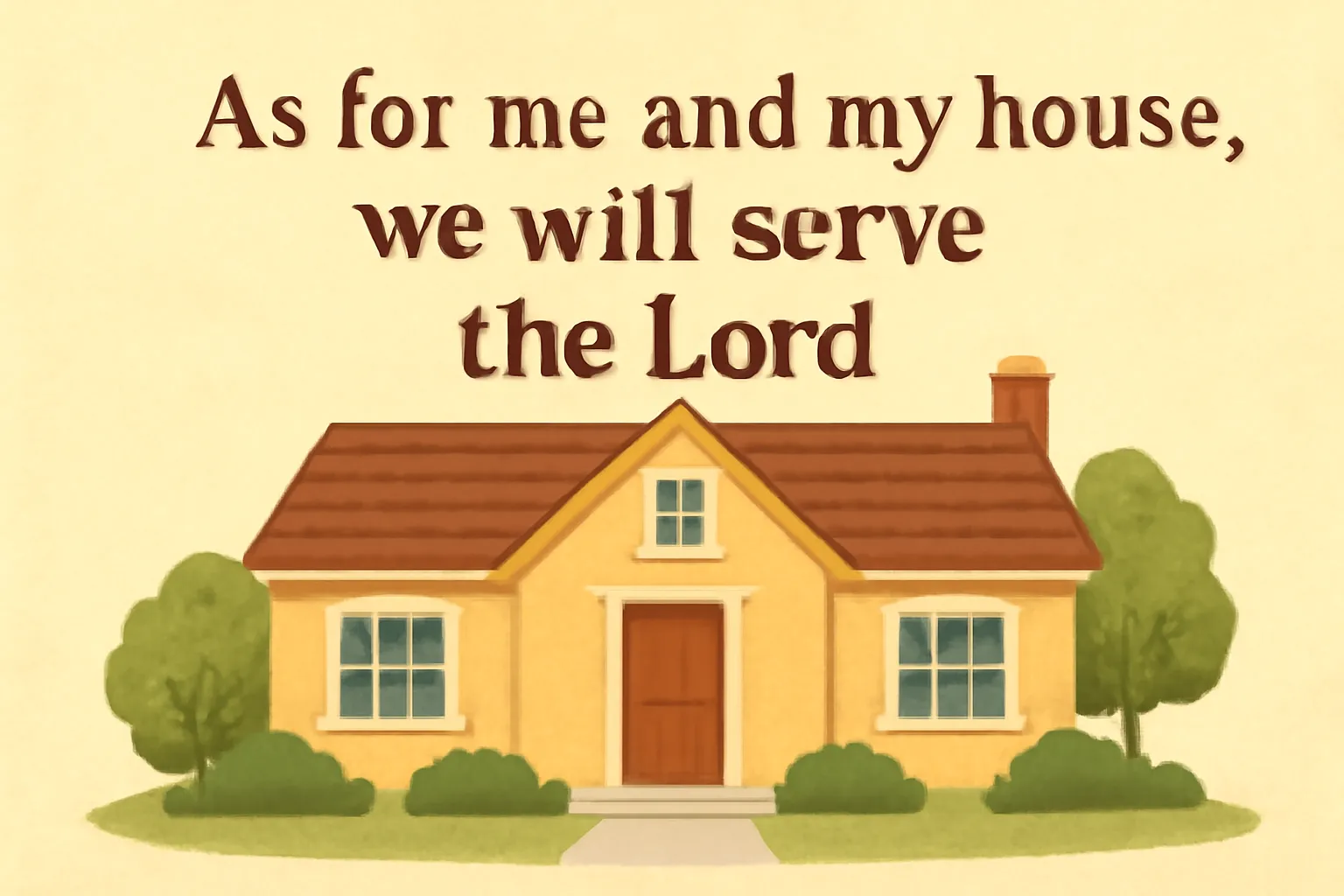
In many families, Joshua 24:15 serves as a turning point—a declaration of faith that binds generations. The words «As for me and my house, we will serve the Lord» become not just a verse to memorize but a lived reality to practice. This article offers a practical, family-friendly devotion guide that centers on that vow, helping households grow in faith, unity, and purpose. Whether you are starting a new routine or deepening a long-standing habit, the framework below invites you to live out devotion together, with honesty, grace, and shared joy.
Before applying a covenant vow to everyday life, it helps to understand where Joshua 24:15 fits in the biblical narrative. Joshua, the successor of Moses, gathers the tribes at Shechem and calls the people to decide whom they will serve after years of wandering and conquest. He recounts God’s faithfulness—deliverance from Egypt, protection in the wilderness, and provision in the land—then presents a clear choice: serve the Lord or serve the gods of their ancestors and the land they inhabit. The atmosphere is both spiritual and practical: faith is not merely an inward sentiment but a public, shared commitment that shapes decisions, priorities, and daily routines. In this setting, the statement as for me and my house, we will serve the Lord becomes a family-level pledge—a bold, hopeful, and sometimes challenging declaration that invites accountability and blessing.
In the original language, the verse carries a sense of covenant loyalty. It is not a private mood but a covenantal stance: a family, tribe, or household choosing fidelity to the One true God as a standard for worship, conduct, and relationships. Recognizing this larger frame helps families approach devotion not as a ritual checkbox but as a relational, transformative practice—one that can be witnessed by children, parents, and extended kin.
What the vow means for today’s families
Adopting a family-centered vow—whether you phrase it one way or another—has practical and spiritual implications. The following points highlight how this commitment can translate into everyday life:
Public witness: Declaring your commitment before God and each other gives the family a shared identity and a recognizable witness to neighbors, friends, and the younger generation.
Shared priorities: The vow helps align time, money, and energy around priorities such as worship, service, generosity, and Sabbath rhythms.
Generational faith: Children watch the choices you make; a home where faith is lived out becomes a classroom without walls, where questions are answered through example as well as words.
Accountability and grace: A family covenant invites gentle accountability—mutual encouragement, confession, and forgiveness when missteps occur, all within a loving framework.
Faithful resilience: When challenges arise—busyness, doubt, trials—this vow provides a steady anchor, reminding the household of its purpose and hope.
As you consider adopting or renewing a family devotion, you may encounter two common impulses: the comfort of tradition and the pressure of perfection. The path Joshua modeled is not perfection but perseverance. The key is a sincere dedication to pursue the Lord together, learning and growing as a family through Scripture, prayer, and thoughtful conversation.
Ways to begin or renew your family devotion
If you are new to family devotions, start small and practical. If you have an established routine, you can infuse it with fresh language, new questions, and shared projects that emphasize the core idea: as me and my house i will serve the lord in daily life. Here are foundational steps you can implement this week, using language that fits your family’s voice:
Choose a time and place: A predictable moment each day (or several days a week) helps everyone know what to expect and reduces friction.
Gather simple materials: A Bible (a kid-friendly translation is okay), a notebook or journal, a pencil, and a small candle or low-lit lamp can set a contemplative mood.
Begin with a brief prayer: Invite God to guide your conversation, open your hearts, and grow your family in love and truth.
Read a short passage: Select a portion of Joshua 24 or a related passage about covenant faith, commitment, and obedience.
Discuss together: Use open-ended questions to invite reflection and honesty among all ages.
Close with a blessing or a prayer: Pronounce a blessing for each family member and for your home’s daily life.
Over time, you can expand to include memory work, service projects, and shared acts of worship. The following sections offer practical, family-friendly structures you can adapt to your unique household.
Weekly devotion framework you can customize
Below is a flexible, repeatable structure designed to be easy for busy households while still meaningful. You can keep it simple or widen it to incorporate more elements as your family grows more comfortable with the rhythm.
Opening moment: Light a small candle or pause for a moment of quiet. Say a short, unified intention—e.g., “Lord, guide our time together.”
Scripture reading: Read a brief passage from Joshua 24, or a parallel text about choosing to serve the Lord.
Reflection: Each person shares one sentence about what the passage means to them today, or one experience from the past week related to faith or family life.
Discussion questions: Use one or two questions to deepen understanding and application. Examples appear in the next section.
Prayer: Pray aloud together, asking for wisdom, courage, and grace to live as a family that serves the Lord daily.
Act of devotion: End with a small practice—reading a children’s catechism, memorizing a verse, or performing a simple act of service together.
Closing blessing: Each member offers a word of blessing to the others or a simple benediction over the home.
As you use this framework, you can focus on different facets of the vow: decision, remembrance, obedience, and witness. In the weeks ahead, you can weave in family projects to anchor the covenant in tangible life.
Week-by-week devotional plan
The following four-week plan offers a practical progression, starting with the commitment itself and moving toward everyday life as a walking out of that commitment. Each week includes a theme, a suggested Scripture, discussion prompts, and a small family activity.
Week 1: The decision and declaration
Affirming the choice to serve the Lord together as a family.
Joshua 24:14-15; Psalm 78:4-7 (as supporting color about teaching the next generation).
What does it mean to choose the Lord “today”? How does this affect daily decisions?
What are some distractions that pull us away from serving the Lord, and how can we notice them together?
Create a “declaration card” with the sentence as me and my house i will serve the lord written beautifully, plus a line for each family member to add a personal commitment for the week.
Week 2: Remembering God’s faithfulness
Recall ways God has shown faithfulness in your family and in the life of your church community.
Joshua 24:17-18; Lamentations 3:22-23 (to emphasize steadfast love and mercy).
Can you remember a time when you saw God at work in your family?
How does recalling God’s faithfulness shape our trust in Him for the future?
Start a “Faithfulness Journal.” Each night, jot down one way God showed up that day and illustrate it with a small drawing.
Week 3: Living the covenant in daily life
Practice fidelity in ordinary moments—home, school, work, and community.
Each week, revisit the central commitment with a phrase that binds your reflections to your vow. You might say, as for me and my house i will serve the lord at the start of the week as a reminder, and again at the close to mark your progress and maintain accountability.
Devotional structure for each evening
To keep your routine accessible for families with young children or busy schedules, use this simple, repeatable structure. It creates a pattern that children learn to expect and adults can sustain with grace.
Greeting and mood check: A quick share about how everyone is feeling and what they hope to gain from the time together.
Scripture reading: A short passage (5–7 verses) focused on covenant, obedience, or God’s faithfulness.
Question and reflection: A guided prompt such as “What in this passage would matter to our family this week?”
Prayer: A unified prayer, followed by personal petitions—one line per person if desired.
Commitment moment: A small, tangible act that reinforces the vow (e.g., writing a short note, performing a service task, or reciting the family declaration).
Blessing and closing: A short blessing spoken aloud over one another or over the home, concluding with a calm moment of gratitude.
As you practice this rhythm, you’ll likely discover what works best for your family’s age range, temperament, and schedule. The goal is not perfection but a growing habit of turning to the Lord together in grace and honesty.
Prayer and Scripture memory work are central to a living faith. The following prompts and memory ideas are designed to be approachable for families with children while still meaningful for adults.
Memory verse ideas:
“But as for me and my house, we will serve the Lord.” (Joshua 24:15, various translations)
“As for me, I will call upon God, and the Lord will save me.” (parallels to Psalms about trust)
Short, repeatable phrases like “We serve the Lord together.”
Simple prayer format:
Acknowledge God’s character (who He is).
Confess where we fall short (honest, age-appropriate).
Ask for help to pursue the vow in daily life.
Thank God for guidance and grace.
Prayer prompts:
Pray for your home to be a place where God’s love is felt and reflected.
Ask for wisdom to balance work, school, and faith commitments.
Pray for neighbors and the wider community to see Christ in your family’s example.
Incorporating these elements gradually helps your family internalize the vow in a way that feels natural rather than forced. The emphasis remains on relationship—with God and with one another—where words become lived actions.
Practical ideas to live out the vow in everyday life
In addition to formal devotion times, consider integrating faith into everyday moments. The following ideas are designed to be practical, scalable, and inclusive for all ages.
Family gratitude journal: Each day, write one thing you are thankful for and one way you saw God at work that day. Share entries during devotion time to celebrate God’s faithfulness.
Acts of service: Plan a monthly family service project, such as preparing care packages for a shelter, helping a neighbor with yard work, or volunteering together at a local ministry.
Faith-filled routines: Integrate brief prayers before meals, a blessing before bedtime, or a short Scripture reflection after school or work.
Generational reading: Mix age groups for family Bible reading. Older siblings can help younger ones, reinforcing a sense of shared mission.
Public declarations: Post your family declaration on a wall or a family bulletin board so that the vow remains visible and actionable.
Addressing challenges with grace
Every family experiences times of waning energy, fatigue, or skepticism. The strength of a covenant devotion is its emphasis on grace, honesty, and patient growth. Consider these approaches when challenges arise:
Be patient with slower seasons: Some weeks will be lighter; others will be fuller. The goal is consistency over time.
Avoid legalism: The vow is about relationship and transformation, not about legal compliance. When you stumble, name it, seek forgiveness, and begin again.
Invite questions: Create a safe space where children can ask difficult questions about faith, doubt, and commitment without fear of judgment.
Seek shared wins: Celebrate small moments when you see the vow lived out, reinforcing motivation to continue.
Below is a curated list of kid-friendly and family-friendly resources you can adapt to your devotion plan. Use what fits your family’s needs and customize as you grow in practice.
Children’s Bibles or illustrated Scripture storybooks for younger readers—great for read-aloud moments and discussion prompts.
Devotional journals designed for families, with prompts that work across ages.
Catechism cards or question-and-answer flashcards for quick, teachable moments.
Memory verse cards with simple visuals to aid retention and repetition.
Service project guides for local outreach, school-based service, or neighborhood acts of kindness.
These tools are not ends in themselves; they are ladders toward a deeper, living faith that your family embodies in ordinary life. The ultimate aim remains simple and profound: to live out a covenant posture that says, openly and joyfully, as me and my house i will serve the lord, in every season and circumstance.
Variations on the vow for semantic breadth
To help families express their commitment in ways that feel natural and Scripture-shaped, you can use a few variations of the core idea. Each variant can function as a header, a spoken line during devotion, or a written reminder in your home. Here are several examples, each carrying the same essential meaning with a slightly different emphasis:
As for me and my house, we will serve the Lord — the classic formulation that anchors your family’s covenant.
As for my household, we will serve the Lord — a compact alternative that emphasizes the household unit.
My family and I will serve the Lord — a voice that centers on collective identity and partnership.
As for me and my family, we will serve the Lord — a bridge between older generations and younger ones, highlighting lineage and blessing.
As for me and my house, we pledge to serve the Lord — a more formal covenant language that can be used in a family ceremony or declaration card.
As for me and my house, we commit to serve the Lord daily — an emphasis on daily devotion and consistency.
As for me and my house, we will walk in faithfulness to the Lord — a broader phrasing that invites holistic living beyond mere worship.
Our home will serve the Lord — a short, memorable version that works well as a family motto on a wall plaque or screen saver.
We, as a family, choose the Lord this day — a slightly poetic option that connects with the “this day” cadence in Joshua 24.
In our home, faith guides every choice — a paraphrase that keeps the focus on practical obedience and daily life.
These variations allow you to tailor the vow to your family voice while preserving the core intent: a public, practical, and daily commitment to serve the Lord together.
Closing reflections
The decision to serve the Lord as a family is not a one-time event but a ongoing way of life. It calls for humility, love, and perseverance, grounded in Scripture and expressed through concrete practices that shape your home’s atmosphere. When you declare, as me and my house i will serve the lord, you invite God to work through your routines, conversations, and acts of service, turning ordinary days into opportunities for worship, learning, and transformation.
This devotion guide aims to equip you with a practical path to live out the vow faithfully. By understanding Joshua 24:15 in its historical setting, applying it to modern family life, and building a routine that balances study, discussion, prayer, and service, you can cultivate a household that reflects the love and faithfulness of God. Remember, the goal is not perfection but consistency, grace, and a shared journey toward deeper faith. May your home be a bright witness to the Lord’s faithfulness as you grow together in love and devotion.

 Por Laura Jara