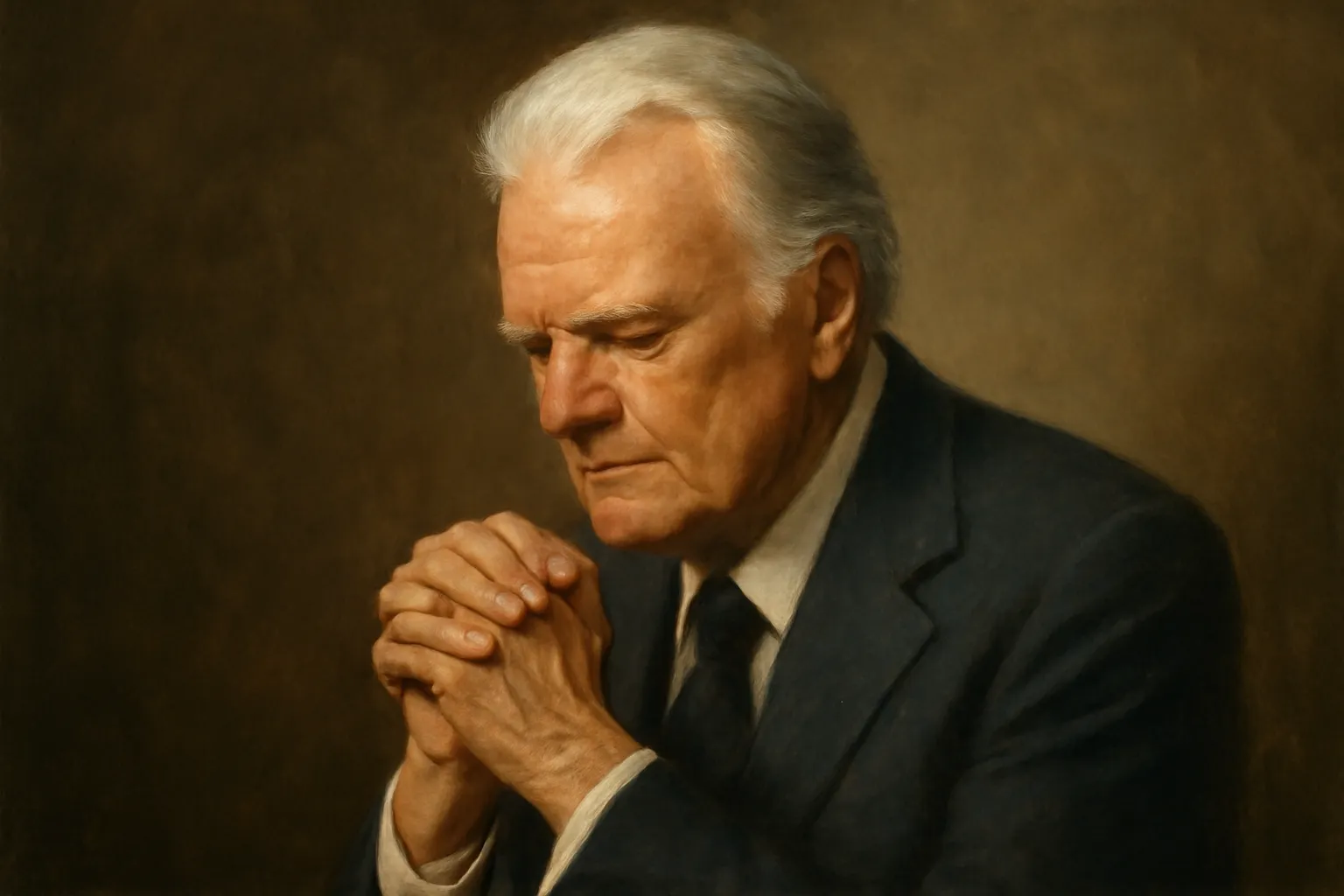
The term Sinner’s Prayer is widely used in evangelical circles to describe a personal response to the gospel that leads to salvation. When people ask about “Billy Graham’s Sinner’s Prayer,” they are often seeking to understand whether the famous evangelist provided a specific, repeatable set of words for someone to pray. In truth, there is no single, canonical Billy Graham sinner’s prayer text. Billy Graham did not publish a standardized script. Instead, his crusades and sermon invitations encouraged individuals to respond to the message of Jesus Christ with personal faith and repentance. This article traces the history, meaning, and practical ways to pray for salvation, while clarifying what Graham actually taught and practiced in his ministry, and offering inclusive guidance for readers seeking to seek God in prayer.
History: The Sinner’s Prayer, Billy Graham, and the Evangelical Invitation
To understand the phrase sinner’s prayer in the context of Billy Graham, it helps to look at the broader tradition of altar calls and personal invitations in 20th-century American evangelicalism. The idea behind the sinner’s prayer is that a person who recognizes they are a sinner and believes in Jesus Christ as Lord can express that faith in a personal, sincere prayer. This moment of confession and commitment is often described as the moment of conversion or the reception of salvation.
Origins of the term
The label “sinner’s prayer” predates Billy Graham and has appeared in various forms in Protestant and evangelical writings. Some writers framed it as a simple, direct confession of sin and a plea for grace. Others described it as a moment of surrender to Jesus. The phrase is, in many respects, a shorthand used by readers and church leaders to summarize a believer’s outward expression of inward faith. Because there is no single, universally agreed-upon text, the precise wording has varied across contexts, denominations, and generations.
Billy Graham, crusades, and the altar call
Billy Graham’s ministry popularized the practice of an “altar call” or public invitation at the end of a sermon or crusade. In Graham’s events, a pastor or trained counselor would invite attendees to come forward or to pray privately with someone if they desired to receive Christ. The core elements were often simple: trust in Jesus, repentance for sin, and a decision to follow Christ. Graham’s emphasis was on the vital decision of faith, not on prescribing a fixed formula. Because millions heard his invitations, the concept of a personal, heartfelt prayer of faith became closely associated with his public ministry—even though no official text is attributed to him as a “prayer script.”
Meaning and Theology: What the Sinner’s Prayer Represents
At its heart, the sinner’s prayer is about placing faith in Jesus Christ for the forgiveness of sins and the hope of eternal life. The meaning of this moment can be explained through several theological pillars that have been central to Billy Graham’s teaching and to evangelical Christianity more broadly:
Key theological pillars
Grace—Salvation is a gift from God, not earned by human works or merit. The sinner’s plea is received by faith as a response to God’s gracious initiative.
Faith in Jesus Christ—The central belief is that Jesus is the Son of God who died for sins, rose again, and is the only way to reconciled relationship with God.
Repentance—A sincere turning away from sin and a turning toward God are often described as part of the process of salvation, not simply a mental assent.
Salvation—A life transformed by the Holy Spirit, with a future hope of eternal life and present experience of God’s peace and guidance.
Assurance—The believer can trust that God’s promise of forgiveness and new life is real, though growth and discipleship continue after the initial decision.
Because the Gospel itself is the source of hope, the moment in which a person decides to trust Christ can be described in different ways across traditions. Some people speak of a “decision for Christ,” others of a “new birth,” and still others refer to a “commitment to Jesus.” The sinner’s prayer is one way many believers describe the explicit, personal response that follows hearing the gospel and recognizing one’s need for forgiveness. In Graham’s language and in the broader gospel tradition, the authentic heart behind any prayer is more important than any single set of words.
The Relationship Between Billy Graham and the Sinner’s Prayer
It is important to note three clarifications about Billy Graham and the sinner’s prayer as a historical phenomenon:
No canonical script: There is no single “Billy Graham Sinner’s Prayer” text that he authored or mandated for all listeners. The invitations were crafted for different crusades and audiences, and counselors often Orientationed their language to be accessible and understandable in the moment.
Emphasis on response, not formula: Graham emphasized a genuine personal response to the gospel. The emphasis was on faith in Christ, repentance, and a decision to follow Jesus, rather than on memorizing a fixed phrase.
Public invitations, private faith: The altar call was a public moment of response, but the real transformation was understood to occur in the heart, by faith, with ongoing discipleship. Graham encouraged believers to grow in their relationship with God through Scripture, prayer, and church involvement.
In the decades following Graham, the concept of a simple prayer of salvation continued to be used widely, sometimes with a fixed formule, sometimes with a flexible approach. Some families and churches teach a child-friendly version of a salvation prayer; others teach a longer, more biblically framed confession. Across cultures, the essential idea remains: personal faith in Christ results in forgiveness, new life, and a call to follow Jesus in daily living.
How to Pray for Salvation: A Practical Guide
For someone seeking to understand or practice a salvation prayer in the tradition of Billy Graham’s invitations, the following practical guide offers a clear and compassionate approach. It is designed for people who are exploring faith, those who want to reaffirm their commitment, or those who wish to guide others through the process with care and honesty.
Before you begin
Take a moment to listen to your own heart. Acknowledge that you sense a need for God’s forgiveness and new life.
Recognize that salvation is a gift of grace offered through faith in Jesus Christ.
Understand that saying a prayer is a starting point for a life of following Christ, not the end point.
Step-by-step approach to a personal prayer
Invite God to speak to you: Open your heart to God and acknowledge your need for Him.
Confess your sins: Admit the ways you have turned away from God, and express repentance. You might say something like, “I admit I have sinned and I am sorry.”
Believe in Jesus: Put your trust in Jesus Christ as the Son of God who died for sins, rose again, and who can save you.
Ask Jesus to come into your life: Invite Him to be your Lord and Savior, to guide you, and to help you grow in faith.
Commit to follow Jesus: Decide to live for Him, read the Bible, pray, and join a faith community for support and accountability.
Variations of the sinner’s prayer for different contexts
People express their faith in different words, and that variety is normal and healthy. Here are several commonly used formats that reflect diverse expressions while aiming at the same core truth: turning to God in faith through Jesus Christ.
Short version: “Dear Jesus, I know I am a sinner and need Your forgiveness. I believe You died for my sins and rose from the dead. I ask You to come into my life, wash away my sins, and make me new. I choose to follow You as my Lord and Savior. Amen.”
Long version: A more extended confession that includes gratitude for God’s love, a request for cleansing, and a vow to live out faith in daily life. It might begin with, “Heavenly Father, I acknowledge my brokenness and the distance I have felt from You. I believe in Your Son, Jesus Christ, who died for my sins and rose again. I ask for forgiveness, I surrender control of my life, and I commit to seeking You through prayer, Scripture, and church.”
Child-friendly version: Simple language, short phrases like “I believe Jesus is God’s Son. I want to follow Him. Please forgive my sins and help me be good.”
Biblically framed version: A prayer that reflects biblical vocabulary, with emphasis on repentance, faith, grace, and new life in Christ (e.g., “I turn away from sin, I trust in Jesus, I receive Your forgiveness by grace, and I dedicate my life to You”).
Although no single script is tied to Billy Graham, sample prayers can help guide men, women, and youth who are exploring faith or seeking to articulate their decision. The following examples show how the core elements—confession, faith in Christ, forgiveness, and commitment—can be expressed in different tones and lengths.
Short sample prayer
“Jesus Christ, I know I have sinned and I need Your forgiveness. Please come into my life today. I believe You died for my sins and rose from the dead. I want to trust You as my Savior and follow You as Lord. Thank You for Your grace. Amen.”
Pastor-led variation
“Lord Jesus, I admit that I have lived apart from You and have missed the mark. I believe You are the Son of God who died for my sins and rose again. I invite You into my life to be my Savior and to guide my steps. Restore me, forgive me, and help me live for You from this day forward.”
Non-religious or respectful framing
“God, if You are real and if Your Son Jesus is who Christians claim Him to be, I want to know. I’m asking for forgiveness and a new start. Please lead me toward a better path and give me the strength to live a life that matters.”
What Happens After the Prayer? Hearing the Call to Discipleship
For many who pray for salvation, the spiritual journey does not end with reading a prayer or uttering a few lines. The subsequent life of faith typically involves several important steps that help deepen the relationship with God:
Reading the Bible to know God’s will and to understand the new life He offers.
Prayer as a daily conversation with God, not merely a one-time utterance.
Fellowship with a community of believers through a church or small group for encouragement and accountability.
Baptism as a public confession of faith in some Christian traditions.
Discipleship—learning to live in obedience to Jesus and growing in love, service, and service to others.
In Billy Graham’s era and in contemporary evangelical practice, the “invitation” moment is thought to be the entrance into a lifelong journey rather than a single, magical moment. The sincerity of the prayer is measured by ongoing faith, repentance, and commitment to following Christ, not merely by the words spoken in a moment of emotion.
Common Questions and Misconceptions About the Sinner’s Prayer and Billy Graham
There are several questions people often ask when they encounter discussions about the sinner’s prayer, Billy Graham, and salvation. Here are some clarifications to help readers think clearly and compassionately:
Is there a single formula for salvation? No. While many people find a short prayer helpful as a starting point, the biblical model centers on faith in Christ, repentance, and a transformed life over time. Different traditions may emphasize different elements, but the core is belief in Jesus and a commitment to Him.
Did Billy Graham invent the sinner’s prayer? No. He popularized the practice of public invitations at crusades and taught people to respond to the gospel, but he did not publish a universal, fixed text for all conversions.
Can someone be saved by repeating words alone? The words themselves are not magic. Genuine salvation is understood to be a work of grace by the Holy Spirit in a person who believes in Jesus, confesses sins, repents, and follows Him—a transformation that manifests in life over time.
What about people who pray in other religions? In Christian teaching, salvation through Christ is often asserted as being available through faith in Jesus. People from other faiths or with different beliefs are welcome to seek truth, but Christian doctrine calls people to respond personally to Jesus in faith.
Historical Context: How the Sinner’s Prayer Fits into Modern Evangelical Practice
In contemporary Christian conversation, the sinner’s prayer is often discussed alongside concepts like “repentance,” “conversion,” and “discipleship.” The modern evangelical landscape is diverse, and practices vary by denomination, culture, and local church tradition. Some churches intentionally teach a concrete, user-friendly version of prayer to help children, new believers, or seekers articulate their faith clearly. Others emphasize quiet, personal conversations with God, where words may be fewer and the inner conviction stronger. Across these variants, the aim remains the same: to welcome people into a living relationship with God through faith in Jesus Christ.
Tips for Readers: How to Evaluate and Engage with the Invitation
For someone considering prayer for salvation or for someone guiding another person through an invitation, here are thoughtful tips to approach the moment with care and honesty:
Be honest about your beliefs: If you are exploring faith, be truthful about what you understand and what you doubt. God meets people as they are, and sincerity matters more than perfect words.
Focus on Jesus: The centerpiece of the invitation is trust in Jesus as Savior and Lord. Let that focus guide your prayer and your decisions.
Offer your life to service: Salvation is often described not only as forgiveness but as a new direction—toward love, obedience, and service to God and others.
Seek supportive community: Joining a church, a small group, or a Christian mentor can provide accountability and growth opportunities.
Conclusion: The Purpose of the Sinner’s Prayer in Billy Graham’s Legacy
Although there isn’t a single, definitive “Billy Graham Sinner’s Prayer” text, the legacy of Billy Graham’s invitations remains a powerful reminder of the central Christian claim: God offers forgiveness and new life through faith in Jesus Christ. The practice of inviting people to respond to the gospel—whether through a short prayer, a longer confession, or personal reflection—has helped countless individuals articulate their decision to trust Christ. The long arc of the gospel, in Graham’s ministry and beyond, is not merely about a moment of pronouncement but about a life transformed by grace, rooted in faith, and sustained by ongoing discipleship.
For readers today, the core message endures: God’s grace is available to all who believe, repent, and commit to following Jesus. If you or someone you know is considering prayer for salvation, the invitation remains open. Whether you use a traditional prayer, a modern version, or a quiet, personal conversation with God, the essential step is faith—placing trust in Christ and seeking to live in obedience to Him from this day forward.

 Por Laura Jara