The Advent calendar is a small, daily ritual that marks the passing of days in the long stretch between late autumn and the Christmas holiday. What began as a devotional device in certain European households gradually transformed into a global tradition that blends faith, family time, craft, and, in many places, chocolate and toys. This article traces the origins, the historical evolution, and the diverse forms the Advent calendar has taken over the decades. By examining the roots, milestones, and modern adaptations, we can better understand why the calendar remains both a symbol of anticipation and a celebration of everyday moments during December.
Origins and Early Practices
The concept of counting down to Christmas long before December 25 began as a devotional practice in German-speaking lands and nearby regions. Families and churches sought meaningful ways to prepare for the holiday, using the days of Advent as a period of reflection, prayer, and anticipation. The earliest forms of an Advent calendar were not the glossy paper-and-chocolate products we know today, but rather simple, personal rites that helped people mark time in a religious context.
Chalk-mark calendars on a wall or door: An often-cited practice involved drawing or chalking a line for each day of Advent, sometimes accompanied by brief prayers or Bible verses. This visual countdown reminded participants of the approaching feast.
Use of candles in Advent devotion: Some households lit a new candle or added candles to an Advent wreath as a way to symbolize progression through the season.
Printed or hand-made devotional sheets: Simple booklets or cards might be distributed, each page or card corresponding to a day in December, offering a verse, a meditation, or a small instruction for prayer.
Religious imagery and verses: The practice often combined pictorial or textual elements with the daily reflection, reinforcing the spiritual dimension of Advent.
1839: A Milestone in Personal Advent Observation
Historically, one of the earliest documented forms of a more structured Advent practice comes from Germany in the 1830s and 1840s. The year 1839 is frequently cited as a landmark date when a German Lutheran pastor and his congregation made an organized, publicly visible countdown to Christmas. In these early efforts, families would often inscribe lines or light a number of candles, occasionally with a prayer, a Bible verse, or a small devotional thought attached to each day. While not yet a “calendar with doors,” this period marks a clear shift toward formalizing Advent observation as a daily ritual rather than a scattered collection of private customs.
These 19th-century origins are important because they establish the Advent calendar as a social practice rooted in the rhythms of the church year. The shift from strictly private devotion to a shared, observable countdown would, in time, make the Advent calendar adaptable to homes, schools, churches, and factories—a key step toward broader popular appeal.
The First Modern Advent Calendar and the Lang Principle
Several decades after the 1839 practices, a pivotal figure emerged in the form of a German publisher named Gerhard Lang. Lang is widely credited with giving the Advent calendar its modern, paper-based form. He drew on his own childhood memory of his mother’s Advent calendar—an object she used to help him count the days until Christmas—and translated that tactile ritual into a mass-produced format.
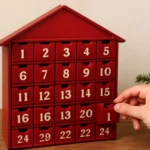
1903: Lang’s innovation appears as the first modern Advent calendar with 24 little doors behind which pictures or motifs could be hidden. This formal design established the template for the classic calendar many people recognize today.
1904–1908: The concept spreads, and more calendars are produced with religious imagery, verses, and small illustrations behind each door.
Early iterations emphasize religious symbolism and devotional content, aligning the calendar with Advent devotion in Catholic and Protestant households alike.
Lang’s “doors behind doors” idea allowed a sense of surprise and discovery every day in December, turning a simple countdown into a small ritual of anticipation. The 1903 calendar, and its subsequent recombinations, demonstrated how a personal family practice could become a cultural artifact that travels beyond a single household. The shift from cut-out pictures and chalk lines to a printable, mass-produced format is the moment when the Advent calendar becomes popular culture in addition to a devotional tool.
Interwar and Wartime Shifts
Between the 1910s and the 1940s, the Advent calendar faced challenges and transformations shaped by political and economic currents. In some regions, the calendars remained rooted in religious life, while in others, they began to incorporate secular themes and everyday motifs. The mid-20th century also saw shortages and rationing during and after World War II, which affected the materials used in calendars. Yet the idea of a daily, anticipatory reveal persisted, and postwar consumer culture would soon reclaim and reimagine the calendar in new forms.
From Devotion to Daily Ritual: The Evolution of Form and Function
As the 20th century progressed, the Advent calendar evolved from a primarily religious object into a versatile, annual ritual for people of diverse backgrounds. This evolution involved shifts in materials, imagery, content, and purpose—from prayerful reflection to playful anticipation, from purely religious art to secular iconography, and from a family activity to a commercially packaged product that could be shared by schools, workplaces, and communities.
Material and design innovations
From paper doors to fold-out calendars and 3D formats: The basic concept expanded into pages, foldable pieces, and later, popup designs that offered more elaborate reveals.
Incorporation of artistry and illustration: Artists and illustrators contributed seasonal motifs, ranging from traditional biblical scenes to modern Christmas imagery and whimsical characters.
Shift toward pop culture and license imagery: In recent decades, calendars feature characters from literature, cinema, and animation, broadening appeal beyond religious audiences.
Content: From prayers to surprises
Early calendars emphasized scriptural verses and devotional messages. Over time, the content broadened to include jokes, riddles, and small gifts. The inclusion of chocolates or other treats became increasingly common as calendars aligned with consumer expectations and the pleasure of daily indulgence, especially for children.
Globalization and cultural exchange
As technology and trade expanded, Advent calendars moved beyond Germany and neighboring regions. Importers and exporters carried calendars to the Netherlands, Scandinavia, the United Kingdom, and eventually North America and other parts of the world. Each place adapted the calendar to local tastes, languages, and holiday customs, producing a global mosaic of Advent countdowns.
Industrialization, Chocolate, and the Rise of Commercial Calendars
One of the most transformative shifts in Advent calendar history occurred when calendars began to incorporate edible components. The introduction of chocolate calendars turned the countdown into a tasty daily ritual and helped secure the calendar’s enduring popularity. This phase is often described as the commercialization of Advent calendars, though it does not erase the devotional roots; rather, it expands the appeal to families seeking a joyful December habit.
Key milestones in commercial Advent calendars
Postwar prosperity and consumer optimism: As economies recovered, calendars increasingly featured small gifts, toys, or edible treats behind each day’s door.
The chocolate surge: Chocolate-filled calendars became staples in German-speaking countries and gradually gained international attention. The idea of opening a door to reveal a chocolate piece helped link Advent to everyday sweetness and joy.
Brand partnerships and licensed themes: In the late 20th and early 21st centuries, calendars began to reflect licensed characters, stories, and brands. This allowed calendars to become keepsakes that families reuse or gift year after year.
Today, there are many varieties of calendars: classic religious calendars with biblical art, children’s calendars with toys and stickers, and adult calendars featuring coffee, beauty products, or mini-bottles of spirits. The spectrum demonstrates how a single tradition can adapt to lifestyle changes and consumer preferences while preserving the core idea of daily anticipation.
Regional Variations and Global Spread
As the Advent calendar traveled beyond its Germanic roots, it picked up regional flavors and adaptations. Different countries embraced unique motifs, languages, and rituals, all linked by the shared idea of counting down to Christmas in a tangible, daily way.
European adoption and diversity
Netherlands and Belgium: Calendars often featured Dutch or Flemish text and charming, painterly illustrations. Chocolate calendars became popular early in these regions, aligning with a strong confectionery tradition.
Scandinavia: Calendars blended wintery motifs, folklore, and modern design. In some cases, calendars include simple poems or short stories in the local languages.
United Kingdom and Ireland: The calendar tradition merged with broader Christmas customs, including school activities, charity initiatives, and media tie-ins. English-language versions appeared in varied formats, from religious to secular.
Central and Eastern Europe: Local craft traditions influenced calendar aesthetics, often integrating folk art, regional motifs, and bilingual or multilingual text to reflect diverse communities.
Non-European contexts and global diffusion
In the second half of the 20th century and into the 21st, Advent calendars found homes around the world. In North America, Australia, and parts of Asia, the calendar is frequently seen as a family tradition tied to December routines rather than strictly religious observance. Modern calendars, especially, reflect cross-cultural appeal: they provide a structured way to build excitement for the holiday while remaining adaptable to secular celebrations, charitable activities, and personal rituals.
Designing the Advent Calendar: Motifs, Formats, and Innovations
The design of Advent calendars has become as varied as the people who use them. While the timeless image of 24 little doors remains iconic, contemporary calendars experiment with formats, materials, and themes to suit different tastes and constraints.
Common formats you’ll encounter
Paper calendars with doors printed onto cardstock or decorative panels.
3D calendars that create miniature scenes, often with a built-in reveal mechanism.
Tin or metal calendars with a durable exterior and a small reveal behind each door or window.
Chocolate calendars featuring a small piece of chocolate behind each day’s door.
Toy calendars or calendars that release small items such as stickers, mini figurines, or craft components.
Calendars today explore a wide range of themes beyond the traditional nativity imagery. You can encounter calendars centered on winter landscapes, Christmas stories, art and design, music and culture, and charity and social causes. There are calendars designed to promote environmental awareness, languages learning, or mindfulness practices, underscoring how the ritual of daily opening can align with modern values.
Digital and hybrid calendars
In the digital era, online Advent calendars and mobile apps provide virtual doors that reveal multimedia content—videos, audio clips, interactive games, or daily reflections. Some programs offer a blend of physical and digital experiences, where a user receives a physical calendar at home but also engages with a companion app for additional content. This evolution shows how the core idea of counting down to Christmas can be adapted to new media and user preferences.
The Spirit of Advent Calendars Today
Despite the many innovations and marketing collaborations, the central appeal of the Advent calendar remains relatively simple: it helps people create a routine of anticipation and shared moments during December. For some families, the calendar is a cherished heirloom, renewed each year with care and creativity. For others, it is a playful, interactive activity that invites children to practice patience, gratitude, and anticipation. In many schools and communities, calendars are used to teach literacy, counting, or charitable giving, turning a festive object into an educational tool.
Social and cultural dimensions
Community building: Group calendars in workplaces or schools foster camaraderie and collective anticipation for the holiday season.
Charitable initiatives: Some calendars are tied to fundraising campaigns or social projects; funds or awareness are raised as participants open doors one by one.
Educational value: Calendars can introduce language practice, art appreciation, or science through carefully chosen daily content.
Family storytelling: Each day can prompt memory sharing, storytelling, and intergenerational learning as grandparents, parents, and children participate together.
Regional preservation and adaptation
Across continents, people preserve traditional elements while adapting calendars to local customs. For some communities, the religious underpinnings remain central; for others, secular celebrations of winter and community are emphasized. The balance between reverence and play reflects broader cultural values, and the calendar serves as a vehicle for expressing those values every December.
Chronology of the Advent Calendar: A Concise Timeline
To grasp the arc of development, here is a concise timeline highlighting major milestones in advent calendar origin, dissemination, and diversification. This timeline emphasizes the evolution from intimate devotional practice to global phenomenon.
Early 19th century – Advent countdowns appear in German-speaking households as chalk lines, prayers, and devotional cards.
1839 – Documented early practice of a devotional countdown; laying groundwork for a daily Advent ritual.
1903 – Gerhard Lang introduces the first modern Advent calendar with 24 doors behind which images could be hidden; a watershed moment in calendar design.
1900s–1930s – The concept spreads across Europe, with increasingly elaborate designs and content, balancing religious and secular elements.
World War II era – Material shortages affect production; calendars adapt to available resources, but the idea persists.
1950s–1960s – Chocolate and toy calendars gain popularity; commercialization accelerates; regional variations flourish.
1970s–1990s – Licensing and pop culture themes come to the fore; calendars feature beloved characters and stories from literature and film.
2000s–present – Digital and hybrid calendars broaden access; monthly or daily experiences extend beyond paper and chocolate to apps, websites, and interactive media.
Across this timeline, the Advent calendar remains a flexible framework that can be serious, sentimental, humorous, or celebratory. The annual product is a reflection of the values and tastes of its creators and users, while still pointing back to the original idea: to mark time in December with a daily opportunity for reflection, delight, or learning.
Preserving the Core Idea: What Counts as an Advent Calendar Today?
Although many modern calendars are candy-and-gift-oriented, the core concept persists: a structured countdown that invites light, anticipation, and daily engagement. This core idea can be preserved in multiple forms, and many families curate calendars that align with their beliefs, values, and celebrations.
Key elements that endure
Structured daily opening: A fixed number of days (usually 24 or 25) that audiences follow in order, creating a predictable rhythm through December.
Surprise or discovery: The appeal of revealing something new each day fosters curiosity and playfulness.
Personal or communal meaning: Calendars can reinforce religious reflection, family bonding, or charitable engagement.
Tradition and memory: The annual ritual becomes a shared memory that can be passed down through generations.
Contemporary considerations and inclusivity
In the 21st century, creators and users increasingly consider inclusivity and inclusiveness. Some calendars emphasize secular themes, those with bilingual or multilingual content, or those designed with accessibility in mind. There is also growing attention to sustainability in materials and packaging, prompting designers to choose reusable, recyclable, or minimalistic formats. The broader idea is to maintain the spirit of the countdown while honoring diverse households and beliefs.
Conclusion: The Advent Calendar as a Living Tradition
From its humble origins in 19th-century German devotion to its present-day global presence, the Advent calendar origin story is one of adaptation, creativity, and communal joy. The tradition began as a spiritual practice that helped people anticipate Christmas. It evolved into a canvas for art, education, and play; it became a marketing and manufacturing phenomenon; and today it exists in a spectrum that ranges from religious and family-oriented calendars to luxury, tech-enabled, and thematically diverse options.
Ultimately, the enduring value of the Advent calendar lies in its ability to reframe time: every day in December becomes an opportunity to pause, reflect, smile, and share something small with others. Whether you approach it as a sacred ritual, a festive hobby, or a daily reminder to practice kindness, the calendar remains a testament to the human impulse to mark the passage of time together. The evolution of this tradition—from chalk lines on a wall to digital doorways—illustrates how a simple idea can travel across centuries and cultures, staying relevant by continually reinventing itself while preserving a sense of anticipation and connection.










Leave a Reply