Advent Candles History: Origins, Meaning, and Traditions
Advent Candles History: Origins, Meaning, and Traditions
Advent Candles History: Origins, Meaning, and Traditions is a exploration of how a simple arrangement of candles evolved into a rich liturgical and familial practice. The story blends theology, culture, and craft, tracing how the lights placed around a wreath or within a table arrangement became a yearly ritual that invites reflection, anticipation, and communal gathering. In this article, we will survey the origins of Advent candles, explain the meaning behind their colors and arrangement, and describe the traditions that have developed in different regions and denominations over time. We will also consider how the practice has adapted in the modern era, when households, churches, and schools around the world use Advent candles in diverse ways.
Advent Candles History: Origins and Early Practices
The term Advent itself comes from the Latin adventus, meaning “coming” or “arrival.” In Christian usage, Advent is the season that anticipates the coming of Christ—both his historical birth at Christmas and the eventual fulfillment of messianic hope. The practice of marking this season with light has deep roots, but the specific custom of using a wreath or a focal candle arrangement became more clearly defined in the recent centuries.
The most widely cited origin story for the Advent wreath places its invention in 1839, in Germany. A Lutheran minister named Heinrich Wilhelm (Heinrich) Wichern founded the Rauhes Haus, a charitable institution in Hamburg that cared for poor and sick children. To teach and comfort the students during the long weeks of waiting, Wichern created a large wooden wheel (later simplified into a circular wreath) with many white candles. Each day, the children would add or light additional candles to count the days of Advent. This approach was later refashioned into the more compact practice of lighting four candles on a wreath—one for each of the Sundays of Advent.
From this origin, several elements became standard across many Christian communities. The use of candles as a symbolic form of light overcoming darkness, the emphasis on waiting and preparation, and the communal aspect of lighting together all contributed to a durable motif. For some readers, the history of Advent candles also intersects with the broader history of liturgical calendars and the ways churches and families use ritual time to structure spiritual attention.
In discussing the Advent candle tradition, it is important to distinguish among the different lines of practice. Some Christian communities adopted a wreath with four candles around a circular base, while others used a simple arrangement of four candles on a table or in a stand. In addition, a growing number of families and churches incorporate a fifth, central candle—often called the Christ candle—to be lit on Christmas Eve or Christmas Day. This variation reflects the way different traditions layer symbolism and timing within the same overarching theme of waiting for the Nativity.
To understand the origins and evolution of Advent candles, consider a few milestones that have helped shape the modern practice:
1839: The Rauhes Haus in Hamburg introduces the Advent wreath concept with a wheel of candles used for a children’s program, laying the groundwork for counting down Advent with light.
Late 19th to early 20th century: The use of a four-candle wreath becomes common in Protestant churches across Europe, especially in Lutheran and Reformed contexts.
Mid-20th century: Catholic communities in many countries begin adopting Advent wreaths as well, blending older parish customs with the now-familiar visual symbol of Advent light.
Contemporary era: Advent candles are widely used in homes, schools, and churches around the world, with regional variations in color, number of candles, and the inclusion or exclusion of a central Christ candle.
Meaning and Symbolism of Advent Candles
What makes Advent candles meaningful goes beyond their glow. The colors, the sequence of lighting, and the communal act of gathering around the candles collectively express a theological narrative. Across many traditions, the candles symbolize hope, preparation, joy, and peace as the Advent season unfolds.
Color Symbolism: Purple, Pink, and White
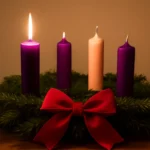
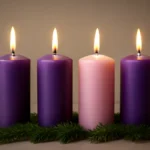
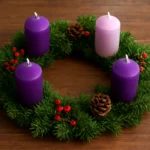
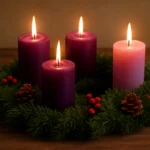
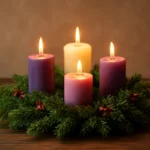
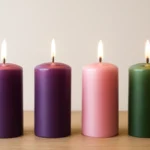
The most prevalent color scheme for Advent candles uses purple (violet) and pink (rose), with a possible white Christ candle in the center. The typical arrangement includes four candles around a wreath, with the usual palette most common in Western Christian worship:
Purple candles: Symbolize penance, preparation, and longing. They mark the season as a time of moral and spiritual readiness as the birth of Christ approaches.
Pink (rose) candle: Lit on the third Sunday of Advent, often called Gaudete Sunday, which means “rejoice.” This candle signals a shift from penitential mood to a more joyful expectation as Christmas nears.
White (Christ candle): In wreaths that include a central white candle, this candle is lit on Christmas Eve or Christmas Day to celebrate the incarnation and the light that has finally come into the world. In some traditions, the white Christ candle is lit together with the other four on Christmas Day.
Beyond these core colors, some regional or denominational practices may use blue or red candles, reflecting local symbolism or liturgical preferences. The key point is that color coding communicates stages of spiritual preparation and joy, helping worshippers and families to pace the season’s promises with a visual rhythm. This mapping of color to meaning is part of the broader theology of light that animates Advent candle history and practice.
In addition to color, the sequence and the act of lighting carry meaning. A typical four-candle Advent wreath invites participants to reflect on the following themes as each candle is lit: hope, preparation, joy, and peace. Some communities place an extra emphasis on mercy or faith as the season deepens. The practice is not just decorative; it is meant to shape the heart and mind toward the mystery of Christmas.
Traditions and Practices around Advent Candles
The ways Advent candles are used reflect local customs, theological emphases, and household routines. The traditions range from parish ceremonies with prayers and readings to intimate family rituals performed around a table at home. What unites most approaches is the act of lighting together, often accompanied by Scripture, hymns, and shared reflections.
Lighting Rituals in Families and Churches
Resetting the pace: Families light candles on successive Sundays, setting a predictable rhythm that anchors time in anticipation of Christmas.
Evening or morning routines: Some households light the wreath in the evening after dinner, others light the candles in the morning as a calm start to the day. The timing varies with family life.
Prayers and readings: Each lighting typically accompanies a short reflection or Scripture passage, a brief prayer, and a hymn or quiet song.
Community connections: Churches may organize an Advent candle lighting service with a reading, a short meditation, and a communal blessing. Schools and youth groups may incorporate the ritual into Advent lessons or performances.
Practical adaptations: In modern homes, the wreath might be artificial or living, and the candles may be the traditional wax or LED substitutes, chosen for safety and practicality while preserving symbolism.
In many contexts, the lighting sequence is fixed: the first candle is lit on the first Sunday of Advent, followed by the second on the second Sunday, and so on. The order and the meaning attached to each candle help participants reflect on themes such as hope, spiritual preparation, rejoicing, and peace as Christmas draws near. Some traditions also include a designated candle for the Bethlehem journey or for an act of mercy or service during the Advent season.
Advent Wreaths: Variations in Design and Use
Although the classic form is a circular wreath with four candles, there are many regional variants. Some key differences include:
Number of candles: The standard is four candles, corresponding to the four Sundays of Advent, but some households or churches may add a central white candle or use five candles to reflect additional symbolism.
Placement: The candles may be placed on a wreath, on a tabletop arrangement, or on a stand in a church chancel. The wreath itself may be made of evergreen branches or other durable materials, and some designs incorporate seasonal greenery, pinecones, or ribbons.
Colors: While purple and pink are common, some parts of the world use blue or red to reflect different liturgical calendars or national traditions.
Frequency of lighting: In some communities, candles are lit weekly with readings and carols; in others, short daily devotions during Advent are held around the wreath at home or at church.
Despite these variations, the core idea remains the same: to create a visual and sensory reminder of waiting, preparation, and the arrival of Christ. The Advent wreath is both a decorative object and a devotional tool, a teaching aid that helps people slow down the pace of the season and orient their hearts toward the mystery of Christmas.
Across different countries and Christian traditions, the Advent candle practice has taken on distinct flavors. These regional variations in the Advent candle history reflect historical development, theological emphasis, and cultural preferences. The following overview highlights some notable patterns in Europe and beyond.
Germany, Lutheran Traditions, and the Wichern Legacy
Because the modern Advent wreath was popularized in Germany by Wichern, German Protestant communities have long been at the forefront of the practice. The early wheel of candles was designed as a pedagogical tool for children, but over time the simplified wreath with four candles became a standard in many German-speaking churches and then spread to neighboring regions. In these contexts, the colors and the sequence often align with the broader liturgical year and the practice of color-coding Sundays in the church calendar.
Catholic and Anglican-Influenced Traditions
In Catholic communities and in some Anglican or Anglican-influenced churches, Advent wreaths are embraced with a combination of reverence and festivity. The wreath may be placed in a sanctuary or a family home, with readings that emphasize hope and waiting as essential elements of the season. The inclusion of a central Christ candle is more common in certain Catholic and ecumenical settings, where the White candle serves as a focal point on Christmas Eve or Christmas Day.
In Scandinavia, Advent candles can take on a distinctive aesthetic that uses local colors, modern materials, and family-centered rituals. Some households light candles at the kitchen table, while others incorporate music, prayer, and seasonal meals into the candle-lighting routine. In Eastern Europe, the Advent season may be integrated with other winter traditions, and the symbolism of light is often linked to themes of endurance and faith during long winter nights.
The Modern Era: Global Adoption and Adaptation
Today, Advent candles are a global symbol of anticipation connected to Christmas. The history of Advent candles in contemporary contexts often emphasizes accessibility, education, and inclusive worship. Some features of the modern era include:
Public displays: Churches, schools, and community centers frequently display Advent wreaths in prominent places to invite public reflection and participate in shared prayer.
Educational activities: Many educational programs use Advent candles as a way to teach children about the calendar, the sequence of Sundays, and the spiritual themes of the season.
Artistic adaptations: Artists and crafters create varied wreaths using natural materials, metals, glass, or even LED lighting, blending tradition with contemporary aesthetics.
Interfaith and secular reflections: Some communities use the symbolism of light and waiting in Advent to discuss universal themes such as hope, generosity, and peace beyond specific doctrinal boundaries.
As the practice spread beyond its European heartland, Advent candle symbolism has been reframed in different languages and cultures. The core meanings—waiting, preparation, and the dawning of light—remain recognizable even when the physical form shifts. This adaptability is a hallmark of the Advent candles history in a global age, where families and congregations adapt the tradition while preserving its essential purpose.
Contemplative and Educational Aspects
Beyond ritual lighting, Advent candles offer a contemplative and educational frame for individuals of all ages. The readings, prayers, and songs associated with Advent candles encourage reflection on themes such as patience, mercy, and the hope that accompanies difficult times. The practice can be integrated into formal catechesis, devotional life, and communal worship, providing a tangible way to slow down the pace of the season and to reflect on the mystery at the heart of Christmas.
Several educational benefits emerge from engaging with the Advent candle tradition:
Time awareness: The weekly lighting marks time in a way that helps learners connect liturgical seasons with daily life.
Scriptural engagement: Readings tied to each candle illuminate biblical themes around the Nativity and the Advent call to prepare the way.
Values formation: The acts of anticipation, charity, joy, and peace linked to Advent candles support moral and spiritual formation in communities.
Artistic expression: Crafting wreaths and decorating spaces provides a creative outlet for families and congregations.
When considering the history of Advent candles, one sees a practice that has evolved with time while retaining a clear core: the ritual power of light to symbolize hope and the patient expectation of a long-anticipated event. This continuity, coupled with regional adaptations, makes Advent candles a compelling example of how religious rituals travel across cultures and generations.
Practical Guidance for Those Interested in the Tradition
If you are new to the tradition or looking to refresh your household practices, here are practical steps and considerations that reflect both the origins and the contemporary traditions of Advent candles.
Decide on a format: Choose a wreath, a tabletop arrangement, or a simple stand with four candles. Consider safety, space, and whether you want a central Christ candle.
Pick your colors: Most commonly, four candles in purple and pink, with optional white. If you prefer a blue or red palette, that can be a meaningful regional touch as well.
Plan the lighting schedule: Establish a routine for lighting one candle on each Sunday of Advent, possibly with readings tied to each week’s theme (hope, preparation, joy, peace).
Gather readings and songs: Select Scripture passages and hymns that align with the weekly themes to accompany each lighting.
Involve others: Invite family members, friends, or church members to participate in the readings and prayers, turning the ritual into a communal activity.
Adapt for safety and accessibility: Use proper candle holders, place the arrangement away from flammable materials, and consider LED options for households with children or pets.
In sum, the Advent candle tradition invites a convergence of theology, art, and communal life. Its history is a story of how a practical device—light in a dark season—became a pedagogical, devotional, and ecumenical practice that resonates in many languages and cultures today.
Conclusion: Why the Advent Candles History Matters
The history of Advent candles matters for several reasons. It shows how a simple custom can grow into a powerful symbol of expectation and grace. It reveals how communities adapt traditions to new contexts while preserving their core meanings. And it highlights the way light—literal and metaphorical—can knit together families, congregations, and nations in shared reflection during one of the year’s most meaningful seasons. Whether you approach Advent candles as a family ritual, a church practice, or an educational tool, you participate in a long history of light that has guided Christians through the centuries toward the mystery of Christmas.
As you consider your own practice, you may reflect on these semantically related phrases that echo the broader conversation about Advent candles history: Advent wreath symbolism, counting down Advent, color symbolism in Advent, Gaudete Sunday traditions, the Christ candle, the evolution of Advent ritual, and regional variations in Advent candle usage. Each thread offers a doorway into the wider story of how a liturgical custom can illuminate faith, culture, and daily life for generations to come.






Leave a Reply