Assistive Listening Devices Church: A Practical Guide
In many faith communities, the spoken word and sung liturgy are central to worship. Yet for congregants with hearing loss or auditory processing differences, participating in a worship service can be challenging. Assistive listening devices, assistive listening systems for churches, or more broadly church hearing assistive technology can transform the experience by delivering clear sound directly to the listener’s ears. This guide offers practical, actionable information on selecting, installing, and maintaining listening aids in church settings, with the aim of making worship spaces more inclusive and accessible to all.
What are assistive listening devices in church settings?
Assistive listening devices (ALDs) are tools that improve the signal-to-noise ratio for listeners with hearing challenges. In a church, this often means a system that takes the pastor’s or choir’s microphone audio, broadcasts it through a transmitter, and delivers it to a listener’s receiver or personal device. The goal is to ensure that every member of the congregation can understand sermons, prayers, and music with minimal strain.
There are several ways to implement ALDs, and different types of listening systems for worship spaces suit different architectural layouts and budgets. Here are the core concepts you’ll encounter:
Induction loop systems (hearing loops) — Convert audio into a magnetic signal picked up by a T-coil in hearing aids or by compatible receivers. These systems are popular for their discreet, wireless nature and compatibility with many hearing devices.
FM broadcast systems — Transmit audio over FM radio frequencies to personal receivers. They often perform well in large rooms and crowded venues, but can be affected by interference.
Infrared systems — Use infrared light to carry audio to receivers. They are generally excellent in terms of privacy and are less susceptible to RF interference, but they require line-of-sight reach for some receivers.
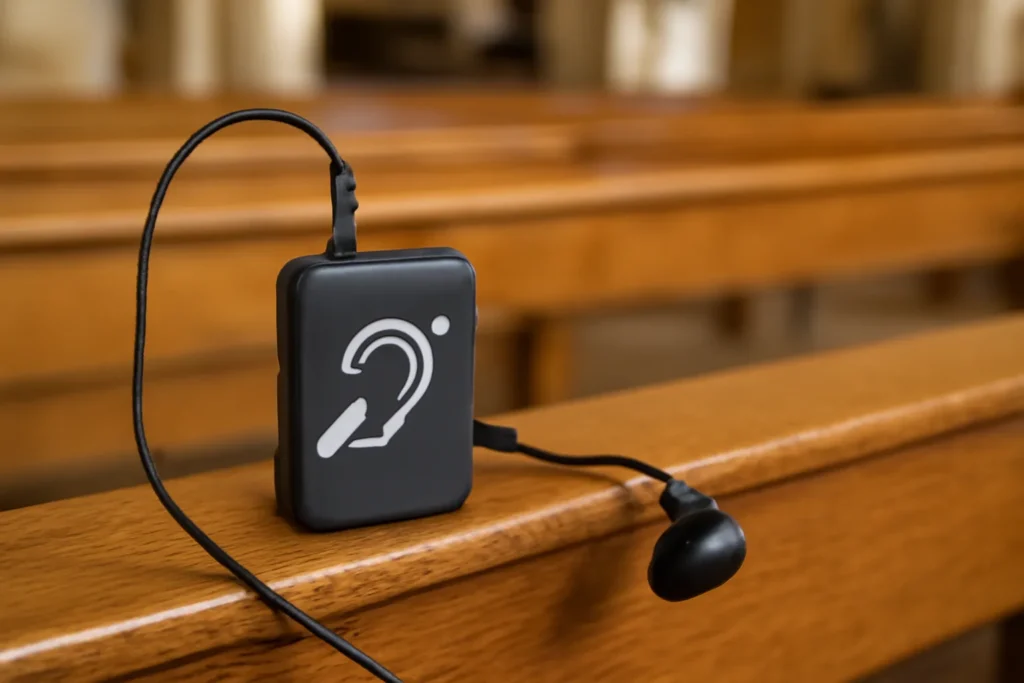
Personal listening devices — Handheld or wearable receivers, often paired with headphones or ear buds. These can be simple or feature-rich (volume control, mute, balance controls).
Smartphone apps and streaming — Some churches support speech-to-text or audio streaming to mobile devices, offering flexibility and low cost for congregants who already own smartphones.
Regardless of the technology, a well-implemented ALD in a church should deliver clear, intelligible sound while maintaining the sacred ambience of the space. It should be easy to use for visitors and accessible to people with a range of hearing abilities.
Why churches should adopt assistive listening devices
Adopting ALDs in worship spaces is not merely a convenience; it is a matter of accessibility and inclusion. Here are key reasons churches invest in listening aids:
Inclusive worship — Ensures that all members of the community, including those with hearing loss, can participate fully in services, prayer, and study.
Better comprehension — Clearer audio improves understanding of sermons, prayers, and announcements, which benefits everyone in attendance.
Multilingual and multi-sensory accessibility — ALDs can be paired with live-captioning, translated sermons, or choir performances to reach a broader audience.
Community engagement — Demonstrates a church’s commitment to accessibility, encouraging attendance, volunteering, and stewardship from a diverse congregation.
Compliance and best practice — While requirements vary by location, many jurisdictions and denominations encourage or require accessible worship environments; ALDs are often a practical core component of accessibility plans.
Beyond the legal or ethical imperatives, ALDs can reduce fatigue for attendees who would otherwise strain to hear. This can translate into a more vibrant, engaged community and a more welcoming atmosphere for visitors and newcomers.
Every church is unique, and the “best” assistive listening solution depends on factors like seating layout, acoustics, technology infrastructure, and budget. Consider the following areas when evaluating options for listening aids in worship spaces:
Church size and room acoustics — A small chapel can often work with a compact induction loop or a single FM transmitter, while a large sanctuary may require multiple transmitters and careful placement to ensure even coverage.
Seating configuration — Fixed pews, movable seating, balconies, and overflow rooms affect how audio will be distributed and where receivers should be placed.
Existing audio system — The ALD should integrate smoothly with the current PA system, including mixers, equalization, and microphones. Some systems converge with the main soundboard, while others operate as independent units.
Portability vs. permanence — Do you need a fixed installation, or can you rely on portable receivers and temporary transmitters for special services?
Budget and total cost of ownership — Initial equipment costs, installation labor, ongoing maintenance, battery purchases, and replacement parts all matter over time.
Staff and volunteer capacity — Do you have technicians who can install, test, and troubleshoot, or will you rely on external support?
Accessibility for all members — Consider the needs of children, seniors, multilingual congregations, and visitors who may not own personal devices.
When selecting between major categories—induction loops, FM systems, infrared, and personal receivers—think in terms of coverage, ease of use, privacy, and maintenance. For example, induction loops offer seamless integration with hearing aids in many cases, but require careful loop design and debugging to avoid gaps or magnetic interference. Infrared systems excel in high privacy and low interference environments but may be limited by line-of-sight for some receivers. FM systems are robust in large spaces but can be more susceptible to RF congestion in crowded areas. Personal listening devices provide simplicity and flexibility but rely on users to obtain and carry a receiver or compatible device.
Understanding technologies in depth
Induction loop systems (hearing loops)
Induction loops create a magnetic field that is picked up directly by hearing aids with a T-coil or by compatible receivers. They are particularly popular in churches for their discreet operation and compatibility with many modern hearing devices. Key considerations:
Proper loop design to ensure even coverage across all seating areas.
Appropriate power levels and good shielding to minimize interference.
Clear signage and staff awareness so visitors know how to access the loop feature.
Potential limitations for users without T-coils, who may need a compatible receiver or headset.
FM broadcast systems
FM-based ALDs transmit audio via radio frequencies. They are often favored for their reach in large rooms and outdoor spaces. Consider:
Reliable receiver availability for congregants who do not own devices.
Potential interference from nearby FM transmissions; choose appropriate frequencies and possibly a guard band.
High versatility for complex venues with multiple overflow rooms.
Infrared systems
Infrared ALDs use light to carry audio signals from a transmitter to receivers. They offer privacy and are generally less susceptible to RF interference, but:
Performance can degrade if line-of-sight is blocked by people or objects.
Ask about compatibility with common hearing devices and whether shared infrared receivers are available for guests.
Personal listening devices and handheld receivers
Individual receivers paired with headphones or earphones can be a straightforward solution, especially in smaller settings or for hosts who want to offer a simple guest experience. Consider:
Ease of distribution and return by ushers.
Battery life, charging options, and the possibility of reusable devices to minimize waste.
Capacity to support multiple language channels or audio streams if needed.
Smartphone integration and apps
With the ubiquity of smartphones, some churches offer streaming or captioning apps that allow parishioners to follow along on their devices. Points to consider:
Data privacy and user access policies.
Compatibility with iOS and Android devices, plus any required subscriptions or software.
Potential for real-time captioning or sign language services to be accessed by attendees.
Design and installation considerations
Implementation is more than just choosing a technology. A thoughtful design approach ensures the solution works across services, seasons, and user groups. Key considerations include:
Transmitter placement — Place transmitters where they provide uniform coverage and minimize feedback or interference. Avoid placing near large metal surfaces or equipment that can cause reflections or detuning.
Receiver accessibility — Ensure audience members can easily obtain and return receivers. Create a simple check-out system at the welcome desk or sound booth.
Acoustic optimization — Work with a sound engineer to tune the main PA and any ALD-related equalization so that the signal remains intelligible without overpowering natural room acoustics.
Power and reliability — Consider backup power options for essential services in case of outages, especially for larger or critical services such as weddings or funerals.
Maintenance planning — Schedule regular checks, battery replacements, cleaning, and firmware updates if your system uses smart receivers or apps.
Aesthetics and discretion — Design installations to blend with the church interior. Consider unobtrusive wall-mounts, discreet cables, and signage that is clear but respectful of the space.
Best practices for use during worship
To maximize effectiveness, establish a set of practical guidelines that can be shared with staff, volunteers, and congregants. Some best practices include:
Clear service integration — Ensure that the ALD system is synchronized with the live sound, including microphones for speaker, choir, and instruments. The goal is feedback-free clarity.
Volunteer training — Train ushers, greeters, and sound booth staff on how to distribute devices, troubleshoot common issues, and assist visitors who may be new to ALDs.
Signage and access — Post simple, visible instructions near entrances about how to borrow or use receivers, as well as how to find the hearing loop or invisible options.
Guest accommodation — Provide a plan for visitors who arrive without devices, including a quick loan option and a way to collect feedback on the experience.
Quiet environment — Encourage a worshipful atmosphere by minimizing device chatter, ensuring chargers are silent, and avoiding loud cues that could distract listeners who use ALDs.
Multilingual support — For multilingual congregations, consider systems that offer language channels or paired captioning to meet diverse needs beyond hearing aid compatibility.
Practical steps to implement assistive listening devices in a church
Here is a practical, step-by-step approach that churches can follow to roll out listening aids effectively. Each step emphasizes planning, evaluation, and sustainability.
Assess community needs — Conduct surveys, engage with parishioners who have expressed concerns about hearing in worship, and collect input from staff. Include questions about preferred systems, languages, and comfort with technology.
Define goals and scope — Decide whether the initial deployment will cover a single service, a specific hall, or multiple zones. Set measurable objectives (for example, percentage of seating coverage and user satisfaction).
Develop a budget — Estimate equipment costs, installation, training, maintenance contracts, and future upgrades. Include a contingency for unexpected issues.
Engage stakeholders — Involve the pastor or worship leader, the AV team, accessibility ministry leaders, facility staff, and church council. Clarify roles and responsibilities.
Run a pilot program — Start with a small, representative group of users. Use feedback to refine the system, signage, and training materials before full deployment.
Choose a solution and install — Select a technology that aligns with your goals and space. Hire qualified installers or work with a trusted AV partner to ensure proper grounding, safety, and certification requirements.
Provide training and user education — Offer brief training sessions for staff and volunteers, plus printed or digital guides for congregants. Include a quick “how to use” card for visitors.
Launch and promote — Announce the availability of ALDs during services, on the church website, social media, and welcome materials. Encourage feedback and questions.
Monitor and adjust — Regularly review usage data, gather user feedback, and perform maintenance. Plan for future upgrades as technology evolves or as church needs change.
Training and education for staff and volunteers
Effective use of ALDs relies on knowledgeable staff and volunteers who understand both the technology and the needs of worshippers. Consider the following training topics:
System basics — How the transmitter and receivers work, how to pair devices, and how to switch channels if multiple language streams are required.
Receiver handling — How to check out and return devices, how to adjust volume if permitted, and how to check for battery life.
Service workflows — How to coordinate ALD usage with liturgy schedules, including special services, weddings, and funerals.
Accessibility etiquette — Treat all receivers respectfully, avoid drawing attention to users, and ensure privacy and comfort for those relying on ALDs.
Maintenance routines — Regular cleaning, charging, battery replacement schedules, and how to report any equipment issues.
Maintenance, troubleshooting, and long-term care
ALDs require ongoing care to stay reliable. A proactive maintenance mindset minimizes downtime and preserves user trust. Key tasks include:
Regular checks — Schedule periodic tests of transmitters, receivers, and loops. Confirm that channels or language streams are active and not causing interference.
Battery management — Keep an inventory of charged batteries, implement a charging protocol, and replace worn-out batteries to prevent failures during services.
Cleanliness and hygiene — Provide cleaning protocols for receivers and headsets, especially in high-traffic settings.
Firmware and software updates — Apply updates for app-based solutions or receivers when available, ensuring compatibility with the church’s equipment.
Troubleshooting basics — Have a simple guide for common issues (no sound, low volume, interference, misaligned loops) and a contact path for technical support.
Funding, grants, and sustainability
Funding assistive listening devices in churches is often a blend of local budgeting, donor contributions, and external grants. Consider these avenues and best practices:
Church budget allocations — Designate a line item for ALD equipment, maintenance, and replacement cycles.
Donor campaigns — Create a targeted fundraising campaign or “donate a listening aid” program that invites individuals to contribute toward specific devices or services.
Grants and subsidy programs — Explore opportunities from disability organizations, church associations, or local government accessibility initiatives that may provide partial or full funding for ALDs or improvements to worship spaces.
Diocesan or denominational support — Some denominations offer guidance, pooled resources, or equipment-sharing arrangements among churches.
Cost-saving strategies — Consider modular solutions that allow scaling over time, reuse of existing PA infrastructure, and batteries with long life to reduce ongoing costs.
Accessibility and inclusivity best practices
Beyond technology, the culture and practices of the church are central to accessibility. A thoughtful approach to inclusive worship should combine equipment with welcoming practices and clear communication:
Signage and information — Provide clear signage describing ALD options, how to borrow devices, and which services are equipped with loops or other systems. Use universal icons and large-print materials where possible.
Privacy and consent — Respect user privacy and avoid requiring individuals to identify themselves to receive assistance. Ensure devices are sanitized and handled with care.
Language and culture accessibility — For multilingual congregations, provide language options and consider collaboration with translation teams to offer simultaneous interpretation via ALDs or apps.
Family and accessibility for children — Ensure that children with hearing differences have age-appropriate access to devices when appropriate, with parental or caregiver supervision.
Quiet, respectful operation — Create an atmosphere where the use of ALDs is normalized and non-disruptive, particularly during moments of silence, prayer, or reflection.
Case studies and scenarios
While every church is unique, a few hypothetical scenarios illustrate how ALDs can be integrated with sensitivity to context and community needs.
Scenario 1: A small rural church with a single service
The building is a compact sanctuary with wooden pews and modest acoustics. The church uses a single podium microphone and a basic PA system. An induction loop is installed to serve most seating areas, along with a small fleet of personal receivers for visitors who don’t own hearing devices. The leadership team runs a short training session for volunteers and creates a simple loan-out process at the welcome desk. Outcome: Wide coverage, good user satisfaction, and a sense of inclusion without disrupting the service’s atmosphere.
Scenario 2: A mid-sized urban church with multilingual services
The church hosts weekly services in two languages and has a diverse congregation. A layered approach is implemented: an induction loop for general listening, two FM channels for language interpretation, and a set of handheld receivers for those who prefer headphones. The AV team coordinates with translators and provides guidance for guests about which channel to select. Outcome: Multilingual accessibility is improved, and attendees experience clearer, more confident participation in worship.
Scenario 3: A large sanctuary with dynamic music and sound design
The space features a choir, orchestral elements, and a live preacher. An infrared system is used to minimize RF interference and maintain high privacy. The church deploys a combination of fixed receivers in the pews and a small pool of loaner devices for visitors. Staff receive thorough training to manage the complexity of multiple channels and to troubleshoot during high-demand services. Outcome: High-quality audio delivery across a large space with minimal disruption, supporting both worship and musical components.
Common questions about assistive listening devices for churches
Here are answers to frequent questions pastors, administrators, and volunteers ask when planning ALDs for church services.
Do ALDs require a lot of maintenance? Not if you design a simple, manageable plan. Regular checks, battery management, and a service contract with a trusted provider can keep downtime minimal.
Can visitors use ALDs without prior notice? Yes, especially with portable receivers and clear, visible instructions. A welcome desk or information kiosk can provide devices and guidance.
Are ALDs compatible with hearing aids? Induction loop (T-coil) compatibility and certain wireless receivers enable easy use for many hearing aid wearers. Always verify compatibility with common devices used by your congregation.
What about non-audio accessibility (captions, sign language)? ALDs can be part of a broader accessibility plan that includes real-time captioning, sign language interpretation, and visual announcements to accommodate varying needs.
How long does installation take? Depending on the scope, it can range from a few days for a small system to several weeks for a full installation with multiple zones and channels.
Measuring success and ongoing improvement
To ensure that assistive listening devices continue to meet the needs of the congregation, establish clear metrics and a feedback loop. Some useful indicators include:
User satisfaction — Gather anonymous feedback from device users about clarity, ease of use, and comfort during services.
Coverage quality — Confirm that all seating zones have reliable audio and identify and address any dead spots.
Service impact — Track participation levels, particularly among newcomers or families who previously found listening challenging.
Maintenance performance — Monitor equipment uptime, battery replacement rates, and service response times.
Adaptability — Assess whether the system supports future needs such as multilingual services, large gatherings, or special events.
Variations in implementation for different church cultures
Different church communities will adopt ALDs in ways that reflect their liturgical style, architectural constraints, and budget realities. Some variations you might encounter include:
Traditions with minimal amplification — Churches that prefer a quiet, reverent ambiance may choose discreet induction loop installations with minimal visible equipment, prioritizing subtle enhancement over loud, audible loudspeakers.
Contemporary churches with large venues — These may rely on robust FM or infrared systems, multiple language channels, and a substantial pool of receivers to accommodate diverse worship styles and growth projections.
Historic buildings — In space-limited or architecturally sensitive structures, engineers may design compact, aesthetically integrated ALD installations that respect historic interiors while delivering necessary accessibility.
Multisite or campus churches — A single system might serve multiple worship spaces, with portable receivers and centralized management, enabling uniform accessibility across locations.
Conclusion: building a more accessible worship experience
Assistive listening devices in churches, whether described as assistive listening systems for churches, church hearing assistive technology, or listening aids for worship spaces, represent a practical commitment to inclusivity. By choosing the right technology, planning installation thoughtfully, training staff, and maintaining equipment, a church can significantly improve the listening experience for a broad spectrum of worshippers. The result is more than enhanced hearing; it is a strengthened sense of belonging and participation in the life of the community.
If you are beginning this journey, start with a needs assessment, engage stakeholders, and pilot a modest installation. As you build experience and gather feedback, your church can progressively expand coverage, update equipment, and refine processes. The goal is simple and important: to ensure that every member of the congregation can hear the message, participate in prayers, and join in the shared experience of worship with clarity, dignity, and joy.







Leave a Reply