Emergency Baptism in Catholic Tradition: A Practical Guide
Emergency Baptism in Catholic Tradition: A Practical Guide
The sacrament of baptism is central in Catholic teaching as the gateway to the life of grace in Christ. In extraordinary situations, when a person faces imminent danger of death or another urgent circumstance, the Church provides a practical and principled path known as an Emergency Baptism or baptism in danger of death. This guide explains what that means in Catholic tradition, how it is performed, who may administer it, and what happens afterward. It blends theological foundations with hands-on steps so families, caregivers, and communities can respond quickly, rightly, and compassionately.
In Catholic practice, an emergency baptism is the baptism administered in a context where the person is in danger of death or in another urgent condition that threatens life or salvation. The term emergency baptism captures a wide range of scenarios, including medical crises, severe injury, or any imminent threat where prompt action may save the person’s soul. It can involve an infant, a child, or an adult who is incapacitated or unable to seek sacramental preparation at that moment.
Danger of death: The classic and most widely cited case is when death seems imminent. In this situation, the act is permitted to be performed by anyone who has the proper intention and the necessary matter and form.
Imminent danger: Even if death does not occur immediately but the person is in grave danger (for example, in a serious accident or medical emergency), baptism may be administered to remove the barrier of sin and to grant sanctifying grace if possible.
Unconscious or non-responsive individuals: When the person cannot express consent or request baptism, Catholic teaching allows a layperson to perform the rite provided they intend to do what the Church does and use the correct words and water.
Infants and children: In emergencies, the baptism of infants or young children can proceed in the same way to ensure they are incorporated into the Body of Christ as early as possible.
Variations of the term you may encounter include emergency baptism in Catholic tradition, baptism in danger of death, urgent baptism, and baptism at the bedside. All of these describe the same fundamental act: a baptism performed under pressing circumstances to ensure salvation and ecclesial belonging when ordinary catechetical preparation may not be possible.
Theological foundation of emergency baptism
The Catholic Church teaches that baptism is a sacrament instituted by Christ and that it imparts grace, remits sins, and joins the baptized to the Church. The Catechism of the Catholic Church emphasizes that baptism is necessary for salvation and is the primary instrument by which one enters into life in Christ. In emergencies, the Church makes a provision so that no one is deprived of this essential grace simply because circumstances are dire.
Key theological ideas to hold in view include:
Affirming the ordinary means: The Church normally administers baptism within the context of a parish, by a priest or deacon, with proper catechesis. In emergencies, the extraordinary means are allowed to ensure salvation and entry into the Church in the most urgent moment.
Valid matter and form: The matter of baptism is water, and the form is the Trinitarian declaration, generally expressed as “I baptize you in the name of the Father, and of the Son, and of the Holy Spirit.”
Intention: The person performing the rite must have the intention to do what the Church does. This intention is essential for the validity of the sacrament when administered by laypersons in an emergency.
Effect of a valid emergency baptism: If done with proper matter and form and with the right intention, the baptism is valid, and the person is considered to be baptized even if the recipient cannot verbally signal consent.
These points are not merely historical; they guide real-world actions in hospitals, homes, and disaster zones, ensuring that compassion and fidelity to doctrine go hand in hand in urgent moments.
The rite: essential elements and permissible variations
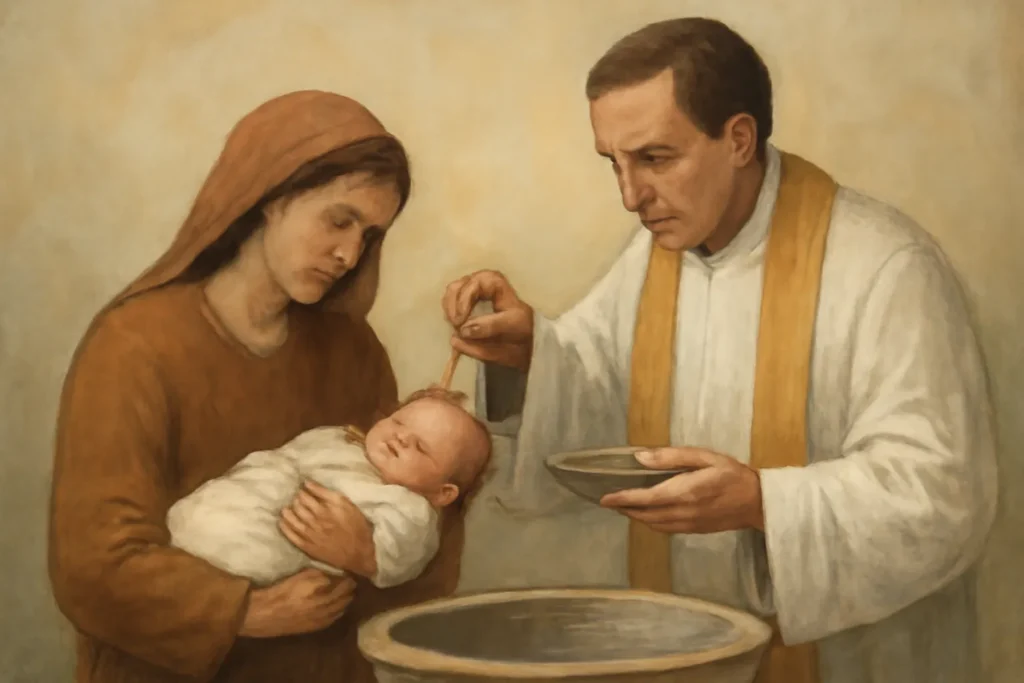
In an emergency baptism, the Church requires the proper matter (water) and the form (the words invoking the Trinity). The ritual may be performed in a simple, direct way to suit the circumstances. The primary objective is to effect the sacrament with the right intention and to ensure that the physical action of water over the person’s head or body is allowed, even if the environment is not ideal.
Matter: Water. It can be poured over the head (affusion) or a brief immersion, according to what is practically possible in the moment.
Form: The invocation of the Holy Trinity, most commonly expressed as, “N., I baptize you in the name of the Father, and of the Son, and of the Holy Spirit.” The exact phrasing should reflect the intention to perform baptism as the Church does.
Minister: In danger of death, the baptism may be administered by anyone who has the requisite intention to do what the Church does. A priest or deacon can perform the rite, but a layperson may do so in urgent circumstances.
In practice, nuns, hospital chaplains, parents, guardians, or rescuers may perform an emergency baptism. The important thing is the correct intent and the use of water and the correct form. If possible, the baptism should be witnessed by someone who can later confirm the event to the parish or the pastor.
Variations you may hear include affusion during emergency baptism, immersion in danger of death, and bedside baptism. Each variation reflects the same core principle: sacramental grace can be conferred at the point of need, even when normal liturgical channels are unavailable.
Who can administer an emergency baptism?
The Church’s teaching gives clear guidance on this point. In the case of danger of death, anyone of good will with the proper intention can perform the baptism using water and the Trinitarian formula. This doctrine underscores the urgency of saving the soul while remaining faithful to the sacramental action.
Priest or deacon: The usual ministers, of course, can perform with canonical form and proper intention.
Catechists or laypeople: In emergency, a layperson who intends to do what the Church does may baptize. The key is the intent to do what the Church does and the accurate use of water and the baptismal formula.
Relatives or caregivers: Parents, guardians, or caregivers often find themselves in the position to administer an emergency baptism at home, in a hospital, or at the scene of an accident.
After an emergency baptism has been performed, the local parish or diocesan office should be informed as soon as feasible so that the sacrament can be documented and pastoral care provided—for example, to arrange for later receiving the sacrament of Confirmation and First Communion if applicable, and to provide spiritual guidance to the family.
What happens after an emergency baptism?
Once the Emergency Baptism has taken place, several practical and pastoral steps follow. The immediate grace conferred remains valid and operative, and the person is considered baptized within the Catholic Church. The subsequent pastoral plan depends on the recipient’s age, health, and circumstances.
Infants and children: The infant or child who has been baptized in an emergency should be brought to the parish as soon as possible for the normal pastoral follow-up, which often includes scheduling for the sacrament of Confirmation and First Holy Communion when appropriate and safe.
Adults and unbaptized persons: For adults who were baptized in an emergency, the Church would still guide them through the normal process if they were not previously catechized; in many cases, the emergency baptism is sufficient for entry into the Church, and they may proceed with further formation to receive the other sacraments in due course.
Community and family involvement: The parish can provide ongoing catechesis, spiritual care, and support for the family, helping the baptized person grow in faith and become integrated into a local Catholic community.
In some cases, especially when the recipient is capable of ongoing spiritual formation, a prudent pastoral plan will include preparation for the sacrament of Confirmation (for those baptized as infants or in urgent circumstances) and the reception of the Eucharist. This supports a full, ongoing initiation into Catholic life.
Practical steps for responding to an emergency baptism
When an urgent situation arises, time is critical. The following practical steps outline how to respond with fidelity and care, ensuring that the emergency baptism is carried out correctly and that the person’s spiritual life is protected and nurtured afterward.
Assess the situation quickly: Determine whether there is a danger of death or other pressing risk. If there is any doubt about whether the person should be baptized immediately, err on the side of performing the rite, as saving a soul takes precedence in an urgent moment.
Seek the necessary materials: Prepare clean water and a suitable container. If water is not readily available, any clean source of water that can be poured over the head will suffice, as long as it is intentional and solemn.
Use the correct form: With clear intent, recite, “N., I baptize you in the name of the Father, and of the Son, and of the Holy Spirit.” The name is the person’s name. Speak with calm and reverent tone, recognizing the seriousness of the moment.
Ensure proper intention: The person performing the rite should intend to do what the Church does in baptism. If an adult performs the rite, they should say it in their own words but with clear intent to imitate the Church’s action.
Record the act: If possible, someone should note the time and place, and identify witnesses who can later verify the baptism for the parish staff. Documentation ensures that the sacrament is recognized and that follow-up care can be arranged.
Arrange for pastoral follow-up: Contact a priest or parish as soon as feasible to confirm the baptism, complete missing pastoral elements if necessary, and plan for the candidate’s continued formation and the reception of other sacraments when appropriate.
Common scenarios and guidance
Different contexts require tailored guidance, yet the core principles remain the same. Here are some common situations and how they are approached in line with Catholic tradition.
Emergency baptism for a newborn in a hospital
Healthcare professionals or family members may perform the rite if the infant is in danger of death.
The matter is water, the form is the Triune invocation, and the intention is to do what the Church does.
Parents should communicate with their parish to arrange for post-emergency sacraments, reaffirmation of faith, and ongoing catechesis.
Emergency baptism in a home setting
In the absence of a church, a family member or caregiver can perform the baptism if necessary, using water and the proper formula.
After the emergency baptism, contact the local parish as soon as possible to document the sacrament and coordinate continuing faith formation for the baptized person.
Emergency baptism in a disaster zone or field hospital
In extreme circumstances, trained responders or chaplains may perform the rite with proper intention and form, using available water.
The priority is to preserve dignity, life, and spiritual well-being, while ensuring the sacrament is recognized within the Church.
Administrative and pastoral considerations
Beyond the immediate act, there are administrative and pastoral matters that help ensure the baptism is properly integrated into the life of the Church.
Notification to the parish: After an emergency baptism, inform the parish so that the baptism can be recorded and the family can receive follow-up pastoral care.
Documentation: The sacrament should be documented with the name of the baptized, the date, the location, and the witnesses if available.
Post-baptism catechesis: If the baptized person is a child or a new convert, arrange for catechesis and initiation into the sacraments of Confirmation and Eucharist as appropriate.
Pastoral sensitivity: It is essential to accompany the family with spiritual support, explaining the meaning of baptism and the path forward in the Catholic faith.
Some common questions arise around emergency baptism. Here are concise answers that reflect Catholic teaching and practical wisdom.
Can anyone baptize in an emergency? Yes, in danger of death, any person with the intention to perform what the Church does, and with the proper water and form, may baptize.
Does the presence of a priest always matter? While priests are the ordinary ministers, in urgent situations the sacrament remains valid without a priest as long as the essential elements are present and the intent is there.
What if the water is not readily available? Any clean water that can be poured over the head or used to baptize by immersion qualifies as the matter of baptism.
Is baptism enough if the person cannot profess faith? Yes. Baptism confers grace and incorporation into Christ and His Church; subsequent confirmation or faith confession complements this but is not a prerequisite for baptism in an emergency.
What about religious suspicion or confusion? The Church urges care and clarity in performing the rite, and afterward, pastoral guidance helps address beliefs, questions, and the journey of faith.
Practical checklists for caregivers and communities
To support churches, hospitals, and families, here are concise checklists that can be used in real emergencies or planning contexts.
Before an crisis: Learn the basic rite and the essential words; discuss emergency baptism with family and caregivers; keep contact information for the local parish handy.
During an crisis: Use clean water, perform the rite with earnest intention, and recite the baptismal formula clearly; record the event if possible and safe to do so.
After an crisis: Contact the parish promptly; arrange for catechesis and confirmation if applicable; ensure the family has spiritual support and resources.
In hospital settings: Hospitals often have chaplains who can assist with emergency baptism; if not, the family can call the local parish for guidance and documentation.
In disaster readiness contexts: Include emergency baptism as part of spiritual care planning; train volunteers in the ethical and liturgical basics so they can respond properly if needed.
Respect for dignity and pastoral care
Emergency baptism, while a powerful sacramental act, is also a moment of pastoral care. The Church asks that communities respond with respect, humility, and compassion. The goal is not simply to perform a rite, but to shepherd the person toward a fuller life of faith in Christ and communion with the Church. Families should be supported, faith formation should be offered, and the baptized person should be welcomed into the life and ministries of the parish.
Key terms and quick reference
For quick recall in urgent moments, these terms are useful:
A practical narrative of a typical emergency baptism scenario
Consider a hospital setting where a newborn is in critical condition. A nurse, aware of the Church’s allowance for emergency baptism, gathers a small amount of clean water and, with the mother's consent and in coordination with the hospital chaplain, proceeds with the rite: the water is poured gently over the infant's head, and the nurse recites, “N., I baptize you in the name of the Father, and of the Son, and of the Holy Spirit.” The nurse remains calm and prayerful, understanding the gravity of the moment. If the child survives, parish staff will be contacted to document the baptism, arrange for follow-up sacramental life, and provide spiritual support to the family. The infant is now a member of the Catholic Church and can receive the other sacraments when appropriate, including Confirmation and the Eucharist, at the right time and in coordination with the local diocese.
In another scenario, a parent at home finds their child in danger. The parent, with a steady voice and reverent demeanor, performs the same rite, ensuring the use of water and the correct words. A neighbor or relative then helps by contacting the local parish and arranging for formal confirmation and guidance on faith formation when the child is able to participate in catechesis. The emphasis remains on mercy, family solidarity, and the Church’s mission to bring souls into the fullness of Christ.
Conclusionless reflection: a concise synthesis
Emergency Baptism in Catholic tradition embodies a practical conviction: when life and salvation are at stake, the Church provides a clear and compassionate path. By recognizing that anyone with proper intent may perform the rite in danger of death, the Church safeguards the essential grace of baptism while inviting ongoing pastoral care. The mystery of the Trinity in the baptismal formula and the magnitude of water as the sacramental sign converge in urgent moments to transform fear into faith and fear of death into hope in Christ. In its most humane form, the emergency baptism is not merely a rule to be followed; it is a call to witness, to serve, and to shepherd every soul toward the fullness of the Catholic life.











Leave a Reply