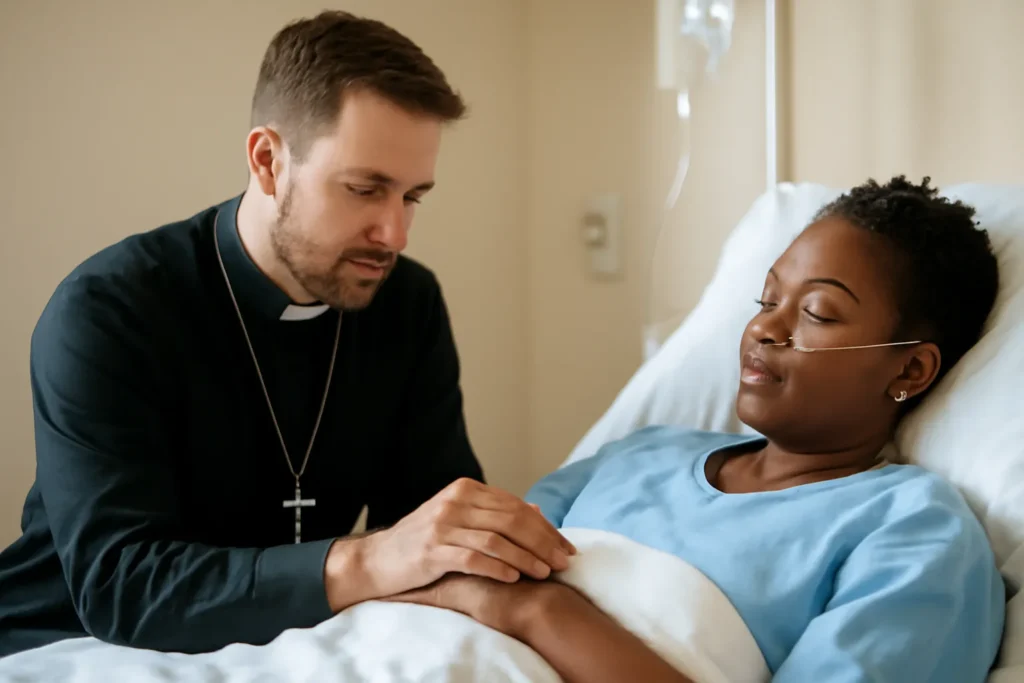
In modern healthcare, chaplains serve as spiritual care providers who accompany patients, families, and staff through the emotional and existential terrains of illness, injury, and loss. Their work goes beyond religious ritual; it centers on listening, presence, and the intentional offering of meaning-making and comfort in alignment with each patient’s beliefs and values. A chaplain’s practice is rooted in patient-centered care, cultural humility, and collaboration with medical teams to support holistic wellbeing.
Chaplains may come from a variety of faith traditions or from nonreligious humanist perspectives. Regardless of explicit creed, their core competencies include:
Active listening that validates fear, grief, hope, or uncertainty
Facilitating spiritual assessment to understand beliefs, practices, and needs
Offering options for prayer, ritual, or reflection that respect patient autonomy
Providing crisis intervention and end-of-life support
Collaborating with clinicians, nurses, social workers, and palliative teams to align care with values
Core goals of chaplain prayers in healthcare
When chaplains offer prayer or ritual in a hospital setting, the overarching aims are to provide comfort, reduce anxiety, and help patients feel seen and supported during a vulnerable time. The goals include:
Affirming the patient’s dignity and sense of control
Promoting inner peace and steadiness amid medical uncertainty
Bolstering hope in alignment with realistic medical possibilities
Encouraging meaning-making—helping patients articulate what matters most to them
Providing spiritual safety by honoring diverse beliefs and avoiding coercion
When and how chaplains pray for patients
Prayer and spiritual practices in healthcare are conducted with careful attention to consent, culture, and the patient’s or family’s wishes. Key practices include:
Consent first: Always ask if the patient would like prayer or a spiritual practice, and respect a patient’s decision to decline.
Private, respectful setting: Choose an appropriate space and time, ensuring confidentiality and dignity.
Tailoring to belief: Adapt language, structure, and ritual to fit the patient’s faith or preference, or opt for a secular approach if requested.
Interdisciplinary coordination: Communicate with the care team to avoid conflicting care plans and ensure sensitivity to medical obligations.
Family dynamics: Invite family members’ participation only if desired by the patient and with consent.
Chaplains often begin with a brief, respectful inquiry, such as: “Would you like me to offer a prayer, a moment of reflection, or a comforting reading?” If permission is granted, they proceed with an approach that fits the patient’s tradition, or with a neutral, inclusive practice for those of no specific faith.
Variations of chaplain prayers for patients
To meet diverse beliefs and values, chaplains may use a range of prayerful or reflective expressions. The following variations illustrate how chaplains can offer spiritual support while honoring pluralism. Each variation can be adapted for different contexts, languages, and comfort levels.
Christian prayer for healing
Sample Christian healing prayer:
“Gracious God, we ask for your healing presence to surround this beloved patient. Bring strength to the body, peace to the heart, and courage to face each new day. May your love sustain family and caregivers, and may your grace bring hope beyond what we can see. Amen.”
Variations may emphasize different biblical images, such as healing as a renewal of body or spirit, and may reference specific traditions within Christian practice. The core idea is a compassionate invocation that aligns with the patient’s faith commitments.
Jewish blessings and prayers
Sample Jewish blessing:
“May the One who blessed our ancestors Abraham, Isaac, and Jacob bless and heal this patient. May they grant strength, courage, and wisdom to the caregivers and hope to the family.”
Other options include reciting traditional psalms, reading from scriptures, or offering a quiet moment with the patient’s own prayers. The measure of efficacy lies in honoring sacred language and ritual while respecting patient autonomy.
Muslim supplication (dua) for healing
Sample dua:
“O Allah, Creator of all, grant healing and relief. Ease their pain, strengthen their heart, and grant patience to their loved ones. If healing is in Your decree, make it swift; if not, grant steadfastness and faith.”
In a hospital setting, a chaplain may use familiar phrases or offer the patient the option to recite their own duas or Arabic prayers, ensuring correct pronunciation and contextual familiarity.
Hindu prayers and blessings
Sample Hindu blessing:
“May the divine light illuminate your heart and guide you toward healing. May you have strength, clarity, and calm in body and mind.”
Hindu chaplains might also invite rituals such as lighting a lamp, sprinkling blessed water, or offering prayers from scriptures like the Bhagavad Gita or the Ramayana, provided the patient consents and identifies with these traditions.
“May all beings be free from suffering. May this patient know ease, safety, and peace. May those who care for them be patient and compassionate.”
Buddhist chaplains may guide a brief breath awareness or metta phrase meditation, emphasizing non-attachment to outcomes and acceptance of whatever arises in the moment.
“Namakku vandi, may the Lord grant healing and protection to this patient. May the family find courage and may the caregivers be blessed with wisdom and compassion.”
Sikh care emphasizes community, service (seva), and humility. Prayer may be offered in Punjabi or the patient’s preferred language, with respect for traditions around scripture reading and kirtan.
Indigenous and earth-centered approaches
Sample Indigenous blessing:
“May the land, ancestors, and spirits of place hold this patient in care. May the breath of life be steady, and may courage and community sustain them on this path.”
These practices may incorporate elements such as ritual cleansing, blessing with water or sage, or momentary silence in a respectful space, all tailored to the patient’s cultural context.
Secular and interfaith options
Nonreligious or interfaith blessings can be inclusive for patients who do not identify with a particular faith. Examples include:
A moment of silence for personal reflection and intention
A universal blessing focused on healing, comfort, and dignity
A short reading from universal values such as compassion, gratitude, and resilience
The emphasis is on universal human values, clarity, and consent, ensuring that those who are nonreligious or from diverse beliefs still receive respectful and meaningful care.
Interfaith and collaborative approaches
In some settings, chaplains coordinate with several faith leaders or with hospital-based multi-faith facilities to create a prayer or ritual plan that can be offered in a way that honors all participants. An interfaith approach might include:
Ethics, evidence, and best practices in spiritual care
Providing spiritual care in healthcare is guided by ethics, patient rights, and emerging evidence about its benefits. Key considerations include:
Autonomy and consent are non-negotiable; patients control whether and how spiritual care is offered.
Non-coercion ensures that care is offered without pressure to adopt beliefs or practices that are not aligned with the patient’s own values.
Cultural humility involves ongoing self-reflection, learning, and adaptation to diverse spiritual and cultural contexts.
Boundaries and safety protect both patients and chaplains, including professional boundaries and confidentiality.
Evidence for impact indicates associations with reduced distress, improved satisfaction with care, and enhanced sense of connection with staff and family, though outcomes vary by context and individual preference.
In practice, chaplains document spiritual assessments and the outcomes of interventions in a way that supports the overall care plan while respecting privacy laws and institutional policies.
Practical guidance for patients, families, and clinicians
All members of the care team can support meaningful spiritual care by approaching it with openness, respect, and clear communication. Consider these practical steps:
Ask early about spiritual needs as part of a holistic assessment, especially in admission or transition points.
Provide options for prayer, ritual, or silent reflection, and document preferences in the care plan.
Respect diversity by honoring different faiths, secular beliefs, and personal practices.
Invite chaplaincy involvement when patients express spiritual concerns, hope, fear, or questions about meaning.
Coordinate with families to ensure that loved ones feel welcome to participate (if desired by the patient).
Balance with clinical care to avoid delays or conflicts with medical treatment and to maintain patient safety.
For patients seeking spiritual support, a simple, direct request can help, such as, “Could you arrange a chaplain visit?” or “Would you be willing to offer a moment of prayer, or would you prefer a quiet space for reflection?” The goal is to honor the patient’s preferences while providing compassionate presence.
How healthcare teams integrate chaplaincy into care plans
Interdisciplinary teams collaborate to ensure spiritual care is accessible and meaningful. Key elements of integration include:
Referral pathways to chaplaincy through nurses, physicians, social workers, or palliative care teams
Documentation of spiritual history and care preferences in the medical record
Joint rounds or huddles that include spiritual care goals as part of the patient’s overall plan
Provision of resources such as quiet rooms, chaplain-led meditative spaces, or reading materials aligned with patient preferences
Training for staff on cultural competence and recognizing spiritual distress
Practical considerations for chaplains: professionalism and self-care
Chaplains operate within a demanding clinical environment. Maintaining professionalism and well-being is essential to provide consistent and effective support. Best practices include:
Clear boundaries between personal belief and patient care
Regular supervision and peer support to manage compassion fatigue
Continuous cultural humility training to serve diverse populations
Continual updates to clinical liaison skills and knowledge about hospital policies
Respect for privacy and confidentiality in all interactions
When chaplains practice with integrity and empathy, patients experience a sense of safety, and families feel valued and heard during difficult times.
Case examples and practical scenarios
Real-world scenarios illustrate how chaplain prayers and spiritual support can be integrated into care:
End-of-life planning: A patient facing terminal illness receives a compassionate, dignified moment of prayer or reflection tailored to beliefs, followed by clear information about care options and comfort measures.
Post-surgical recovery: A patient anxious about recovery receives a calming, secular breathing exercise with a brief, inclusive blessing that emphasizes hope and resilience.
Family distress: A family experiencing grief after a sudden loss is offered a ritual or reading that validates their emotions and honors cultural traditions.
Informed consent and choices: A patient who has questions about faith and healing receives responsive listening, resource sharing, and a plan that aligns with personal values.
Conclusion
Chaplain prayer for patients represents a compassionate facet of healthcare that recognizes the profound connection between spirituality and health. By offering diverse, respectful, and patient-centered spiritual care, chaplains support healing that encompasses body, mind, and spirit. The practice is most effective when it is voluntary, culturally sensitive, and integrated with the broader care team. Whether through a traditional prayer, a secular moment of reflection, or an interfaith blessing, the core aim remains the same: to accompany patients and families with presence, dignity, and hope, while affirming their autonomy and beliefs.









Leave a Reply