Religious Christian tattoos have long been a way for believers to carry their faith visibly on their skin. For many, a tattoo is more than decoration—it is a tangible reminder of values, a chronicle of personal testimony, and a symbolic invitation to reflection or repentance. In a world where messages can be fleeting, a thoughtfully chosen design can preserve a moment of salvation, grace, or devotion in a lasting form. This article explores the meaning, the designs, and the symbols commonly found in Christian tattoos, while also offering guidance on how to choose respectfully and intentionally.
The landscape of Christian ink is diverse. You will encounter minimalist linework and complex iconography, scriptural verses inked in careful calligraphy, and composite pieces that weave several motifs into a single narrative. Whether your goal is to commemorate a turning point, celebrate a favorite passage, or honor a patron saint, understanding the depth of each symbol helps ensure the design communicates what you intend.
What makes Christian tattoos meaningful
Tattoos rooted in the Christian tradition carry layers of theological significance, personal memory, and community resonance. Here are some core aspects often at play:
Personal testimony: A tattoo can narrate a journey—from doubt to faith, from suffering to healing, or from bondage to freedom through grace.
Symbols of grace: Many motifs express the idea that salvation is a gift, not a reward earned by works. Symbols like the cross or the dove frequently symbolize divine mercy and presence.
Remembrance and consecration: Some designs memorialize a baptism, confirmation, first communion, or a vow to follow Christ more closely.
Inspiration for daily life: A verse, image, or emblem can serve as a daily reminder to act with compassion, integrity, and faithfulness.
Shared language within faith communities: Tattoos can connect wearers to a broader Christian story—its icons, saints, and biblical imagery—while retaining personal meaning.
When choosing a Christian tattoo, many find it helpful to articulate the reason behind the design and to consider how it will be perceived in different contexts—family, church communities, workplaces, and public life. Thoughtful design choices help ensure the tattoo communicates reverence rather than sensationalism.
Common Christian symbols and their meanings
The Christian tradition offers a rich vocabulary of symbols, each with its own history and interpretation. Below are some of the most enduring motifs you will encounter in Christian tattoo art, along with notes on how designers and wearers often understand them.
Cross tattoos
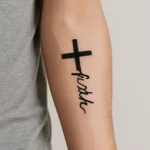
The Cross is the most recognizable symbol of Christianity. It functions at once as a reminder of sacrifice, redemption, and hope. There are many variantes:
Latin cross—the simple, vertical and horizontal bar form, widely used in Protestant and Catholic contexts.
Crucifix—the cross that includes the figure of Jesus, emphasizing the incarnation and sacrifice.
Orthodox cross—often with additional crossbars, reflecting Eastern Christian traditions.
Cross with symbolism—a cross combined with other motifs (dove, crown of thorns, nails) to deepen the narrative.
Cross tattoos can be rendered in clean line art, bold blackwork, delicate watercolor splashes, or shaded realism. They may stand alone or be integrated into larger scenes—landscapes, portraits, or Bible verses—so that the cross remains the anchor of the piece.
Ichthys (the Fish) and other early Christian symbols
The ichthys, or fish symbol, dates to the early church as a clandestine sign of faith and a shorthand for the phrase “Jesus Christ, Son of God, Savior.” In tattoo form, it often appears as a simple silhouette or integrated into more elaborate compositions with waves, anchors, or Greek letters. Other early symbols you might see:
Chi-Rho (XP)—an ancient monogram combining the Greek letters chi and rho, representing Christ.
Alpha and Omega—the first and last letters of the Greek alphabet, signifying God’s eternal nature.
The Lamb—a reference to Christ as the Lamb of God, often depicted with a banner or flag.
These emblems connect wearers with the broad sweep of Christian history, from the apostolic era to the present day. The choice to include them can signal a fidelity to foundational beliefs or a preference for traditional iconography.
Dove and the Holy Spirit
The dove is a common representation of the Holy Spirit, peace, and divine guidance. A dove tattoo may be paired with a flame or an olive branch to evoke the Spirit’s presence at baptism or in the believer’s daily life. Styles range from soft watercolor doves to geometric, minimalist outlines that emphasize form over shading.
Agnus Dei (Lamb of God)
The Lamb of God imagery recalls Jesus’s sacrificial role in Christian theology. It’s often depicted with a banner that bears the motto “Agnus Dei” or with a shepherd’s staff. In tattoo art, it may symbolize innocence and redemption or the triumph of grace over sin.
For Catholic and some Anglican traditions, rosary beads are a meaningful devotional symbol. Tattoos may show a string of beads with a crucifix, sometimes arranged in a circular motif around a chest or upper arm, or embedded into other designs. Marian symbols—such as the Virgin’s veil, a sacred heart with a crown of roses, or the Immaculate Heart—are used by some believers to honor Mary’s role in salvation history.
Saints and apostolic figures
Portraits or emblems of canonical saints, such as St. Francis, St. Peter, or St. Teresa, can communicate particular gifts, virtues, or life stories relevant to the wearer. Saints can act as patrons or role models—those who inspire charity, courage, or humility in daily life.
Other symbols and motifs
Beyond the canonical signs, Christian tattoo art often blends motifs to reflect personal theology:
Alpha and Omega with a circle or ring, symbolizing eternity within a wearable frame.
Crown of thorns as a reminder of sacrifice and the cost of discipleship.
Tree of life representing growth, vitality, and the connectivity of all creation under God.
Anchor as a symbol of hope and steadfastness in faith.
Roses and lilies—often used to convey purity, beauty, and the sweetness of grace.
Words, verses, and typography in Christian tattoos
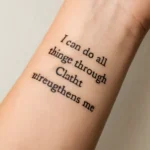
For many wearers, the script is as important as the imagery. Bible verses, prayers, or personal mantras can be inked in a script that reflects the tone of the message—bold and modern, elegant and cursive, or compact and geometric. When choosing text, consider not only the translation but also the length, legibility, and how the words will age with you.
Popular inked passages include short phrases like "I am with you always", "Faith, hope, love", or longer verses such as John 3:16 (often abbreviated as “for God so loved the world…”) and Psalm 23. Some people select a single word with profound resonance, such as grace, mercy, redeemed, or salvation.
When text is used, it is wise to:
Choose a legible font style that remains readable over time.
Consider the language and translation to avoid misinterpretation.
Keep the verse’s context in mind; ensure the chosen text reflects your faith journey accurately.
Work with a tattoo artist who specializes in script to prevent blurring and distortion.
Text can stand alone or be paired with images. For example, a verse might be placed alongside a cross silhouette, or a single word could be integrated into a ribbon that winds around a dove or an anchor.
Design styles and how Christian symbols are rendered
The stylistic approach you choose affects how the symbolism reads at a glance as well as how it ages. Here are several design families you’ll likely encounter in Christian tattoo art:
Traditional/Old School—bold lines, solid black shading, bright colors, and iconic shapes that age well with appropriate care.
Realistic/Portrait—lifelike renderings of saints, biblical scenes, or symbolic figures; requires skilled shading and detail work.
Minimalist/Linework—clean, delicate lines, often monochrome; suited for subtle, everyday wear and thoughtful symbolism.
Blackwork—dense, black ink patterns that emphasize form and contrast; can include cross-hatching and negative space.
Neo-traditional—a modern twist on traditional imagery, with richer shading and more nuanced color palettes.
Geometric/Abstract—shapes and symmetry arranged to suggest sacred geometry, emphasizing order and harmony.
Watercolor—soft color washes that can evoke ethereal light, halos, or a sense of spiritual movement.
The symbolism can be enhanced or tempered by the style. For instance, a dove painted in watercolor may feel more radiant and spiritual, while a cross in blackwork can communicate solemnity and resilience.
Placement, size, and how design choices affect meaning
Where a tattoo sits on the body and how large it is can influence how it is perceived by others and how personal the piece remains. Here are common considerations some people weigh when planning a Christian tattoo:
Visibility: Visible placements (hands, forearms, neck) communicate openness about faith and can serve as ongoing testimony, but may affect workplace norms or social environments. Private placements (chest, back, ribs) can feel more intimate.
Scale: A small, discreet emblem (a tiny cross or fish) can be a subtle reminder of faith; larger compositions allow for more storytelling through accompanying symbols and verses.
Integration: Larger pieces often weave several motifs—cross with waves, text along a banner, or a saint’s figure accompanied by script—into a cohesive narrative that reflects a complex personal journey.
Health and aging considerations: The visibility of aging skin, sun exposure, and weight fluctuations can influence how a tattoo holds up over time. A design with strong outlines and sufficient negative space tends to retain legibility longer.
Planning a Christian tattoo: steps to thoughtful decision-making
If you are considering a religious tattoo, a careful planning process helps ensure the outcome aligns with your beliefs and life story. Here is a practical approach:
Clarify your motivation: What do you want the tattoo to symbolize? Is it a personal conversion story, a memorial, or a commitment to live differently?
Choose motifs intentionally: Start with one or two core symbols and consider how they relate to one another. Be ready to explain your choices to a trusted confidant or spiritual mentor.
Research meanings: Read about the symbolism of potential motifs from credible sources or consult with a pastor, priest, or theologian to ensure alignment with your tradition's interpretation.
Select a reputable artist: Look for portfolios that demonstrate skill in the desired style and a respectful attitude toward religious themes. Ask about aftercare, healing times, and policy on corrections or cover-ups if needed.
Discuss placement and size: Talk through practical considerations with the artist, including how the design will age, how it will look in different clothing, and whether you want future expansions.
Plan for care and longevity: Tattoo longevity depends on sun exposure, skin type, and aftercare. Establish a routine that preserves line clarity and color vibrancy over the years.
A thoughtful approach can prevent regrets and help ensure the piece remains a source of encouragement and reverence through different seasons of life.
Ethical, spiritual, and cultural considerations
Tattoos intersect with personal belief systems, religious communities, and cultural contexts. It is wise to consider several dimensions:
Respect for tradition: Some traditions reserve certain imagery for liturgical contexts or sacred spaces. If you belong to a specific denomination, you may want to consult with your faith community about any guidelines or sensitivities around certain symbols.
Intent and humility: Wearing a religious symbol can be a way to witness or to remind oneself of a higher calling. Framing the tattoo as a sign of humility rather than a declaration of superiority often leads to more constructive reception.
Workplace and community norms: In some settings, visible religious tattoos may raise questions or be subject to policy. Consider how you will respond and how you want your faith to be represented.
Artistic integrity: Choose symbols that you understand and can explain with honesty. Avoid stereotypes or misrepresentations of sacred imagery for the sake of trendiness.
Reflections on imagery: Some symbols have deep ecumenical significance; others are more devotional or regional. A design that honors tradition while remaining accessible to a broader audience can be a thoughtful choice.
Care, maintenance, and longevity of Christian tattoos
A tattoo’s life is shaped by how well it is cared for and how it ages. Christian ink deserves particular attention to maintain legibility and meaning over decades.
Initial healing: Follow your artist’s aftercare instructions, which typically include washing with mild soap, keeping the area moisturized, and avoiding sun exposure, soaking, or picking at scabs during healing.
Sun protection: UV exposure can fade inks and blur lines. Use broad-spectrum sunscreen on exposed tattoos once the skin is fully healed, and consider long sleeves or shade in bright sun.
Color maintenance: Bold colors may fade differently than black ink. Periodic touch-ups can help preserve the intended vibrancy of a watercolor or neotraditional piece.
Style preservation: Fine lines may blur more quickly on some skin types. If you notice blurring or loss of detail, consult your artist about a touch-up plan that respects the original design.
Respectful display: If a piece is deeply sacred to you, ensure its presentation remains dignified in communal contexts through thoughtful sizing and placement.
Religious and cultural sensitivity: navigating diverse contexts
The global Christian tradition spans many cultures and languages. When choosing a Christian tattoo, you may encounter variations in symbolism and iconography across different contexts:
Ecumenical resonance: Some symbols—such as the cross, the dove, or Alpha and Omega—have broad ecumenical appeal and are widely recognized across denominations.
Regional symbolism: Local saints, Marian symbols, or biblical motifs can hold unique significance in a given culture or parish community. If you are connected to a regional tradition, you might incorporate motifs that reflect that heritage while staying faithful to core beliefs.
Avoiding misrepresentation: Not every image associated with Christian art functions the same way in every tradition. Take care to learn what a motif means in your own tradition to avoid misinterpretation.
Frequently asked questions about Christian tattoos
Here are concise answers to common questions people ask when considering religious Christian tattoos:
Are Christian tattoos approved by churches? Opinions vary by denomination and local congregation. It is best to consult with your pastor or faith leader if you are unsure about the reception in your community.
Will a tattoo interfere with sacraments or religious rites? Most Christian rites do not preclude tattoos, but some churches have guidelines or expectations about modesty and symbolism. Always consider how your design aligns with your spiritual commitments.
What about offspring and future changes in belief? Tattoos are permanent, and beliefs can evolve. If there is a risk you might disassociate from the symbolism, choose motifs with timeless significance or ensure you are comfortable explaining the meaning to future generations.
How do I choose the right artist? Look for artists who respect sacred imagery, have experience with fine line work or the chosen style, and who practice clean, professional safety standards. Request to see consent forms, aftercare guidelines, and a portfolio of related work.
Can tattoos be removed or covered if I later change my mind? yes, but removal and cover-up can be costly and physically challenging. If you anticipate possible changes in belief or context, discuss future-proof design options and potential cover-up plans with the artist.
Conclusion: embracing faith, art, and conscience in Christian tattooing
A Christian tattoo offers a bridge between spiritual life and everyday living. It is a visible confession, a private vow, and a reminder of grace that endures through time. Whether you are drawn to a solitary symbol, a verse you treasure, or a sweeping composition that tells a broader story, the most meaningful tattoos are those that deepen faith, inspire compassion, and honor the sacred expectations you hold for yourself and your community.
In the end, a careful, respectful approach—paired with thoughtful contemplation of symbolism, placement, and style—helps ensure that your religious Christian tattoo remains a source of blessing rather than controversy. It becomes not only a piece of body art but a living reminder of the faith you profess, the grace you receive, and the life you strive to live in light of enduring truths.








Leave a Reply