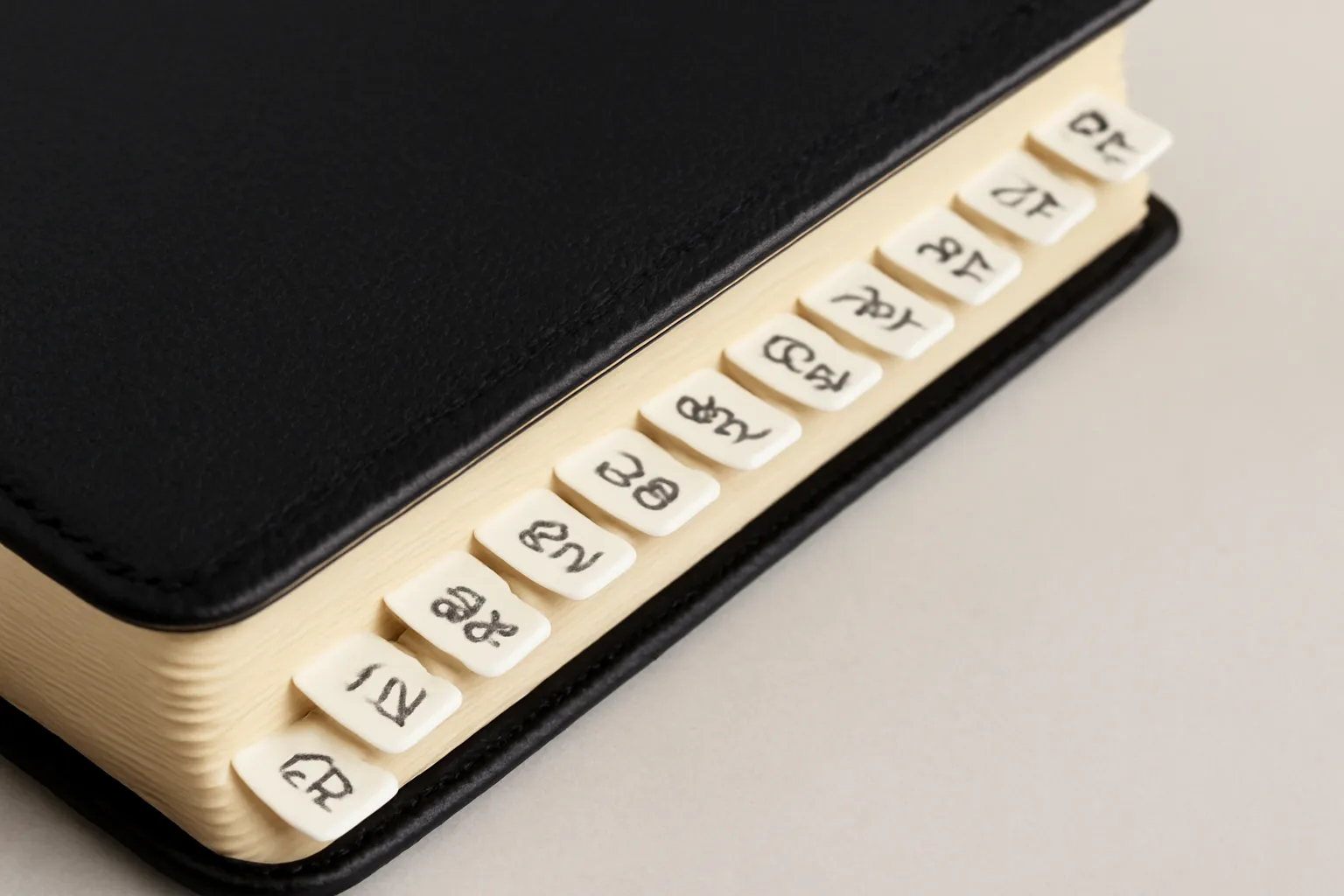
If you study, teach, or preach from the Bible regularly, you know that bible indexing tabs can dramatically improve how quickly you find passages, how neatly your reference material stays organized, and how durable your study setup remains over time. The goal of bible indexing tabs is simple: to create a fast, reliable system that helps you navigate the Bible’s books, chapters, and sections without fumbling at the margins or losing your place. In this article, you’ll discover how to organize your Bible with durable tabs, explore different materials and labeling strategies, learn best practices for installation and maintenance, and consider how to integrate physical indexing with digital study tools. By the end, you’ll have a practical blueprint for a tab system that suits your Bible size, study style, and environment—whether you’re in a classroom, onto the pulpit, or on the go.
The idea behind bible indexing tabs extends beyond mere labels. A well-chosen tab system can reduce cognitive load, increase reading flow, and protect the pages from wear. Durable tabs are particularly important for frequent use, shared study environments, or travel Bibles where edges, covers, and bindings face more handling. This article emphasizes durable tab design, color-coded schemes, and practical installation tips—so you can customize a system that lasts for years without losing readability or accuracy.
What are Bible indexing tabs?
At its core, bible indexing tabs are small, labeled indicators attached to or integrated with the pages of a Bible to help you locate sections quickly. They come in various formats, including self-adhesive stickers, vinyl or Mylar lift-tabs, and reusable index strips that can sit along the edge of the pages. Some systems focus on the entire order of the books (from Genesis to Revelation), while others emphasize grouping by testament, section, or literary category.
The primary benefits of bible indexing tabs are threefold: speed (you reach the desired book in seconds), satisfaction (a tidy, uniform look), and longevity (well-made tabs resist tearing, smudging, and peeling). For many readers, a well-implemented tab system becomes a kind of cockpit for Bible study, helping the reader move with momentum through complex passages, cross-references, and sermon preparation.
Variations in naming and approach
People use a range of terms and approaches when talking about bible indexing tabs, which reflects different study goals and Bible formats. Here are common variations you may encounter:
Bible tab index sets or Bible tab sets—complete collections designed for a particular Bible size or version.
Reference tabs or indexing tabs—emphasizing quick access to passages and cross-references.
Book tabs or book-name tabs—labeling each book for direct navigation.
Old Testament / New Testament tabs—labeling schemes that separate the two testaments explicitly.
Section tabs—color-coded or labeled to indicate divisions like the Pentateuch, Historical Books, Poetry/Writings, Wisdom Literature, Major Prophets, Minor Prophets, Gospels, Epistles, and Revelation.
Labeling variants—full book names (Genesis, Exodus, …) vs. common abbreviations (Gen, Exod, Lev, …) depending on space and reader preference.
Each approach serves a slightly different use case. If you often preach or teach from a single book, a compact tab system that highlights the books you use most can be ideal. If you study the entire Bible in-depth, a broader system with sub-divisions like “Gospels,” “Epistles,” and “Prophets” can reduce search times across multiple sections. Regardless of the variant, the core idea remains the same: clear labeling, stable placement, and readable typography.
In practice, you may combine variations. For example, some tab sets use full book names on the outer edge while using color-coded ribbons or smaller secondary labels for major sections (e.g., Genesis–Isaiah as OT and Matthew–Revelation as NT). The best system aligns with your preferred reading order, your Bible’s size and binding, and how you typically navigate the text during study or teaching.
The choice of durable tabs is not lights-out aesthetics; it directly affects your study workflow and the lifespan of your Bible. Here are key reasons to prioritize durability:
Resistance to wear: Tabs take repeated contact with fingers, turning pages, and occasional moisture. Durable materials reduce wear and tear at tab edges.
Adhesive longevity: Strong, stable adhesives keep tabs affixed over time, avoiding peeling and loose corners that hinder readability.
Colorfastness: Durable dyes and finishes resist fading from light exposure, oil from fingers, or cleaning attempts.
Tear resistance: Reinforced tab materials withstand bending at the corner of pages, especially in thinner or flex-binder Bibles.
Readability: High-contrast typography and clear labeling maintain legibility as the tabs age.
When durability is your goal, you’ll typically see tabs made from vinyl, Mylar, or laminated paper with strong acrylic or silicone-based adhesives. Each material has trade-offs in flexibility, removal impact, and cost. The key is to pick a system designed for frequent handling and the particular Bible you own.
Materials used for durable tabs
Vinyl and Mylar tabs
Vinyl tabs are common because they are flexible, durable, and resistant to tearing. They lie flat along the page edge and resist curling. Mylar (a polyester film) tabs offer exceptional strength and clarity, often used in higher-end tab sets. Both materials work well on regular paper pages and on coated or glossy pages, though you should confirm compatibility with your Bible’s page finish.
Laminated paper and coated options
Laminated paper tabs combine a paper core with a clear laminate layer to protect printed text, prevent ink transfer, and extend tab life. They tend to be thinner and lighter than vinyl or Mylar, which can be advantageous for thin-margin pages or tight binders. Coated options reduce smudging and make labels more legible over time.
Tyvek and fabric-backed tabs
For heavy-use environments, Tyvek-based tabs or fabric-backed systems offer exceptional durability and resistance to moisture. They can be slightly stiffer, so consider how they interact with your Bible’s binding, especially if it’s a compact or medium-size edition.
Adhesive choices
The longevity of tabs largely depends on the adhesive you choose. Common options include:
Acrylic adhesives—strong, long-lasting, and generally kid-glove on most paper pages.
Permanent pressure-sensitive adhesives—great for single-bible sets that won’t be relocated often.
Removable or repositionable adhesives—useful for trial arrangements or rental Bibles but may wear faster over time.
When installing, test a small area first if your tabs use a stronger adhesive, so you avoid damaging the page surface or leaving residue.
Design and labeling strategies
Effective design and labeling are as important as material choice. The goal is readability, fast recognition, and minimal interference with the Bible’s text. Here are practical strategies you can adopt.
Abbreviations vs. full names
Decide early whether to print full book names or common abbreviations. Full names (Genesis, Exodus, Leviticus, …) are unmistakable but take more space. Abbreviations (Gen, Exod, Lev, …) save space and can reduce clutter on the tab edge, but require a moment of recognition. A common compromise is to use full names on the first page of the section or on a dedicated index page, while tabs use abbreviations for space efficiency.
Grouping by testament vs. by literary style
Some systems label tabs to emphasize structure:
OT vs NT separation for quick top-level navigation.
Ordering by canonical sequence vs. study priority (e.g., marking daily reading paths).
Cross-references and secondary labeling
Some tab systems include a tiny secondary label or color cue indicating cross-reference clusters or related themes. For instance, a tab might carry a tiny symbol or color to indicate a linkage to a favorite set of verses or a study outline.
Color coding and organization
Color coding is one of the most intuitive ways to speed navigation. A thoughtful color scheme can help you distinguish sections at a glance, especially in a large Bible or a teaching-ready edition. Here are common schemes and best practices.
Testament-based color codes: assign one color to the Old Testament and another to the New Testament.
Section-based color codes: use different colors for Law, History, Poetry, Wisdom, Prophets, Gospels, Epistles, and Revelation.
Color ramps for density: bolder colors for frequently referenced books and lighter colors for less-used sections.
Contrast and readability: ensure text on color labels remains legible in various lighting conditions; consider high-contrast combinations like dark text on light tabs or vice versa.
When choosing a color scheme, consider your typical use case. If you teach from multiple testaments in a single session, a clear OT/NT division plus a secondary color-coding for the major/ minor prophets or the Gospels can be especially helpful.
Installation methods and tips
There are two broad families of tab systems: self-adhesive tabs and insertable or removable tabs. Each has its own setup steps, advantages, and caveats.
Installing self-adhesive tabs
Clean the edge of the page to remove oils or dust that could reduce adhesion.
Lay out the tab order (Genesis through Revelation) on a flat surface to confirm alignment.
Peel back a small portion of the backing at one corner and align the tab with the page edge. Press along the edge to secure.
Proceed to the next tab, ensuring even spacing and consistent alignment with each edge of the page.
Check readability: confirm that all labels face outward and are not crumpled.
Using removable or reusable tabs
Place the tab at the desired position and gently press to engage the adhesive on a small area.
Test removal by lifting a corner; if residue forms, use a gentle adhesive remover or a wax-free cloth to clean.
Reposition tabs as needed until you achieve a clean, orderly edge.
For covers or thin pages, avoid over-sticking to prevent page damage; consider using a slim, low-profile tab.
Tips for alignment and durability
Use a ruler or a straightedge to keep tabs in straight, even rows for a professional look.
Lay out the tabs before applying them to confirm order and spacing.
Consider taping thin protective edges along the very outermost edge of the pages to guard against tearing in high-use Bibles.
Maintenance and longevity
A well-designed tab system can last for years, but maintenance is a key part of longevity. Here are practical steps to extend the life of your bible indexing tabs.
Regular inspection: check for peeling edges, fading labels, or residue buildup. Address issues early before they affect readability.
Clean handling: avoid rough cleaning with abrasive materials that might scratch the tab surface or remove ink.
Replacement strategy: keep spare tabs on hand for areas that wear faster (e.g., front and back edges, commonly referenced sections).
Environmental care: store your Bible away from extreme heat, humidity, and direct sun to minimize adhesive failure and color fading.
If you use a reusable tab system, you can cycle through newer color schemes or font styles without permanently altering your Bible. For long-term use, pair durable materials with stable adhesives to reduce the need for frequent replacements.
Digital complements and hybrid systems
While bible indexing tabs are a physical navigation aid, many readers benefit from a hybrid approach that includes digital tools. Here are several integration ideas:
Digital cross-references: maintain a separate digital index that mirrors your physical tabs, providing quick lookup via search while you scroll through the text.
Study notes integration: keep notes linked to specific tabs (e.g., a color-coded pop-up in a digital Bible app that corresponds to a physical tab’s section).
Printable index sheets: create printable pages that list which tab color corresponds to which book or section, then place the sheet in a ring binder or beside the Bible for quick reference.
Hybrid study plans: combine a tab-based reading plan with a digital tracker to monitor progress across Old and New Testament sections.
Even if you primarily study with a physical Bible, these hybrid approaches can enhance accountability, consistency, and accessibility across environments—classrooms, libraries, and home study rooms.
Case studies and use scenarios
Different readers have distinct needs when it comes to indexing tabs. Here are a few representative scenarios and how a tab system can best serve them.
Pastor or preacher: a durable tab system that highlights the Gospel books and the major prophetic books helps reduce search time during sermons or to quickly pull references during preparation.
Graduate student or academic: a color-coded, section-based indexing plan (Law, History, Poetry, Prophets, Gospels, Epistles) supports structured, multi-volume reading plans and cross-text comparisons.
Children’s ministry or classroom: bright, high-contrast color tabs with large, legible print may aid younger readers and teachers in guiding discussion and activities.
Pastoral care or counseling: tabs that clearly separate Psalms, Prophets, and Wisdom literature can help locate comforting passages quickly in difficult conversations.
Travel or field work: compact Bibles with minimalist tab sets maximize portability while providing essential navigation cues for on-the-go study.
Choosing tabs for different Bible sizes and formats
Bibles come in a range of sizes, layouts, and bindings. The right bible indexing tabs must fit the page thickness, margin width, and the binding’s flexibility. Here are guidelines to help you select tabs according to your Bible format.
Compact or pocket Bibles: choose ultra-thin vinyl or laminated paper tabs with abbreviated book names to avoid crowding the margins.
Standard-sized Bibles: you have room for full book names or two-line labels; consider color-coding for quick visual recognition.
Large-print or study Bibles: you can use broader, bolder labels with longer color blocks and a dedicated index page for cross-references.
Text-only or minimalist editions: opt for subtle color cues and concise abbreviations to keep the typography clean while preserving utility.
Regardless of size, a key principle is to keep a consistent alignment along the edge. Misaligned tabs can be distracting and reduce speed, especially in dim lighting or when you are teaching from a podium.
Frequently asked questions
What is the best material for Bible tabs? There is no universal “best”—it depends on how often you handle the Bible, the page material, and the binding. For heavy daily use, many prefer vinyl or Mylar with a strong adhesive. For lighter use, laminated paper can be a cost-effective option.
Should I label with full names or abbreviations? Full names are more readable for beginners or in shared teaching spaces; abbreviations save space and can be faster once you’re familiar with them. Consider mixing both by using full names on the index page and abbreviations on the tabs.
Can tabs damage my Bible? If installed with care and using adhesives appropriate for paper, tabs should not damage pages. Avoid aggressive adhesives and ensure tabs are not pulling at the page corners.
How do I remove tabs without leaving residue? Use removable adhesives or carefully lift tabs at a small angle, then wipe away any adhesive residue with a gentle, non-abrasive cleaner or a specialized adhesive remover designed for paper.
Is it worth combining tabs with digital study tools? Yes. A well-integrated system—physical tabs for quick navigation and digital notes for deeper cross-referencing—can significantly improve study flow and retention.
Practical examples and ready-to-use ideas
If you’re unsure where to start, here are concrete, ready-to-use ideas you can adopt or adapt to your preferences.
Classic two-toned OT/NT system: use a warm color for the Old Testament and a cool color for the New Testament, with bold white or black text for book names.
Section-focused tabs: assign distinct colors to Torah, Historical Books, Wisdom, Prophets, Gospels, and Epistles. Include a small secondary label on the tab edge for quick recognition (e.g., “Gospels”).
Minimalist single-language setup: in a single-language Bible, use concise abbreviations on tabs and a central index page with full names for clarity.
Teach-ready multi-color system: create a color palette aligned with sermon topics (e.g., blue for promises, red for law, green for wisdom) to support themed study sessions.
A well-chosen bible indexing tab system is a practical investment in your study and teaching toolkit. By prioritizing durable materials, thoughtful labeling, and coherent color coding, you create a navigational framework that supports focus, recall, and confidence when you open the Bible. Whether you prefer traditional, text-forward tabs or contemporary, color-rich designs, the best approach is the one that fits your Bible size, your study routine, and your teaching needs—without obstructing the text or slowing you down.
As you consider a tab system, remember that the ultimate aim is ease of use, clarity, and longevity. With the right combination of materials, labeling strategy, and maintenance plan, your bible indexing tabs can become a trusted companion in every study session, sermon prep, and quiet time.

 Por Laura Jara