Introduction: Why the verse matters in everyday life
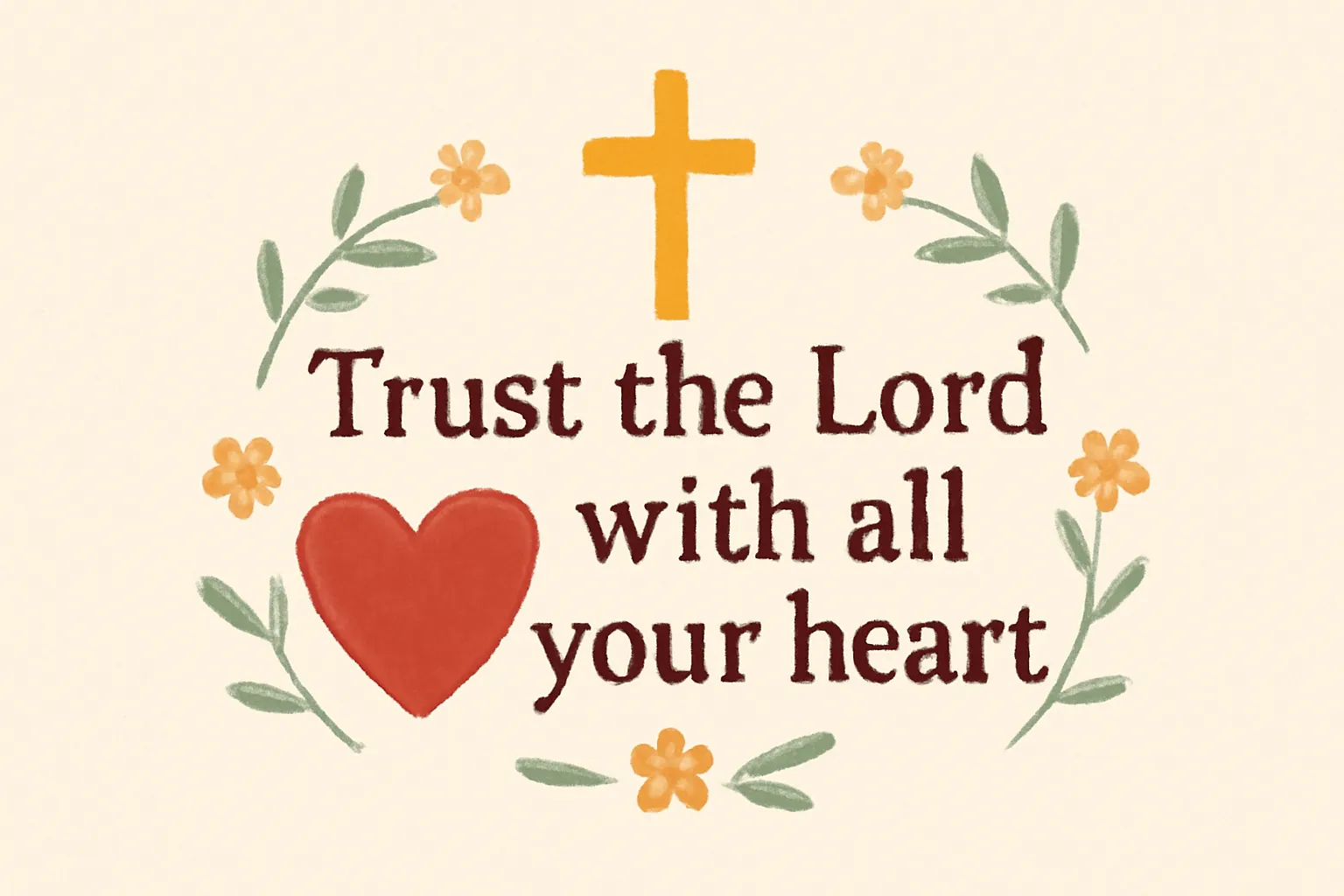
The verse often summarized as “Trust in the Lord with all your heart” sits at a crossroads of faith, wisdom, and everyday decision making. It invites readers to reframe dependence—not as a sign of weakness or passivity, but as a posture of wholehearted reliance on the divine vastly larger than any single moment of doubt or anxiety. In many Christian traditions, this guidance is not a one-time decision but a lifelong practice: to tilt the heart toward God, to invite divine wisdom into ordinary choices, and to resist the pull of self-reliance when circumstances demand steadiness beyond human strength.
In this article, we explore the breadth and depth of this beloved Bible verse, its literary and historical context, how its core ideas are expressed across translations, and practical ways to live out its call day by day. We will consider not only the direct command to trust but also the companion phrases that refine how we trust: to avoid leaning on our own understanding, to acknowledge God in all our ways, and to expect direction for our paths. Through a mix of interpretation, historical background, and concrete steps, readers can gain a richer understanding of what it means to cast the entire weight of the heart on the trustworthy God.
Origins, context, and core message
The sentence often quoted as “Trust in the Lord with all your heart” comes from a cluster of instructions in the Book of Proverbs, a collection of ancient Hebrew wisdom literature. In most Bible translations, the fuller part of the sentence runs something like: “Trust in the Lord with all your heart and lean not on your own understanding; in all your ways acknowledge him, and he will direct your paths.” The passage presents a practical theology: trust is not casual or partial; it is wholehearted and told in the context of daily life, decisions, and moral judgment.
From a literary standpoint, the word for heart in the original Hebrew signifies more than emotion alone. It encompasses the center of a person’s will, intention, discernment, and motivation. To trust with the heart, then, is to orient one’s entire inner life toward God, inviting God into motives as well as outcomes. The admonition to “lean not on your own understanding” warns against overreliance on human reason in isolation from divine wisdom, acknowledging the limits of human perspective when faced with complex circumstances.
Key phrases explained
Why “trust” is a bold choice
To trust in this biblical sense means more than mere belief. It implies confidence that God is good, reliable, and powerful enough to steer life in ways that honor the person trusting. Trust engages the heart, mind, will, and action. It is a posture that translates into patience in waiting, courage in uncertain times, and generosity toward others because the heart rests in God’s promises.
The force of a wholehearted heart
The phrase “with all your heart” emphasizes unity and coherence. A divided heart—one that trusts in God at moments and in self at others—may produce hesitation, inconsistency, or ambivalence. The wholehearted trust seeks alignment between intention and behavior. It invites an inner life where concerns—career, family, health, finances, and vocation—are understood through the lens of God’s character and purposes.
“Lean not on your own understanding”
This clause cautions that personal judgment is finite and often biased by fear, pride, or limited information. It does not condemn reasoning but invites humility: when we face decisions, we should seek God’s perspective as well as the best of human insight. It also points to the importance of humility in leadership, relationships, and spiritual formation.
To acknowledge God in all your ways means to recognize God’s presence and authority in every facet of life—work, family, worship, community, ethics, and even moments of rest. It is an invitation to see God as involved in the ordinary and the extraordinary, the mundane and the transformative. Acknowledgment is an active practice: through prayer, discernment, and obedience, a life becomes a continual conversation with the divine.
“He will direct your paths”
The promise that follows is not a guarantee of a pain-free life but a guarantee of divine guidance. When trust is genuine and the heart is sincere, God’s direction can provide clarity, steadiness, and hope in the midst of uncertainty. This direction may come through Scripture, wise counsel, circumstances, or peaceful inner conviction. The result is a life that moves with purpose rather than flounders in ambiguity.
Variations across translations and languages
The core idea of trusting God with the whole heart travels across translations, sometimes with subtle shifts in nuance. Below are representative variations that illuminate semantic breadth while preserving the essence of the message.
“Trust in the Lord with all your heart; do not lean on your own understanding.” (common English rendering; emphasizes active prohibition against overreliance on self.)
“Trust the LORD with all your heart and do not lean on your own insight.” (a variation that uses «insight» to capture the sense of personal comprehension.)
“Trust in the Lord with all your heart, and do not rely on your own understanding.” (reiterates reliance on human reasoning’s limits.)
“Put your trust in the Lord with all your heart; never lean on your own understanding.” (adds a tonal emphasis on decisiveness.)
“In all your ways acknowledge him, and he will make your paths straight.” (shorter catchphrase often cited in modern paraphrases; emphasizes direction and clarity.)
Across Scripture translations, other phrases reinforce the same idea in slightly different cadences:
“Trust in the Lord with all your innermost being.” (a more expansive sense of heart that includes will and motive.)
“Rely on God with every part of your heart.” (a more contemporary phrasing that stresses total reliance.)
“Acknowledge Him in all your ways.” (shorter but carries the same practical demand of life orientation.)
In some languages, the breadth of the metaphor stretches further to capture the relational nature of trust. In languages with a strong distinction between intellect and will, translators might translate as confidence of the heart or trust of the soul, underscoring that trust is not merely intellectual assent but a lived trust that reshapes choices.
Theological themes connected to the verse
Faith as a daily practice: The verse invites continuous, practical faith, not just occasional belief. Trust is exercised in daily decisions, conversations, and plans.
Humility before divine wisdom: By warning against relying solely on human understanding, the text foregrounds humility and teachability.
Divine guidance as a formative goal: The promise of direction highlights a God who cares about routes, not just destinations.
Integration of life values: Acknowledging God in all ways fosters alignment between worship and work, ethics and relationships.
Hope amid uncertainty: The passage offers reassurance that steadfast trust can sustain a person through ambiguity and trial.
Historical and literary context: wisdom literature and covenant faith
Proverbs belongs to the wisdom tradition of the Hebrew Bible, often presenting ethical instructions that assume a devout relationship with God rather than purely secular prudence. The counsel to trust in the Lord intertwines with covenant language: trust is part of a loyal relationship with God who acts in history to direct life toward righteousness and flourishing. In that sense, the verse functions not as an isolated proverb but as a hinge between practical ethics and theological trust—a call to live in the presence of God with integrity in every ordinary moment.
Practical applications: how to live out the verse in daily life
Turning a timeless principle into concrete daily practice involves small, repeatable habits. Here are practical ways to embody trusting the Lord with all your heart in real life.
Begin the day with a posture of trust. Start with a short prayer or reflection that places the day in God’s hands. Reaffirm the commitment to trust rather than control.
Invite God into decisions big and small. When facing choices, pause to ask, “What would honoring God look like in this moment?”
Seek godly counsel to supplement your understanding. While you should not lean solely on others, listening to trusted mentors helps you avoid blind spots and grow in discernment.
Practice acknowledgement in all your ways. Find ways to honor God in work, family, community, and personal time—through honesty, generosity, and patience.
Journal the journey of trust. Record moments when trusting God led to unexpected blessings or required perseverance. Reflection reinforces the habit over time.
Cultivate a calm heart in the face of anxiety. When worry rises, redirect attention to prayer, Scripture, or a trusted friend, choosing trust over fear in the moment.
These steps are not a formula for a problem-free life, but rather a transformation of how we approach life. Trust becomes a lens through which we interpret risk, success, failure, and uncertainty.
Stories and examples: trust lived out in communities
Across centuries and cultures, people have found that trust in God can shape decisions in times of famine, war, epidemic, or personal loss. Consider themes such as:
Individuals who faced a difficult career decision and chose a path aligned with wisdom and ethical integrity, even when it meant sacrifice in the short term.
Families who navigated financial hardship by practicing stewardship and daily dependence on God rather than fear-driven hoarding.
Church communities that leaned on collective discernment, prayer, and mutual accountability to navigate ethical dilemmas or leadership transitions.
Peers who offered practical support while modeling confidence that God’s guidance would unfold over time.
These stories underscore the dynamic tension between human planning and divine direction, highlighting how trust can sustain, at times requiring patience in the waiting and obedience in the moment.
Common questions and clarifications
There are several questions readers often have about this verse. Here are concise answers to help clarify intent and practice.
Does trusting in the Lord mean I shouldn’t plan? No. The invitation to trust does not cancel planning; rather, it invites planning under the awareness that ultimate direction belongs to God. Planning with prayerful dependence is a compassionate and wise approach.
How do I trust when I feel overwhelmed? Begin with small, reachable steps—prayer, breathing, seeking counsel, and repeating the reminder that God is present. Trust grows in the midst of honest steps toward God, even when emotions are unsettled.
What if my experience contradicts what I think God wants? Discerning God’s will often requires time, community, and humility. It’s wise to seek clarity, test motives, and be willing to adjust course while remaining committed to integrity and faith.
How does this verse relate to spiritual growth? Trust is a cornerstone of spiritual growth. It opens space for wisdom to take root, humility to deepen, and character to mature as one learns to depend on God through varied life seasons.
Is trust in God compatible with doubt? Yes. Doubt can be a doorway to deeper trust when it leads you to seek God more earnestly and to rely on God’s promises rather than solely on your own understanding.
Prayer and meditation practices to reinforce trust
Prayer is a powerful practice to cultivate trust in daily life. Here are several approaches you can adopt, individually or with a group.
Breath prayer: Inhale with a simple acknowledgment of God’s presence, exhale with a release of control. For example, breathe in: “Lord, you are with me,” breath out: “I trust you.”
Scripture reflection: Read a portion of Proverbs 3:5-6 and paraphrase it in your own words. Journal what trusting “with all your heart” looks like in concrete situations today.
Prayer of surrender: A short, honest prayer that names areas of life where trust is being tested and invites God’s guidance and peace.
Journaling prompts: Write about a time when trusting God changed an outcome, what you learned, and how you can apply it to future decisions.
Community reflection: Gather with others to share stories of trust, prayers for direction, and practical steps for living out the verse together.
The goal of these practices is not to force certainty but to cultivate a relationship in which trust grows as your heart encounters God’s faithfulness over time.
Contemporary implications: trust in a changing world
Living out a verse that calls for wholehearted trust is particularly relevant in an era of rapid change, uncertainty, and abundant information. In such a world:
Trust in the Lord can offer a stabilizing frame for decision making when data conflict or opinions diverge.
Wholehearted trust invites us to examine what we place at the center of our lives—career success, social status, or the comfort of routine—and to reorient toward God’s purposes.
Humility before human understanding helps us avoid overconfidence and fosters collaborative discernment across communities and cultures.
Daily acknowledgment keeps faith integrated into work ethics, family life, and public life, ensuring that spiritual commitments inform social responsibilities.
Direction for paths becomes a hopeful anchor when faced with decisions about health, education, or moral challenges, even if the path is not immediately clear.
Different Christian traditions emphasize various aspects of the verse, yet the core invitation remains to rely on God with a sincere heart. Some traditions highlight obedience as the natural outgrowth of trust, while others stress relational trust as the basis for social justice and compassion. Regardless of emphasis, the verse offers a shared framework: trust God, resist shallow confidence in self, acknowledge God in every domain of life, and anticipate God’s guidance. This shared framework can foster conversations across generations and denominations about character formation, ethical living, and vocation.
Additional biblical cross-references for broader understanding
To deepen understanding, consider how the themes in this verse echo throughout Scripture. Several passages illuminate related ideas:
Psalm 37:5—“Commit your way to the Lord; trust in him, and he will act.”
Jeremiah 17:7-8—“Blessed is the one who trusts in the Lord… he is like a tree planted by water.”
Isaiah 26:3—“You keep him in perfect peace whose mind is stayed on you.”
James 1:5-6—Trusting God in the midst of trials and seeking wisdom from above.
Proverbs 16:3—“Commit your work to the Lord, and your plans will be established.”
Together, these references help readers form a broader biblical worldview: trust in God is foundational to wisdom, peace, and rightly ordered life.
Closing reflections: cultivating a lifelong posture of trust
Trust in the Lord with all your heart is not merely a slogan; it is a compass for life. It invites believers to align their inner dispositions with God’s character, integrate faith into every sphere of life, and pursue wisdom that leads to flourishing for themselves and for others. When readers practice wholehearted trust, they learn to navigate uncertainty with patience, to welcome guidance when it comes, and to remain hopeful even when outcomes are not yet visible.
As you continue to explore this verse, consider turning its invitation into a personal practice: choose a specific daily habit that embodies wholehearted trust. It might be a morning reminder to acknowledge God, an evening reflection on how you leaned on God rather than your own understanding, or a weekly gesture of service to someone in need as a tangible expression of trust. The growth is incremental, and with time, the heart learns to trust more deeply, not because circumstances always align with our plans, but because God’s faithfulness offers a reliable horizon.
In summary, the enduring message remains clear: trust the Lord with all your heart, resist leaning on your own understanding, acknowledge Him in all your ways, and watch for the direction He supplies for your life. This journey—rooted in wisdom, sustained by prayer, and enacted in daily choices—transforms both the person and the path they walk.

 Por Laura Jara