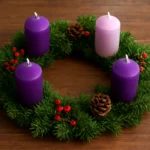
The Advent candle wreath is a circular evergreen arrangement that serves as a visual and liturgical countdown to Christmas. It is not merely decorative; it functions as a symbolic calendar that marks the passing weeks of Advent, the season of preparation for the birth of Jesus. In its most familiar form, the wreath holds four candles, each representing a specific theme that unfolds on successive Sundays. Some traditions add a fifth candle, the Christ candle, placed at the center to be lit on Christmas Eve or Christmas Day. Whether used in homes, churches, classrooms, or community spaces, the Advent wreath embodies the shared rhythm of anticipation and worship that characterizes this time of year.
In this guide, we explore the meaning of the Advent candle wreath from its ancient roots to its modern practices. You will discover how the circle’s symbolism, the colors of the candles, and the sequence of lighting illuminate the spiritual path of hope, peace, joy, and love that Advent invites us to inhabit. By examining meaning of the Advent wreath across different cultures and denominations, you will gain a fuller sense of why this ritual endures and how to carry its spirit into family life and communal worship.
Historical roots and the enduring symbolism
The Advent wreath meaning has deep roots in European Christian practices of late medieval and early modern periods. While evergreen branches have long symbolized eternal life and resilience in harsh winters, the circular form communicates a timeless truth: God’s promises endure without beginning or end. The circle is deliberately unbroken, representing God’s unending love and the continuity of salvation history. Over centuries, communities adapted the wreath to their local liturgies, languages, and artistic styles, but the core idea—the journey toward Christmas through expectation and worship—remains constant.
In many traditions, the first Advent candles were lit in the home or parish as a way to invite laypeople into preparation. The practice gradually settled into a pattern: four candles arranged in a circle, with an empty center or a white Christ candle depending on local custom. The symbolism of the wreath is often described in terms of a voyage: coming nearer to the coming of Christ, while staying rooted in the faith that has sustained Christians for generations.
Symbolism behind the candles: meaning of the Advent candles
The four candles and their themes
The standard Advent wreath features four candles that are lit one by one on each Sunday of Advent. Each candle embodies a distinct theme that shapes prayer, Scripture readings, and hymns during that week. While the exact formulations may vary by tradition, the popular sequence is:
Hope (or Expectation): The first candle speaks to the promise of redemption and the hopeful waiting that characterizes the faithful as they anticipate Christ’s coming.
Peace: The second candle emphasizes the peace of God that surpasses human understanding and that Christians are called to nurture in a world of conflict and division.
Joy (often the Gaudete Sunday candle): The third candle marks a shift toward joyful anticipation as the faithful rejoice in the nearing celebration of Christmas. In many traditions, this candle is rose or pink to symbolize a lighter, more festive mood within the season of penance and preparation.
Love: The fourth candle lifts up the love of God demonstrated in the incarnation, inviting believers to reflect on the call to love God and neighbor with renewed sincerity.
Some calendars and homilies include a fifth candle or decorative element in the center—the Christ candle. This center candle is lit on Christmas Eve or Christmas Day to signify the arrival of Christ, the light entering the darkness of the world. The combination of four outer candles and a central Christ candle offers a powerful visual of preparation leading to discovery.
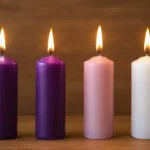
The most common color scheme for the Advent candles is purple (violet) for the first, second, and fourth candles, with a pink (rose) candle on the third Sunday. This color pattern emphasizes penitence, preparation, and festive anticipation. In some Protestant and Anglican communities, you may encounter blue candles or different color sequences, but the core idea remains: colors help congregants grasp the mood and focus of each week.
The wreath’s green evergreens symbolize life and growth, while the circular shape reminds worshippers that God’s plan for salvation has no end. The interplay of color and form invites introspection during the season, balanced by the gradations of celebration as Christmas approaches.
Practical meanings: how the Advent candle wreath functions in worship and home
Liturgical purpose and devotional use
The Advent candle wreath meaning is realized through prayer, Scripture, and song. In a church setting, pastors or liturgists guide the congregation through readings that correspond to each candle, allowing the people to experience a rhythm of anticipation. In homes, families often gather around the wreath for short devotional times, light the appropriate candle, and reflect on a theme for the week. The wreath becomes a centerpiece for contemplation and a tangible reminder that faith is a journey that unfolds over time.
Ritual cues and practical steps during worship
Typical steps in using the Advent wreath include:
Place the wreath in a prominent location where it can be seen by all participants.
Light a single candle on the first Sunday, with short readings and prayers that focus on hope.
On each subsequent Sunday, light the next candle and add a brief meditation on the relevant theme (peace, joy, love).
Offer a blessing or a communal prayer that connects the candle’s symbolism to daily life.
Conclude with a blessing and, if desired, a brief hymn or scripture reading.
Color symbolism, prayers, and liturgical mood
Purple and violet: penance, preparation, and longing
The purple candles (three of them) invite believers into a posture of contemplation and penitence. They symbolize the inner preparation that accompanies waiting: a time to examine conscience, to seek reconciliation, and to prepare to welcome the Messiah with humility.
Pink/rose: joy breaking through
The pink candle marks the midpoint of Advent and the easing of strict penitence. It signals a turning toward joy as Christmas approaches. The symbolism here is not frivolity but a measured pause to acknowledge that hope and expectation are moving toward celebration.
Greenery and the ring: life, continuity, and eternity
The evergreen content of the wreath stands for enduring life and the continuity of God’s promises, even amid winter or hardship. The circle has no beginning or end, reinforcing the sense that God’s love encircles all time.
Advent wreath traditions around the world
Western Christian variations
In many Western churches, the Advent wreath is a shared creation of congregants that travels between the sanctuary and the pews. Some communities place the wreath on a podium, while others embed it in a large canvas or wood sculpture that becomes a focal point for worship. The schedule may align with the lectionary readings of the church year, but personal devotion often shapes family practices as well.
Across the Catholic, Anglican, Lutheran, and many Protestant traditions, the Advent wreath can look different:
In some Catholic churches, the wreath is blessed by the priest before being placed at the altar, emphasizing liturgical integrity and sacramental blessing.
In Anglican and Lutheran settings, lay leadership often participates in the lighting and prayers, highlighting lay involvement as a core element of worship.
In evangelical and some Protestant schools, you may see more emphasis on family-led devotion and home-based rituals, sometimes with a smaller or more portable wreath.
Global adaptations and creative expressions
Outside of Europe and North America, Advent wreaths appear in diverse forms. Some regions incorporate traditional colors or fabrics from local cultures, while others blend the wreath with native crafts, bells, or lanterns. The core symbolism—anticipation, light entering darkness, and communal worship—remains a unifying thread that connects these varied expressions.
Making, blessing, and using an Advent wreath at home or in community spaces
Guidance for constructing a wreath
If you are building an Advent wreath at home or for a classroom or church, here are practical steps to shape a meaningful centerpiece:
Choose a base: a wreath form or a sturdy circular base with evergreen foliage. Evergreen branches symbolize life; ensure you have a stable base to hold the candles safely.
Decide on candle colors: arrange three purple candles and one pink candle, or follow your denomination’s preferred color scheme. Consider a central white Christ candle if you wish to expand the wreath with an additional focal point.
Place the candles evenly around the circle, leaving space in the center if you will add the Christ candle later. Secure the candles so they won’t tip during lighting.
Decorate with accents such as pinecones, ribbons, dried fruit, or small ornaments that reflect your tradition or family heritage. Be mindful of fire safety and ensure candles are well anchored.
Plan a lighting schedule and prayers for each Sunday of Advent. Prepare brief readings that tie into the candle’s theme of hope, peace, joy, and love.
Blessing the wreath
In many denominations, the wreath is blessed by a pastor, priest, or lay leader before its use. The blessing invites God’s presence, asks for protection, and dedicates the wreath to the season’s purposes. In congregational settings, a brief litany or prayer may accompany the blessing to remind participants that the wreath’s symbolism is not merely ritual but a living invitation to spiritual growth.
Using the wreath in worship and at home
The Advent wreath can serve as a central feature in:
Worship spaces where lighting accompanies Scripture readings and hymns.
Family homes where daily or weekly prayers accompany lighting of the candles.
Classrooms as a teaching tool for children and youth about the themes of Advent.
Community gatherings where shared liturgy reinforces unity and mutual expectation.
How to observe Advent with the wreath in different settings
Description of a typical home practice
A common home practice involves lighting one candle on the first Sunday, adding a second on the second Sunday, and so forth. Families often pair each lighting with a short Scripture reading, a short meditation, and a prayer. The atmosphere can be quiet and reflective, with music or devotional readings that align with the candles’ meanings.
For households with children, the wreath can become a learning tool—explaining the symbolism behind each candle and encouraging questions about faith, hope, and the meaning of Christmas. The cadence of lighting and prayer helps create a predictable spiritual rhythm during the weeks leading up to Christmas.
In churches, worship services may feature sermons or meditations that explicitly tie the candle lighting to the season’s gospel narratives. Schools may integrate the Advent wreath into religious education, with students reading prayers, leading songs, or explaining what each candle represents. The shared practice fosters a sense of community and continuity across generations.
Why the Advent candle wreath remains culturally relevant
Contemporary relevance: meaning of the Advent wreath in the modern world
In a fast-paced, visually saturated culture, the Advent wreath offers a tangible reminder to slow down and center one’s life around meaningful preparation rather than hurried consumption. The ritual invites pause, reflection, and communal engagement—qualities that many people seek in a busy season of activities. The phrase Advent candle wreath meaning today often includes a personal dimension: what each week’s light means in one’s family story, neighborhood, or church community.
Advent wreath as a bridge between tradition and modern life
The wreath is versatile enough to adapt to households with varying schedules, spaces, and resources. It can be a simple ring of greens with one candle, or a fuller display with decorative elements that reflect local culture and family values. This adaptability preserves the core symbolism while allowing each community to express its unique faith journey during Advent.
Common questions about the Advent candle wreath
What is the meaning of the Advent wreath in non-liturgical families? It serves as a shared tradition that helps children and adults slow down and prepare their hearts for Christmas, even if liturgical language isn’t used.
Why are there four candles and a possible center candle? The four outer candles represent the four weeks of Advent, while the center candle (Christ candle) symbolizes the Light that comes into the world with the birth of Christ.
Can the colors be different from purple and pink? Yes. Some communities use blue or other color schemes, but the underlying purpose remains: to guide devotion and mark time in a meaningful sequence.
Is an Advent wreath only for churches? No. Families, schools, clubs, and community centers often use it to cultivate a season-long practice of contemplation and shared celebration.
Variations in practice: digital and symbolic adaptations
In an era of screens and remote gatherings, some people incorporate virtual Advent wreaths or display seasonal imagery on digital devices. While these do not hold lit candles, they preserve the symbolic rhythm of lighting intentions and daily or weekly reflections. The core idea remains: to create a structured opportunity to reflect on the themes of Advent—hope, peace, joy, and love.
Symbolic substitutes for space-limited homes
For compact spaces where a traditional wreath is impractical, households may use a candle centerpiece or a tabletop arrangement with four candles, a center candle, and a few symbolic decorations. The emphasis is on the sequence of candles and the accompanying prayers rather than the size of the arrangement.
Conclusion: embracing the enduring Advent candle wreath meaning
The Advent candle wreath meaning rests on a simple premise: to walk through the weeks of Advent with intention, light, and shared reflection. The circle’s evergreen permanence invites believers to trust in the steadfast love of God, while the lighting of each candle marks a step forward in the spiritual journey toward Christmas. Whether in a grand cathedral, a small parish hall, a classroom, or a family kitchen table, the wreath remains a living invitation to prepare our hearts for the coming of the Christ child.
By understanding the symbolism of the Advent candles—the candles of hope, peace, joy (Gaudete Sunday), and love—and by honoring the wreath’s eternal circle, believers can cultivate a season of meaningful worship, hospitality, and transformation. The Advent wreath meaning is not a static relic; it is a dynamic practice that invites everyone to participate in a sacred rhythm of anticipation, community, and celebration.









Leave a Reply