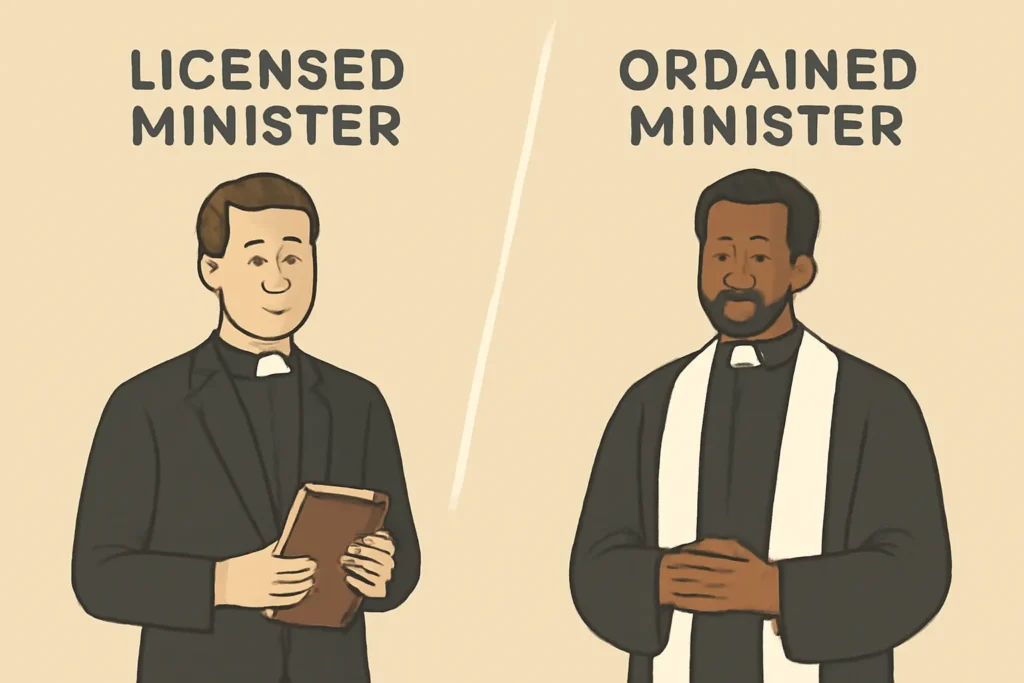
Licensed minister vs ordained minister: The difference
The terms licensed minister and ordained minister are common in many religious communities, but they describe different kinds of authority, training, and responsibilities. In everyday speech, people might say "a licensed pastor" or "an ordained priest," but the precise meaning can vary widely depending on the denomination, local laws, and the church’s own governance. This article explores what each term typically means, how the paths differ, and what that means for a person who wants to lead worship, officiate ceremonies, or provide pastoral care. Throughout, you’ll see a focus on practical implications for churches, couples planning weddings, families seeking funerals, and anyone curious about how church authority is structured.
Definitions and core distinctions
At a high level, licensed ministry usually refers to a formal credential granted by a church or a regional religious body that allows a person to perform certain ministerial duties under defined limits. An ordained ministry, on the other hand, typically signifies a higher level of ecclesiastical authority that results from a rite of passage—ordination—that confers a broader mandate and accountability within a church’s hierarchy. These distinctions matter because they shape what duties a minister may perform, who can supervise them, and how they are held responsible for their conduct.
Key terms you should know
License or licensure: A permission granted by a church or jurisdiction to perform specific functions, often with defined limits and a renewal cycle.
Ordination: A formal rite or ceremony that recognizes a person as having the authority to perform sacred duties and sacraments within a tradition.
Clergy: A broad term for individuals authorized to lead religious services; this umbrella includes both licensed and ordained ministers, as well as other ordained roles in some traditions.
Authority: The power to lead worship, preach, administer sacraments, or officiate life-cycle events, which may be limited by licensing terms or broadened by ordination.
Accountability: The mechanisms by which ministers are answerable to their church leadership, denominational rules, and sometimes civil authorities when performing rites like weddings or funerals.
In many denominations, a licensed minister holds a credential that authorizes them to perform specific duties, usually under the oversight of a local church, a ministerial board, or a diocese. This licensing is often connected to a period of probation, a set of proven competencies, or a clear scope of practice. Importantly, licensing is typically the first formal step toward broader ministry and may be part of a longer pathway toward ordination in some traditions.
What licensing typically covers
Preaching and teaching within designated church contexts
Leading worship under the supervision of a supervising elder/presbyter
Performing weddings, funerals, or baptisms in specific situations or with approval
Pastoral visiting, counseling, and care within a defined community
Serving as a guest speaker or temporary pastor in specific circumstances
Who issues a minister’s license
Local congregations or church boards
Regional or national church bodies (e.g., dioceses, synods, or boards of ministries)
Independent denominations that maintain their own credentialing processes
Limitations and renewal
Licenses are often time-bound and require renewal, evaluation, or continuing education
They may be conditional on ongoing alignment with doctrinal statements, ethical standards, and supervision
Permissions can be rescinded or suspended for doctrinal deviations, misconduct, or failure to meet performance standards
Ordination is widely understood as a more formal and enduring conferment of ministerial authority. In many Christian traditions, ordination is a sacramental or churchly act that recognizes a person as part of the clergy with responsibilities that extend beyond provisional licensing. The process often involves examination, endorsement by senior church leaders, and a public rite that marks entrance into the ordained ministry. For some denominations, ordination bestows the authority to administerSacraments, lead in governance, and provide long-term pastoral leadership.
The core implications of being an ordained minister
Authority to administer most or all sacraments and rites recognized by the tradition
Stewardship of spiritual oversight over a local congregation or a defined ministry
Full participation in church governance, ordination councils, and ecclesial discipline
Clarified lineage of apostolic or denominational succession in some traditions
Different faith communities structure ordination in distinct ways. For example, in many historic Christian traditions, only bishops, priests, or designated ministers may confer sacraments. In larger Protestant denominations, ordination is typically reserved for regular pastors or elders who have completed seminary or equivalent training and have undergone a formal commissioning process. In some non-denominational or newer church movements, ordination may be less hierarchical and more about long-standing commitment and community recognition than about a formal rite with a fixed lineage.
Legal and civil recognition: how secular law intersects with church credentials
Beyond church governance, civil law in many countries regulates who can officiate certain life events, especially marriages. In some places, a valid marriage ceremony requires the presence of a licensed or ordained religious official, a civil officiant, or a magistrate. The distinction between a licensed minister and an ordained minister can affect civil recognition and the enforceability of weddings, as well as the ability to sign official documents like marriage licenses or birth certificates. It is essential to understand both the church’s internal rules and the state’s statutes when planning ceremonies.
Some jurisdictions require state-licensed officiants or those in good standing with a recognized religious body
Other regions allow churches to designate their own ministers to perform marriages without additional civil certification
Conflicts can arise if a minister’s authority is limited by the church’s license but not recognized by civil authorities
Couples often verify with the local clerk’s office what credentials are needed for the ceremony to be legally binding
Training, education, and the path to ministry
Education and preparation differ widely among religious communities. A licensed minister may enter ministry through mentorship, on-the-job training, or formal coursework, with the expectation of continuing education and eventual ordination. A person who pursues ordination typically undertakes more extensive training, which can include seminary study, doctrinal instruction, pastoral internships, and comprehensive examinations. The choice of path can be influenced by the denomination’s tradition, the congregation’s needs, and the individual’s calling.
Education and credentialing pathways
Seminary or Bible college programs for advanced preparation and exposure to pastoral topics
Mentored ministry during a licensed period, with performance reviews and supervision
Denominational exams or interviews as part of the ordination process
Community or mission-based routes that emphasize practical ministry skills and doctrinal alignment
Continuing formation and accountability
Regular denominational conferences, ordination boards, or ministry councils provide oversight
Ethical codes, confidentiality standards, and safeguarding training are commonly required
Annual or multi-year requirements for ongoing education and reflective practice
Accountability, governance, and clergy discipline
Both licensed and ordained ministers are expected to conduct themselves in ways that align with their church’s beliefs and standards. However, the level of accountability and the processes for addressing concerns can differ. Ordained ministers are typically integrated into a formal governance structure with clear lines of supervision or appeal. Licensed ministers may be subject to supervision by a supervisory committee, a church board, or a regional authority that can renew, reassign, or revoke the license. In all cases, there are mechanisms to address misconduct, doctrinal violations, or failure to meet pastoral obligations.
What can trigger discipline or revocation?
Ethical misconduct or criminal conduct as defined by church policy
Failure to adhere to doctrinal standards or local church agreements
Misuse of church resources or breach of fiduciary duties
Incompetence or persistent inability to meet congregational needs
Practical implications for various roles and life events
The practical differences between licensed ministry and ordained ministry become most visible when officiating rites of passage, leading worship, or providing spiritual leadership. For couples planning a wedding, families arranging funerals, or someone seeking spiritual counsel, the credential type can influence which clergy are eligible to perform certain ceremonies, the scope of their duties, and the assurances a congregation can provide about the minister’s standing.
: In many regions, either licensed clergy or ordained ministers can legally officiate, but some locales require a specific civil authorization for geographic areas or for the paperwork to be filed with civil authorities.
and communion: Ordination often expands access to sacramental leadership in traditions where sacraments are central; licensed ministers may perform these rites within approved boundaries.
Pastoral care: Both licensed and ordained ministers provide counseling and visitation, but ordained ministers may have broader authority to set policy and supervise other staff in a congregation.
Church governance: Ordained ministers are more likely to hold seats on denominational boards or governing councils; licensed ministers may lead within a church but report to a supervising authority.
Choosing between licensed and ordained ministry: practical guidance
For someone discerning a call to ministry, deciding whether to pursue licensure, ordination, or both depends on several factors: the tradition you’re drawn to, the kind of ministry you want to practice, and the communities you intend to serve. Here are some practical considerations to help navigate the choice.
Consider the tradition and denomination
Some traditions place a strong emphasis on formal ordination as a rite of passage and a marker of credentials that confer authority to perform all sacraments.
Other communities emphasize practical ministry and pastoral leadership through licensing, with a pathway to ordination later if the person’s calling deepens.
Historical lineage, governance structure, and theological emphases will shape what is required for credentialing and what authority is granted.
Think about the scope of your ministry
If your goal is to lead a church, administer sacraments, and provide long-term pastoral leadership, ordination is often the natural goal.
If you see yourself serving in a particular community, helping with worship, preaching, or performing rites under supervision, a licensed minister track may be appropriate first.
In some contexts, you may pursue both: obtain a license to practice early in your career and pursue ordination when it aligns with your vocational trajectory.
Plan for education and formation
Research the educational requirements for licensing vs ordination in your tradition
Consider practical internships, mentorships, and supervised ministry as you prepare
Factor in the time, cost, and commitments involved in seminary or equivalent training
Myths, misconceptions, and clarifications
Like many topics in religion and law, there are common myths about licensed ministers and ordained ministers that can lead to confusion. Clarifying these points helps ensure accurate expectations for congregants and ministers alike.
Myth: A licensed minister is not truly a minister. Reality: A licensed minister is a recognized ministry professional with defined authority within a church; the difference is the scope and permanence of the credential.
Myth: Ordination always means more power. Reality: Ordination signifies broader responsibility and accountability in the church, but it also entails greater accountability and ongoing obligations.
Myth: Licenses are permanent and cannot be revoked. Reality: Licenses can be reviewed, renewed, or revoked for ethical, doctrinal, or professional reasons, just as ordination can be suspended or revoked in extreme cases.
Myth: Only certain denominations offer licensed ministry. Reality: Most traditions have some form of credentialing, whether licensing, commissioning, or ordination; the terminology varies by tradition.
Case studies: real-world illustrations of licensed vs ordained ministry
While every tradition has its own rules, the following illustrative scenarios highlight how licensing and ordination play out in practice. These are hypothetical but reflect common patterns across denominations.
Case study A: A pastor in a Baptist-influenced tradition
A young candidate begins as a licensed minister after a period of mentorship and a review by the church board. The license allows them to preach, teach, and officiate weddings with the supervision of a senior pastor. After several years of demonstrated competence, doctrinal alignment, and completion of seminary coursework, they are recommended for ordination by the regional association. The ordination ceremony is a public recognition of their full ministerial authority to oversee a congregation, administer sacraments, and participate in governing duties at the denomination level.
Case study B: A church planter in a mainline Protestant context
An upcoming church planter starts with a formal license to preach and lead worship as they launch a new congregation. The licensing period includes pastoral training, leadership development, and community outreach. Once the church community grows and the planter completes the denominational requirements, ordination follows, granting broader responsibilities, including mentoring other pastors, serving on a presbytery or district council, and presiding over significant rites of passage.
Case study C: A priest in a traditional Catholic setting
In a Catholic context, the pathway to authority begins with discernment and seminary formation, culminating in ordination to the priesthood after a rite conducted by a bishop. There is no parallel licensing track for priests; the priesthood itself is the credential. A deacon, who may be in a transitional or permanent role, may have a different form of commissioning but does not have the same scope of priestly faculties as ordained priests.
Key takeaways: how to think about licensed vs ordained ministry
Licensed minister and ordained minister represent different levels of authority, responsibility, and formal recognition within a church.
Licensing is often a step in a longer pathway toward ordination, or it may stand as a complete credential for specific ministry functions.
Ordination generally indicates broader ecclesial authority, deeper accountability, and a mandate to lead more fully within the church’s governance and sacramental life, depending on tradition.
Civil recognition of religious officiants can differ from church credentials; check local law to understand who can legally officiate rites like weddings.
Deciding between pursuing a licensed minister track or an ordination track depends on the denomination, personal calling, and long-term ministry goals.
Common questions about the difference between licensed and ordained ministers
To help readers quickly grasp the practical distinctions, here are answers to frequently asked questions that people often have when exploring ministry paths or engaging with ministers from different traditions.
Can a licensed minister perform weddings? In many places yes, often with church approval or within the scope of the license; in some jurisdictions, civil authorization may also be required.
Is an ordained minister always licensed? Ordination does not inherently depend on licensure in every tradition, but many denominations use a licensing stage as part of the path to ordination.
What is the difference in training? Licensing may require mentorship and basic theological education; ordination typically involves more extensive study, testing, and oversight.
Can a licensure be revoked? Yes, licenses can be suspended or revoked for misconduct, doctrinal deviation, or failure to fulfill responsibilities.
Does ordination guarantee a job? No. Ordination confirms suitability for ministry in a tradition, but placement often depends on openings, parish needs, and calling.
Final reflections: the broader landscape of ministry credentials
Across the Christian world—and beyond—credentials for ministry exist to balance spiritual calling with accountability, training, and community governance. The licensed minister and ordained minister pathways are two complementary routes that help churches manage leadership, ensure ethical practice, and provide continuity of care for congregations. For some people, the licensing track provides meaningful entry into ministry, serving as a proving ground before a more formal ordination. For others, the traditional route to priestly or pastoral authority is ordination from youth to elder statesman, with a clear lineage of authority and responsibility.
When evaluating ministers for a church or when planning your own vocational journey, it’s helpful to keep the following guiding principles in mind: clarity of role, accountability, training and formation, and respect for tradition. Understanding the difference between a licensed minister and an ordained minister can save confusion during ceremonies, ensure proper governance within the church, and help families and communities know whom to trust in moments of joy and sorrow alike.
Glossary of terms used in this article
For quick reference, here are the key terms discussed, with their typical meanings in many denominations. Note that meanings can vary by tradition.
Licensed minister
A clergy member authorized by a church or regional body to perform certain duties within defined limits, often with a path toward further credentials.
Ordained minister
A minister who has received formal authorization through a rite or ceremony and is typically empowered to perform a broad range of church duties, including sacraments and governance.
Ordination
The formal process or ceremony that confers ministerial authority within a tradition.
Ministry credentials
Permits, commissions, or degrees that validate a person’s ability to lead, teach, and shepherd a church community.
Whether you are exploring ministry as a calling, planning a wedding, or simply seeking to understand the structure of church leadership, recognizing the distinction between license and ordination helps you navigate expectations, responsibilities, and the spiritual authority that shapes worship and community life.









Leave a Reply