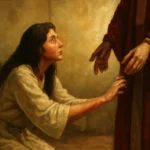
The Woman with the Issue of Blood: A Model of Faith and Perseverance
📅 1st century AD, approximately early 30s AD · 📜 Her name is not explicitly given, but 'hemorrhaging woman' is descriptive; 'blood' in symbolic terms represents life and purification in Hebrew/Greek contexts.
faithhealingperseveranceJesus
And immediately the fountain of her blood was dried up, and she felt in her body that she was healed of the affliction. And Jesus, knowing in himself that virtue had gone out of him, turned around in the crowd and said, 'Who touched my clothes?'— Mark 5:29-30
The Woman with the Issue of Blood was a woman suffering from a chronic bleeding condition for twelve years. Despite medical expenses and social isolation, she exhibited remarkable faith in Jesus' healing power. Believing that simply touching His cloak would heal her, she pressed through the crowd and made contact. Immediately, she felt her body healed, and Jesus acknowledged her faith with compassion. Her story highlights themes of persistent faith, vulnerability, and divine compassion, illustrating how personal trust in Jesus can lead to miraculous healing and restoration. Her act of belief boldly crossing societal boundaries underscores her deep spiritual insight, making her a powerful example of hope and perseverance for believers today.
🏛️ Cultural & Historical Context
In the 1st-century Jewish society, women were often regarded as ritually unclean, especially those with chronic blood issues. Such women faced social ostracism and were marginalized, making her act of reaching out to Jesus both daring and significant. Women’s roles largely centered around family and household duties, with limited access to public religious life. Her story challenges cultural norms, highlighting personal faith over societal stigma, and underscores the transformative power of Jesus’ ministry that broke barriers of gender and status.
The biblical text does not specify her family or personal relationships, emphasizing her individual faith journey.
✨ Character Traits
faithcourageperseverancehumility
⛪ Theological Significance
Her story exemplifies ultimate faith and the immediacy of divine healing through belief in Jesus. It highlights that faith is accessible to all, regardless of social status or gender. Her touch symbolizes faith’s power to activate salvation, prefiguring the universality of Christ’s mission to heal spiritual and physical wounds. Her encounter affirms that Jesus responds compassionately to genuine faith, reinforcing the themes of divine grace, mercy, and the accessibility of God's healing power in salvation history.
📖 Lessons for Today
📖 Lesson 1
Persistent faith can lead to miracles; trust in Jesus even in seemingly hopeless situations is key.
📖 Lesson 2
Breaking social barriers with faith demonstrates that God’s grace transcends societal limitations.
📖 Lesson 3
Humility and vulnerability in seeking help open the door to divine intervention and spiritual renewal.
🔗 Connections to Other Biblical Women
Like Hannah or Ruth, she exemplifies hope and perseverance amidst adversity. Unlike Mary, the mother of Jesus, her faith manifests in active pursuit rather than submission. Her story contrasts with women like the Samaritan woman at the well, both engaging Jesus directly, but with different contexts of expectation and social status, emphasizing that divine reach extends beyond societal boundaries.
📜 Scripture References
Reference
Mark 5:25-34
Matthew 9:20-22
Luke 8:43-48
❓ Frequently Asked Questions
Was the Woman with the Issue of Blood healed instantly?
Yes, according to Mark 5:29, she was healed immediately when she touched Jesus’ cloak, demonstrating faith’s power to produce instant healing.
Why was her touch significant in Jesus’ eyes?
Her touch was significant because it demonstrated her faith and belief that Jesus could heal her, even without her needing His physical presence, symbolizing divine power accessible through faith.
Did her social status change after her healing?
The biblical account does not specify social changes, but her act of faith and Jesus’ acknowledgment suggest spiritual restoration, breaking social isolation caused by her condition.
✨ Did You Know?
Despite her suffering, her story is one of the few instances in the Gospels where an individual's act of faith prompts a direct interaction with Jesus. Linguistically, the term 'touch' signifies more than physical contact; it represents a profound act of spiritual trust and expectation in divine healing.

 Por Mario Acevedo