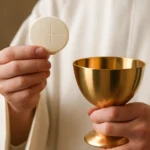
For Catholics, the Eucharist is the source and summit of the Christian life. The Bread of Life discourse in John 6 invites believers to encounter Jesus in a unique and transformative way, not merely as a sign but as the living Center of the Church’s worship. In this article we study the historical setting of the discourse, the language Jesus uses about eating and drinking, and the way the Catholic Church has read these lines through the centuries, especially in the NABRE translation used in our liturgy. We will distinguish the symbolic language from the Church’s recognized teaching about the Real Presence: that Christ is truly present—body, blood, soul, and divinity—under the appearances of bread and wine. This truth shapes Catholic faith, worship, daily prayer, and the Church’s mission to bring life to the world through the Eucharist. Understanding this passage helps Catholics appreciate Mass, adoration, and the daily reception of the Eucharist. It also answers common questions about faith, grace, and how God meets us in the sacrament.
Historical context: The Gospel of John was written by John the Apostle in the late first century, around 90-100 AD, within the Catholic canon. It contains the Bread of Life discourse in John 6:22-59, set after the miracle of the feeding of the five thousand. The Catholic Bible includes this Gospel in its canonical list; while John is not deuterocanonical, this Gospel is accepted by Catholics and Protestants alike in their New Testament canons. In NABRE, the passage emphasizes Jesus as the bread from heaven. The Eucharist in John 6 is not the Last Supper narrative; rather it presents Jesus promising Himself as life-giving food, inviting faith and communion with Him. The teaching becomes foundational for the Church’s understanding of the Real Presence and liturgical life, which are developed through the centuries in light of Scripture and Tradition.
Most Important Verses from The Eucharist in John 6
John 6:22-24: After the crowd is fed, Jesus moves the crowd’s focus from signs to the bread from heaven, inviting faith.
John 6:33: The bread of God is that which comes down from heaven and gives life to the world.
John 6:35: I am the bread of life. Whoever comes to me shall not hunger, and whoever believes in me shall never thirst.
John 6:44: No one can come to me unless the Father who sent me draws him.
John 6:47-50: Amen, Amen, I say to you, whoever believes has eternal life; I am the bread of life that came down from heaven.
John 6:51: I am the living bread that came down from heaven; if anyone eats this bread, he will live forever; and the bread that I will give is my flesh for the life of the world.
John 6:53-56: Unless you eat the flesh of the Son of Man and drink his blood, you do not have life within you.
John 6:63: It is the Spirit who gives life; the flesh is of no avail. The words I have spoken to you are Spirit and life.
John 6:66-69: Many disciples found the saying hard; but the Twelve remain, and Peter confesses Jesus, the Holy One of God.
What the Catholic Church Teaches
Key Catholic teachings on the Eucharist are found in the Catechism of the Catholic Church and in the great ecumenical councils:
CCC 1322: The Eucharist is the source and summit of the Christian life.
CCC 1323-1324: The Eucharist is the memorial of Christ’s Passover and the sacrifice of the Church; it makes present the saving events of Christ’s death and Resurrection.
CCC 1333: The Church’s teaching on the real presence; the Eucharist contains the true Body and Blood of Christ through the mystery of transubstantiation, defined by the Council of Trent.
CCC 1376-1377: Proper disposition to receive the Eucharist—freedom from mortal sin and desire for union with Christ.
Council of Trent (1545-1563): Defined transubstantiation, teaching that bread and wine become the actual Body and Blood of Christ while retaining appearances.
Vatican II: Reaffirmed the Eucharist as the source and summit and encouraged active participation in the liturgy (Sacrosanctum Concilium) and the church’s life as the People of God (Lumen Gentium).
1 Corinthians 11:23-29 in Sacred Scripture supports the practice of the Eucharist and the need for worthy reception; the Catholic reading harmonizes Paul with John’s witness about Real Presence.
Church history shows a steady development of Eucharistic doctrine and practice rooted in John 6 and other biblical texts:
Saint Augustine of Hippo (4th-5th c.) interpreted John 6 as pointing to a real nourishment in the Eucharist and defended the Real Presence in his exegesis of the Gospel.
Early Fathers such as Cyril of Jerusalem and John Chrysostom preached the efficacy of the Eucharist and explained Jesus’ words in John 6 as pointing toward communion with His Body.
Saint Thomas Aquinas (13th c.) systematized Eucharistic theology in the Summa Theologiae, showing how faith, grace, and sacramental presence cooperate in the Eucharist.
The Feast of Corpus Christi was instituted by Pope Urban IV in the 13th century to celebrate and teach the Real Presence; it owes much to the Thomistic synthesis.
Council of Trent reaffirmed transubstantiation, clarifying the Catholic understanding in response to Protestant objections.
Vatican II renewed emphasis on participation and the ecclesial dimension of the Eucharist; St. John Paul II’s Ecclesia de Eucharistia (2003) highlighted its central place in Catholic life.
Frequently Asked Questions
Is John 6 teaching a symbolic or literal presence of Jesus in the Eucharist?
How does John 6 relate to the Last Supper described in the Synoptic Gospels and in 1 Corinthians?
What does transubstantiation mean, and why does the Church teach it?
Why must we receive the Eucharist in a state of grace?
How can Catholics explain the Real Presence to others who are skeptical or from other Christian traditions?
Prayer: O Jesus, you are the Bread of Life. Give me faith to believe, reverence to adore you in the Blessed Sacrament, and grace to live as nourishment for others. Amen.

 Por Fernando Ortiz