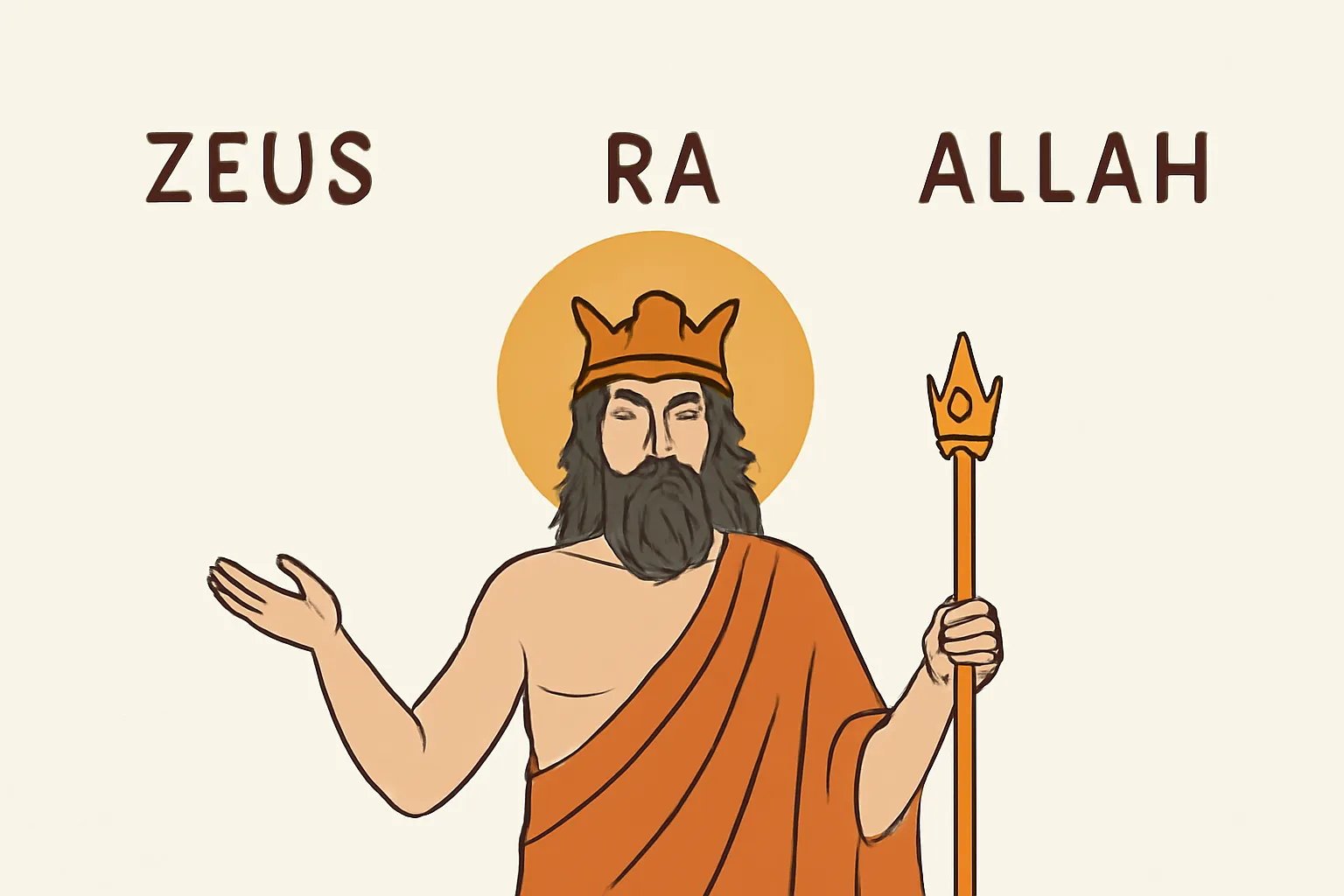
Names carry power and stories. In many traditions, the given name of a deity is more than a label—it is a mini-portrait of the being’s domain, attributes, and the relationship people imagined between the divine and the world. A name can signal authority, origin, or a guiding virtue. This guide gathers well-known gods from several major traditions and explains what their names and common epithets signify. By looking at the meanings behind these names, readers gain a clearer sense of who these deities are, what they guard, and how they were worshipped across cultures.
Zeus stands as the archetype of a pan-hellenic sky-god, king of the principal pantheon in classical Greece. The name is traditionally linked to the sky and to the concept of heavenly power. In many sources, Zeus is described as the sky-father and the ruler who upholds cosmic order. In Roman tradition, the equivalent figure is Jupiter, sometimes called Iuppiter in Latin. The Roman form reflects the same essential role, and in worship he was often honored as the guarantor of oaths and the upholder of social and divine order.
Variations:Zeus (Greek), Jupiter / Iuppiter (Roman), sometimes encountered as Dios in poetic Latin contexts.
Athena / Minerva
Athena is the Greek goddess of wisdom, strategic war, crafts, and civic virtue. Her name is closely tied to intellect, skill, and prudent planning. The Roman counterpart is Minerva, who embodies similar powers of wisdom and arts. In both cultures, she often appears as a guardian of cities and a patron of crafts and learning.
Core meaning:Wisdom, craft, strategic warfare.
Key epithets:Pallas Athena (often used as a youthful epithet), Athena Parthenos (the Virgin Athena).
Variations:Athēna (Greek), Minerva (Roman).
Poseidon / Neptune
Poseidon is best known as the god of the sea, but he is also associated with earthquakes and horses. The epithet Earth-Shaker captures the powerful, sometimes abrupt, force attributed to him by seafarers and island communities. The Roman form, Neptune, carries the same sea-sovereign role, with additional associations to waters, harbors, and navigational lore.
Core meaning:Sea lord, earth-shaker.
Key epithets:Ennosigaios (earth-shaker in some Greek sources), Poseidon Hippios (of horses).
Variations:Poseidon (Greek), Neptune (Roman).
Hera / Juno
Hera is the queen of the gods, goddess of marriage, family, and women’s issues. Her name is linked to authority, sovereignty, and the ideal of the married woman as a social pillar of the ancient world. The Roman equivalent is Juno, who shares many of the same domains and is often celebrated as the nurturing head of the household and the sanctuary of loyalty and fidelity among families and cities.
Core meaning:Queen of the gods, guardian of marriage and family.
Key epithets:Hera Teleia (the complete one), Hera Bia (queen and wife).
Variations:Hera (Greek), Juno (Roman).
Demeter / Ceres
Demeter is the goddess of harvest, grain, and fertility of the earth. Her name evokes the cycles of sowing and reaping, and she is intimately tied to agricultural seasons and human sustenance. The Roman form Ceres carries the same agricultural emphasis and is central to fertility rites and seasonal festivals linked to crop safety and abundance.
Core meaning:Harvest, fertility, mother-earth.
Key epithets:Demeter is the Bringer of Seasons, Demeter Chthonia (Earth Mother).
Variations:Demeter (Greek), Ceres (Roman).
Norse and Germanic Deities: Names and Meanings
Odin / Woden / Wōodan
Odin is the All-Father, a complex figure of wisdom, poetry, magic, which includes a heavy cost in pursuit of knowledge. The name’s exact etymology is debated, but scholars often connect Odin with inspiration, frenzy, or the pursuit of hidden knowledge. In Old English, he is Woden, while in other Germanic tongues he bears cognate forms such as Wōdan. Across the Norse sagas, Odin embodies the paradox of a seeker who pays a price for revelation.
Core meaning:All-Father, seeker of wisdom.
Key epithets:Allfather, the Wanderer, Hár (high one) in some contexts.
Variations:Odin (Norse), Woden (Old English), Wōdan (Gothic/Old High German variants).
Thor / Donar / Thunor
Thor is the thunder-god, the protector of humans against giants and a symbol of raw, communal strength. The element thunder in his name is a direct reflection of his primary domain. In other Germanic languages, he appears as Donar (East Germanic) or Thunor (Old English), all sharing the same thunderous essence and martial vigor.
Core meaning:Thunder-god, protector, strength.
Key epithets:Mjölnir’s master (referring to his hammer), the Thunderer.
Freyja (sometimes anglicized as Freya) is the goddess of love, beauty, fertility, and magic. Her name is tied to alluring warmth and the powers of attraction. Frigg (often called Frigga in later sources) is Odin’s wife, associated with marriage, motherhood, and household matters. Both are central to the Norse pantheon, but Freyja’s sphere includes more intimate, magical, and erotic dimensions, whereas Frigg embodies the domestic and relational order of gods and humans.
Core meaning:Love, beauty, fertility (Freyja); Wife of Odin, household order (Frigg).
Key epithets:Vanadis (the love-goddess in some contexts), Frigg (the lady or wife).
Variations:Freyja (Norse), Frigg (Norse, often as Frigga in Englishized texts).
Loki
Loki is the famous trickster of the Norse world, a shapeshifter whose mischief often disrupts the cosmology and then inadvertently prompts change. While not a creator of order in the same sense as Odin or Thor, Loki’s name and myth signal cunning, deception, and the unsettling creativity that accompanies change. He is not a typical benevolent deity, yet his stories illuminate how cultures understood balance, chaos, and the costs of cleverness.
Core meaning:Trickster, shapeshifter, catalyst of change.
Key epithets:Loptr (the Bend-Skilled One), Flísdannr (shape-shifter in some sagas).
Variations:Loki (Norse), various cognate forms appear in other Germanic mythologies.
Ra (often written as Re in transliterations) is the ancient sun god—the cosmic orb illuminating the sky and sustaining life. The name itself is strongly associated with light, day, and the inexhaustible energy of the sun. Ra is also linked to creation myths as a primordial force who navigates the heavens with the sun’s daily journey.
Core meaning:Sun, creator, day-bringer.
Key epithets:Ra-Horakhty (Ra who is Horus of the Two Horizons), Ra-Atum (a combination with Atum in creation myths).
Variations:Ra (Egyptian), Re (alternative transliteration).
Isis / Aset
Isis is the queen of the gods in many tales, renowned for her magical skill, motherhood, and cunning problem-solving. The name Aset is one of the earliest forms of her name in Egyptian, often connected to power over the throne (the throne symbol appears in some of her titles). In myth, Isis embodies healing, protection, and familial loyalty, and she is frequently depicted as the mother and wife who uses magic to restore life and order.
Core meaning:Goddess of magic, motherhood, and royal authority.
Key epithets:Aset (Egyptian form), Isis-Nettu (Queen of the Gods in certain inscriptions).
Variations:Isis (Greek/Latin texts), Aset (original Egyptian).
Osiris / Ausar
Osiris rules the realm of the dead and the afterlife, a symbol of resurrection and moral order. In many depictions, his name connotes strength and sovereignty in death as in life. The earlier form Ausar appears in Egyptian texts and often appears alongside myths of judgment, renewal, and the divine kingship that spans both earthly and subterranean realms.
Core meaning:Ruler of the underworld, rebirth.
Key epithets:Osiris-Apophis (as a combined figure in some myths), Un-Nefer (the good king in some inscriptions).
Anubis is the jackal-headed god associated with mummification and afterlife rites. While his exact name meaning is debated, the imagery of a jackal and his role in guiding souls to the afterlife tie him intimately to funerary traditions. The original Egyptian form Anpu is encountered in early texts and is often linked with protection during the journey to the afterlife.
Core meaning:Protector of graves, guide of the dead.
Key epithets:Inpu (alternate transliteration), Anubis-Jeschu (as seen in some mythic lists).
Hathor is the goddess of love, music, dance, and joy. Her name, and her many cult titles, evoke a sense of hospitality and festive life. She is sometimes depicted as a protector of women and a patron of motherhood. In some periods, Hathor was revered as a sky goddess and linked to the sun, linking warmth, artistry, and fertility in one divine family portrait.
Core meaning:Love, music, motherhood, joy.
Key epithets:Hathor-Of-The-Sky, Lady of Drunkenness in ritual contexts where wine and merriment were celebrated.
Variations:Hathor (Egyptian), with cosmopolitan variants in Greco-Roman era texts.
Brahma is the creator-god in the Hindu Trimurti, the being who brings the cosmos into existence. The name is often linked to the root meaning “to grow, to expand” and to the concept of creation itself. In many traditions, Brahma’s role is less about governance and more about the birth of the universe and the underlying order of reality.
Core meaning:Creator, cosmic artisan.
Key epithets:Svayambhu (self-manifested), Padma-Sambhava (lotus-born in some texts).
Vishnu is the preserver and sustainer of the universe, often described as the divine protector who descends in various avatars to restore dharma. The name Vishnu itself is associated with nourishment and sustenance in many scriptural passages. Narayana emphasizes the cosmic abode and the life-giver, while Padmanabha refers to his lotus-born form in some legends.
Core meaning:Preserver, sustainer, protector of cosmic order.
Key epithets:Vaikuntha Dhiesa (referring to his celestial realm), Adi-Narayana (primordial Narayana).
Shiva is the auspicious one and a complex figure representing destruction, regeneration, and cosmic balance. The name Shiva embodies auspiciousness and transformative power. In many contexts, he is also Maheshvara (great lord) and Rudra (howling one, a progenitor of storm), both used to highlight different aspects of the same supreme force.
Core meaning:Auspicious, transformative power; destroyer and regenerator.
Durga is the fierce form of the Divine Mother, a warrior goddess who defeats demons and protects the righteous. Her name connotes invincible power and maternal protection. Kali, another fierce form, represents time, change, and the destruction of evil. She is often depicted in a terrifying yet protective avatar, reminding devotees that transformation can be both fearsome and life-affirming.
Key epithets:Parvati (married to Shiva in some legends, a broader family name), Kali (the dark, transformative goddess).
Variations:Durga (principal form), Kali (ferocious goddess of time and change).
Ganesha / Ganapati
Ganesha is the elephant-headed remover of obstacles and patron of beginnings. The name Ganesha is associated with prosperity and wisdom, while Ganapati emphasizes the master of multi-formed energies. He is one of the most widely worshipped deities in Hindu practice, invoked at the start of rituals and journeys alike.
Core meaning:Obstacle- remover, guardian of new ventures.
Key epithets:Vinayaka (the humble one), Gajanana (elephant-headed).
Variations:Ganesha (popular), Ganapati (ritual name in some texts).
Mesopotamian and Near Eastern Deities: Names and Meanings
Enlil
Enlil is the storm-god and a chief deity in Mesopotamian theology, often described as lord wind or lord of the air. His name appears in cuneiform sources as a major force behind order, weather, and kingship, sometimes depicted as a stern guardian of divine ordinance.
Core meaning:Lord of the wind and air; sovereign of the divine assembly.
Key epithets:Enlil-barsi (lord of the lands), Ninlil (his consort’s name, representing a family of deities).
Variations:Enlil (Akkadian), various Akkadian spellings appear across tablets.
Enki / Ea
Enki (also known as Ea in Akkadian) is the god of wisdom, water, and crafts. He is often portrayed as a benevolent, clever deity who provides irrigation, healing, and knowledge to humanity. The name is associated with water and possibility—perhaps a sense of life-giving intelligence.
Core meaning:Water-wisdom, creator of life and crafts.
Key epithets:Lord of Eridu, giver of wisdom.
Variations:Enki (Sumerian), Ea (Akkadian).
Inanna / Ishtar
Inanna (Sumerian) and Ishtar (Akkadian) stand at the crossroads of love, war, and celestial sovereignty. The name and the myths surrounding her convey complexity: she embodies both seductive power and martial strength, a goddess who conquers realms through desire and force alike.
Core meaning:Goddess of love, war, and heavenly power.
Key epithets:Queen of Heaven, Lady of Battles.
Variations:Inanna (Sumerian), Ishtar (Akkadian).
Marduk
Marduk eventually rose to prominence as the chief god of Babylon. The name is linked to leadership and order—qualities that aligned with the city’s political consolidation. In myth, Marduk’s rise parallels the creation of a stable cosmos, and his cult emphasizes law, justice, and the maintenance of divine order.
Core meaning:King of the gods, upholder of order.
Key epithets:Asarluhi (a scholarly or scribal form associated with him in some lists), Lamurudu (through various literary allusions).
Variations:Marduk (Babylonian), Merodach (older Babylonian transcription in Western texts).
East Asian and Pacific Deities: Names and Meanings
Amaterasu / Amaterasu-ōmikami
Amaterasu is the Shinto sun goddess, central to the Japanese understanding of the heavens and crops. Her name is tied to light and the sun’s life-sustaining power. As the mythic ancestor of the imperial line, Amaterasu embodies revelation, visibility, and the clarity that daylight brings to human affairs.
Core meaning:Sun goddess, bringer of light and auspicious order.
Susanoo is the storm-demon-slayer deity who traverses sea and land to confront calamities and restore balance. The name and myths emphasize wind, waves, and the testing of boundaries between chaos and order in Japanese tradition.
Core meaning:Storm god, climate and sea guardian.
Key epithet:Suzanoo-no-Mikoto (his full divine title).
Variations:Susanoo (common), Susa-noo (older spellings in some texts).
Tsukuyomi / Tsuki-Yomi
Tsukuyomi is the moon deity in Shinto, governing the night and the lunar cycle. The name is associated with the moonlit order of time and the quiet, reflective aspects of the night as opposed to Amaterasu’s daylight center.
Brigid is the goddess of hearth, healing, poetry, and smithcraft in many Celtic traditions. Her name is often interpreted as signaling exalted status and fiery vitality, reflecting both the hearth’s warmth and the flame of inspiration that fuels the artisan and the poet.
Core meaning:Goddess of hearth, healing, poetry.
Key epithet:Brigid of the Bright All (in some poetic variants).
Variations:Brigid (Gaelic), Brigit (Anglicized), Bride (older English forms).
Dagda
Dagda is known as the “good god,” a paternal figure who commands abundance, wisdom, and the druidic arts. His name itself is a simple, powerful label that underscores a sense of benevolent authority and protective strength.
Core meaning:The good god, fatherly strength.
Key epithet:Dagda Mor (Great Dagda) in some myths.
Variations:Dagda (Irish), with related forms in other Celtic narratives.
The Morrigan
The Morrigan is a triad or sometimes a solitary goddess associated with fate, prophecy, and war. The name’s exact etymology is debated, but her persona is inseparable from the image of the battlefield, sovereignty, and the changing patterns of victory and loss. She embodies a very particular sense of divine feminine power—mysterious, formidable, and often transformative.
Core meaning:War goddess, fate and sovereignty.
Key epithets:Morrígan (plural or feminine form in some texts), Badb (a war-crone aspect in others).
Variations:The Morrigan (Anglicized form), with regional variants across Celtic myth cycles.
Mesoamerican Deities: Names and Meanings
Quetzalcoatl / Ketzalpatl
Quetzalcoatl translates most often as “Feathered Serpent,” a figure who is associated with learning, civilization, and the wind. The name itself points to the god’s hybrid nature—combining the brilliance of birds (feathers) with the earthbound strength of a serpent, symbolizing both sky and earth and the human pursuit of knowledge.
Core meaning:Feathered Serpent, culture-hero.
Key epithets:Kukulkan (Maya variant of the same deity), Ce- prefixes in various contexts.
Huitzilopochtli is the sun god of war and the patron of the Mexica (Aztec) capital. The name is commonly interpreted as “Hummingbird of the South” or “Hummingbird on the Left,” signaling the swift, aggressive energy of the deity who led the people in battle and guided them toward cosmic order through ritual sacrifice and conquest.
Core meaning:Sun-war god, patron of warfare.
Key epithet:Huitzilopochtli-Quauhtzin (a warrior-adapted title in some texts).
Variations:Huitzilopochtli (Aztec), with related forms in neighboring cultures’ mythologies.
Tlaloc is the rain god, a central figure for agricultural fertility in many Mesoamerican societies. His name evokes the life-giving waters and the storms that bring rain to crops, but also the potential danger of floods. Rituals around Tlaloc emphasize balance between moisture and drought, the human and the divine, and the cycles of sowing and harvest.
Core meaning:Rain god, moisture-provider.
Key epithets:Tláloc (with variations in spelling across codices).
Variations:Tlaloc (Aztec), with regional forms among neighboring cultures.
African Diaspora and Traditional African Deities: Names and Meanings
Yemaya / Yemoja
Yemaya (also spelled Yemoja in some traditions) is the mother-serpent goddess of the sea in Yoruba and diasporic traditions like Santería and Candomblé. The name conveys motherly nourishment and the vast, life-sustaining ocean. Yemaya embodies protection, fertility, and the guiding voice of the maternal divine that soothes and shelters her children.
Core meaning:Mother of the waters, sea goddess.
Key epithets:Orisha of the sea, Queen of the Ocean.
Variations:Yemaya (Yoruba); Yemoja (diasporic spellings in Cuban, Brazilian, and other Caribbean traditions).
Shango / Chango
Shango (or Chango in some spellings) is the thunder and lightning deity of the Yoruba and related African diaspora beliefs. The name itself evokes the explosive and transformative power of storms, as well as justice and masculine sovereignty. In ritual practice, Shango embodies courage, judicial fairness, and the dynamic energy of the storm that clears the old and makes way for the new.
Key epithets:Ogundaye (glorious warrior), Ọbàtálá (though sometimes used for other orishas in syncretic traditions).
Variations:Shango (Yoruba), Chango (diasporic forms in Cuba and Brazil).
Ogun / Ogún
Ogun is the god of iron, technology, and war in Yoruba-influenced traditions. The name evokes the craftsman’s fire and forge—metalworking, tools, and the power to shape the world through labor and skill. Ogun’s influence extends into protection for travelers, hunters, and workers who demand safety and strength.
Core meaning:Iron, smithing, war, and technological prowess.
Key epithets:Ogún-Ilá (master of the forge in some contexts), Arojinle (guardian figure in certain regional myths).
Variations:Ogun (Yoruba), Ogûn (diasporic spellings in Latin-influenced communities).
How Names Shape Belief and Practice
Across these traditions, the significance of a deity’s name reveals itself in several recurring ways. First, a name often encodes a deity’s domain—the realm the god or goddess governs, whether it is the sky, the sea, wisdom, or harvest. Second, variations of a name—different linguistic forms, epithets, or regional titles—signal epic narratives and cultic contexts in which a deity appears. For example, the same god may take on sharper combat associations in warlike epithets, or gentler, protective aspects in maternal titles. Third, names can mirror the cosmology of a culture: a sun deity anchors daytime order, a moon god governs time and reflection, and a storm god embodies transformative power that binds communities to the seasons and to ritual calendars.
In practice, worshipers frequently invoked a compound form or an epithet when addressing the divine in prayer or ritual. For instance, a prayer might call on a deity as “Zeus Olympios,” invoking the celestial realm and the order of the gods, or as “Odin All-Father,” borrowing an epithet that emphasizes authority and wisdom. These variants are not mere linguistic flourishes; they are ceremonial tools that align the speaker with the deity’s particular power at that moment.
How to Use Names in Study and Reflection
Cross-cultural comparison: When reading myths, note how a single role is named differently across cultures—what is “the sun” in one tradition may be a personified deity with a family of epithets in another.
Epithets as clues: Epithets often reveal the deity’s primary function. If a god is described as “Earth-Shaker” or “the Preserver,” these phrases foreground how worshippers understood his or her impact on daily life.
Names and rituals: In many traditions, naming a deity in a specific form or title aligns with particular rites—like starting a ceremony with “Whom do we invoke as the All-Father?” or opening a harvest festival with the sun-god’s primary name.
Variations and Modern Relevance
Today, scholars and enthusiasts often encounter multiple spellings and forms for the same deity. This diversity reflects historical transmission, translation, and adaptation to new cultural landscapes. For instance, Greek Zeus and Roman Jupiter represent the same mythic figure at different linguistic and ritual stations; Viking-era texts preserve Odin beside Woden, while Japanese myth retains both the vitality of Amaterasu and the storm-driven energy of Susanoo.
Moreover, contemporary works—from novels and video games to scholarly anthologies—often remix these names to energize familiar narratives or to propose new interpretations of ancient stories. This ongoing reinvention does not erase the original meanings; instead, it expands the ways we think about divinity, power, and human connection to the cosmos. If you are exploring a myth tradition for the first time, paying attention to how names carry meaning can dramatically deepen your understanding of the stories and the communities that created them.
Closing Thoughts: Reading Deity Names as Windows into Culture
The names of gods and their many forms offer a kind of map—one that traces human relationships with the divine across time and terrain. By examining the meaning behind a deity’s name, you glimpse the culture’s priorities: what life force they wanted to honor, which forces they sought to regulate, and how they imagined the world’s order. Whether you are studying classical epics, exploring mythologies from different continents, or simply curious about how people have conceived the powerful and mysterious, the names themselves are a rich entry point for learning, reflection, and wonder.
In this quick guide, we have touched on a wide tapestry of deities and the meanings embedded in their names. From the sky-father Zeus and the sun goddess Amaterasu to the thunder-wielding Shango and the sea-mother Yemaya, each name tells a story about the role of the divine in human life. By carrying these names with care and curiosity, you participate in a long tradition of naming that binds belief, ritual, literature, and daily practice into a living, evolving conversation with the sacred.

 Por Laura Jara