Introduction: How did God destroy Sodom? An overview of the question and its significance
The question “How did God destroy Sodom?” sits at the crossroads of narrative history, moral teaching, and literary imagery in the biblical story of Sodom and Gomorrah. The core episode is brief, but its reception has been long and diverse. In the Genesis account, Sodom’s destruction is presented as a dramatic act of divine judgment initiated in response to widespread wickedness. Later writings in the New Testament and early Christian literature, as well as modern scholarly discussions, expand the question to include tensions between history and interpretation, miraculous action and natural process, and the purposes of such a story for communities facing moral questions of their own time.
This article surveys biblical accounts, surveys a range of theories about what happened and why, and lays out a plausible chronology of events as described in scripture. A careful look shows how the basic question—how did God destroy Sodom?—receives different emphases depending on whether one foregrounds literal interpretation, literary symbolism, or historical-contextual analysis.
Biblical accounts: where the destruction is described
The destruction of Sodom is primarily found in the Genesis narrative, where the city and its neighboring Gomorrah are described as exceedingly wicked. The core text presents a sequence in which visitors arrive, the elders of the city reject hospitality, and divine judgment falls in a dramatic fashion. Additionally, several later biblical writers reference Sodom’s fate to illustrate judgments, moral exhortations, and eschatological themes.
The Genesis narrative: Genesis 18–19
In the opening portion of the story, Abraham entertains three visitors, and one of them speaks as the LORD (Genesis 18). This is commonly interpreted as a theophany—the presence of God with human-like figures. The visitors disclose that the outcry against Sodom and Gomorrah is great, and they declare that judgment is imminent. The scene shifts to a dramatic encounter in Sodom itself.
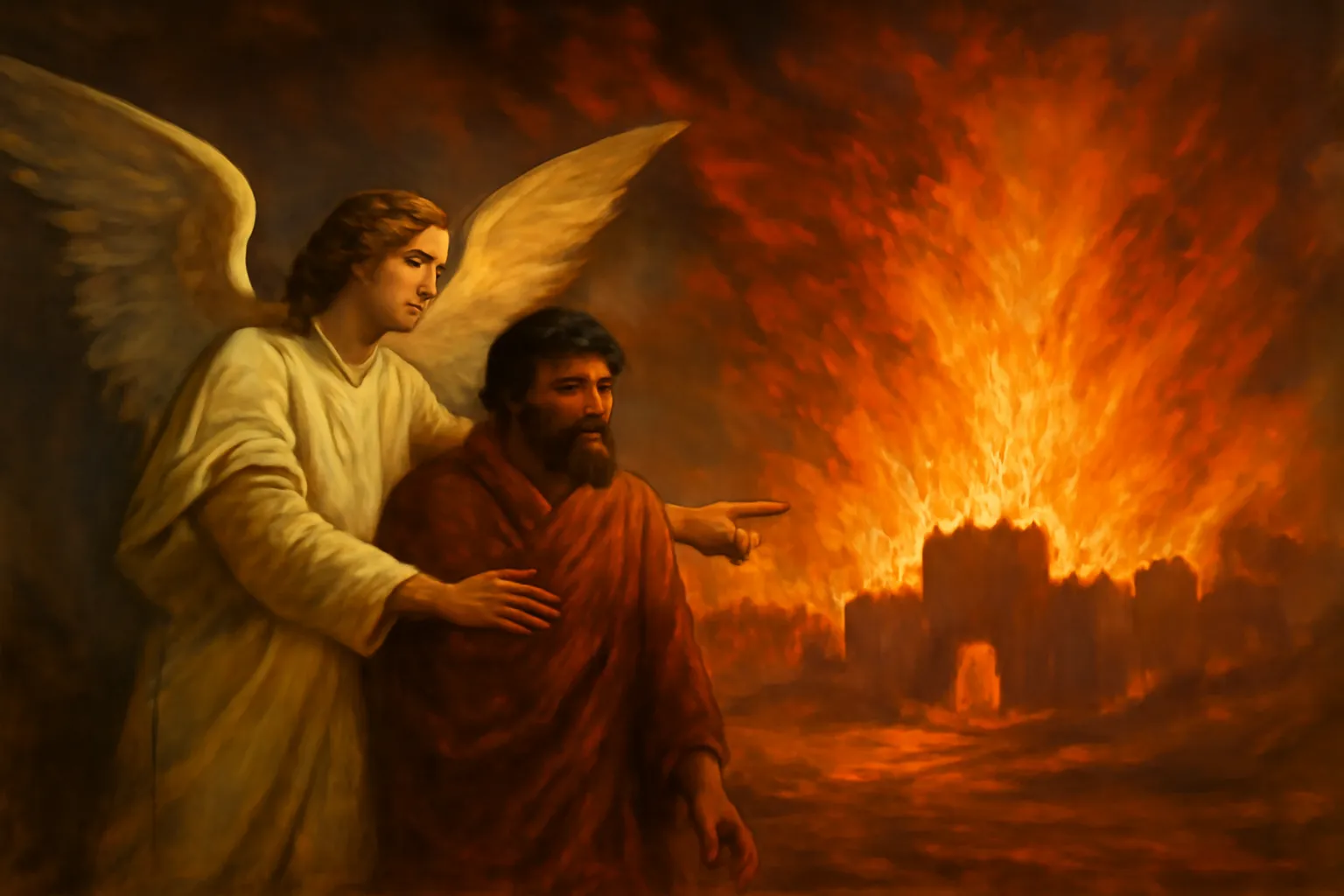
In Genesis 19, two angels arrive in Sodom, and Lot—a nephew of Abraham—hosts them in his home. The men of the city surround Lot’s house, demand that the visitors be sent out so they may “know” them in a hostile sense, and threaten violence. Lot offers his guests protection and even tries to shield them with a controversial gesture by offering his own unmarried daughters. The visitors restrain Lot’s hospitality concerns, reveal their traveling identity, and warn Lot to flee the city with his family.
The decisive moment comes when fire and brimstone rain down from heaven upon Sodom and Gomorrah, destroying all the inhabitants and the land on which they stood. The text explicitly states that the LORD rained sulfur and fire on the cities, bringing total obliteration. In the aftermath, Lot and his two daughters escape, while his wife looks back and becomes a pillar of salt (Genesis 19:26). This note on Lot’s family has long been discussed for its symbolic and moral implications as well as its narrative force.
Additional biblical references about Sodom’s destruction
Several later biblical passages echo or reference the fate of Sodom and Gomorrah to illustrate moral warnings or divine justice:
Jude 1:7 presents Sodom and Gomorrah as examples of those who suffered the vengeance of eternal fire, highlighting the severity and permanence of the punishment.
2 Peter 2:6–8 speaks of God turning the cities to destruction, condemning them as unlawful and serving as a warning to the godly to persevere in righteousness.
Luke 17:28–30 places the story of Sodom in a broader teaching about the days of Lot, warning readers to be prepared for sudden judgment in the fullness of time.
These passages do not always recite the full Genesis narrative, but they reaffirm the core imagery: divine intervention, sudden catastrophe, and moral significance attached to the events surrounding Sodom and Gomorrah.
How did God destroy Sodom? Different angles on the core question
The central question—how did God destroy Sodom—receives attention from several interpretive angles. While the Genesis account attributes the destruction to fire and brimstone, many readers and scholars explore additional layers: the possibility of a dramatic, immediate act of divine justice; implications of hospitality and inhospitality; and the way the story has functioned as a moral and theological warning across various traditions.
Literal, miraculous interpretation: the standard reading
In the most straightforward reading, divine fire and brimstone were unleashed from the sky in a heavenly judgment. This interpretation treats the destruction as a literal, supernatural intervention by God, distinct from natural processes. The emphasis is on the power of God to intervene directly in history when the moral fabric of a society reaches a breaking point.
Naturalistic and environmental explanations
Some scholars and commentators propose that the Genesis account could reflect a catastrophic natural event that affected the region in antiquity. The theory spaces include:
Volcanic or geothermal activity in the Dead Sea region, potentially releasing heat, ash, or vaporized minerals that could resemble “fire from heaven.”
A meteor or fireball impact that produced a rapid, devastating blaze and smoke, interpreted as divine action by a later generation.
Explosive volcanic eruption of sulfur-rich compounds that leave a lasting memory in oral and written tradition.
Proponents of naturalistic explanations do not deny the moral and theological significance of the narrative; rather, they explore how ancient audiences might have understood extraordinary phenomena as acts of divine judgment revealed through natural means.
The symbolic and literary reading
Another approach treats the Sodom destruction as a mythic or etiological narrative that communicates moral truths rather than providing a precise empirical report. In this view, the emphasis is on why the story became canonical, what it reveals about hospitality, social violence, and divine justice, and how the tale mobilizes readers to reflect on their own communities and ethical choices.
Cultural and theological contexts
The way one understands the question of how God destroyed Sodom is shaped by broader theological commitments. In Judeo-Christian traditions, it is often tied to the justice of God and the consequences of societal corruption. Some readers emphasize mercy and possibility of repentance that is glimpsed in the Abraham–Lot narrative, while others emphasize the irrevocability of judgment in the Genesis account. The debate reflects longstanding questions about divine mercy, human responsibility, and cosmic justice.
To appreciate the question of how the destruction unfolded, it helps to outline a chronology drawn from the primary biblical text and corroborating references. The following sequence captures the main beats as they are commonly read in Scripture.
Visit and inquiry: Abraham hosts three visitors; the Lord communicates a plan to reveal judgment on Sodom.
Announcement of judgment: The visitors declare that the outcry against Sodom and Gomorrah is grave and that their judgment is imminent.
Travel to Sodom: The narrative shifts to the cities in the plain where Lot has settled with his family.
Hospitality and hostility: Lot offers shelter to the visitors; the men of the city attempt to violate hospitality and assault the guests.
Protective intervention: The visitors warn Lot and urge him to flee with his family, signaling imminent danger to the city.
Escape and exhortation: Lot and his daughters flee to a safe place; Lot’s wife lingers, resulting in her transformation into a pillar of salt—an emblematic moment in the narrative.
Destruction: The cities are destroyed by fire and brimstone, as described in the Genesis text. The landscape is altered, embodying divine judgment as witnessed by survivors.
Aftermath: Lot and his daughters survive; the surrounding land bears the marks of catastrophe, and the story moves into themes of mercy, consequences, and the fragility of human decisions.
It is important to note that some scholars detect differences in emphasis between the Abrahamic account (which foregrounds hospitality, hospitality’s violation, and a dramatic rescue) and the later references (which emphasize judgment and moral warnings). Still, the core chronology remains centered on a consequence-laden judgment that leaves a lasting moral and theological memory.
Theological interpretations and implications
Across traditions, readers have asked not only what happened but why it happened and what it means for today. The destruction of Sodom serves as a hinge for discussions about divine justice, human responsibility, and the danger of moral decay. Several broad interpretive strands are worth noting.
Ethical and moral dimensions
The story is often read as a stark warning about inhospitality, violence, and social corruption. The parallel narrative of Abraham bargaining with God for mercy (Genesis 18) underscores the possibility of mercy for some, but the final outcome shows that justice may prevail when abuses become extreme.
Mercy, judgment, and the possibility of repentance
In the Abraham–Lot arc, there are moments that invite reflection on mercy and repentance, even in cities described as deeply wicked. The tension between justice and mercy lies at the heart of many theological discussions about how a just God relates to a world marred by sin.
Ethical lessons for communities and readers
Contemporary readers often draw lessons about hospitality, safety, and communal responsibility. The narrative challenges readers to consider how societies confront wrongdoing and how individuals respond when faced with moral choices that carry communal consequences.
Archaeological and historical considerations
The question of whether Sodom and Gomorrah can be located archaeologically has attracted significant interest. While the Bible places Sodom in the land of Canaan, near the valley of Siddim (the Salt Sea), the precise location remains a matter of scholarly debate. Some researchers have proposed sites near the Dead Sea with evidence of ancient destruction layers consistent with large-scale catastrophe. Others caution that the biblical text does not provide enough precise geographic coordinates to identify a single historical site with confidence.
From a historical-critical perspective, scholars may emphasize:
The possibility that multiple disasters over time contributed to a memory of total destruction.
The likelihood that stories about Sodom circulated among neighboring communities as moral exempla, even if embedded in real historical experiences of conflict or disaster.
The role of regional geology, such as natural fires or sulfur-rich eruptions, in shaping the imagery associated with the city’s fall.
Regardless of scholarly conclusions about exact locations, the account’s impact on religious thought and literature remains robust. The story functions within biblical tradition as a powerful narrative about divine justice, moral accountability, and the consequences of social corruption.
Variations in how different traditions read the question
Across Jewish, Christian, and Islamic traditions, the question of how did God destroy Sodom has produced a spectrum of interpretive outcomes. While the Genesis text is shared, each tradition highlights aspects that align with its theological priorities.
In Jewish interpretation, the story is often read within the larger narrative of the patriarchs and the covenant, emphasizing communal responsibility, hospitality, and justice aligned with divine instruction.
In Christian interpretation, the narrative frequently becomes a typology for judgment and mercy, with emphasis on New Testament reflections on righteousness, salvation, and divine sovereignty.
In Islamic tradition, while Sodom is less central than in the Judeo-Christian corpus, its themes of hospitality, moral conduct, and divine accountability resonate with Qur’anic exhortations about sin and repentance, and the admonition that communities should heed divine warnings.
The cross-traditional conversation highlights how a single biblical episode can be reframed to address different ethical and theological questions across centuries.
How this topic informs modern readers: lessons and cautions
The enduring question of how did God destroy Sodom is not merely about a distant historical event. It also invites readers to reflect on their own communities, institutions, and personal lives. Some of the practical implications that scholars and theologians emphasize include:
Addressing inhospitality and violence in communities, recognizing how they undermine social trust and moral order.
Recognizing the limits of judgment and the complex relationship between mercy and justice in divine action.
Considering how narratives of catastrophe shape moral memory and influence ethical decision-making in contemporary society.
In all discussions, the phrase “how did God destroy Sodom” remains a gateway to exploring the deeper questions about divine justice, human responsibility, and the ongoing relevance of ancient texts for present-day life.
Conclusion: reevaluating the question with care and nuance
The biblical account of Sodom’s destruction is a compact narrative that has generated a wealth of interpretation. Whether one reads it as a literal, miraculous event or as a symbolic moral tale, the central motifs—divine judgment, human moral failure, and the striking imagery of judgment by fire—continue to provoke reflection. The question how did God destroy Sodom? thus serves as a catalyst for broader inquiries: What does justice look like in a divinely governed world? How should communities respond to pervasive wrongdoing? And what can ancient testimonies teach readers about courage, hospitality, and ethical integrity in the present day?
By examining the biblical accounts, evaluating the theories that theologians and scholars have proposed, and reading the chronology of events in a careful and contextual way, readers can gain a nuanced understanding that respects the complexity of the text while recognizing its enduring significance.

 Por Laura Jara