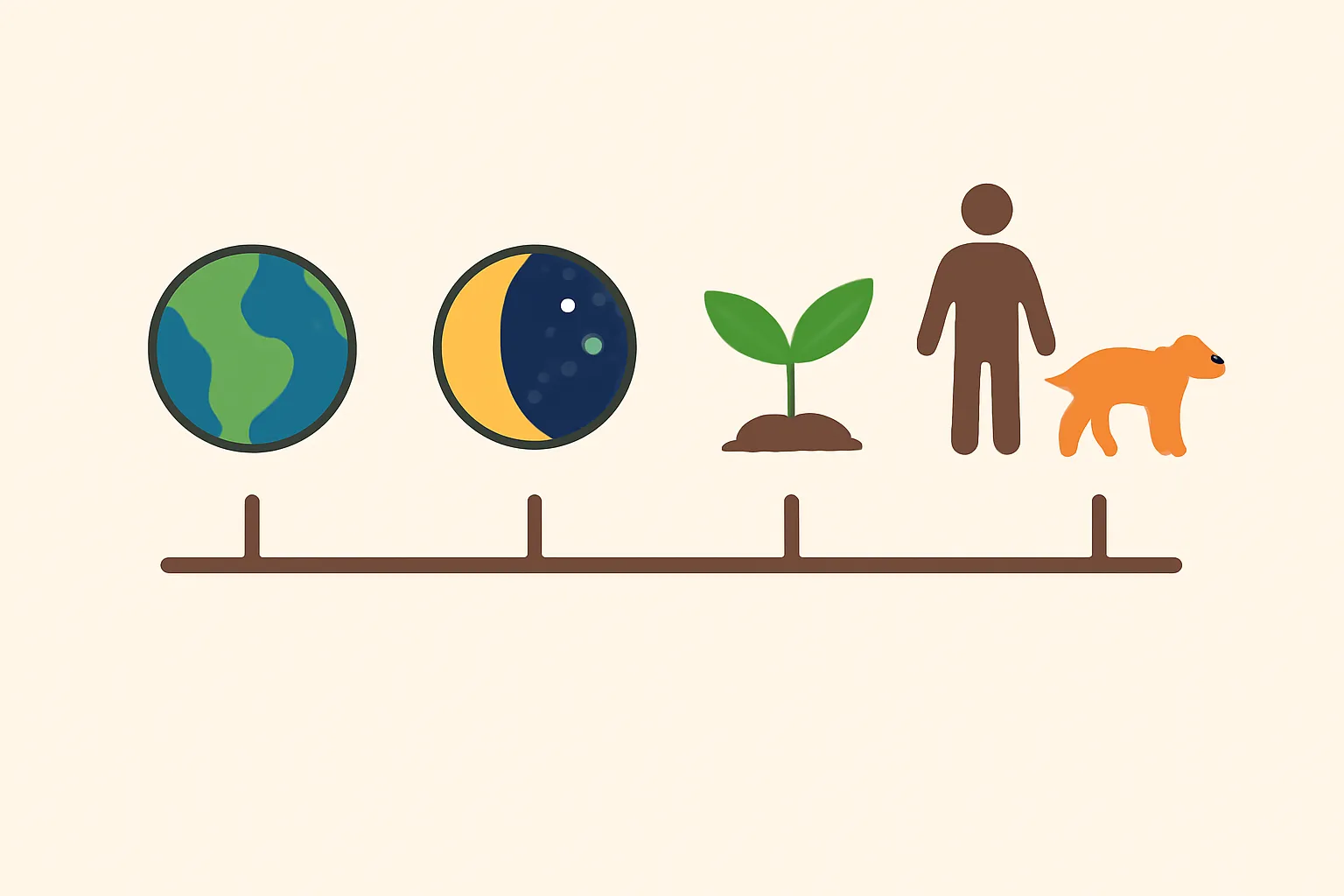
Understanding the timeline in the book of Genesis helps readers connect the cosmos, human origins, and the formation of the people of Israel. This guide presents a comprehensive overview of the Genesis timeline, from the beginnings of creation to the early patriarchs, and then to the formation of nations after the Flood and the Tower of Babel. The timeline is not a simple ledger of dates but a narrative framework that shapes theology, ethics, and worldview in the biblical tradition. In this article, we explore the major epochs, provide a sequential map, discuss varied interpretations, and offer practical tips for study.
Genesis Timeline: A Complete Guide to Creation and Key Events
At its core, the Genesis chronology spans several distinct but connected eras: the Creation Week, the primeval history that includes the generations from Adam to Noah, the flood narrative, the postdiluvian dispersion at Babel, and finally the patriarchal era that introduces Abraham, Isaac, and Jacob. Each stage contributes a piece to the theological map of origins—cosmic, human, moral, and national. Throughout this guide you will encounter multiple expressions for the same broad idea: the genesis timeline, the Creation chronology, the Genesis sequence, and the timeline of Genesis. They are used interchangeably in scholarly and popular discussions, but the focus remains the same: how one story unfolds into the next according to a divine plan.
Foundations of the Genesis timeline
To organize the material, it helps to picture the genesis timeline as layers that build on one another. The foundational layers are:
Creation narrative (Genesis chapters 1–2), which establishes the order of the cosmos and humanity.
Primeval history (Genesis 1–11), a chapter group that surveys humanity’s early generations, their moral choices, and the consequences that follow.
The Flood story (Genesis 6–9), which resets human civilization and introduces a covenantal pattern that recurs with Noah and his descendants.
The Babel episode (Genesis 11), explaining the dispersion of peoples and the formation of nations in the wake of human pride and divine intent.
The Patriarchal timeline (Genesis 12–50), which narrows the scope to a family lineage—the promises given to Abraham and their unfolding through Isaac and Jacob.
Creation week: A day-by-day scaffold
The centerpiece of the Creation timeline is the six-day workweek followed by a day of rest. The events are commonly presented in an ordered list to emphasize structure and purpose:
Day 1 — Light and darkness: God separates light from darkness, calling the light Day and the darkness Night.
Day 2 — Sky and seas: The sky is formed, separating waters above from waters below.
Day 3 — Dry land and vegetation: The waters gather, dry ground appears, and vegetation emerges in abundance.
Day 4 — Sun, moon, and stars: The celestial bodies govern day and night and mark seasons, days, and years.
Day 5 — Sea life and birds: Creatures of the waters and of the sky come into being according to their kinds.
Day 6 — Land animals and humanity: Land animals are created, followed by humanity in the image of God, with humanity given dominion over creation and the capacity for relationship with the Creator.
Day 7 — Rest: God rests, establishing the pattern of Sabbath rest and setting creation in a state of divine blessing.
Interpreters frequently discuss
Literal readings, which describe 24-hour days, and
Non-literal or day-age readings, which view the “days” as successive periods or symbolic phases.
Across traditions, the Creation Week establishes that God orders rather than chaos, that humanity bears a unique place in creation, and that time itself is structured by divine intention. This framing is foundational for the rest of the Genesis timeline.
The primeval chronology covers the earliest generations from Adam onward. It presents a pattern of human flourishing, moral failure, and divine response that informs the subsequent narrative threads. A concise way to view this era is to trace the main genealogical lines and their symbolic and theological significance:
Adam and Eve, rulers of the first household and caretakers of the Garden.
Cain and Abel, whose stories introduce themes of jealousy, sacrifice, and righteousness.
Generations from Adam to Noah, often summarized as the line of Seth and the broader post-diluvian lineage.
Within this section, the narrative emphasizes a few recurring motifs: the sacred image of humanity, the moral responsibilities that accompany that image, and the consequences of disobedience. The genealogies function on several levels: they preserve memory, demonstrate continuity, and prepare the reader for the cataclysmic events of the Flood that will reframe human history.
A compact representation of the Adam-to-Noah genealogical chain (often cited as the antediluvian line) is as follows:
Adam
Seth
Enosh
Kenan
Mahalalel
Jared
Enoch
Methuselah
Noah
These generations culminate in a pivotal turn of page for the Genesis timeline: Noah enters the scene, and the divine decision to judge humanity through a flood leads to a reset that reshapes the moral and spiritual topology of the ancient world.
The Flood: A turning point in the Genesis chronology
The Noah narrative marks a major hinge in the Genesis timeline. It moves from a world already marked by sin to a reestablished world in which human relationships with God are renegotiated. Several key moments can be mapped in the Noah cycle:
God’s decision to judge humanity for widespread corruption, initiating the Flood.
Noah’s righteousness and his wary obedience as the ark-builder and proclaimer of divine intention.
The ark as a vessel of salvation for Noah, his family, and representative animal kinds.
The Flood rains for 40 days and nights, followed by a longer period when waters prevail for 150 days.
The receding of waters and the ark’s resting on the mountains of Ararat, followed by gradual dry land and new life on earth.
The covenant with Noah, symbolized by the rainbow and accompanied by promises and conditions for future generations.
After the flood, the Genesis timeline shifts toward repopulation and the reordering of human civilization under divine stewardship. This postdiluvian era introduces new dynamics—human settlement, genetic multiplicity, and the beginnings of distinct nations that will later form the mosaic of the ancient Near East.
After the flood: The postdiluvian era and the Babel episode
Following the Flood, the Genesis sequence focuses on two core developments: the repopulation of the earth and the dispersion of peoples that results from a divine intervention at Babel.
Postdiluvian generations begin anew with Noah’s three sons—Shem, Ham, and Japheth—and their descendants, who populate different regions and cultures.
The Tower of Babel episode explains linguistic and geographic diversification, setting the stage for the emergence of nations with distinct languages and identities.
In this sense, the Babel narrative serves as a bridge between the primeval history and the patriarchal timeline, showing how divine actions shape human history and set up the conditions for the next major movement in Genesis: the call of Abraham and the unfolding of the covenantal story.
The patriarchal timeline: From Abraham to the founding of a people
The heart of the Genesis chronology turns toward the Patriarchs, beginning with Abraham. This segment emphasizes covenant, promise, geography, and blessing, and it traces a lineage that will become the nation of Israel. Key moments in this era include the following:
Call of Abraham (formerly Abram): a decisive shift from a generic family to a chosen lineage through whom all families of the earth will be blessed.
Covenant with Abraham: the land promise, the promise of numerous offspring, and the declaration of blessing for all nations through his descendants.
Sarah and Abraham’s offspring: the birth of Isaac, which preserves the line of the covenant through the next generation.
Isaac and Jacob: the transition from the father to the sons who carry the lineage forward; Jacob’s name change to Israel signals a new phase in the Genesis chronology.
Joseph and the descent into Egypt: a dramatic turn in the narrative that explains the later Exodus and anchors the connection between the Genesis timeline and the broader biblical history.
In compact form, the patriarchal sequence can be summarized as: the call and journey of Abram/Abraham, the birth of Isaac, the continuing line through Jacob (who becomes Israel), and the dramatic arc of Joseph that leads to the Israelites living in Egypt. These events set the stage for the liberation narrative that opens the next major portion of biblical history.
Chronology debates and interpretive frameworks
Scholars and readers have offered a variety of ways to understand the chronology of Genesis. Different interpretive lenses shape how one reads the Genesis timeline, the length of creation days, the dating of events, and the relationship between Genesis and later biblical books. The principal frameworks include:
Literal 24-hour days (Young Earth Creationism)
This view maintains that the Creation Week consists of six consecutive 24-hour days, creating a young earth with a relatively recent origin. Proponents often cite genealogies to argue for dates ranging from approximately 6,000 to 10,000 years ago. They typically contend that the Genesis sequence should be read as a straightforward chronology with minimal symbolic interpretation.
Day-age or framework interpretation
In this reading, the days of creation are seen as symbolic periods or “frames” that convey theological truth rather than a literal, sequential day-by-day account. Supporters argue that the structure highlights order, purpose, and divine governance, while allowing for an expansive view of earth history. The framework approach emphasizes literary design and motifs within the Genesis creation account.
Gap theory and pre-Adamic ages
The gap theory proposes a temporal gap between Genesis 1:1 and 1:2, suggesting there was an older world that experienced judgment before the creation as described in Genesis 1:2. This framework is used by some to harmonize scriptural language with long geological timescales. It remains a minority position in many traditions but has influenced various interpretive conversations about origins.
Symbolic and literary readings
Some interpreters approach Genesis as a composition that uses symbolic language and ancient Near Eastern literary forms to convey truth about God, humanity, and destiny. In this view, historical precision is balanced with theological meaning, and readers are invited to discern the underlying messages—such as divine sovereignty, human responsibility, and the promise of blessing through Abraham’s line.
Other considerations
Readers also weigh the relationship between Genesis 1–11 and later biblical genealogies, the dating of patriarchal events, and how the Genesis timeline interfaces with archaeological findings. While scholars debate exact dates, the genesis timeline remains a powerful narrative device for understanding faith, identity, and God’s purposes in human history.
Genesis timeline in the broader biblical narrative
Genesis does not exist in isolation; it is the opening movement of a larger biblical symphony. The Creation chronology and the events that follow inform the narrative arc of the Old Testament and connect to the exodus, the wilderness wanderings, and the eventual formation of Israel as a people bound by covenant with God. A few connective threads include:
The Covenant motif that begins with Noah and expands with Abraham, continuing to Moses and the nation of Israel.
The promised land as a geographic fulfillment of divine blessing and a stage for national formation.
The moral arc that incorporates sin, judgment, mercy, and reconciliation, culminating in redemptive anticipation within the broader biblical story.
As a result, the Genesis timeline can be read as a script for understanding how creation, fall, judgment, and blessing unfold in a purposeful sequence that leads toward Israel’s historical and spiritual formation.
Methodologies and sources for studying the Genesis chronology
Studying the Genesis timeline benefits from a combination of textual analysis, literary approach, and historical-contextual understanding. Some practical methods include:
Comparative reading of Genesis 1–11 with ancient Near Eastern creation narratives to appreciate shared motifs and distinctive biblical emphasis.
Textual criticism to examine how different manuscripts and translations affect numerology and phrasing in key passages.
Genealogical mapping to trace the lineages and their theological significance across Genesis 1–11 and into the patriarchal narratives.
Thematic cross-referencing with Exodus, Kings, and Chronicles to understand how the Genesis timeline informs later biblical events.
Scholars emphasize that precise dating may be elusive, but the order, structure, and purpose of the Genesis timeline remain clear: to present a coherent story of origins that frames human responsibility, divine promises, and the path toward blessing for all nations.
Common questions and misconceptions about the Genesis chronology
Readers frequently encounter questions when engaging with the Genesis timeline. Some common topics include:
Were the days of creation literal or symbolic? The answer depends on interpretive tradition, with both positions offering important insights into divine intention and biblical genre.
How do the genealogies affect timelines? Genealogies provide a framework for sequential progression, but many readers acknowledge potential inclusions, gaps, or symbolic emphasis within ancient genealogical records.
How old is the earth according to Genesis? Estimates range from a few thousand years to billions, depending on the interpretive lens applied to creation days and genealogies.
How do we harmonize Genesis with science? Perspectives vary; some prefer concordist approaches that seek harmony, while others emphasize distinct domains of knowledge—science for natural history, scripture for theological meaning.
What is the order of major events? Creation, the Garden, the Fall, the Cain/Abel narrative, the genealogies, the Flood, the Babel dispersion, and the rise of the patriarchs.
Practical takeaways for students and readers
Whether you study the Genesis timeline for theology, biblical literacy, or academic inquiry, several practical takeaways can guide your approach:
Approach the Creation chronology with an awareness of different interpretive horizons and the value of both historical and theological insights.
Use a timeline map to visualize the sequence of events from creation to the patriarchs, recognizing how each epoch builds on the previous one.
Recognize the recurring motifs—covenant, blessing, judgment, and restoration—that traverse the Genesis record and connect with the rest of the Bible.
Distinguish between literal details and symbolic meaning in numbers and ages, appreciating the broader narrative message even when exact dating is debated.
Consult a variety of sources—commentaries, introductory surveys, linguistic studies, and archaeological syntheses—to gain a balanced understanding of the Genesis sequence and its implications for faith and life.
Key takeaways for study and application
Across traditions, the Genesis timeline remains a vital map for understanding creation, human responsibility, and God’s unfolding plan. A few distilled insights help readers apply the timeline to study and daily life:
Creation order matters: The sequence of creation highlights orderly design, purpose, and the dignity of humanity as bearers of God’s image.
Judgment and mercy coexist: The Flood story and the Babel episode show that divine judgment is real, yet mercy and covenant promise persist across generations.
Faithfulness and failure run through generations: The genealogies and narratives of the patriarchs reveal a pattern of faith, doubt, obedience, and divine intervention that shapes Israel’s story.
Promises propel history: The Abrahamic covenant becomes the axis around which the biblical narrative rotates, setting expectations for land, offspring, and blessing that echo throughout the Bible.
Interpretation evolves: Different approaches to the genesis chronology illuminate diverse questions about time, science, and theology, inviting readers to grow in wisdom and humility.
In sum, the Genesis timeline is more than a chronology; it is a narrative framework that invites readers to explore origins, divine purpose, and the shaping of a people under a covenantal God. Whether you approach it as a literal sequence, a literary structure, or a blended interpretation, the timeline remains a foundational guide to understanding how creation moves toward promise, how humanity experiences consequence, and how a blessing plan unfolds across generations.

 Por Laura Jara