Good Friday timeline of events: A comprehensive chronology of Jesus’ Passion Week
The narrative of Good Friday is not a single moment but a sequence of events that unfolds within Passion Week, moving from intimate moments in the upper room to the public spectacle of crucifixion. This article presents a detailed chronology drawn from the gospel accounts and supported by scholarly reflection, offering a structured view of the day commonly remembered as the crucifixion of Jesus. While the four Gospels share core elements, they also present distinct emphases and timings. The goal here is to lay out a cohesive timeline that honors the range of sources while highlighting the essential milestones, turning points, and symbolic moments that shape the Good Friday narrative.
Foundations: what makes this day distinctive
Good Friday marks the culmination of Jesus’ path toward the cross within the broader Passion Week. It is the day on which many Christian traditions emphasize the sacrifice, redemption, and atonement proclaimed in the New Testament. The timeline of events centers on a series of judicial hearings, a Roman sentence, a brutal execution, and a hasty burial. Across the gospel accounts, the events take place in and around Jerusalem, with pivotal stops at places such as the Garden of Gethsemane, the courts of the Sanhedrin, the Praetorium (Pilate’s house), Golgotha (also called Calvary), and the tomb belonging to Joseph of Arimathea.
In order to appreciate the chronology, it helps to recognize a few overarching patterns:
Time markers in the Gospels are often given in terms of Jewish hours (for example, the third hour, the sixth hour, and the ninth hour) and Roman timekeeping. When translated to modern conventions, these time references place key moments in the late morning to early afternoon window on Friday.
The sequence includes both human agency (Judas’ betrayal, the Sanhedrin’s trial, Pilate’s handling of the case) and divine purpose (narratives of fulfillment, atonement, and mercy) that many readers find harmoniously braided across the four canonical accounts.
Several events are presented with varying details in the four Gospels. A comprehensive timeline respects the core continuity while noting a few differences in emphasis and order.
Overall structure of the day: a chronological map
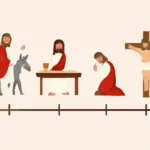
The following timeline lays out the Good Friday events in a structured sequence, organized to reflect how the day unfolds in traditional readings and in the chronological sense that scholars and preachers often employ. Each major moment is introduced with its label, followed by a concise description and, where helpful, sub-points that illuminate key elements.
Good Friday timeline of events: a chronological walk-through
Garden arrest and Judas’s betrayal — After the Last Supper, Jesus and his intimate followers retreat to the Garden of Gethsemane. Judas Iscariot arrives with a cohort to betray Jesus with a kiss. The arrest is swift and decisive, signaling the transition from the intimate teaching moments of Thursday to the ensuing trial and crucifixion on Friday.
Judas’s betrayal and the crowd’s approach with torches and weapons.
Peter’s impulsive defense (cutting off a servant’s ear) and Jesus’s response emphasizing restraint and obedience to the Father’s will.
The crowd leads Jesus away, initiating the sequence of religious and civil proceedings that will culminate in the cross.
Trial before the Sanhedrin — In the pre-dawn hours, Jesus is taken to the house of Caiaphas, where the Jewish authorities press charges, seek a formal verdict, and accuse him of blasphemy. The night session includes testimonies that are difficult to verify by modern standards but serve the purpose of the Gospel narrative: to present Jesus as the obedient Messiah who is condemned by religious authorities for claiming a divine title.
Formal accusations of blasphemy and the question of Jesus’s identity.
Condemnation by the Sanhedrin, preparing the case for presentation to the Roman authorities.
Word spreads that Jesus must be handed over to Rome for sentencing in a way that would satisfy public and religious concerns.
Trial before Pilate and then Herod — The next phase moves to the Roman governor, Pontius Pilate, who is confronted with a political dilemma: the crowd demands execution, but Pilate seeks a way to release Jesus if possible. This section also records an encounter with Herod Antipas, who has sought to see Jesus but finds no grounds to condemn him. The political theater culminates in Pilate’s decision to condemn Jesus to crucifixion, driven by public pressure and the desire to maintain order.
Pilate’s inquiry into charges and his search for a legal justification to release Jesus.
The crowd’s demand for the release of Barabbas and the condemnation of Jesus.
The washing of hands as a symbolic gesture reflecting Pilate’s attempt to distance himself from the decision.
Scourging, mockery, and the preparations for crucifixion — After condemnation, Jesus undergoes brutal scourging, is mocked with a purple robe and a crown of thorns, and is forced to bear the cross’s beam toward the place of execution. This phase emphasizes both the physical suffering and the humiliation that surrounds the crucifixion narrative.
The scourging and the crown of thorns, a symbol often discussed in theological reflections.
The soldiers’ mockery: “Blessed is the King of the Jews” becomes a grim reversal of the claim Jesus accepts as true about his kingship.
Forging the cross and preparing for the ultimate act of execution at Golgotha.
The way to Golgotha and the crucifixion — Jesus is compelled to carry or at least drag the crossbeam to the hill called Golgotha (the Place of a Skull). On the hill, he is crucified between two criminals. The act of crucifixion is the central, undeniable moment of the day, executed in a solemn but public manner.
Arrival at Golgotha, the cross raised, and the crowd’s witness to the event.
The inscription placed on the cross—often described as “King of the Jews”—and the crowd’s varied reactions.
Jesus’s final declarations and the questions raised by bystanders and passersby about his identity and mission.
Crucifixion hours, darkness, and the dying cry — A notable moment in the Good Friday account is the period of darkness that covers the land from roughly noon until the ninth hour (3 p.m.). In the Christian tradition, this darkness is interpreted as a sign of cosmic significance—divine mourning, judgment, or the breaking of the natural order as Jesus bears sin and sorrow.
The darkness that covers the land and the sense of cosmic upheaval it conveys.
Jesus’s final poignant statements from the cross and his loud cry, often translated as “It is finished” or “Father, into your hands I commit my spirit.”
The moment of death, followed by a quiet pause that invites reflection on the meaning of the sacrifice being presented in the narrative.
The veil, the centurion, and the opening to burial — Immediately after Jesus’ death, several dramatic signs appear in the temple and the surrounding space. The tearing of the temple veil is read by many traditions as a symbol of access to God breaking through the barrier that had separated humanity from the divine. At the same time, a Roman centurion proclaims Jesus to be righteous, underscoring the sense of recognition that emerges from the event. Then, preparations for burial begin.
The temple veil’s tearing is a focal image for many theologians and liturgical poets, representing access to divine presence through the crucifixion.
The provincial centurion’s witness reflects a recognition of Jesus’ extraordinary stature and significance beyond the circle of his immediate followers.
Joseph of Arimathea requests Jesus’s body and buries it in a tomb he has prepared, with the assistance of Nicodemus or other followers according to tradition.
Burial in the tomb and the preparations for the Sabbath — Jesus is laid in a tomb owned by Joseph of Arimathea, and a large stone is rolled across the entrance. Women who had followed Jesus prepare spices and plan to return after the Sabbath to complete the anointing, a detail that connects to dawn on Sunday in the Easter narrative.
The role of women as faithful followers who observe the burial and plan for ritual honors.
The sense of waiting that Thursday night and Friday brings, setting the stage for the Sunday events in Christian tradition.
The Sabbath rest that begins in late Friday continues into early Saturday, shaping the pace of activity described in the narrative.
The Gospel portrait: cross-reading the four accounts
The four canonical Gospels—Matthew, Mark, Luke, and John—offer parallel lines of the same story, each emphasizing different facets of the Good Friday timeline. A few study points help readers compare the accounts:
All four indicate a trial before Pilate and a verdict leading to crucifixion, though the sequence and details (such as the involvement of Herod) differ across sources.
All describe the crucifixion and the event of the cross, with variations in the details of the crowd, the inscriptions, and the interactions with the condemned criminals.
All recount the death of Jesus and the subsequent burial, but the precise sequence of signs (veil tearing, earthquakes, and witnesses) is presented with varying emphasis in the different gospels.
Cross-gospel reflections: harmonies and tensions
In considering the Good Friday chronology, scholars often discuss how the Gospels harmonize or diverge in their accounts:
Harmonization highlights a shared core—arrest, trials, crucifixion, death, and burial—while acknowledging that some time markers and sequence details differ between Matthew, Mark, Luke, and John.
Differences may reflect theological priorities: John’s high Christology and the emphasis on Jesus’s control of events; Luke’s focus on marginalized figures and compassion; Mark’s brisk narrative and sense of immediacy; Matthew’s fulfillment motifs and the temple imagery.
The net effect is a robust portrait of a complex day, with a central action (the crucifixion) that anchors all the surrounding scenes.
Theological themes that emerge from the Good Friday chronology
Beyond the sequence of events, several central themes emerge when one considers the Good Friday timeline in light of doctrine and devotion:
Atonement and redemption: Jesus’ suffering and death are understood in traditional Christian thought as the moment of atonement for sin and the opening of a path to reconciliation with God.
Sacrifice and obedience: Jesus’s willingness to endure the cross is seen as the ultimate act of obedience to the Father’s redemptive plan.
Fulfillment of prophecy: The events are read by many as the fulfillment of Old Testament types and expectations about the Messiah’s suffering and kingship.
Human agency and divine sovereignty: The timeline foregrounds the human actors who participate in the events while also keeping the larger purpose of God’s plan in view.
Key places and characters that anchor the Good Friday chronology
Several figures and settings recur in the Good Friday story, serving as anchors for memory and interpretation:
Gethsemane — The moment when Jesus prays with acute distress, highlighting his humanity alongside his divine calling.
Caiaphas and the Sanhedrin — The religious authorities who push for condemnation in a formal religious process.
Pilate and Herod — The Roman authorities who operate within the political and legal frameworks of the day, ultimately authorizing Jesus’s death.
Golgotha — The hill of crucifixion that becomes a symbol of the cross’s central meaning.
Joseph of Arimathea — The devotee who secures Jesus’s body for burial, fulfilling a compassionate act in a difficult political moment.
Variations in time and emphasis: why the Good Friday timeline matters for faith and study
The exact times and the sequence of minor details differ among sources. Yet the overarching narrative remains coherent: a night of anguish, a day of confrontation, a day of public execution, and a burial that signals the transition into the Easter narrative. For readers and worshippers, the timeline functions in multiple ways:
As historical narrative: It offers a sense of how these events unfolded within the social and political context of first-century Jerusalem.
As liturgical memory: The timeline informs worship practices, sermons, and meditative readings around Good Friday.
As theological reflection: It invites contemplation of the meaning of suffering, sacrifice, and divine love expressed in the cross.
Readers frequently ask about specific moments in the timeline. Here are concise responses to a few widely circulated inquiries:
What time did Jesus die? The Gospel accounts typically place the death at or around the ninth hour (about 3 p.m.).
Why did the temple veil tear? The tearing of the veil is interpreted as a symbol of access to God through Jesus’s death, removing the barrier between human beings and divine presence.
Was Jesus in control of the events? The narrative emphasizes both human agency (accusations, decisions, and political moves) and the sense that Jesus knowingly entrusted himself to the Father’s will.
For modern readers, the Good Friday chronology offers several practical avenues for reflection:
As a narrative of compassion and mercy: Jesus’s suffering is portrayed as a conduit for divine compassion for humanity.
As a model of courage and steadfast faith: The figures who remain faithful—such as Joseph of Arimathea and the women who accompany Jesus—are offered as examples of steadfastness in the face of fear and uncertainty.
As a call to humility and reconciliation: The events invite readers to consider how communities respond to conflict, power, and human need.
Historical notes and interpretive cautions
When engaging with the Good Friday timeline, it is wise to remember:
The accounts are ancient documents written for faith communities, not modern police reports. They reflect theological aims and liturgical purposes as well as historical details.
Different Christian traditions may emphasize different aspects of the day and highlight distinct devotional themes (e.g., atonement, sacrifice, mercy, justice).
Scholars continue to explore the historical context of first-century Judea and Roman rule to better understand the setting in which these events occurred.
The Good Friday timeline of events offers more than a sequence of actions; it invites a meditation on the human experiences of fear, courage, betrayal, and grief, viewed through the lens of divine mission and hope. As a story that moves from the stillness of a garden to the loud cries of a crowd, the cross becomes not merely a symbol of suffering but a focal point for contemplation about meaning, justice, and mercy. For believers, the day remains a call to remember the cost of grace and to reexamine the ways in which compassion, justice, and faith intersect in daily life.
This comprehensive chronology of the Passion Week’s climactic moments—often labeled the Good Friday events—serves as a resource for study, worship, and personal reflection. By tracing the arc from arrest to burial, readers encounter a narrative that has shaped Christian memory for two millennia and continues to provoke questions, awe, and devotion in contemporary faith communities.
Notes for further study
If you wish to explore this topic further, consider:
Comparative readings across the Gospels to see how each author frames the same events.
Historical and geographical studies of Jerusalem and Roman governance in the first century.
Liturgical practices and hymns associated with Good Friday in different Christian traditions.

 Por Laura Jara