Introduction: The Wilderness Test and the Third Temptation
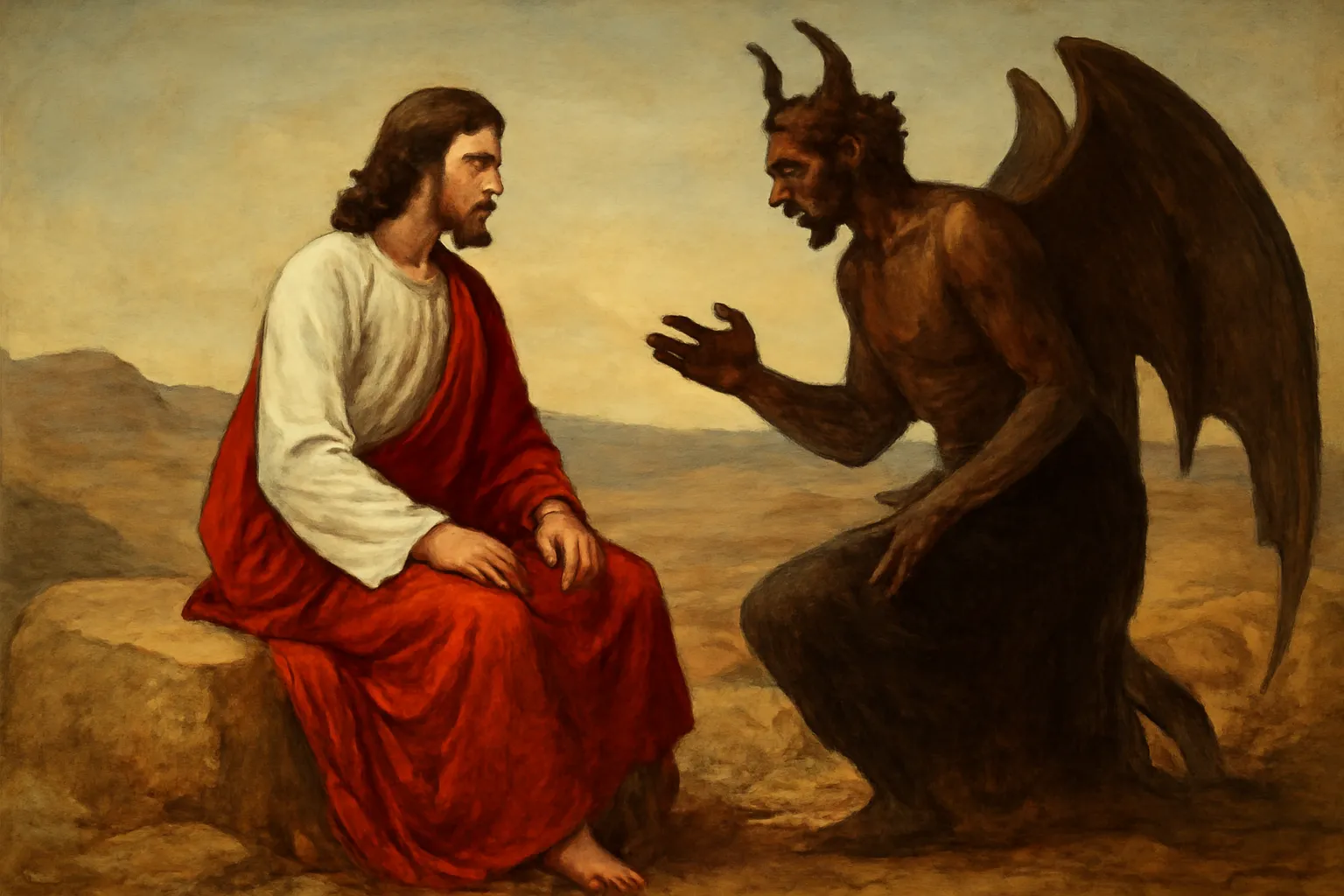
The account of Jesus’ temptations in the wilderness is one of the most compact yet consequential narratives in the Gospels. Within this desert episode, the final temptation—often called the third temptation—poses a climactic choice about power, public display, and trust. In this encounter, Satan presses Jesus to prove his identity and telegraph his kingdom through a dramatic, spectacular act. The wording, the place, and the theological stakes are all tightly focused on the question: Will the Messiah reveal himself through miraculous spectacle or through steadfast obedience to the Father’s word?
In this article, we examine the third temptation in its biblical context, its textual siblings, and its broader significance for Christian faith and ethics. We consider variations in wording and sequence between Gospel accounts, the historical and literary backdrop of the wilderness setting, and the enduring interpretive strands from patristic to modern exegesis. The goal is to illuminate not only what happens in the text, but what the temptation reveals about the nature of Jesus’ mission and the kinds of faith demanded of readers today.
The Narrative Context: Where This Final Test Appears
The wilderness temptation occurs immediately after Jesus’ baptism and a 40-day fast, a period scholars often describe as a formative crisis that tests his commitment to his vocation. The temptation is not a whimsical story about magic tricks; it is a reflective probe into the authenticity of Jesus as the Son of God and the kind of authority he will wield. The final test centers on whether Jesus will manipulate reality to summon proof of his divine status or endure as one who trusts in God’s provision and order.
Matthew vs. Luke: a glance at the textual variations
Two canonical accounts present the wilderness temptations with subtle but meaningful differences. In the Gospel of Matthew, the temptations unfold as:
First temptation: turning stones into bread to satisfy physical hunger.
Second temptation: being invited to throw himself down from the pinnacle of the temple to test God’s protection.
Third temptation: to worship Satan in exchange for all the kingdoms of the earth (this is sometimes treated as the climactic moment depending on the reading).
In the Gospel of Luke, the sequence begins similarly with hunger, but then emphasizes a broader vision of worldly authority before culminating in the temple test as the final temptation in the narrative arc. Luke places the pinnacle test in a moment of dramatic confrontation where Jesus is urged to “cast thyself down from hence.” The triad can be summarized as: bread → kingdoms → temple pinnacle, with the final command echoing the words that would create a public, spectacular proof of his protection. Because of these variations, scholars often speak of a “third temptation” in Luke as the climactic confrontation, while recognizing Matthew’s temple-test has a parallel role in the sequence of testing.
Regardless of the exact ordering, the core issue in the third temptation remains: will Jesus require signs or perform exploits to authenticate his status, or will he rely on the Father’s word and plan? The answer Jesus gives in both accounts is a decisive refusal to coerce God or to coerce others into faith through sensational acts.
The Content of the Third Temptation: What Satan Proposes
The climactic test hinges on a precise, provocative prompt from Satan: a challenge to demonstrate divine protection in a spectacular, public way. The main elements are:
Identity assertion: “If you are the Son of God.” The tempter presses Jesus to prove who he is by outward signs, not by obedient trust.
Public risk: The act would expose Jesus to a dramatic fall from a high place where witnesses could see and marvel, thereby creating a spectacle that could rally public acclaim or fear.
Scriptural twist: Satan offers a misapplied use of scripture to suggest that divine protection would and should extend to dangerous publicity—the very thing Jesus is being asked to provoke.
The specific wording in the temptation is strikingly pointed in the biblical text. In the words of Luke, the temptation at the pinnacle of the temple reads as a direct test: “If thou be the Son of God, cast thyself down from hence: for it is written, He shall give his angels charge over thee: and in their hands they shall bear thee up, lest at any time thou dash thy foot against a stone.” This is a classic case where a spiritual misquotation is offered as a guarantee for a dangerous act. Jesus’ counter-education, rooted in Deuteronomy, emphasizes a radical fidelity: “Thou shalt not tempt the Lord thy God.”
Thus, the 3rd temptation in Luke’s account asks for a public demonstration of divine protection, while the response highlights a theological principle: God’s care is real, but it is not to be manipulated or prodded into service by human desire for spectacle.
Key Theological Themes in the Third Temptation
Several enduring theological threads surface in the analysis of the climactic test in the wilderness. These themes help explain why the third temptation matters for Christian doctrine and ethics:
Testing God versus trusting God: The act of throwing oneself down tests God’s reliability, a move Jesus rejects. The boundary here is not skepticism but a refusal to demand signs as a condition of faith or safety.
Authority and delivery modes: Satan invites Jesus to exercise authority in a way that would be public, spectacular, and worldly. Jesus’ refusal preserves the distinction between divine kingship and self-serving manipulation.
Scripture used in service of power: Satan cites Scripture to justify a high-risk test. Jesus counters by appealing to a more faithful hermeneutic—one that interprets Scripture in light of God’s overarching will rather than cherry-picking verses to sanction a stunt.
Messianic expectations in tension with vocation: The temptation tests how Jesus understands his mission—whether he will become a political or thaumaturgic celebrity or remain the faithful servant who, through suffering and obedience, brings about God’s kingdom.
Historical and Theological Interpretations Across Traditions
Across Christian history, the climactic wilderness test has been parsed and applied in diverse ways. The patristic era read the third temptation as a warning against the allure of spectacular signs that could mislead followers or provoke worship of the instrument rather than the God who uses humble means. Early commentators emphasized that Jesus did not resort to magical demonstrations or to worldly power to reveal his identity; rather, he embraced a path of obedience even when it meant rejection by those who sought power through spectacle.
The Reformation period sharpened an ethical emphasis: genuine faith does not require miraculous proof, and the true test of discipleship is whether one resists the urge to coerce God for personal gain or reputation. Reformers like Luther and Calvin stressed that the conscience must be guided by Scripture, not by sensational claims or self-serving promises of protection. The third temptation thus becomes a case study in how faith adheres to God’s word in the face of public pressure.
In modern scholarship, scholars often highlight the symbolic dimensions of the wilderness setting—the place of testing, purification, and formation. The desert represents not merely a geographical location but a spiritual pedagogy: a space where false assurances are stripped away and what remains is fidelity to the Word. Some theologians also draw attention to the political dimensions of the temple setting in Matthew’s account, where the act of casting oneself down could be read as a challenge to religious authority, a temptation Satan uses to foment popular uprising or chaos. In this light, the third temptation becomes a meditation on the proper channeling of power and the ethics of leadership.
Symbolic Significance: Desert, Temple, and the Shape of Testimony
Two locations occur prominently in the third temptation narrative: the wilderness, where Jesus is tested, and the temple pinnacle, the stage for a dramatic demonstration. Each setting carries symbolic weight:
Desert as formation: The wilderness is not a punitive space but a place of formation, where dependence on God is trained and discernment is sharpened.
Pinnacle as exposure: The temple’s high point is a literal and figurative stage, where visibility and risk intersect. A fall could be seen as a fall from grace or a fall into public confidence, depending on the observer’s interpretation.
Scripture misused as weapon: The misuse of sacred text to authorize dangerous acts is a recurring motif in both testaments—an invitation to read the Bible as a toolkit for power rather than as a guide to faith and love.
Ethical Implications for Faith Communities
The ethical lessons drawn from the climactic wilderness encounter remain resonant for contemporary faith communities. A few salient takeaways are:
Resisting sensationalism: Communities should distinguish between legitimate signs of God’s presence and the sensationalism that can accompany public demonstrations of power.
Trusting God’s word over worldly proofs: The fidelity of Jesus in this encounter models a trust that’s grounded in Scripture and in the character of God rather than in empirical spectacle.
Humility in leadership: Leaders who center vulnerability and obedience — rather than spectacle or dominance — mirror the path Jesus chooses in the wilderness.
Pastoral Reflections: Lessons for Today
Pastorally, the third temptation invites believers to examine where their own faith leans toward sensational proof or toward quiet, obedient trust. In a world fascinated by miracles, headlines, and dramatic displays, the text challenges readers to ask: Do we worship or rely on the God who sometimes works through ordinary, unseen means? Do we seek to prove our identity, or do we let God define it? The episode invites a posture of humility and dependence, even in the face of risk, and it calls communities to interpret hardship not as a sign of God’s absence but as an arena in which courage, faithfulness, and scriptural wisdom can mature.
Several popular oversimplifications sometimes accompany discussions of the climactic temptation. Clarifying these helps preserve the text’s depth:
Misunderstanding: Jesus simply refuses any form of protection or miraculous intervention.
Clarification: The issue is not a blanket rejection of miracles but a refusal to force God’s aid or to coerce belief through dangerous tests.
Misunderstanding: The third temptation was the only time Jesus was tempted to perform miracles to gain followers.
Clarification: Temptations in the wilderness are a narrative device to reveal Jesus’ fidelity; miracles as public signs occur elsewhere in the Gospel narratives, but the wilderness test emphasizes obedience over spectacle.
Theological Implications for Christology and Soteriology
From a Christological perspective, the climactic wilderness test reinforces the understanding of Jesus as One who bears human vulnerability yet remains faithful to God. The refusal to worship Satan or to leverage divine protection for public glory underscores a consistent witness that Jesus embodies a self-offering rather than self-promotion. The third temptation, in this light, becomes a lens through which one reads Jesus’ entire mission: not a quest for political power or sensational proof, but the path of obedience unto death, which the Gospels present as the decisive act by which humanity is reconciled to God.
Concluding Reflections: The Message of the Third Temptation
The third temptation of Jesus, as it appears in Luke’s account and in parallel strands of Matthew’s narrative, offers a compact but profound meditation on faith, power, and trust. It asks readers to consider how divine direction and human responsibility intersect. The key resolution—Jesus’ quelling response, grounded in Deuteronomy’s law and the reverent fear of God—provides a model for faithful living: do not mistake signs for substance, do not weaponize religious authority, and do not demand protection in ways that presume to shortcut the road of obedience. In this sense, the wilderness test—particularly the climactic temple-tested moment—serves as a very old but continually relevant template for discerning, faithful discipleship in any era.
To return to the topic at hand, the 3rd temptation in the wilderness is not merely a snippet of narrative drama; it is a compact doctrinal proclamation: God’s purposes are best realized through humble fidelity to God’s Word, not through sensational displays of power. It is an invitation to readers across ages to trust the Father’s care, obey the Word, and resist every urge to coerce God or people into faith through dramatic acts. In a world eager for spectacle, the third temptation stands as a steady reminder that authentic faith rarely needs to prove itself through public stunts; it proves itself through patient obedience, steadfast love, and unwavering fidelity to God’s revealed will.
For further study, readers may wish to compare how the Temple-peril moment in Matthew and Luke shapes different theological emphases—one highlighting test within a temple-centered setting, the other emphasizing a broader revelation of sovereignty over kingdoms—while recognizing that the essential moral is the same: true authority is exercised in accordance with God’s word, not the world’s tests.

 Por Laura Jara