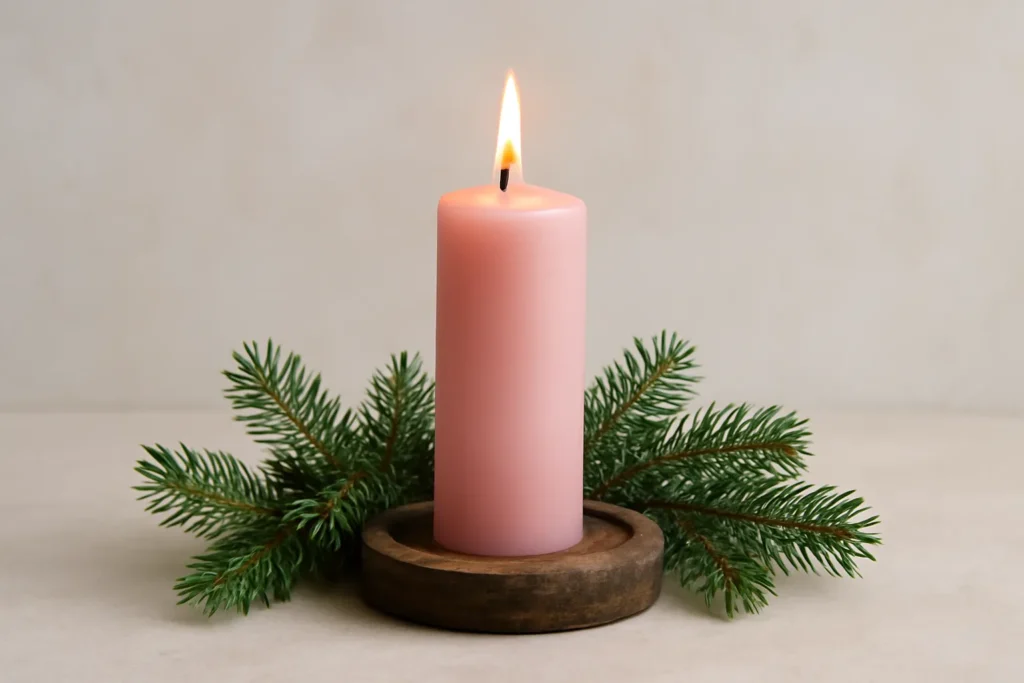
The Advent pink candle, sometimes called the rose candle, is one of the four candles used in the traditional Advent wreath. In most Western Christian traditions, the wreath holds four candles arranged around a circle of evergreen foliage. Each Sunday of Advent, one candle is lit, advancing the anticipation toward Christmas. What makes the pink or rose candle distinctive is that it is generally lit on the third Sunday of Advent, a day commonly known as Gaudete Sunday, which means “rejoice” in Latin. This candle serves as a color-coded reminder that the season, while still penitential in tone, is moving toward a moment of joyful celebration.
Across denominations and households, you will encounter variations in the exact shade, naming, or order of the candles. Some churches and families refer to it as the pink Advent candle or simply the rose candle, while others may describe it as a light pink, blush rose, or soft pink candle within the Advent wreath. Regardless of the descriptor, the central idea remains the same: to symbolize joy interrupting the season of preparation and waiting.
Meaning of the Pink Candle in Advent
Joy on Gaudete Sunday
The Gaudete Sunday theme is central to understanding the appearance of the pink candle. On the third Sunday of Advent, the faithful are invited to acknowledge a growing sense of joy as the Christmas event approaches. The pink candle embodies that distinct feeling of gladness that emerges in the midst of expectant waiting. It is a gentle pivot in the liturgical mood—more buoyant than the previous Sundays, yet still mindful of the penitential roots of the season.
Color Symbolism and its Layered Meaning
Pink as a sign of joy: In many traditions, pink is associated with a lighter, more celebratory tone without discarding the sense of preparation that Advent embodies.
Contrast with purple: The other three candles are often purple (or violet) to signal penitence, hope, and preparation. The pink candle provides a visual and thematic contrast that highlights the progression toward Christmas.
Balance of themes: While the Advent season remains focused on anticipation, the pink candle reminds worshippers that joy is a proper response to God’s coming—both in the heart and in the world.
Liturgical and Personal Implications
Liturgical cue: Lighting the pink candle on Gaudete Sunday is a concrete ritual that signals a shift in the season’s calendar and mood.
Personal devotion: For families and individuals, the pink candle is a prompt to reflect on the sources of joy in the Christmas narrative—God’s promise, the gift of community, and the mercy that accompanies the Advent waiting.
Educational value: Using the pink candle in teaching moments helps explain the rhythm of Advent, the meanings of the four Sundays, and the way color carries message across generations.
Historical Roots: The Advent Wreath and the Pink Candle
The Advent wreath has a well-documented lineage that blends medieval symbolism with modern practice. The concept of shortening the waiting period for Christmas into a weekly, candle-lit ritual is widely attributed to German-speaking communities in the late Middle Ages and early modern era. The most influential figure in the creation of the contemporary Advent wreath is Johann Hinrich Wichern, a Lutheran minister who built a large wooden wreath with many candles for orphans in Hamburg in 1839. This early kind of wreath was designed to teach and sustain children through the long weeks of Advent and Christmas.
From that seed, the form of the Advent wreath spread across Protestant, Catholic, and other Christian communities. The classic arrangement of four candles around the circle—three purple or violet candles and one pink rose candle—became a standard in many churches and homes by the 20th century. The evolution is nuanced, however, and not universal. Some congregations use blue candles or all purple candles; some use only three candles, while others add a fifth or even fewer to accommodate regional or denominational practices.
The pink Advent candle was integrated as a distinct marker for Gaudete Sunday only after this framework had become established. In many liturgical calendars, Gaudete Sunday sits roughly in the middle of Advent, marking a pivot from solemn preparation to a more exuberant expectation. The rose-colored flame, then, is more than a decorative choice—it embodies a theological and pastoral shift that aligns the liturgy with the reality of Christmas near at hand.
15th–16th centuries: Advent wreath ideas begin to appear in German sermons and devotional literature, often as a simple circle of greenery to symbolize eternal life and hope.
1839: Johannes Hinrich Wichern introduces a large wreath with candles for an orphanage in Hamburg, helping to popularize the format of a weekly candle ritual.
Early to mid-1900s: The four-candle design becomes widely adopted in Western churches, with purple (violet) candles framing a single pink candle on the third Sunday in many traditions.
Contemporary practice: Some communities retain purple for all four candles, while others emphasize the pink candle as a central symbol of joy during Gaudete Sunday. Home observances often adapt colors to reflect personal or cultural preferences while preserving the overall rhythm of Advent.
Liturgical Use and Home Observances: How the Pink Candle Is Used
In the Church: Ritual, Readings, and Community
In many churches, the Advent wreath is placed in a visible location during worship services. The typical liturgical order involves lighting one candle on the first Sunday of Advent, a second the following week, the pink candle on Gaudete Sunday, and the final purple candle on the fourth Sunday. The sequence underscores a spiritual journey: hope, preparation, joyful anticipation, and renewed commitment to faith.
The pink candle is not merely decorative. Its lighting is accompanied by prayers, readings, or a brief reflection on joy in expectation and the ways God’s coming changes the world. In some congregations, a brief homily or meditation on the theme of rejoicing accompanies the lighting, inviting the entire assembly to contemplate how joy can exist alongside longing and need.
In practice, many churches pair the lighting with a responsive reading or a hymn that centers the congregation’s attention on the season’s midpoint. The symbolism invites participation: the people sing together, light a flame together, and carry the message of the pink candle into the week ahead.
In the Home: Family Devotions, Décor, and Personal Reflection
Families often adapt the Advent wreath into a domestic symbol of spiritual preparation. Lighting the pink candle on the third Sunday can become a family moment for thanksgiving, gratitude, and plan-making for Christmas-time acts of charity or hospitality. Home use may include brief prayers, a shared reading from a devotional guide, or a discussion about acts of kindness to perform before Christmas Eve.
Decoration-wise, the pink candle in the home is frequently the centerpiece of an arrangement that includes evergreen boughs, pine cones, dried oranges, cinnamon sticks, and fairy lights. This arrangement can be kept on a dining table, an entryway, or a living room altar. The goal is to create a calm, reflective space that invites slow, meaningful contemplation during the Advent season.
Decoration Ideas: Creative Ways to Display the Advent Pink Candle
One of the most compelling aspects of the Advent pink candle is how it blends symbolism with aesthetics. The pink flame on Gaudete Sunday can be a catalyst for decorating ideas that are both beautiful and meaningful. Below are ideas tailored for homes, churches, classrooms, or community spaces.
Wreath and Centerpiece Ideas
Classic evergreen wreath with four candles: place three purple candles and one pink candle in a circular arrangement. Add a bow in metallic gold or silver for a festive touch.
Natural, rustic wreath using pinecones, cedar, eucalyptus, and dried citrus slices to echo winter scents and textures. The pink candle stands out against the greens and woods.
Minimalist wreath with a monochrome palette, focusing on the contrast between the purple candles and the pink candle, accented by a single ribbon bearing a hopeful message.
Table centerpiece that combines the Advent wreath with a low, wide bowl of winter greens, cinnamon sticks, and a few glass ornaments. The pink candle can be the focal point, drawing the eye and inviting conversation.
Indoor and Outdoor Display Ideas
Mantel display: elevate the pink candle with a small garland of greenery, candles of varying heights, and subtle lighting to create a warm, contemplative atmosphere.
Tabletop arrangements: pair the pink candle with a set of smaller, related decorations—mini lanterns, wooden stars, or ceramic snowflakes—to create a seasonal vignette.
Porch or entryway display: a weather-resistant wreath with the pink candle can greet guests, signaling the Advent season as soon as people arrive.
Classroom or church space: use color-coded ribbons or labels that explain the meaning of each candle, turning the display into an educational tool for learners of all ages.
DIY candle sleeves: wrap the pink candle with a fabric sleeve or paper tag that includes a prayer or a blessing for the season.
Colored candle options: if you cannot source a traditional pink candle, use a light pink or even a soft lavender to preserve the color symbolism while matching available supplies.
Felt or wooden symbols: create small decorative shapes (stars, hearts, local symbols) to place around the base of the wreath, reinforcing the theme of joy and anticipation.
Power-safe alternatives: for homes with small children or pets, consider LED candles that mimic the pink candle’s glow. Use a timer to create overnight or morning lighting effects without fire risk.
Scent, Texture, and Color Coordination
Seasonal scents: incorporate pine, cinnamon, clove, or orange zest to evoke winter warmth without overpowering the space.
Texture contrasts: mix smooth glass candle holders with rough wood or woven textiles to create tactile interest around the pink flame.
Color harmony: coordinate the pink candle with textiles, pottery, or glassware in complementary tones like cream, gold, or deep plum to maintain an elegant palette.
Materials, Safety, and Practical Considerations
Choosing Real Wax vs. Scented or LED Options
Deciding between real wax candles and alternatives depends on space, sensitivity, and personal preference. Real wax, such as beeswax or soy candles, provides a natural fragrance and a traditional glow. LED or battery-operated candles offer safety and durability, especially in homes with small children or pets. If you choose real candles, ensure you use a sturdy candle holder or drip protector to catch melted wax and prevent spills.
Safety Guidelines
Never leave burning candles unattended, especially when the pink candle is lit in a shared space.
Place candles on a stable, heat-resistant surface, away from curtains, paper, or other flammable materials.
Keep outreach distances around the flame clear; children should be supervised around the Advent wreath.
Use a candle snuffer or gently blow out candles to prevent splatter or fire risk.
Maintenance and Longevity
Trim wicks to about 1/4 inch before each lighting to ensure a clean burn and reduce soot.
Rotate the pink candle’s position in the wreath as needed to promote even burning, especially if a particular candle heats unevenly.
Ensure humidity and temperature are controlled to minimize wax cracking or color fading over multiple Advent seasons.
Global and Denominational Perspectives
The Advent pink candle is celebrated in a variety of liturgical contexts, and the symbolism has been interpreted slightly differently across traditions. In many Lutheran, Anglican, and Catholic communities, the four candles are a shared framework, though the exact color schema and narrative emphasis may vary. Some Catholic parishes use blue advent candles or render the pink candle in a different position to reflect local customs. Orthodox churches may follow different Advent countdowns and use a separate set of colors or prayers tied to their own liturgical calendar.
In addition to denominational differences, cultural variations influence how households display and use the pink candle. Some cultures place extra emphasis on family-centered devotions, while others focus more on community worship and outreach during Advent. Nevertheless, a common thread remains: the pink candle marks a turning point toward joy and the approaching celebration of Christmas, even as the season continues to remind believers of their longing for renewal and peace in the world.
The practice surrounding the Advent pink candle provides opportunities for education, reflection, and service. Teachers, pastors, and family leaders can use this candle to teach about the rhythms of the Christian year, the language of liturgical colors, and the meaning of joy that is rooted in faith. Community groups can coordinate activities that embody the candle’s symbolism through acts of charity, hospitality, or outreach programs during Advent. The pink flame thus becomes a catalyst for learning, sharing, and hope during a season that invites both contemplation and action.
For educators and parents, the pink candle can function as a storytelling entry point: exploring the biblical readings associated with the third Sunday of Advent, discussing the historical Gaudete Sunday, and inviting students or children to reflect on what joy means in their own lives. The candle’s glow can accompany readings about compassion, gratitude, and the coming of the Prince of Peace, aligning the lessons with both religious and universal themes of human flourishing.
Creative Variations: Reimagining the Pink Candle Beyond Tradition
While the classic Advent wreath remains a trusted tradition, there is room for creative expression that honors the core symbolism of the pink candle while adapting to modern spaces and needs. Here are some ideas for reinterpreting the pink Advent candle in innovative but meaningful ways.
Seasonal color storytelling: use the pink candle as the centerpiece of a color-based devotional. Pair it with readings or art about joy, mercy, and hope, inviting participants to articulate what brings them joy in the season.
Environmentally mindful setups: combine the pink candle with recycled materials, natural textures, and locally sourced greenery to highlight stewardship as part of Advent preparation.
Youth and family activities: create a small, modular set of Advent activities around the pink candle—gratitude journaling, acts of service, and a simple Christmas bake or craft night.
Interfaith or community spaces: adapt the pink candle’s symbolism to shared values of peace, generosity, and goodwill, inviting neighbors of diverse backgrounds to participate in a seasonal gathering.
Conclusion: The Enduring Symbolism of the Advent Pink Candle
The Advent pink candle remains a meaningful and adaptable element of the Advent season. Its rose hue signals a distinctive moment of joy within the broader arc of preparation for Christmas. Through liturgical practice, home devotion, and creative decoration, the pink candle invites believers to dwell in the tension between longing and celebration, between penance and praise. Whether in a church sanctuary, a family living room, or a classroom, the pink flame helps illuminate the truth that joy is not the opposite of waiting—it is its companion and culmination when Christmas arrives.
As you consider how to incorporate this candle into your own observance, remember that the power of the pink candle lies not in its color alone but in the intention and community that gather around its light. The Advent pink candle offers a tangible, contemplative focal point for exploring themes of joy, expectation, and renewal—an invitation to slow down, reflect, and prepare with heart and home for the greatest gift of the season.








Leave a Reply