American Flag and Christian Flag: History, Symbolism, and Meaning
American Flag and Christian Flag: History, Symbolism, and Meaning
The symbols of a nation and of a faith can sit side by side in public life, guiding
identity, ceremony, and daily practice. This article explores two prominent banners:
the American flag—often called the Stars and Stripes or Old Glory—
and the Christian flag—a popular emblem in many churches and schools of faith.
While the US flag serves as the official national emblem of the United States,
the Christian flag functions as a portable symbol of Christian belief, worship, and unity.
By tracing their history, examining their symbolism, and considering their meaning in public and private life, we can better understand how these flags shape
memory, ceremony, and values in the American landscape.
Overview: The American Flag and the Christian Flag in Context
Flags operate on multiple levels: they are objects of design, artifacts of history, instruments of
public ritual, and, for many people, expressions of identity. The American flag and
the Christian flag occupy distinct spheres—one tied to a political union, the other tied to a religious community—
yet both offer a shared language of color, form, and meaning that helps communities order memory and
practice. The stars, the stripes, the canton, and the cross each tell stories about ideals such as liberty, sacrifice, faith, and service.
History: Origins and Evolution
Origins of the American Flag: From Union to Nation
The American flag did not appear in a single moment of invention but grew out of
historical circumstances surrounding the Pacific, Atlantic, and revolutionary days of the American colonies.
Early banners in colonial America often carried the colors red, white, and blue and borrowed
from European heraldry and colonial practice. A widely cited, though debated, culture is the legend
of Betsy Ross sewing a flag for the Continental Army; while the exact truth of that legend
is contested by historians, the story embodies a sense that the flag’s design emerged from popular memory
and patriotic aspiration. In the years leading to independence and beyond, the flag assumed a ceremonial
and symbolic role at patriot gatherings, military encampments, and public gatherings.
The first widely recognized version of a flag used by American forces—the Grand Union Flag—
appeared in 1775. It carried thirteen alternating red and white stripes and, in a small canton,
the Union Jack of Great Britain. This arrangement symbolized a desire to blend allegiance to the empire with the
need for a distinct colonial identity. Over time, as the new republic formed, the nation settled on a design
that would be more distinctly American: a field of red and white stripes with a blue canton bearing stars,
representing the states united in a single republic.
By 1777, the Continental Congress approved the Stars and Stripes design as the official flag of
the new nation, though it would evolve again as new states joined the Union. The early versions alternated
stripes and stars, reflecting the number of colonies and later the number of states. A key principle driving
later changes was that the stripes would remain thirteen to honor the original thirteen colonies,
while the stars would be added or rearranged to indicate new states.
A major turning point comes with the Flag Act of 1795, which added two stripes and two stars to reflect
the admission of Vermont and Kentucky. The flag continued to grow as new states joined, culminating, by the mid-20th
century, in the modern standard: fifty stars for fifty states and thirteen stripes
to honor the founding colonies.
The current design—fifty white stars on a blue field with thirteen red and white stripes—has been
in effect since July 4, 1960, following the admission of Hawaii as the fiftieth state. The flag today is
a symbol of national unity, resilience, and shared heritage, and it anchors public ceremonies, classrooms, and
civic rituals across the country.
Origins of the Christian Flag: Design, Adoption, and Community Practice
In contrast to the national banner, the Christian flag is not a government-issued emblem. It emerged
from the broader history of Christian education and church culture in the United States in the early 20th century.
The flag is widely associated with Sunday school and denominational display, and it traveled with
immigrant and missionary movements that sought portable symbols of faith suitable for classroom settings, revival meetings,
and mission programs.
The flag is commonly attributed to an American church context and is often linked to the name Charles C. Overton, who is frequently cited in church histories as having helped popularize a flag designed for
Christian use around the year 1907. Whether or not every detail of that account is verifiable, the
flag’s design became standardized through church organizations and religious educational ministries.
Symbolism: What the Elements Mean
Symbolism of the American Flag: Colors, Stripes, and the Union
The colors and the arrangement of the elements on the American flag carry layered meanings
that have become deeply embedded in civic life. Here are the core symbolic associations most commonly taught and
reiterated in schools and public memory:
Red stands for valor, courage, and the willingness to sacrifice for the common good.
White evokes purity, innocence, and moral clarity in the face of challenge.
Blue represents vigilance, perseverance, and justice, as well as fidelity to the constitutional union.
The canton, the blue field in the upper left, is known as the Union and symbolizes the unity of the states.
The thirteen stripes honor the original colonies that declared independence, connecting modern Americans to their roots.
The fifty stars convey the number of states that comprise the United States today, shining as a collective constellation of rights and responsibilities.
The colors and layout together communicate a narrative of national purpose, resilience, and shared values under a single republic.
In addition to symbolism, the flag has become a vehicle for memory—for example, commemorations of the country’s founding, the Civil War, and the long arc of civil rights progress.
The stars and the stripes are not merely decorative. They are a visual shorthand for a living
political community in which power is exercised through elections, laws, and civic institutions. The flag’s
symbolism can also be reframed as a narrative of citizenship—a reminder that freedom is
shared, not owned by any single group, and that citizens bear responsibility to uphold the rule of law and the common good.
Symbolism of the Christian Flag: White Field, Blue Canton, and Red Cross
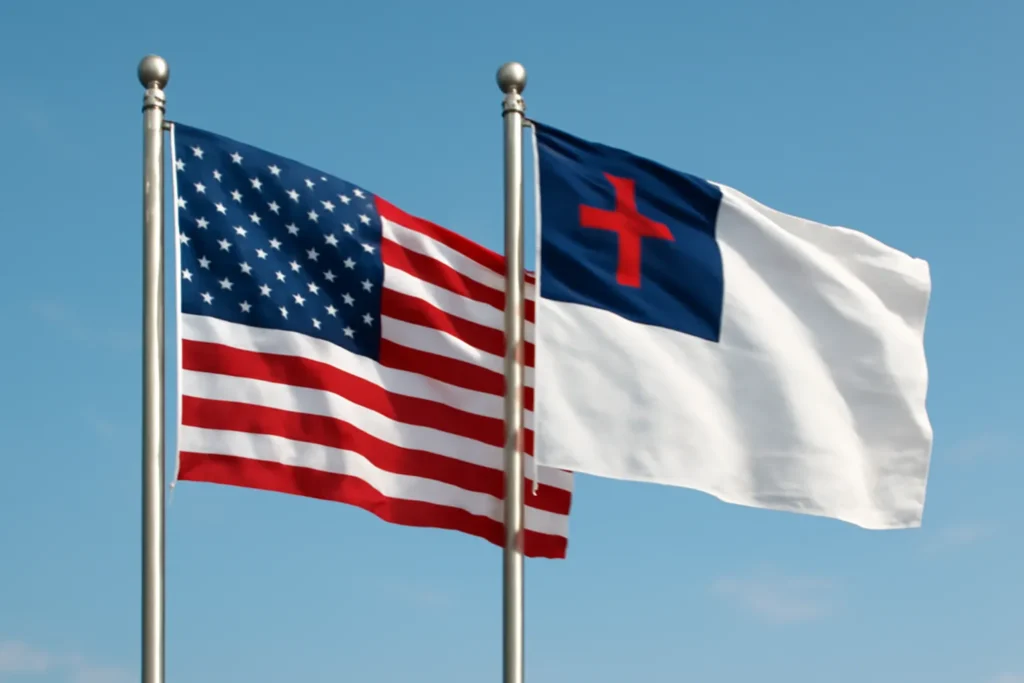
The Christian flag is typically described as a white field with a blue canton that bears a red cross. The
symbolism here is deeply pastoral and devotional, reflecting core aspects of Christian faith and worship:
White field symbolizes purity, holiness, and the desire for a life set apart in service to God.
Blue canton stands for fidelity, truth, and steadfastness in belief and practice; it can also evoke the heavens
or the divine standard by which believers strive to live.
Red cross in the canton represents sacrifice, the atoning work of Jesus Christ, and the love that motivated Christ’s life, death, and resurrection.
The cross itself is central to Christian symbolism, signaling salvation, grace, and the invitation to follow a cruciform path.
Together, these elements present a compact theology: purity in living, faithfulness in walking with God, and a Christ-centered
story of redemption that informs public worship and personal devotion.
Some churches use the Christian flag as a teaching tool and as a visual aid during catechesis, worship services,
and youth programs. The flag’s message is intentionally simple yet rich: it invites believers to center their practice on
Christ, to cultivate moral integrity, and to demonstrate Christian love in public life.
Meaning in Public Life: Display, Etiquette, and Everyday Use
Public Display: How the Flags Are Used
Flags serve in churches, schools, government buildings, and civic ceremonies. Both banners are commonly displayed together
in places where faith and national identity intersect, such as veterans’ hospitals, veterans’ organizations, schools with
a history of religious education, and public parades.
In many settings, the American flag is flown higher or given precedence in public spaces, in accordance with
the prevailing flag etiquette frameworks. The Christian flag, when flown alongside the US flag, is often placed on a separate
staff or displayed to the left of the viewer, reflecting its status as a religious symbol rather than a governmental
emblem.
The practice of displaying these two banners together is not merely decorative; it expresses a community’s
self-understanding in which national commitments coexist with religious beliefs. For individuals and congregations,
this arrangement can become a focal point for ceremonies such as national holidays, school programs that include prayer or
biblical reflection, and public worship that honors both civic duties and spiritual devotion.
Etiquette and Care: Respect for Each Symbol
The United States Flag Code offers guidelines for the care, display, and disposal of the American flag.
Practitioners often summarize key principles as follows:
The flag should be treated with respect and not allowed to fall into disrepair. A damaged flag is typically disposed of
in a respectful ceremony, usually by burning in a dignified manner.
The flag is flown from sunrise to sunset, and in some cases, may be illuminated at night.
When multiple flags are displayed, the US flag is generally given the place of honor, and other flags are positioned to complement
or respectfully contextualize the display.
Flag documentation and education programs emphasize patriotic symbolism as well as civic virtue—students learn about constitutional
rights, the rule of law, and the sacrifices of those who served the country.
There is no single official federal code that governs the display of a Christian flag in public spaces, because it is not a
governmental symbol. However, many church organizations and religious nonprofits follow established guidelines to handle
the flag with reverence, prevent misuse, and ensure it remains suitable for worship and instruction.
Contemporary Use and Variations
Today, both the American flag and the Christian flag appear in a wide range of contexts beyond their original settings:
Education: In schools that discuss civics, history, and religion, the flags may be used to illustrate themes of liberty,
faith, service, and community involvement.
Public ceremonies: Parades, Memorial Day observances, veterans’ events, and interfaith gatherings often feature both flags as a
reminder of shared commitments and diverse identities.
Church life: In churches, the Christian flag appears during worship, processions, and leadership commissioning rituals, alongside
other symbols of faith and tradition.
Private devotion: Families and individuals use the flag as a reminder of national history or Christian commitments in home prayer
spaces and personal reflection areas.
Shared Meaning: Intersections of national and religious Symbols
Though the American flag and the Christian flag originate in different spheres, they often meet in
the same life events: a public ceremony that includes a pledge of allegiance, a church consecration, a school hall assembly, or a
veterans’ program that closes with a benediction. In these moments, people may reflect on how national ideals—liberty, equality,
and justice—interact with religious aims such as service, compassion, and moral integrity.
For many citizens, the stars and stripes remind them that a diverse population comes together to form a single republic,
while the cross on the Christian flag calls believers to examine their lives in light of Christian teachings. The
juxtaposition can inspire discussions about pluralism, civic responsibility, and spiritual formation—conversations that are common in
churches that host civic clubs, student groups, and community service projects.
Timeline Snapshots: Key Dates and Milestones
1775 – The Grand Union Flag appears, a colonial banner that blends the struggle for independence with a nascent sense of American identity.
1777 – The Continental Congress adopts the first official design of the Stars and Stripes with thirteen stripes and a union of stars.
1795 – The flag is modified to reflect the admission of two new states, Vermont and Kentucky, through the Flag Act.
1818 – A new law stabilizes the flag’s design by retaining thirteen stripes but allowing for additional stars as states join.
1861–1865 – The Civil War era reinforces national unity and the flag’s symbolism as a living emblem of the republic.
1907 – The Christian flag is associated with early church education movements, gaining traction in Sunday schools and mission programs.
1960 – Hawaii becomes the fiftieth state, and the fifty-star flag becomes the official banner of the United States.
Today – Flags continue to play a central role in public ceremonies, religious education, and community life, adapting to new cultural contexts while retaining traditional meanings.
Common Misconceptions and Clarifications
Myth vs. Reality: Betsy Ross and the Flag’s Design
A long-standing anecdote attributes the original design of the American flag to Betsy Ross, but
historical evidence does not confirm this claim in a definitive way. The tale has become part of the flag’s lore,
illustrating how national iconography is shaped by storytelling as much as by documentation. The enduring lesson is that
symbols can be powerful precisely because they acquire meaning through memory, shared narrative, and collective reverence.
Is the Christian flag a governmental symbol?
No. The Christian flag is not a government flag. It is a religious emblem used by many denominations and Christian
organizations to promote unity, education, and worship within a Christian framework. This distinction helps clarify
expectations about public display, political neutrality, and religious liberty in diverse communities.
While the standard Christian flag features a white field, blue canton, and red cross, variations exist in some locales
or institutions that reflect particular traditions. The essential idea remains the same: a simple, portable symbol that
communicates faith, purity, fidelity, and sacrifice. In most communities, these core meanings endure even when minor design
details differ.
The American flag and the Christian flag offer a window into how symbols function within a pluralistic society.
The Stars and Stripes embodies a national story of founding principles, constitutional governance,
and shared civic obligations. The Christian flag embodies a faithful narrative about worship, community,
and the call to serve others in love. Together, they illuminate a broad spectrum of public life—from classrooms
and auditorium stages to sanctuaries and civic squares. For educators, pastors, veterans, students, and families,
these banners are not only decorative cloth; they are vessels of memory, identity, and meaning that continue to shape
how Americans think about freedom, faith, and responsibility in the modern world.
If you plan to study or discuss these banners further, consider focusing on:
The historical timeline behind each flag and how changes in society influenced design decisions.
The symbolic meanings embedded in color, form, and placement, and how these meanings are taught in different communities.
The practices of display—and how etiquette informs respectful engagement with symbols in schools, churches, and public spaces.
The interplay of memory and identity—how flag narratives are reinterpreted by each generation while maintaining continuity with tradition.
In a diverse nation, flags can function as common ground where history, faith, and civic life meet. By exploring
the American flag and the Christian flag with care for their origins, meanings, and
uses, readers gain a richer sense of how symbols guide communities through celebration, reflection, and public service.









Leave a Reply